SUBSCRIBE TO OUR FREE NEWSLETTER
Daily news & progressive opinion—funded by the people, not the corporations—delivered straight to your inbox.
5
#000000
#FFFFFF
To donate by check, phone, or other method, see our More Ways to Give page.
Daily news & progressive opinion—funded by the people, not the corporations—delivered straight to your inbox.
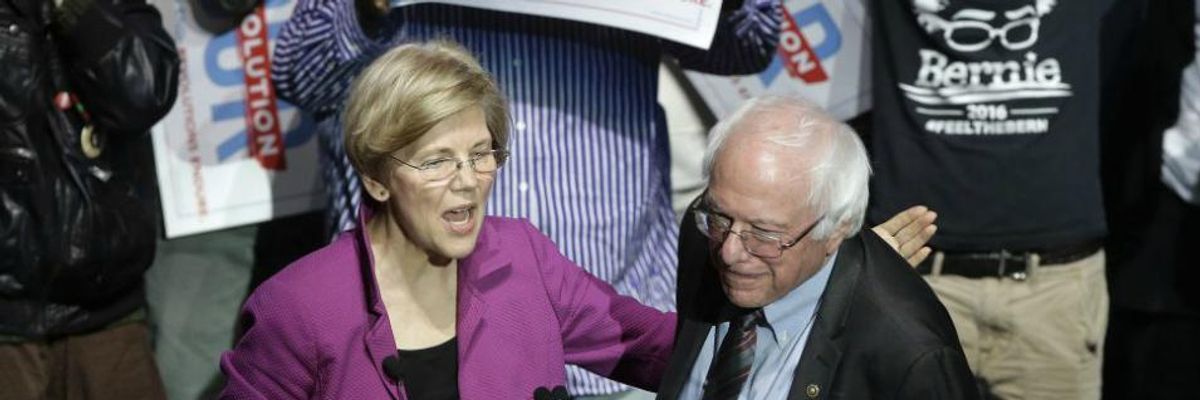
Sens. Elizabeth Warren (D-Mass.) and Bernie Sanders (I-Vt.) greet one another on stage at a rally in Boston in April, 2017. (Photo: Steven Senne/AP)
The first 2020 Democratic presidential primary is still over a year away, but Wall Street executives are reportedly already freaking out about two likely progressive candidates: Sens. Elizabeth Warren (D-Mass.) and Bernie Sanders (I-Vt.).
"It can't be Warren and it can't be Sanders," the CEO of a "giant bank" anonymously told Politico, which reported on Monday that Wall Street executives are "getting panicked" about the presidential prospects of the Senate's two fiercest financial sector critics.
"The best indication of who you should vote for in the Democratic primary if you actually want progressive policy is who Wall Street doesn't like, which essentially means Bernie or Warren."
--Josh Mound, journalist
Warren launched an exploratory committee for president last month, vowing to take on the "corruption" that is "poisoning our democracy." Sanders, for his part, has yet to publicly announce a bid for the White House--but Yahoo News reported on Friday that the Vermont senator plans to launch his campaign "imminently."
Both progressive senators have placed scrutiny of Wall Street's size, record of large-scale fraud, exorbitant CEO pay packages, enormous political influence, and lack of stringent regulations at the center of their political agendas for years, and deep-pocketed bankers who have profited immensely from President Donald Trump's tenure are worried that one of the two could ascend to the White House and threaten their pocketbooks.
"Bankers' biggest fear," Politico reported, is that the 2020 Democratic presidential "nomination goes to an anti-Wall Street crusader" like Warren or Sanders.
"The result is a kind of nervous paralysis of executives pining for a centrist nominee like Michael Bloomberg," Politico noted, referring to the billionaire former New York City mayor, who is reportedly considering a self-funded presidential bid.
According to Politico, Wall Street executives who want Trump out of the White House mentioned "a consistent roster of appealing nominees" they would find acceptable outside of Bloomberg, who the outlet describes as Wall Street's "platonic ideal."
This "roster" reportedly included Democratic Sens. Cory Booker (N.J.), Kirsten Gillibrand (N.Y.), and Kamala Harris (Calif.); former Vice President Joe Biden; and former Rep. Beto O'Rourke (D-Texas).
As CNBC reported earlier this month, Harris, Booker, and Gillibrand have all reached out to Wall Street to gauge support for 2020 campaigns. Harris announced that she is running for president last week, and Gillibrand launched an exploratory committee for president earlier this month.
One executive--who Politico described as a hedge fund manager and a top Democratic donor--declared, "If it's Biden and Beto or Biden and Harris, that might make a difference. The good news for Biden is everyone likes him. The bad news is there is not a lot of passion."
Progressives were quick to argue on Twitter that Wall Street's fear of a possible Sanders or Warren presidency constitutes a powerful endorsement of both candidates.
By coming out so strongly against the progressive senators, argued The Daily Beast's Gideon Resnick, Wall Street is "literally giving them a campaign slogan."
In response to Wall Street's largely anonymous attacks on Sanders and Warren, People for Bernie tweeted, "We bathe in your tears."
"The best indication of who you should vote for in the Democratic Primary if you actually want progressive policy is who Wall Street doesn't like, which essentially means Bernie or Warren," concluded journalist Josh Mound.
Dear Common Dreams reader, It’s been nearly 30 years since I co-founded Common Dreams with my late wife, Lina Newhouser. We had the radical notion that journalism should serve the public good, not corporate profits. It was clear to us from the outset what it would take to build such a project. No paid advertisements. No corporate sponsors. No millionaire publisher telling us what to think or do. Many people said we wouldn't last a year, but we proved those doubters wrong. Together with a tremendous team of journalists and dedicated staff, we built an independent media outlet free from the constraints of profits and corporate control. Our mission has always been simple: To inform. To inspire. To ignite change for the common good. Building Common Dreams was not easy. Our survival was never guaranteed. When you take on the most powerful forces—Wall Street greed, fossil fuel industry destruction, Big Tech lobbyists, and uber-rich oligarchs who have spent billions upon billions rigging the economy and democracy in their favor—the only bulwark you have is supporters who believe in your work. But here’s the urgent message from me today. It's never been this bad out there. And it's never been this hard to keep us going. At the very moment Common Dreams is most needed, the threats we face are intensifying. We need your support now more than ever. We don't accept corporate advertising and never will. We don't have a paywall because we don't think people should be blocked from critical news based on their ability to pay. Everything we do is funded by the donations of readers like you. When everyone does the little they can afford, we are strong. But if that support retreats or dries up, so do we. Will you donate now to make sure Common Dreams not only survives but thrives? —Craig Brown, Co-founder |
The first 2020 Democratic presidential primary is still over a year away, but Wall Street executives are reportedly already freaking out about two likely progressive candidates: Sens. Elizabeth Warren (D-Mass.) and Bernie Sanders (I-Vt.).
"It can't be Warren and it can't be Sanders," the CEO of a "giant bank" anonymously told Politico, which reported on Monday that Wall Street executives are "getting panicked" about the presidential prospects of the Senate's two fiercest financial sector critics.
"The best indication of who you should vote for in the Democratic primary if you actually want progressive policy is who Wall Street doesn't like, which essentially means Bernie or Warren."
--Josh Mound, journalist
Warren launched an exploratory committee for president last month, vowing to take on the "corruption" that is "poisoning our democracy." Sanders, for his part, has yet to publicly announce a bid for the White House--but Yahoo News reported on Friday that the Vermont senator plans to launch his campaign "imminently."
Both progressive senators have placed scrutiny of Wall Street's size, record of large-scale fraud, exorbitant CEO pay packages, enormous political influence, and lack of stringent regulations at the center of their political agendas for years, and deep-pocketed bankers who have profited immensely from President Donald Trump's tenure are worried that one of the two could ascend to the White House and threaten their pocketbooks.
"Bankers' biggest fear," Politico reported, is that the 2020 Democratic presidential "nomination goes to an anti-Wall Street crusader" like Warren or Sanders.
"The result is a kind of nervous paralysis of executives pining for a centrist nominee like Michael Bloomberg," Politico noted, referring to the billionaire former New York City mayor, who is reportedly considering a self-funded presidential bid.
According to Politico, Wall Street executives who want Trump out of the White House mentioned "a consistent roster of appealing nominees" they would find acceptable outside of Bloomberg, who the outlet describes as Wall Street's "platonic ideal."
This "roster" reportedly included Democratic Sens. Cory Booker (N.J.), Kirsten Gillibrand (N.Y.), and Kamala Harris (Calif.); former Vice President Joe Biden; and former Rep. Beto O'Rourke (D-Texas).
As CNBC reported earlier this month, Harris, Booker, and Gillibrand have all reached out to Wall Street to gauge support for 2020 campaigns. Harris announced that she is running for president last week, and Gillibrand launched an exploratory committee for president earlier this month.
One executive--who Politico described as a hedge fund manager and a top Democratic donor--declared, "If it's Biden and Beto or Biden and Harris, that might make a difference. The good news for Biden is everyone likes him. The bad news is there is not a lot of passion."
Progressives were quick to argue on Twitter that Wall Street's fear of a possible Sanders or Warren presidency constitutes a powerful endorsement of both candidates.
By coming out so strongly against the progressive senators, argued The Daily Beast's Gideon Resnick, Wall Street is "literally giving them a campaign slogan."
In response to Wall Street's largely anonymous attacks on Sanders and Warren, People for Bernie tweeted, "We bathe in your tears."
"The best indication of who you should vote for in the Democratic Primary if you actually want progressive policy is who Wall Street doesn't like, which essentially means Bernie or Warren," concluded journalist Josh Mound.
The first 2020 Democratic presidential primary is still over a year away, but Wall Street executives are reportedly already freaking out about two likely progressive candidates: Sens. Elizabeth Warren (D-Mass.) and Bernie Sanders (I-Vt.).
"It can't be Warren and it can't be Sanders," the CEO of a "giant bank" anonymously told Politico, which reported on Monday that Wall Street executives are "getting panicked" about the presidential prospects of the Senate's two fiercest financial sector critics.
"The best indication of who you should vote for in the Democratic primary if you actually want progressive policy is who Wall Street doesn't like, which essentially means Bernie or Warren."
--Josh Mound, journalist
Warren launched an exploratory committee for president last month, vowing to take on the "corruption" that is "poisoning our democracy." Sanders, for his part, has yet to publicly announce a bid for the White House--but Yahoo News reported on Friday that the Vermont senator plans to launch his campaign "imminently."
Both progressive senators have placed scrutiny of Wall Street's size, record of large-scale fraud, exorbitant CEO pay packages, enormous political influence, and lack of stringent regulations at the center of their political agendas for years, and deep-pocketed bankers who have profited immensely from President Donald Trump's tenure are worried that one of the two could ascend to the White House and threaten their pocketbooks.
"Bankers' biggest fear," Politico reported, is that the 2020 Democratic presidential "nomination goes to an anti-Wall Street crusader" like Warren or Sanders.
"The result is a kind of nervous paralysis of executives pining for a centrist nominee like Michael Bloomberg," Politico noted, referring to the billionaire former New York City mayor, who is reportedly considering a self-funded presidential bid.
According to Politico, Wall Street executives who want Trump out of the White House mentioned "a consistent roster of appealing nominees" they would find acceptable outside of Bloomberg, who the outlet describes as Wall Street's "platonic ideal."
This "roster" reportedly included Democratic Sens. Cory Booker (N.J.), Kirsten Gillibrand (N.Y.), and Kamala Harris (Calif.); former Vice President Joe Biden; and former Rep. Beto O'Rourke (D-Texas).
As CNBC reported earlier this month, Harris, Booker, and Gillibrand have all reached out to Wall Street to gauge support for 2020 campaigns. Harris announced that she is running for president last week, and Gillibrand launched an exploratory committee for president earlier this month.
One executive--who Politico described as a hedge fund manager and a top Democratic donor--declared, "If it's Biden and Beto or Biden and Harris, that might make a difference. The good news for Biden is everyone likes him. The bad news is there is not a lot of passion."
Progressives were quick to argue on Twitter that Wall Street's fear of a possible Sanders or Warren presidency constitutes a powerful endorsement of both candidates.
By coming out so strongly against the progressive senators, argued The Daily Beast's Gideon Resnick, Wall Street is "literally giving them a campaign slogan."
In response to Wall Street's largely anonymous attacks on Sanders and Warren, People for Bernie tweeted, "We bathe in your tears."
"The best indication of who you should vote for in the Democratic Primary if you actually want progressive policy is who Wall Street doesn't like, which essentially means Bernie or Warren," concluded journalist Josh Mound.