SUBSCRIBE TO OUR FREE NEWSLETTER
Daily news & progressive opinion—funded by the people, not the corporations—delivered straight to your inbox.
5
#000000
#FFFFFF
To donate by check, phone, or other method, see our More Ways to Give page.
Daily news & progressive opinion—funded by the people, not the corporations—delivered straight to your inbox.
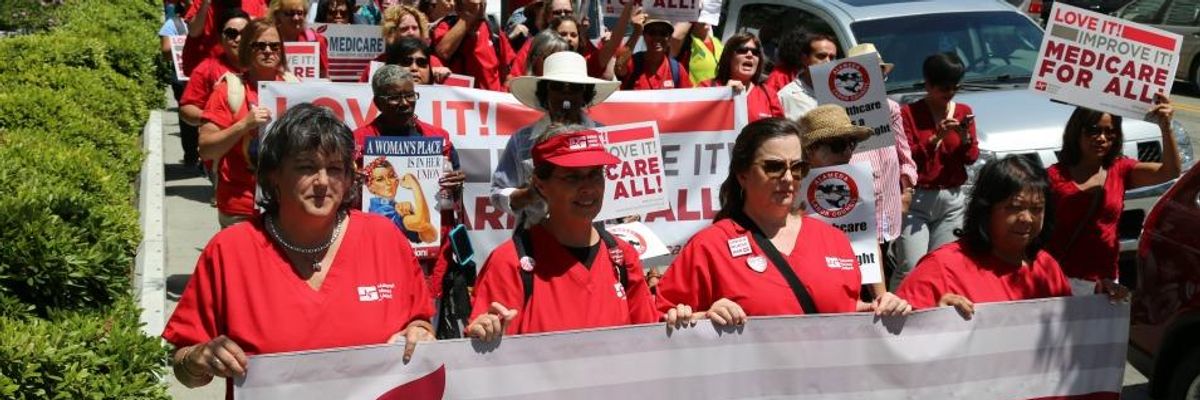
National Nurses United have led the fight for Medicare for All, staging demonstrations and lobbying politicians since the organization began in 2009. (Photo: National Nurses United/Flickr/cc)
As progressive groups push Democratic leaders on Capitol Hill to bring Medicare for All legislation up for a vote in the new year--a move that would bring Congress closer to passing a proposal supported by 70 percent of voters--one of the nation's leading advocates for a single-payer system is asking supporters to make their voices heard in the fight to make universal healthcare a reality in the United States.
National Nurses United (NNU), which has been fighting for the proposal since the union's founding in 2009, is asking members and supporters to host Medicare for All "barnstorms" during a National Week of Action from February 9th to 13th.
"To build the mass collective action we know we'll need to win, we're asking activists like you across the country to organize a Medicare for All barnstorm in your community," the group wrote to supporters in its petition asking for volunteers. "At the barnstorm you'd gather with volunteers near you, talk about the plan to win, and begin organizing to knock doors, make phone calls, and more in your community."
Organizers believe that the barnstorms will demonstrate the widespread support that Medicare for All has gained in recent years, especially among Democratic voters--84 percent of whom support the proposal--as the Progressive Change Campaign Committee (PCCC) and other groups call on the new Democratic House majority to push for a vote on the legislation.
"If Congress brings Medicare For All for a vote, we will see who stands with over 70 percent of Americans, and who stands with the lobbyists. Then we'll know who needs persuasion--and who needs a primary," said the PCCC last week.
Public support for Medicare for All has grown amid repeated attacks on the Affordable Care Act (ACA)--the latest of which came in the form of a federal judge's ruling earlier this month that declared the ACA unconstitutional.
Progressives have pointed to such attacks as clear evidence that Medicare for All legislation would provide a stable healthcare system that would extend care to all Americans. As such, proponents are calling for expanding and improving one of the most popular government-run programs instead of allowing states to administer, or refuse to administer, the ACA's provisions while continuing to prop up the for-profit health insurance industry.
While U.S. District Court Judge Reed O'Connor ruled that the ACA is unconstitutional due to its individual mandate requiring all Americans to purchase insurance, Rep. Ro Khanna (D-Calif.) noted, Medicare for All would be immune from such claims.
"There's no doubt that would be constitutional. Medicare is already constitutional and what we're saying is extend it to everyone, so there can be no constitutional argument," Khanna told The Hill last week.
The lawsuit, which followed the Republicans' attempt to repeal the ACA in 2017 and the Trump administration's expansion of short-term healthcare plans, among other sabotage efforts, "is one more example of how tenuous the law really is," Eagan Kemp of the advocacy group Public Citizen, told The Hill.
"You don't see the same type of sabotage to Medicare. So to me it highlights that the Medicare program remains the third rail of politics, so if we're going to build a new health-care system, it's something that can be safe," Kemp said.
Though Sen. Bernie Sanders' (I-Vt.) Medicare for All proposal now has the support of 15 senators, some Democrats have continued to insist in recent weeks that the plan is somehow "unrealistic" or difficult to afford--despite the fact that even a study by the Koch brothers-funded Mercatus Center found that the plan would $2 trillion less over ten years compared to the current for-profit system.
"We all support Medicare for all," said former Virginia Gov. Terry McAuliffe--who is rumored to be a 2020 presidential candidate--in an interview with CNN over the weekend. "But we have got to figure out how we pay for it. It's unrealistic in terms of how we pay for it today."
McAuliffe was quickly rebuked on social media by advocates who know that with current total healthcare expenditures at $3.5 trillion in 2017--up from 2016--Americans would spend at least $35 trillion on healthcare over the next 10 years under the current system, instead of the $32.6 trillion that Medicare for All is projected to cost.
Dear Common Dreams reader, It’s been nearly 30 years since I co-founded Common Dreams with my late wife, Lina Newhouser. We had the radical notion that journalism should serve the public good, not corporate profits. It was clear to us from the outset what it would take to build such a project. No paid advertisements. No corporate sponsors. No millionaire publisher telling us what to think or do. Many people said we wouldn't last a year, but we proved those doubters wrong. Together with a tremendous team of journalists and dedicated staff, we built an independent media outlet free from the constraints of profits and corporate control. Our mission has always been simple: To inform. To inspire. To ignite change for the common good. Building Common Dreams was not easy. Our survival was never guaranteed. When you take on the most powerful forces—Wall Street greed, fossil fuel industry destruction, Big Tech lobbyists, and uber-rich oligarchs who have spent billions upon billions rigging the economy and democracy in their favor—the only bulwark you have is supporters who believe in your work. But here’s the urgent message from me today. It's never been this bad out there. And it's never been this hard to keep us going. At the very moment Common Dreams is most needed, the threats we face are intensifying. We need your support now more than ever. We don't accept corporate advertising and never will. We don't have a paywall because we don't think people should be blocked from critical news based on their ability to pay. Everything we do is funded by the donations of readers like you. When everyone does the little they can afford, we are strong. But if that support retreats or dries up, so do we. Will you donate now to make sure Common Dreams not only survives but thrives? —Craig Brown, Co-founder |
As progressive groups push Democratic leaders on Capitol Hill to bring Medicare for All legislation up for a vote in the new year--a move that would bring Congress closer to passing a proposal supported by 70 percent of voters--one of the nation's leading advocates for a single-payer system is asking supporters to make their voices heard in the fight to make universal healthcare a reality in the United States.
National Nurses United (NNU), which has been fighting for the proposal since the union's founding in 2009, is asking members and supporters to host Medicare for All "barnstorms" during a National Week of Action from February 9th to 13th.
"To build the mass collective action we know we'll need to win, we're asking activists like you across the country to organize a Medicare for All barnstorm in your community," the group wrote to supporters in its petition asking for volunteers. "At the barnstorm you'd gather with volunteers near you, talk about the plan to win, and begin organizing to knock doors, make phone calls, and more in your community."
Organizers believe that the barnstorms will demonstrate the widespread support that Medicare for All has gained in recent years, especially among Democratic voters--84 percent of whom support the proposal--as the Progressive Change Campaign Committee (PCCC) and other groups call on the new Democratic House majority to push for a vote on the legislation.
"If Congress brings Medicare For All for a vote, we will see who stands with over 70 percent of Americans, and who stands with the lobbyists. Then we'll know who needs persuasion--and who needs a primary," said the PCCC last week.
Public support for Medicare for All has grown amid repeated attacks on the Affordable Care Act (ACA)--the latest of which came in the form of a federal judge's ruling earlier this month that declared the ACA unconstitutional.
Progressives have pointed to such attacks as clear evidence that Medicare for All legislation would provide a stable healthcare system that would extend care to all Americans. As such, proponents are calling for expanding and improving one of the most popular government-run programs instead of allowing states to administer, or refuse to administer, the ACA's provisions while continuing to prop up the for-profit health insurance industry.
While U.S. District Court Judge Reed O'Connor ruled that the ACA is unconstitutional due to its individual mandate requiring all Americans to purchase insurance, Rep. Ro Khanna (D-Calif.) noted, Medicare for All would be immune from such claims.
"There's no doubt that would be constitutional. Medicare is already constitutional and what we're saying is extend it to everyone, so there can be no constitutional argument," Khanna told The Hill last week.
The lawsuit, which followed the Republicans' attempt to repeal the ACA in 2017 and the Trump administration's expansion of short-term healthcare plans, among other sabotage efforts, "is one more example of how tenuous the law really is," Eagan Kemp of the advocacy group Public Citizen, told The Hill.
"You don't see the same type of sabotage to Medicare. So to me it highlights that the Medicare program remains the third rail of politics, so if we're going to build a new health-care system, it's something that can be safe," Kemp said.
Though Sen. Bernie Sanders' (I-Vt.) Medicare for All proposal now has the support of 15 senators, some Democrats have continued to insist in recent weeks that the plan is somehow "unrealistic" or difficult to afford--despite the fact that even a study by the Koch brothers-funded Mercatus Center found that the plan would $2 trillion less over ten years compared to the current for-profit system.
"We all support Medicare for all," said former Virginia Gov. Terry McAuliffe--who is rumored to be a 2020 presidential candidate--in an interview with CNN over the weekend. "But we have got to figure out how we pay for it. It's unrealistic in terms of how we pay for it today."
McAuliffe was quickly rebuked on social media by advocates who know that with current total healthcare expenditures at $3.5 trillion in 2017--up from 2016--Americans would spend at least $35 trillion on healthcare over the next 10 years under the current system, instead of the $32.6 trillion that Medicare for All is projected to cost.
As progressive groups push Democratic leaders on Capitol Hill to bring Medicare for All legislation up for a vote in the new year--a move that would bring Congress closer to passing a proposal supported by 70 percent of voters--one of the nation's leading advocates for a single-payer system is asking supporters to make their voices heard in the fight to make universal healthcare a reality in the United States.
National Nurses United (NNU), which has been fighting for the proposal since the union's founding in 2009, is asking members and supporters to host Medicare for All "barnstorms" during a National Week of Action from February 9th to 13th.
"To build the mass collective action we know we'll need to win, we're asking activists like you across the country to organize a Medicare for All barnstorm in your community," the group wrote to supporters in its petition asking for volunteers. "At the barnstorm you'd gather with volunteers near you, talk about the plan to win, and begin organizing to knock doors, make phone calls, and more in your community."
Organizers believe that the barnstorms will demonstrate the widespread support that Medicare for All has gained in recent years, especially among Democratic voters--84 percent of whom support the proposal--as the Progressive Change Campaign Committee (PCCC) and other groups call on the new Democratic House majority to push for a vote on the legislation.
"If Congress brings Medicare For All for a vote, we will see who stands with over 70 percent of Americans, and who stands with the lobbyists. Then we'll know who needs persuasion--and who needs a primary," said the PCCC last week.
Public support for Medicare for All has grown amid repeated attacks on the Affordable Care Act (ACA)--the latest of which came in the form of a federal judge's ruling earlier this month that declared the ACA unconstitutional.
Progressives have pointed to such attacks as clear evidence that Medicare for All legislation would provide a stable healthcare system that would extend care to all Americans. As such, proponents are calling for expanding and improving one of the most popular government-run programs instead of allowing states to administer, or refuse to administer, the ACA's provisions while continuing to prop up the for-profit health insurance industry.
While U.S. District Court Judge Reed O'Connor ruled that the ACA is unconstitutional due to its individual mandate requiring all Americans to purchase insurance, Rep. Ro Khanna (D-Calif.) noted, Medicare for All would be immune from such claims.
"There's no doubt that would be constitutional. Medicare is already constitutional and what we're saying is extend it to everyone, so there can be no constitutional argument," Khanna told The Hill last week.
The lawsuit, which followed the Republicans' attempt to repeal the ACA in 2017 and the Trump administration's expansion of short-term healthcare plans, among other sabotage efforts, "is one more example of how tenuous the law really is," Eagan Kemp of the advocacy group Public Citizen, told The Hill.
"You don't see the same type of sabotage to Medicare. So to me it highlights that the Medicare program remains the third rail of politics, so if we're going to build a new health-care system, it's something that can be safe," Kemp said.
Though Sen. Bernie Sanders' (I-Vt.) Medicare for All proposal now has the support of 15 senators, some Democrats have continued to insist in recent weeks that the plan is somehow "unrealistic" or difficult to afford--despite the fact that even a study by the Koch brothers-funded Mercatus Center found that the plan would $2 trillion less over ten years compared to the current for-profit system.
"We all support Medicare for all," said former Virginia Gov. Terry McAuliffe--who is rumored to be a 2020 presidential candidate--in an interview with CNN over the weekend. "But we have got to figure out how we pay for it. It's unrealistic in terms of how we pay for it today."
McAuliffe was quickly rebuked on social media by advocates who know that with current total healthcare expenditures at $3.5 trillion in 2017--up from 2016--Americans would spend at least $35 trillion on healthcare over the next 10 years under the current system, instead of the $32.6 trillion that Medicare for All is projected to cost.