

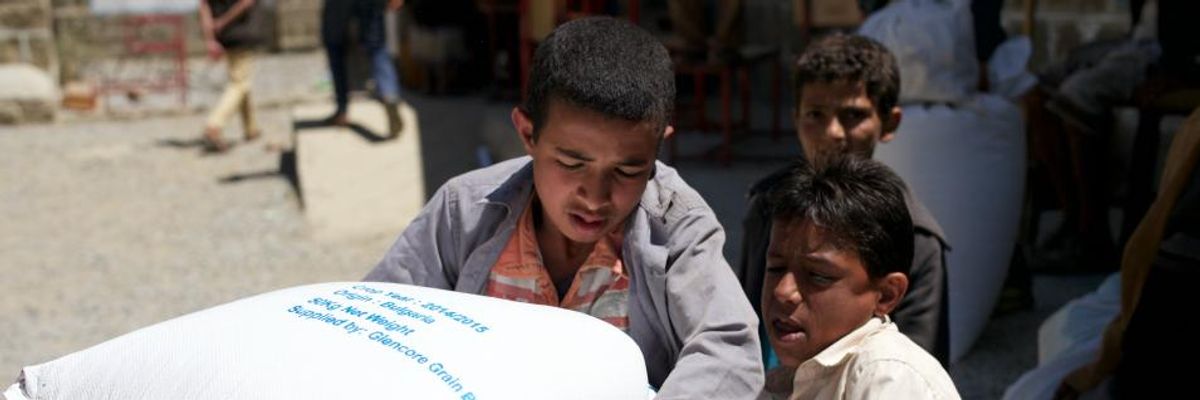
International food aid is distributed in Raymah, Yemen in 2016. (Photo: Julien Harneis/Flickr/cc)
Food Aid to Yemen 'Snatched From the Starving' by US-Backed Saudi Allies
With armed forces on both sides of civil war accused of seizing aid destined for starving civilians, one U.N. official said, "If there is no corruption, there is no famine."
Amid famine and rampant disease that have spawned from Yemen's four-year civil war, an Associated Press report out Monday revealed that food aid pouring in from across the globe, meant to curb the world's worst humanitarian crisis, is "being snatched from the starving" by armed forces allied with the Saudi-led, U.S.-backed coalition that supports the Yemeni government as well as the Houthi rebels.
As the AP reports:
Across Yemen, factions and militias on all sides of the conflict have blocked food aid from going to groups suspected of disloyalty, diverted it to front-line combat units or sold it for profit on the black market, according to public records and confidential documents obtained by the AP and interviews with more than 70 aid workers, government officials, and average citizens from six different provinces.
[...]
Some observers have attributed the near-famine conditions in much of the country to the coalition's blockade of ports that supply Houthi-controlled areas. AP's investigation found that large amounts of food are making it into the country, but once there, the food often isn't getting to people who need it most--raising questions about the ability of United Nations agencies and other big aid organizations to operate effectively in Yemen.
As one senior U.N. official, who spoke on the condition of anonymity, put it, "If there is no corruption, there is no famine."
"All of this is man-made," Geert Cappelaere, Middle East director for UNICEF, said of the mass starvation of civilians in Yemen. Accusing authorities on "all sides" of the war from blocking aid, he added, "All of this has to do with poor political leadership which doesn't put the people's interest at the core of their actions."
"All of this has to do with poor political leadership which doesn't put the people's interest at the core of their actions."
--Geert Cappelaere, UNICEF
Following the report, the U.N. World Food Program (WFP) announced in a statement that the group had documented food aid diversion in Houthi-controlled regions, including Yemen's capital city, Sana'a. "At a time when children are dying in Yemen because they haven't enough food to eat, that is an outrage," said WFP executive director David Beasley. "This criminal behavior must stop immediately."
The London-based organization Save the Children estimated last month that some 85,000 children under age five have starved to death since the conflict began.
More broadly, the AP estimates--citing an analysis by global relief groups--that "even with the food aid that is coming in, more than half of the population is not getting enough to eat--15.9 million of Yemen's 29 million people. They include 10.8 million who are in an 'emergency' phase of food insecurity, roughly 5 million who are in a deeper 'crisis' phase, and 63,500 who are facing 'catastrophe,' a synonym for famine."
"At a time when children are dying in Yemen because they haven't enough food to eat, that is an outrage."
--David Beasley, WFP
The AP report comes just weeks after peace talks between the coalition and the Houthis started up again after more than two years. The talks in Sweden have led to "a reduction in fighting and eased the challenges of getting food aid into and out of Hodeidah, the port city that is a gateway to the Houthi-controlled north," the AP notes, "but even if donors are able to get more food in, the problem of what happens to food aid once it makes landfall remains."
It also follows a recent New York Times report that detailed the Saudi coalition's use of Sudanse child soldiers in Yemen--to which peace advocates responded with renewed calls for the U.S. to stop backing the coalition. Although mounting outrage among the American public led to a "historic" vote in the Senate this month to end U.S. support for Saudi Arabia's bombing campaign in Yemen, Republicans and a handful of Democrats in the House ultimately blocked the measure.
Urgent. It's never been this bad.
Dear Common Dreams reader, It’s been nearly 30 years since I co-founded Common Dreams with my late wife, Lina Newhouser. We had the radical notion that journalism should serve the public good, not corporate profits. It was clear to us from the outset what it would take to build such a project. No paid advertisements. No corporate sponsors. No millionaire publisher telling us what to think or do. Many people said we wouldn't last a year, but we proved those doubters wrong. Together with a tremendous team of journalists and dedicated staff, we built an independent media outlet free from the constraints of profits and corporate control. Our mission from the outset was simple. To inform. To inspire. To ignite change for the common good. Building Common Dreams was not easy. Our survival was never guaranteed. When you take on the most powerful forces—Wall Street greed, fossil fuel industry destruction, Big Tech lobbyists, and uber-rich oligarchs who have spent billions upon billions rigging the economy and democracy in their favor—the only bulwark you have is supporters who believe in your work. But here’s the urgent message from me today. It’s never been this bad out there. And it’s never been this hard to keep us going. At the very moment Common Dreams is most needed and doing some of its best and most important work, the threats we face are intensifying. Right now, with just four days to go in our Spring Campaign, we are not even halfway to our goal. When everyone does the little they can afford, we are strong. But if that support retreats or dries up, so do we. Can you make a gift right now to make sure Common Dreams not only survives but thrives? There is no backup plan or rainy day fund. There is only you. —Craig Brown, Co-founder |
Amid famine and rampant disease that have spawned from Yemen's four-year civil war, an Associated Press report out Monday revealed that food aid pouring in from across the globe, meant to curb the world's worst humanitarian crisis, is "being snatched from the starving" by armed forces allied with the Saudi-led, U.S.-backed coalition that supports the Yemeni government as well as the Houthi rebels.
As the AP reports:
Across Yemen, factions and militias on all sides of the conflict have blocked food aid from going to groups suspected of disloyalty, diverted it to front-line combat units or sold it for profit on the black market, according to public records and confidential documents obtained by the AP and interviews with more than 70 aid workers, government officials, and average citizens from six different provinces.
[...]
Some observers have attributed the near-famine conditions in much of the country to the coalition's blockade of ports that supply Houthi-controlled areas. AP's investigation found that large amounts of food are making it into the country, but once there, the food often isn't getting to people who need it most--raising questions about the ability of United Nations agencies and other big aid organizations to operate effectively in Yemen.
As one senior U.N. official, who spoke on the condition of anonymity, put it, "If there is no corruption, there is no famine."
"All of this is man-made," Geert Cappelaere, Middle East director for UNICEF, said of the mass starvation of civilians in Yemen. Accusing authorities on "all sides" of the war from blocking aid, he added, "All of this has to do with poor political leadership which doesn't put the people's interest at the core of their actions."
"All of this has to do with poor political leadership which doesn't put the people's interest at the core of their actions."
--Geert Cappelaere, UNICEF
Following the report, the U.N. World Food Program (WFP) announced in a statement that the group had documented food aid diversion in Houthi-controlled regions, including Yemen's capital city, Sana'a. "At a time when children are dying in Yemen because they haven't enough food to eat, that is an outrage," said WFP executive director David Beasley. "This criminal behavior must stop immediately."
The London-based organization Save the Children estimated last month that some 85,000 children under age five have starved to death since the conflict began.
More broadly, the AP estimates--citing an analysis by global relief groups--that "even with the food aid that is coming in, more than half of the population is not getting enough to eat--15.9 million of Yemen's 29 million people. They include 10.8 million who are in an 'emergency' phase of food insecurity, roughly 5 million who are in a deeper 'crisis' phase, and 63,500 who are facing 'catastrophe,' a synonym for famine."
"At a time when children are dying in Yemen because they haven't enough food to eat, that is an outrage."
--David Beasley, WFP
The AP report comes just weeks after peace talks between the coalition and the Houthis started up again after more than two years. The talks in Sweden have led to "a reduction in fighting and eased the challenges of getting food aid into and out of Hodeidah, the port city that is a gateway to the Houthi-controlled north," the AP notes, "but even if donors are able to get more food in, the problem of what happens to food aid once it makes landfall remains."
It also follows a recent New York Times report that detailed the Saudi coalition's use of Sudanse child soldiers in Yemen--to which peace advocates responded with renewed calls for the U.S. to stop backing the coalition. Although mounting outrage among the American public led to a "historic" vote in the Senate this month to end U.S. support for Saudi Arabia's bombing campaign in Yemen, Republicans and a handful of Democrats in the House ultimately blocked the measure.
Amid famine and rampant disease that have spawned from Yemen's four-year civil war, an Associated Press report out Monday revealed that food aid pouring in from across the globe, meant to curb the world's worst humanitarian crisis, is "being snatched from the starving" by armed forces allied with the Saudi-led, U.S.-backed coalition that supports the Yemeni government as well as the Houthi rebels.
As the AP reports:
Across Yemen, factions and militias on all sides of the conflict have blocked food aid from going to groups suspected of disloyalty, diverted it to front-line combat units or sold it for profit on the black market, according to public records and confidential documents obtained by the AP and interviews with more than 70 aid workers, government officials, and average citizens from six different provinces.
[...]
Some observers have attributed the near-famine conditions in much of the country to the coalition's blockade of ports that supply Houthi-controlled areas. AP's investigation found that large amounts of food are making it into the country, but once there, the food often isn't getting to people who need it most--raising questions about the ability of United Nations agencies and other big aid organizations to operate effectively in Yemen.
As one senior U.N. official, who spoke on the condition of anonymity, put it, "If there is no corruption, there is no famine."
"All of this is man-made," Geert Cappelaere, Middle East director for UNICEF, said of the mass starvation of civilians in Yemen. Accusing authorities on "all sides" of the war from blocking aid, he added, "All of this has to do with poor political leadership which doesn't put the people's interest at the core of their actions."
"All of this has to do with poor political leadership which doesn't put the people's interest at the core of their actions."
--Geert Cappelaere, UNICEF
Following the report, the U.N. World Food Program (WFP) announced in a statement that the group had documented food aid diversion in Houthi-controlled regions, including Yemen's capital city, Sana'a. "At a time when children are dying in Yemen because they haven't enough food to eat, that is an outrage," said WFP executive director David Beasley. "This criminal behavior must stop immediately."
The London-based organization Save the Children estimated last month that some 85,000 children under age five have starved to death since the conflict began.
More broadly, the AP estimates--citing an analysis by global relief groups--that "even with the food aid that is coming in, more than half of the population is not getting enough to eat--15.9 million of Yemen's 29 million people. They include 10.8 million who are in an 'emergency' phase of food insecurity, roughly 5 million who are in a deeper 'crisis' phase, and 63,500 who are facing 'catastrophe,' a synonym for famine."
"At a time when children are dying in Yemen because they haven't enough food to eat, that is an outrage."
--David Beasley, WFP
The AP report comes just weeks after peace talks between the coalition and the Houthis started up again after more than two years. The talks in Sweden have led to "a reduction in fighting and eased the challenges of getting food aid into and out of Hodeidah, the port city that is a gateway to the Houthi-controlled north," the AP notes, "but even if donors are able to get more food in, the problem of what happens to food aid once it makes landfall remains."
It also follows a recent New York Times report that detailed the Saudi coalition's use of Sudanse child soldiers in Yemen--to which peace advocates responded with renewed calls for the U.S. to stop backing the coalition. Although mounting outrage among the American public led to a "historic" vote in the Senate this month to end U.S. support for Saudi Arabia's bombing campaign in Yemen, Republicans and a handful of Democrats in the House ultimately blocked the measure.