SUBSCRIBE TO OUR FREE NEWSLETTER
Daily news & progressive opinion—funded by the people, not the corporations—delivered straight to your inbox.
5
#000000
#FFFFFF
To donate by check, phone, or other method, see our More Ways to Give page.
Daily news & progressive opinion—funded by the people, not the corporations—delivered straight to your inbox.
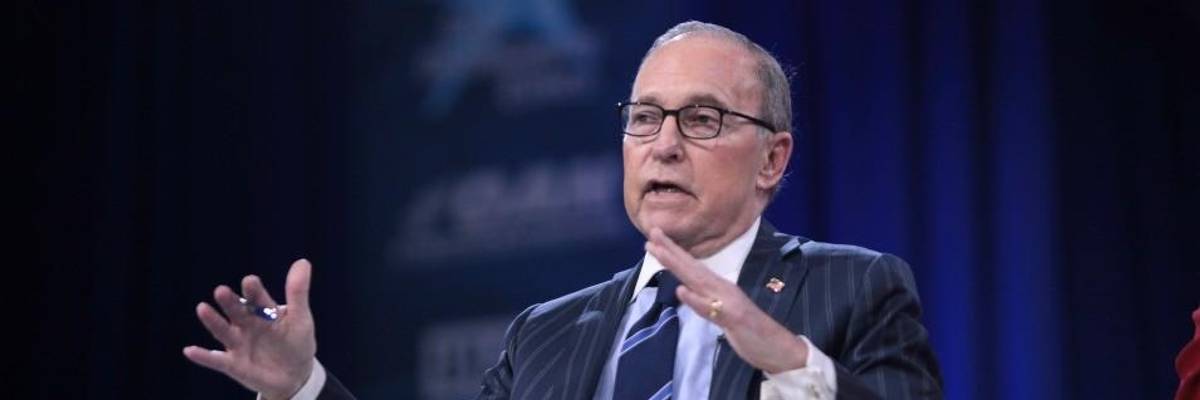
White House economic adviser Larry Kudlow said Thursday that he would fight against any effort by Democrats to raise the federal minimum wage. (Photo: Gage Skidmore/Flickr/cc)
Despite mounting evidence to the contrary, White House economic adviser Larry Kudlow said Thursday that corporate tax cuts are the best way to lift low-income Americans out of poverty--not a federal minimum wage hike, which he denounced as "silly."
Kudlow, who heads the National Economic Council, told a crowd at a live event hosted by the Washington Post that the federal minimum wage overall--which was first introduced in 1938 as a way to alleviate the effects of the Great Depression on American families--is a "terrible idea" which damages small businesses' ability to operate.
"Vote, because this White House wants to abolish the minimum wage." --Working Families PartyThe president's top economic adviser also said that should Democrats win control of the House or Senate in the midterm elections, the White House would fight against any effort to raise the federal minimum wage.
Progressives and Democratic lawmakers immediately seized on the comments as the latest proof that President Donald Trump's policies and proposals endanger working families while propping up corporations and the wealthiest Americans--and urged voters to keep that in mind when they go to the polls on November 6.
" Donald Trump and his advisers believe in huge tax breaks for billionaires, but when it comes to raising wages for workers they actually want to abolish the minimum wage," Sen. Bernie Sanders (I-Vt.) said in a statement following Kudlow's remarks. "Too many Americans today are forced to work two or three jobs to survive. That's wrong. If you work 40 hours a week, you should not live in poverty. We must raise the federal minimum wage to a living wage, $15 an hour."
The federal minimum wage has stood at $7.25 per hour--just over $16,000 per year--for nearly a decade. According to the National Low Income Housing Coalition, an employee earning the minimum wage would be unable to afford to rent a small two-bedroom apartment in any state in the nation.
While Kudlow suggested that corporate tax cuts are the most effective way to help working families, nearly a year after the passage of the Republican tax plan, that theory has been proven to be demonstrably false. According to the Tax Policy Center, 83 percent of the $1.5 trillion plan's benefits went to the wealthy, and only 4.3 percent of American workers were expected to see those benefits down to them in the form of raises or substantial bonuses according to Americans for Tax Fairness.
Kudlow also said that a federal minimum wage did not make sense for a country in which the cost of living varies from state-to-state.
"Idaho is different than New York. Alabama is different than Nebraska. That's why the federal minimum wage doesn't work for me," Kudlow said. The comment drew criticism from advocates for a $15 minimum wage--who believe that cost-of-living disparities mean that that minimum wage in more expensive states should be far higher than those in states with cheaper housing, to allow workers to support themselves and their families.
Dear Common Dreams reader, It’s been nearly 30 years since I co-founded Common Dreams with my late wife, Lina Newhouser. We had the radical notion that journalism should serve the public good, not corporate profits. It was clear to us from the outset what it would take to build such a project. No paid advertisements. No corporate sponsors. No millionaire publisher telling us what to think or do. Many people said we wouldn't last a year, but we proved those doubters wrong. Together with a tremendous team of journalists and dedicated staff, we built an independent media outlet free from the constraints of profits and corporate control. Our mission has always been simple: To inform. To inspire. To ignite change for the common good. Building Common Dreams was not easy. Our survival was never guaranteed. When you take on the most powerful forces—Wall Street greed, fossil fuel industry destruction, Big Tech lobbyists, and uber-rich oligarchs who have spent billions upon billions rigging the economy and democracy in their favor—the only bulwark you have is supporters who believe in your work. But here’s the urgent message from me today. It's never been this bad out there. And it's never been this hard to keep us going. At the very moment Common Dreams is most needed, the threats we face are intensifying. We need your support now more than ever. We don't accept corporate advertising and never will. We don't have a paywall because we don't think people should be blocked from critical news based on their ability to pay. Everything we do is funded by the donations of readers like you. When everyone does the little they can afford, we are strong. But if that support retreats or dries up, so do we. Will you donate now to make sure Common Dreams not only survives but thrives? —Craig Brown, Co-founder |
Despite mounting evidence to the contrary, White House economic adviser Larry Kudlow said Thursday that corporate tax cuts are the best way to lift low-income Americans out of poverty--not a federal minimum wage hike, which he denounced as "silly."
Kudlow, who heads the National Economic Council, told a crowd at a live event hosted by the Washington Post that the federal minimum wage overall--which was first introduced in 1938 as a way to alleviate the effects of the Great Depression on American families--is a "terrible idea" which damages small businesses' ability to operate.
"Vote, because this White House wants to abolish the minimum wage." --Working Families PartyThe president's top economic adviser also said that should Democrats win control of the House or Senate in the midterm elections, the White House would fight against any effort to raise the federal minimum wage.
Progressives and Democratic lawmakers immediately seized on the comments as the latest proof that President Donald Trump's policies and proposals endanger working families while propping up corporations and the wealthiest Americans--and urged voters to keep that in mind when they go to the polls on November 6.
" Donald Trump and his advisers believe in huge tax breaks for billionaires, but when it comes to raising wages for workers they actually want to abolish the minimum wage," Sen. Bernie Sanders (I-Vt.) said in a statement following Kudlow's remarks. "Too many Americans today are forced to work two or three jobs to survive. That's wrong. If you work 40 hours a week, you should not live in poverty. We must raise the federal minimum wage to a living wage, $15 an hour."
The federal minimum wage has stood at $7.25 per hour--just over $16,000 per year--for nearly a decade. According to the National Low Income Housing Coalition, an employee earning the minimum wage would be unable to afford to rent a small two-bedroom apartment in any state in the nation.
While Kudlow suggested that corporate tax cuts are the most effective way to help working families, nearly a year after the passage of the Republican tax plan, that theory has been proven to be demonstrably false. According to the Tax Policy Center, 83 percent of the $1.5 trillion plan's benefits went to the wealthy, and only 4.3 percent of American workers were expected to see those benefits down to them in the form of raises or substantial bonuses according to Americans for Tax Fairness.
Kudlow also said that a federal minimum wage did not make sense for a country in which the cost of living varies from state-to-state.
"Idaho is different than New York. Alabama is different than Nebraska. That's why the federal minimum wage doesn't work for me," Kudlow said. The comment drew criticism from advocates for a $15 minimum wage--who believe that cost-of-living disparities mean that that minimum wage in more expensive states should be far higher than those in states with cheaper housing, to allow workers to support themselves and their families.
Despite mounting evidence to the contrary, White House economic adviser Larry Kudlow said Thursday that corporate tax cuts are the best way to lift low-income Americans out of poverty--not a federal minimum wage hike, which he denounced as "silly."
Kudlow, who heads the National Economic Council, told a crowd at a live event hosted by the Washington Post that the federal minimum wage overall--which was first introduced in 1938 as a way to alleviate the effects of the Great Depression on American families--is a "terrible idea" which damages small businesses' ability to operate.
"Vote, because this White House wants to abolish the minimum wage." --Working Families PartyThe president's top economic adviser also said that should Democrats win control of the House or Senate in the midterm elections, the White House would fight against any effort to raise the federal minimum wage.
Progressives and Democratic lawmakers immediately seized on the comments as the latest proof that President Donald Trump's policies and proposals endanger working families while propping up corporations and the wealthiest Americans--and urged voters to keep that in mind when they go to the polls on November 6.
" Donald Trump and his advisers believe in huge tax breaks for billionaires, but when it comes to raising wages for workers they actually want to abolish the minimum wage," Sen. Bernie Sanders (I-Vt.) said in a statement following Kudlow's remarks. "Too many Americans today are forced to work two or three jobs to survive. That's wrong. If you work 40 hours a week, you should not live in poverty. We must raise the federal minimum wage to a living wage, $15 an hour."
The federal minimum wage has stood at $7.25 per hour--just over $16,000 per year--for nearly a decade. According to the National Low Income Housing Coalition, an employee earning the minimum wage would be unable to afford to rent a small two-bedroom apartment in any state in the nation.
While Kudlow suggested that corporate tax cuts are the most effective way to help working families, nearly a year after the passage of the Republican tax plan, that theory has been proven to be demonstrably false. According to the Tax Policy Center, 83 percent of the $1.5 trillion plan's benefits went to the wealthy, and only 4.3 percent of American workers were expected to see those benefits down to them in the form of raises or substantial bonuses according to Americans for Tax Fairness.
Kudlow also said that a federal minimum wage did not make sense for a country in which the cost of living varies from state-to-state.
"Idaho is different than New York. Alabama is different than Nebraska. That's why the federal minimum wage doesn't work for me," Kudlow said. The comment drew criticism from advocates for a $15 minimum wage--who believe that cost-of-living disparities mean that that minimum wage in more expensive states should be far higher than those in states with cheaper housing, to allow workers to support themselves and their families.