SUBSCRIBE TO OUR FREE NEWSLETTER
Daily news & progressive opinion—funded by the people, not the corporations—delivered straight to your inbox.
5
#000000
#FFFFFF
To donate by check, phone, or other method, see our More Ways to Give page.
Daily news & progressive opinion—funded by the people, not the corporations—delivered straight to your inbox.
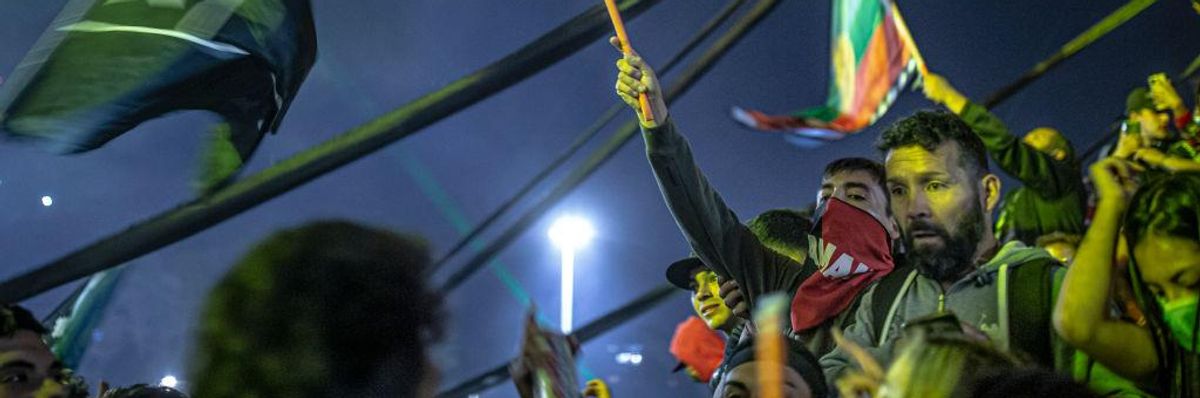
People gather to celebrate the victory of the referendum, in Santiago, Chile, on October 25, 2020 that will replace its 40-year-old constitution, written during the dictatorship of General Augusto Pinochet, in Santiago, Chile. (Photo by Felipe Vargas Figueroa/NurPhoto via Getty Images)
October has been a busy month for South American social movements and constitutional change. It joins October 2019 as a critical moment for mass movement demands.
Yesterday, October 25, the Chilean people passed a referendum to abolish Augusto Pinochet's constitution of 1980.
A week ago, on the 18th, Bolivia's indigenous socialist Movimiento al Socialismo returned to power after winning a decisive election against the coup-installed rightwing evangelical president Jeanine Anez. For Bolivia, this signaled a return of the nation's Law of Mother Earth and "vivir bien" or "good life" governance, "a complex set of ideas, worldviews, and knowledge deriving from indigenous movements, activist groups, and scholars of indigeneity."
Two weeks before Bolivia's election, constitutional change passed the Legislative Assembly of El Salvador. The reform, led by the FMLN and socio-environmental groups, would constitutionalize water as a public good that people have a human right to access for personal survival. It is a rebuke to the nation's authoritarian president Nayib Bukele and corporations eyeing the nation's water crisis.
These developments are not isolated: decolonial constitutional demands are being elevated elsewhere, including in Iraq and Lebanon.
October 2019
In the first days of October 2019, protests erupted in Iraq. Youth flooded the streets to demand a better world. Of their demands: the abolition of Iraq's ethno- and sectarian-based muhasasa system, which "determines political representation based on communal identities (religious, ethnic, or sectarian)." (The system was created by the United States in 2003 and has roots to the British colonization of the region.)
Two weeks later, on October 17, 2019 the Lebanese government proposed a regressive WhatsApp fee, bringing similar decolonial demands to the streets of Beirut. A core demand: protesters wanted to abolish Lebanon's sectarian voting system that bases representation on religion.
The next day, the 18th, the government of Santiago, Chile hiked its public transportation fare.
Chile 2020
On October 18, 2019, Chileans revolted against the fare hike--joining Iraqis and Lebanonese. These protests quickly led to demands for the abolition of Augusto Pinochet's neoliberal constitution.
One year and one week later (yesterday), Chilean voters approved a referendum to scrap the Pinochet constitution. The historic vote signals a departure from neoliberal and colonialist systems of law, which in Chile's case protected "freedoms" for consumers, rather than basic human rights and the necessities of life. As Claudio Nash, a professor of international law at the University of Chile, recently explained to NPR: "In Chile the right to health is not guaranteed as a right....What is guaranteed is the freedom of people to choose the health system they want--the public system, the private system--but access to quality health care is not guaranteed."
In December 2019, a "citizen consultation" held by Chile's Association of Municipalities in 200 municipalities showed the electoral popularity of replacing the constitution. Citizens aged 14 and up were allowed to participate.
Bolivia 2020
The electoral victory of Bolivia's Movimiento al Socialismo returns to power the indigenous-led socialist government that passed the 2010 Law of Mother Earth, a key piece of legislation for international movements to advance decolonial legal frameworks, including for the Rights of Nature.
El Salvador 2020
El Salvador has been dealing with constitutional crises throughout 2020. In February, authoritarian president Nayib Bukele intimidated and coerced the country's Legislative Assembly, threatening to dissolve it while invoking emergency law.
Now, in a rejection to Bukele's power, and the corporate control of land and water, constitutional reform has passed the Legislative Assembly, to establish a fundamental human right to water that guarantees access to a quantity of clean water "sufficient for personal and domestic use."
Under the reform, the state would have the "obligation to remove whatever barrier, be it fiscal or economic, which impedes access to water--especially for the poor and historically marginalized groups." (All translations by this author.)
The constitutional reform also aims to sustainably preserve water systems and declares water "bien publico" or a "public good." To take effect, it must be ratified by the next Legislative Assembly (2021-2024).
The reform was first proposed through a collective of human rights and socio-environmental groups, academics, and attorneys who presented an initial initiative to the Legislative Assembly in August 2018.
Movements in the United States Playing Catch-Up
In the United States, the mainstream constitutional debate centers around the structure of the Supreme Court, and its number of judges.
Dear Common Dreams reader, It’s been nearly 30 years since I co-founded Common Dreams with my late wife, Lina Newhouser. We had the radical notion that journalism should serve the public good, not corporate profits. It was clear to us from the outset what it would take to build such a project. No paid advertisements. No corporate sponsors. No millionaire publisher telling us what to think or do. Many people said we wouldn't last a year, but we proved those doubters wrong. Together with a tremendous team of journalists and dedicated staff, we built an independent media outlet free from the constraints of profits and corporate control. Our mission has always been simple: To inform. To inspire. To ignite change for the common good. Building Common Dreams was not easy. Our survival was never guaranteed. When you take on the most powerful forces—Wall Street greed, fossil fuel industry destruction, Big Tech lobbyists, and uber-rich oligarchs who have spent billions upon billions rigging the economy and democracy in their favor—the only bulwark you have is supporters who believe in your work. But here’s the urgent message from me today. It's never been this bad out there. And it's never been this hard to keep us going. At the very moment Common Dreams is most needed, the threats we face are intensifying. We need your support now more than ever. We don't accept corporate advertising and never will. We don't have a paywall because we don't think people should be blocked from critical news based on their ability to pay. Everything we do is funded by the donations of readers like you. When everyone does the little they can afford, we are strong. But if that support retreats or dries up, so do we. Will you donate now to make sure Common Dreams not only survives but thrives? —Craig Brown, Co-founder |
October has been a busy month for South American social movements and constitutional change. It joins October 2019 as a critical moment for mass movement demands.
Yesterday, October 25, the Chilean people passed a referendum to abolish Augusto Pinochet's constitution of 1980.
A week ago, on the 18th, Bolivia's indigenous socialist Movimiento al Socialismo returned to power after winning a decisive election against the coup-installed rightwing evangelical president Jeanine Anez. For Bolivia, this signaled a return of the nation's Law of Mother Earth and "vivir bien" or "good life" governance, "a complex set of ideas, worldviews, and knowledge deriving from indigenous movements, activist groups, and scholars of indigeneity."
Two weeks before Bolivia's election, constitutional change passed the Legislative Assembly of El Salvador. The reform, led by the FMLN and socio-environmental groups, would constitutionalize water as a public good that people have a human right to access for personal survival. It is a rebuke to the nation's authoritarian president Nayib Bukele and corporations eyeing the nation's water crisis.
These developments are not isolated: decolonial constitutional demands are being elevated elsewhere, including in Iraq and Lebanon.
October 2019
In the first days of October 2019, protests erupted in Iraq. Youth flooded the streets to demand a better world. Of their demands: the abolition of Iraq's ethno- and sectarian-based muhasasa system, which "determines political representation based on communal identities (religious, ethnic, or sectarian)." (The system was created by the United States in 2003 and has roots to the British colonization of the region.)
Two weeks later, on October 17, 2019 the Lebanese government proposed a regressive WhatsApp fee, bringing similar decolonial demands to the streets of Beirut. A core demand: protesters wanted to abolish Lebanon's sectarian voting system that bases representation on religion.
The next day, the 18th, the government of Santiago, Chile hiked its public transportation fare.
Chile 2020
On October 18, 2019, Chileans revolted against the fare hike--joining Iraqis and Lebanonese. These protests quickly led to demands for the abolition of Augusto Pinochet's neoliberal constitution.
One year and one week later (yesterday), Chilean voters approved a referendum to scrap the Pinochet constitution. The historic vote signals a departure from neoliberal and colonialist systems of law, which in Chile's case protected "freedoms" for consumers, rather than basic human rights and the necessities of life. As Claudio Nash, a professor of international law at the University of Chile, recently explained to NPR: "In Chile the right to health is not guaranteed as a right....What is guaranteed is the freedom of people to choose the health system they want--the public system, the private system--but access to quality health care is not guaranteed."
In December 2019, a "citizen consultation" held by Chile's Association of Municipalities in 200 municipalities showed the electoral popularity of replacing the constitution. Citizens aged 14 and up were allowed to participate.
Bolivia 2020
The electoral victory of Bolivia's Movimiento al Socialismo returns to power the indigenous-led socialist government that passed the 2010 Law of Mother Earth, a key piece of legislation for international movements to advance decolonial legal frameworks, including for the Rights of Nature.
El Salvador 2020
El Salvador has been dealing with constitutional crises throughout 2020. In February, authoritarian president Nayib Bukele intimidated and coerced the country's Legislative Assembly, threatening to dissolve it while invoking emergency law.
Now, in a rejection to Bukele's power, and the corporate control of land and water, constitutional reform has passed the Legislative Assembly, to establish a fundamental human right to water that guarantees access to a quantity of clean water "sufficient for personal and domestic use."
Under the reform, the state would have the "obligation to remove whatever barrier, be it fiscal or economic, which impedes access to water--especially for the poor and historically marginalized groups." (All translations by this author.)
The constitutional reform also aims to sustainably preserve water systems and declares water "bien publico" or a "public good." To take effect, it must be ratified by the next Legislative Assembly (2021-2024).
The reform was first proposed through a collective of human rights and socio-environmental groups, academics, and attorneys who presented an initial initiative to the Legislative Assembly in August 2018.
Movements in the United States Playing Catch-Up
In the United States, the mainstream constitutional debate centers around the structure of the Supreme Court, and its number of judges.
October has been a busy month for South American social movements and constitutional change. It joins October 2019 as a critical moment for mass movement demands.
Yesterday, October 25, the Chilean people passed a referendum to abolish Augusto Pinochet's constitution of 1980.
A week ago, on the 18th, Bolivia's indigenous socialist Movimiento al Socialismo returned to power after winning a decisive election against the coup-installed rightwing evangelical president Jeanine Anez. For Bolivia, this signaled a return of the nation's Law of Mother Earth and "vivir bien" or "good life" governance, "a complex set of ideas, worldviews, and knowledge deriving from indigenous movements, activist groups, and scholars of indigeneity."
Two weeks before Bolivia's election, constitutional change passed the Legislative Assembly of El Salvador. The reform, led by the FMLN and socio-environmental groups, would constitutionalize water as a public good that people have a human right to access for personal survival. It is a rebuke to the nation's authoritarian president Nayib Bukele and corporations eyeing the nation's water crisis.
These developments are not isolated: decolonial constitutional demands are being elevated elsewhere, including in Iraq and Lebanon.
October 2019
In the first days of October 2019, protests erupted in Iraq. Youth flooded the streets to demand a better world. Of their demands: the abolition of Iraq's ethno- and sectarian-based muhasasa system, which "determines political representation based on communal identities (religious, ethnic, or sectarian)." (The system was created by the United States in 2003 and has roots to the British colonization of the region.)
Two weeks later, on October 17, 2019 the Lebanese government proposed a regressive WhatsApp fee, bringing similar decolonial demands to the streets of Beirut. A core demand: protesters wanted to abolish Lebanon's sectarian voting system that bases representation on religion.
The next day, the 18th, the government of Santiago, Chile hiked its public transportation fare.
Chile 2020
On October 18, 2019, Chileans revolted against the fare hike--joining Iraqis and Lebanonese. These protests quickly led to demands for the abolition of Augusto Pinochet's neoliberal constitution.
One year and one week later (yesterday), Chilean voters approved a referendum to scrap the Pinochet constitution. The historic vote signals a departure from neoliberal and colonialist systems of law, which in Chile's case protected "freedoms" for consumers, rather than basic human rights and the necessities of life. As Claudio Nash, a professor of international law at the University of Chile, recently explained to NPR: "In Chile the right to health is not guaranteed as a right....What is guaranteed is the freedom of people to choose the health system they want--the public system, the private system--but access to quality health care is not guaranteed."
In December 2019, a "citizen consultation" held by Chile's Association of Municipalities in 200 municipalities showed the electoral popularity of replacing the constitution. Citizens aged 14 and up were allowed to participate.
Bolivia 2020
The electoral victory of Bolivia's Movimiento al Socialismo returns to power the indigenous-led socialist government that passed the 2010 Law of Mother Earth, a key piece of legislation for international movements to advance decolonial legal frameworks, including for the Rights of Nature.
El Salvador 2020
El Salvador has been dealing with constitutional crises throughout 2020. In February, authoritarian president Nayib Bukele intimidated and coerced the country's Legislative Assembly, threatening to dissolve it while invoking emergency law.
Now, in a rejection to Bukele's power, and the corporate control of land and water, constitutional reform has passed the Legislative Assembly, to establish a fundamental human right to water that guarantees access to a quantity of clean water "sufficient for personal and domestic use."
Under the reform, the state would have the "obligation to remove whatever barrier, be it fiscal or economic, which impedes access to water--especially for the poor and historically marginalized groups." (All translations by this author.)
The constitutional reform also aims to sustainably preserve water systems and declares water "bien publico" or a "public good." To take effect, it must be ratified by the next Legislative Assembly (2021-2024).
The reform was first proposed through a collective of human rights and socio-environmental groups, academics, and attorneys who presented an initial initiative to the Legislative Assembly in August 2018.
Movements in the United States Playing Catch-Up
In the United States, the mainstream constitutional debate centers around the structure of the Supreme Court, and its number of judges.