SUBSCRIBE TO OUR FREE NEWSLETTER
Daily news & progressive opinion—funded by the people, not the corporations—delivered straight to your inbox.
5
#000000
#FFFFFF
To donate by check, phone, or other method, see our More Ways to Give page.
Last summer Bill McKibben and 350.org, the organization he and a group of Middlebury College seniors founded in 2006 to fight global heating, brought thousands of protesters to Washington DC to protest the Keystone XL Pipeline. As you'll recall, they circled the White House in a ring five people deep; thousands were arrested over the course of two weeks; and the construction of the Keystone was at least delayed, if not entirely crushed.
Bill reminded us that Exxon Mobil and the other big oil, coal and gas companies are by far the richest in the world. Why should they be getting subsidies for doing business when those funds are sorely needed by citizens for basic services like education, health care and retirement?
And why should we be rewarding companies that not only pollute the environment, but also are responsible for spewing the greenhouse emissions that are rapidly making our planet uninhabitable for many current species, including humans?
"No other industry is allowed to dump its garbage in the streets," Bill declared. "Why should it not only be allowed, but subsidized, for the industry that is responsible for the most dangerous product of all, the CO2 that could totally destabilize our planet?"
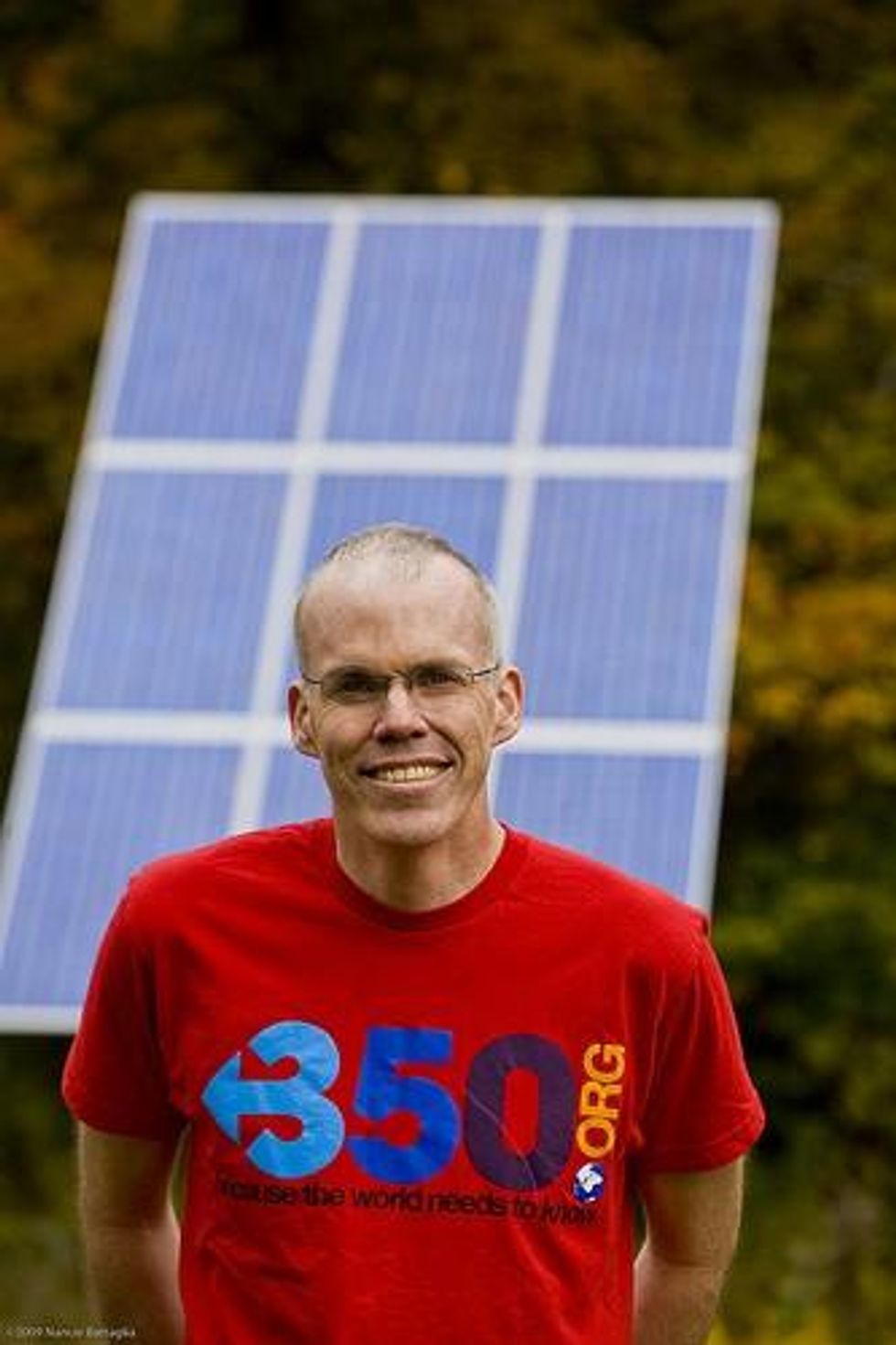
Bill began his speech by noting apologetically that he has become known as a "professional bummer-outer," and it was true: it was impossible to come away from his hour-long talk without feeling shaken by the severity of the future he laid out for us.
He gave several hard-hitting statistics and anecdotes of the gathering steamroller of global heating: the melting of the Arctic ice pack, the acidification of the ocean, the increase of floods, droughts, storms and disease.
Bill laid the blame squarely in the laps of the fossil fuel industry, which, he said, has been using its vast wealth to forestall political action on moving to renewable energy.
"Their business model is the problem," he said. "It's either wreck their business model or wreck the planet."
He's not talking about destroying Exxon-Mobil and the other oil giants; just about forcing them to re-invent themselves as clean energy companies, and start putting their great resources behind the swift transition to renewable energy technologies.
How to accomplish this sea change?
"We'll never match their money, so we need to deal in a different currency," he said, "the currency of movements: passion, spirit, and creativity."
Bill showed pictures from around the world of climate activists, most of whom, as he observed drily, "do not look like Sierra Club environmentalists, but they care just as passionately about saving our planet." The movement he envisions must be international, but since Americans and Europeans bear most of the blame for the dramatic rise in greenhouse gases we have a special responsibility to work hard to make things right.
... It's the fossil fuel industry's business model that's the problem, says McKibben: "It's either wreck their business model or wreck the planet."
"I'm a writer," Bill said. "I'd rather be sitting home in Vermont typing." Instead, he's on the road much of the time now, addressing groups and working behind the scenes to build a climate movement powerful enough to take on the fossil fuel lobbies and head off disaster.
At this conference of economists, there were many gray heads in the hall, and many people wearing conservative professional clothing. Bill called on the older folks, in particular, to join the movement to head off global heating, because "once you're past a certain age, it doesn't matter so much if you have an arrest record."
"We have to get more confrontational," he said, recalling the civil disobedience campaigns of Dr. Martin Luther King Jr.
Among the confrontational tactics we can look forward to this summer are "Nascar-style" blue blazers for members of Congress, with the logos of all the corporations from which they've accepted cash blazoned on their backs. 350.org will also be hosting an online Congressional scoreboard, so that citizens can easily see how each senator or congressional representative has voted with regard to climate stabilization and environmental health.
"We're not radicals or militants," Bill insisted. "We're actually quite conservative. We want the planet to stay the way it is, or go back to the way it was when we were born. The radicals work at the oil companies," he declared to applause.
"We're not radicals or militants. We're actually quite conservative. We want the planet to stay the way it is, or go back to the way it was when we were born. The radicals work at the oil companies." --McKibben
Bill ended by reminding the audience that the U.S. Chamber of Commerce recently issued a statement saying that there was no cause for alarm about climate change, because human beings will be able to adapt our behavior and physiology as the planet warms.
"What are they imagining?" Bill asked indignantly. "Are we going to start growing gills?"
It's not gills we need, but guts--to follow Bill McKibben's lead and force the politicians to represent the will of the people, rather than the will of the industries that are destroying our planet in the name of the next quarter's profits.
Something tells me it's going to be a hot summer.
Last summer Bill McKibben and 350.org, the organization he and a group of Middlebury College seniors founded in 2006 to fight global heating, brought thousands of protesters to Washington DC to protest the Keystone XL Pipeline. As you'll recall, they circled the White House in a ring five people deep; thousands were arrested over the course of two weeks; and the construction of the Keystone was at least delayed, if not entirely crushed.
Bill reminded us that Exxon Mobil and the other big oil, coal and gas companies are by far the richest in the world. Why should they be getting subsidies for doing business when those funds are sorely needed by citizens for basic services like education, health care and retirement?
And why should we be rewarding companies that not only pollute the environment, but also are responsible for spewing the greenhouse emissions that are rapidly making our planet uninhabitable for many current species, including humans?
"No other industry is allowed to dump its garbage in the streets," Bill declared. "Why should it not only be allowed, but subsidized, for the industry that is responsible for the most dangerous product of all, the CO2 that could totally destabilize our planet?"
Bill began his speech by noting apologetically that he has become known as a "professional bummer-outer," and it was true: it was impossible to come away from his hour-long talk without feeling shaken by the severity of the future he laid out for us.
He gave several hard-hitting statistics and anecdotes of the gathering steamroller of global heating: the melting of the Arctic ice pack, the acidification of the ocean, the increase of floods, droughts, storms and disease.
Bill laid the blame squarely in the laps of the fossil fuel industry, which, he said, has been using its vast wealth to forestall political action on moving to renewable energy.
"Their business model is the problem," he said. "It's either wreck their business model or wreck the planet."
He's not talking about destroying Exxon-Mobil and the other oil giants; just about forcing them to re-invent themselves as clean energy companies, and start putting their great resources behind the swift transition to renewable energy technologies.
How to accomplish this sea change?
"We'll never match their money, so we need to deal in a different currency," he said, "the currency of movements: passion, spirit, and creativity."
Bill showed pictures from around the world of climate activists, most of whom, as he observed drily, "do not look like Sierra Club environmentalists, but they care just as passionately about saving our planet." The movement he envisions must be international, but since Americans and Europeans bear most of the blame for the dramatic rise in greenhouse gases we have a special responsibility to work hard to make things right.
... It's the fossil fuel industry's business model that's the problem, says McKibben: "It's either wreck their business model or wreck the planet."
"I'm a writer," Bill said. "I'd rather be sitting home in Vermont typing." Instead, he's on the road much of the time now, addressing groups and working behind the scenes to build a climate movement powerful enough to take on the fossil fuel lobbies and head off disaster.
At this conference of economists, there were many gray heads in the hall, and many people wearing conservative professional clothing. Bill called on the older folks, in particular, to join the movement to head off global heating, because "once you're past a certain age, it doesn't matter so much if you have an arrest record."
"We have to get more confrontational," he said, recalling the civil disobedience campaigns of Dr. Martin Luther King Jr.
Among the confrontational tactics we can look forward to this summer are "Nascar-style" blue blazers for members of Congress, with the logos of all the corporations from which they've accepted cash blazoned on their backs. 350.org will also be hosting an online Congressional scoreboard, so that citizens can easily see how each senator or congressional representative has voted with regard to climate stabilization and environmental health.
"We're not radicals or militants," Bill insisted. "We're actually quite conservative. We want the planet to stay the way it is, or go back to the way it was when we were born. The radicals work at the oil companies," he declared to applause.
"We're not radicals or militants. We're actually quite conservative. We want the planet to stay the way it is, or go back to the way it was when we were born. The radicals work at the oil companies." --McKibben
Bill ended by reminding the audience that the U.S. Chamber of Commerce recently issued a statement saying that there was no cause for alarm about climate change, because human beings will be able to adapt our behavior and physiology as the planet warms.
"What are they imagining?" Bill asked indignantly. "Are we going to start growing gills?"
It's not gills we need, but guts--to follow Bill McKibben's lead and force the politicians to represent the will of the people, rather than the will of the industries that are destroying our planet in the name of the next quarter's profits.
Something tells me it's going to be a hot summer.