SUBSCRIBE TO OUR FREE NEWSLETTER
Daily news & progressive opinion—funded by the people, not the corporations—delivered straight to your inbox.
5
#000000
#FFFFFF
To donate by check, phone, or other method, see our More Ways to Give page.
Daily news & progressive opinion—funded by the people, not the corporations—delivered straight to your inbox.
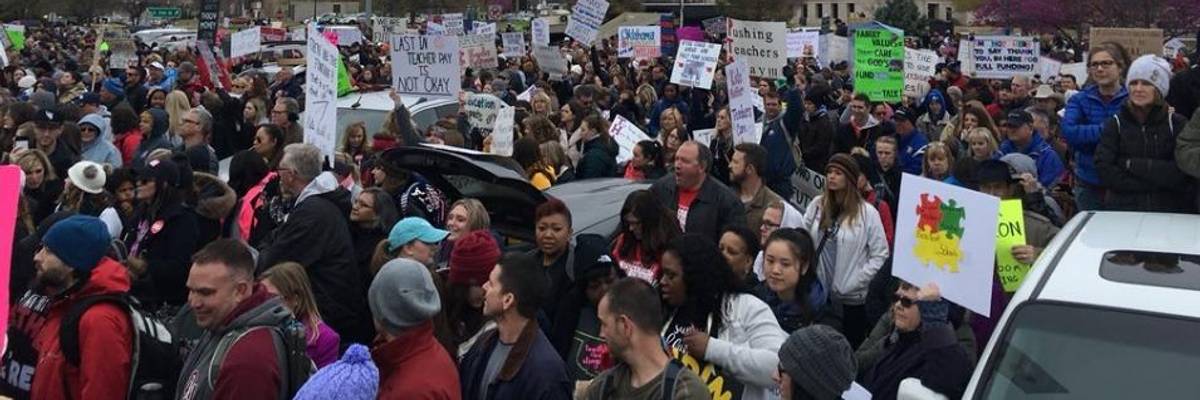
An estimated 30,000 Oklahoma teachers rallied at the State Capitol on Monday, demanding far more funding for education than what was included in the legislature's last-minute effort to avoid a strike last week. (Photo: @cora/Twitter)
A weeks-long mobilization in Oklahoma resulted in teachers striking across the state on Monday, with tens of thousands of educators and supporters rallying at the State Capitol in Oklahoma City to demand more funding for schools and higher wages for teachers.
Organizers planned to speak with state lawmakers about how decades of funding cuts have affected their schools--and why a bill passed in the legislature last week that would raise taxes on oil and gas production to give teachers a $6,100 raise and allot $50 million for school funding was not enough to stop the protest.
An NBC News aerial video of the scene at the demonstration showed an estimated crowd of 30,000 people gathered outside the Capitol.
Oklahoma Education Association (OEA) president Alicia Priest told CNN the package was "a good starting point," but said teachers see it as a last-ditch effort by lawmakers to keep the strike from happening and not a genuine attempt to improve schools.
"Fifty million dollars will buy less than one textbook per student, so it's not a real way to fund education," Priest said. "We've been cut over 28 percent in the last 10 years in education funding, and our schools just can't maintain all of the supplies, instructional materials, textbooks, even copy paper. Copies are limited in schools to maybe 30 a week."
The OEA is demanding a $200 million funding bill for schools, and a $10,000 raise for teachers over the next three years.
As teachers across the state prepared to rally, four teachers shared in a CNN video the numerous side jobs they have had to take on to make ends meet while educating Oklahoma's schoolchildren. One educator with 25 years of experience detailed his work as a bus driver, landscaper, and roof salesman. Another said she works 15 to 20 hours in retail to supplement her teaching salary.
On social media, teachers and supporters also shared images showing the dire need for more education funding so schools can afford basic supplies like textbooks.
Teachers boarded buses across the state early on Monday morning, with an estimated 30,000 expected at the State Capitol.
As Common Dreams has reported, Oklahoma is just one state where teachers have railed against poor funding and chronically low pay in recent weeks. Also on Monday, a strike in Kentucky over changes to teachers' pension plans continued, with educators traveling from across the state to the State Capitol in Frankfort. Most schools were closed for spring break, with teachers and supporters using their time off to protest--while 21 counties's schools closed for the strike.
Teachers in Arizona held a demonstration in Phoenix last week--also hoping to draw attention to per-student funding, which was cut by more than 36 percent from 2008 to 2015.
The wave of protests follows the teachers' strike in West Virginia last month, which shuttered every public school in the state for nine days and resulted in a five percent pay raise for teachers and an agreement to work towards funding for the state employee health insurance program.
In all the states where teachers have been voicing their dissatisfaction, lawmakers have spent decades handing out tax cuts to corporations while cutting funding for schools and leaving teachers with stagnant wages.
"After ten long years in a lot of these conservative states, the chicken is finally coming home to roost," Lily Eskelsen Garcia, president of the National Education Association, told the Huffington Post. "They've given tax breaks to big corporations, defunded public schools, and said, 'What could go wrong?'"
Dear Common Dreams reader, It’s been nearly 30 years since I co-founded Common Dreams with my late wife, Lina Newhouser. We had the radical notion that journalism should serve the public good, not corporate profits. It was clear to us from the outset what it would take to build such a project. No paid advertisements. No corporate sponsors. No millionaire publisher telling us what to think or do. Many people said we wouldn't last a year, but we proved those doubters wrong. Together with a tremendous team of journalists and dedicated staff, we built an independent media outlet free from the constraints of profits and corporate control. Our mission has always been simple: To inform. To inspire. To ignite change for the common good. Building Common Dreams was not easy. Our survival was never guaranteed. When you take on the most powerful forces—Wall Street greed, fossil fuel industry destruction, Big Tech lobbyists, and uber-rich oligarchs who have spent billions upon billions rigging the economy and democracy in their favor—the only bulwark you have is supporters who believe in your work. But here’s the urgent message from me today. It's never been this bad out there. And it's never been this hard to keep us going. At the very moment Common Dreams is most needed, the threats we face are intensifying. We need your support now more than ever. We don't accept corporate advertising and never will. We don't have a paywall because we don't think people should be blocked from critical news based on their ability to pay. Everything we do is funded by the donations of readers like you. When everyone does the little they can afford, we are strong. But if that support retreats or dries up, so do we. Will you donate now to make sure Common Dreams not only survives but thrives? —Craig Brown, Co-founder |
A weeks-long mobilization in Oklahoma resulted in teachers striking across the state on Monday, with tens of thousands of educators and supporters rallying at the State Capitol in Oklahoma City to demand more funding for schools and higher wages for teachers.
Organizers planned to speak with state lawmakers about how decades of funding cuts have affected their schools--and why a bill passed in the legislature last week that would raise taxes on oil and gas production to give teachers a $6,100 raise and allot $50 million for school funding was not enough to stop the protest.
An NBC News aerial video of the scene at the demonstration showed an estimated crowd of 30,000 people gathered outside the Capitol.
Oklahoma Education Association (OEA) president Alicia Priest told CNN the package was "a good starting point," but said teachers see it as a last-ditch effort by lawmakers to keep the strike from happening and not a genuine attempt to improve schools.
"Fifty million dollars will buy less than one textbook per student, so it's not a real way to fund education," Priest said. "We've been cut over 28 percent in the last 10 years in education funding, and our schools just can't maintain all of the supplies, instructional materials, textbooks, even copy paper. Copies are limited in schools to maybe 30 a week."
The OEA is demanding a $200 million funding bill for schools, and a $10,000 raise for teachers over the next three years.
As teachers across the state prepared to rally, four teachers shared in a CNN video the numerous side jobs they have had to take on to make ends meet while educating Oklahoma's schoolchildren. One educator with 25 years of experience detailed his work as a bus driver, landscaper, and roof salesman. Another said she works 15 to 20 hours in retail to supplement her teaching salary.
On social media, teachers and supporters also shared images showing the dire need for more education funding so schools can afford basic supplies like textbooks.
Teachers boarded buses across the state early on Monday morning, with an estimated 30,000 expected at the State Capitol.
As Common Dreams has reported, Oklahoma is just one state where teachers have railed against poor funding and chronically low pay in recent weeks. Also on Monday, a strike in Kentucky over changes to teachers' pension plans continued, with educators traveling from across the state to the State Capitol in Frankfort. Most schools were closed for spring break, with teachers and supporters using their time off to protest--while 21 counties's schools closed for the strike.
Teachers in Arizona held a demonstration in Phoenix last week--also hoping to draw attention to per-student funding, which was cut by more than 36 percent from 2008 to 2015.
The wave of protests follows the teachers' strike in West Virginia last month, which shuttered every public school in the state for nine days and resulted in a five percent pay raise for teachers and an agreement to work towards funding for the state employee health insurance program.
In all the states where teachers have been voicing their dissatisfaction, lawmakers have spent decades handing out tax cuts to corporations while cutting funding for schools and leaving teachers with stagnant wages.
"After ten long years in a lot of these conservative states, the chicken is finally coming home to roost," Lily Eskelsen Garcia, president of the National Education Association, told the Huffington Post. "They've given tax breaks to big corporations, defunded public schools, and said, 'What could go wrong?'"
A weeks-long mobilization in Oklahoma resulted in teachers striking across the state on Monday, with tens of thousands of educators and supporters rallying at the State Capitol in Oklahoma City to demand more funding for schools and higher wages for teachers.
Organizers planned to speak with state lawmakers about how decades of funding cuts have affected their schools--and why a bill passed in the legislature last week that would raise taxes on oil and gas production to give teachers a $6,100 raise and allot $50 million for school funding was not enough to stop the protest.
An NBC News aerial video of the scene at the demonstration showed an estimated crowd of 30,000 people gathered outside the Capitol.
Oklahoma Education Association (OEA) president Alicia Priest told CNN the package was "a good starting point," but said teachers see it as a last-ditch effort by lawmakers to keep the strike from happening and not a genuine attempt to improve schools.
"Fifty million dollars will buy less than one textbook per student, so it's not a real way to fund education," Priest said. "We've been cut over 28 percent in the last 10 years in education funding, and our schools just can't maintain all of the supplies, instructional materials, textbooks, even copy paper. Copies are limited in schools to maybe 30 a week."
The OEA is demanding a $200 million funding bill for schools, and a $10,000 raise for teachers over the next three years.
As teachers across the state prepared to rally, four teachers shared in a CNN video the numerous side jobs they have had to take on to make ends meet while educating Oklahoma's schoolchildren. One educator with 25 years of experience detailed his work as a bus driver, landscaper, and roof salesman. Another said she works 15 to 20 hours in retail to supplement her teaching salary.
On social media, teachers and supporters also shared images showing the dire need for more education funding so schools can afford basic supplies like textbooks.
Teachers boarded buses across the state early on Monday morning, with an estimated 30,000 expected at the State Capitol.
As Common Dreams has reported, Oklahoma is just one state where teachers have railed against poor funding and chronically low pay in recent weeks. Also on Monday, a strike in Kentucky over changes to teachers' pension plans continued, with educators traveling from across the state to the State Capitol in Frankfort. Most schools were closed for spring break, with teachers and supporters using their time off to protest--while 21 counties's schools closed for the strike.
Teachers in Arizona held a demonstration in Phoenix last week--also hoping to draw attention to per-student funding, which was cut by more than 36 percent from 2008 to 2015.
The wave of protests follows the teachers' strike in West Virginia last month, which shuttered every public school in the state for nine days and resulted in a five percent pay raise for teachers and an agreement to work towards funding for the state employee health insurance program.
In all the states where teachers have been voicing their dissatisfaction, lawmakers have spent decades handing out tax cuts to corporations while cutting funding for schools and leaving teachers with stagnant wages.
"After ten long years in a lot of these conservative states, the chicken is finally coming home to roost," Lily Eskelsen Garcia, president of the National Education Association, told the Huffington Post. "They've given tax breaks to big corporations, defunded public schools, and said, 'What could go wrong?'"