SUBSCRIBE TO OUR FREE NEWSLETTER
Daily news & progressive opinion—funded by the people, not the corporations—delivered straight to your inbox.
5
#000000
#FFFFFF
To donate by check, phone, or other method, see our More Ways to Give page.
Daily news & progressive opinion—funded by the people, not the corporations—delivered straight to your inbox.
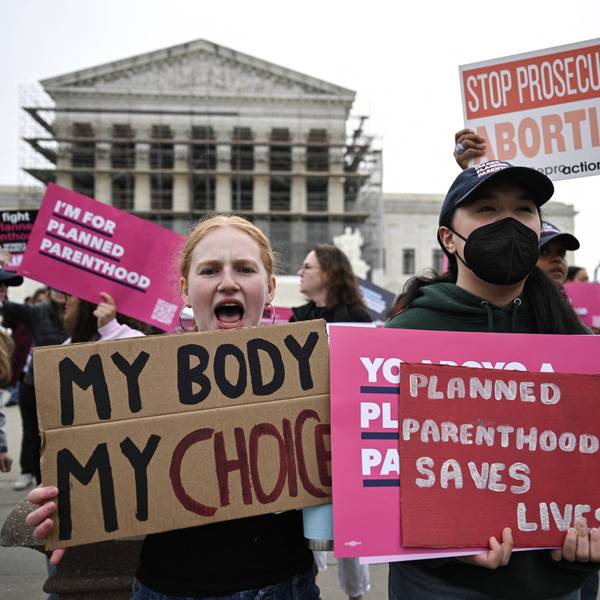
The significance of Monday's landmark Supreme Court decision on abortion is already being felt across the nation, giving women's health advocates reason to hope that the concerted right-wing assault on reproductive rights has been "stopped in its tracks."
On Tuesday, the Supreme Court rejected appeals from Mississippi and Wisconsin seeking to put admitting privilege restrictions similar to those struck down in Whole Women's Health v. Hellerstedt. Mississippi's law would have closed the lone abortion clinic in the state.
"Today's decision should send a loud signal to anti-abortion politicians that they can no longer hide behind sham rationales to shut down clinics and prevent a woman who has decided to end a pregnancy from getting the care she needs," said Larry Dupuis, legal director of the American Civil Liberties Union of Wisconsin, which represented an abortion clinic in the Wisconsin case.
"Whether in Mississippi, Texas, or any other state across the U.S., politicians cannot insert their personal beliefs into a woman's decision whether to continue or end a pregnancy," added Nancy Northup, president and CEO of the Center for Reproductive Rights, which filed the Mississippi lawsuit in 2012. "We are confident that courts across the country will continue to affirm that politicians cannot pass laws attacking women's access to safe, legal abortion."
Additionally, late on Monday, Alabama's Attorney General Luther Strange said his office would drop its appeal in a similar case because of Monday's ruling, admitting "there is no good faith argument that Alabama's law remains constitutional in light of the Supreme Court ruling."
According to the Center for Reproductive Rights, similar admitting privilege requirements—for which the Supreme Court could find no medical justification—exist in Missouri, North Dakota, Utah, and Tennessee and are on hold in Kansas, Louisiana, and Oklahoma. The surgical-center standards that the Court also struck down are in place in Michigan, Missouri, Pennsylvania, and Virginia and are on hold in Tennessee.
"We are currently looking at all avenues to invalidate those two restrictions in Missouri," president and CEO of Planned Parenthood of Kansas and Mid-Missouri Laura McQuade said in a conference call with reporters on Monday.
"As the news in Alabama, Wisconsin, and Mississippi shows, yesterday's landmark ruling was just the beginning," said Cecile Richards, president of the Planned Parenthood Federation of America. "This decision has opened the door to go state by state, legislature by legislature, law by law, and restore access to safe, legal abortion."
Indeed, as author and columnist Jessica Valenti wrote on Monday:
The ruling represents a significant loss for anti-abortion groups, who have been pushing Targeted Regulation of Abortion Providers (Trap laws) over the last decade: as of this year, 24 states have some sort of law or policy that restricts abortion access through targeting the way providers work.
But the Whole Woman's Health decision - which laid bare the way that these mandates constitute an undue burden on women seeking abortion - stands to put that years-long strategy in jeopardy. It will be that much harder for anti-choice legislators to shroud their policies in rhetoric about protecting women when the highest court in the country has essentially called the tactic nonsense.
Furthermore, as Politico wrote on Tuesday, "The decision's political ramifications are significant. It will galvanize both sides of the divisive abortion debate as the presidential campaign builds toward the national party conventions and intensify the political focus on the Supreme Court's vacancy, which has been frozen in the Senate. The Whole Women's Health decision will surely be cited as the two sides in the debate remind voters that the next president will almost certainly name several justices to the bench, providing a rare opportunity to cement the court's political stance for years to come."
While both Hillary Clinton and Bernie Sanders praised the Supreme Court ruling on Monday, GOP frontrunner Donald Trump "has gone into hiding," as Planned Parenthood Action Fund political communications director Erica Sackin said on Tuesday. Trump, who earlier this year suggested women who have abortions should be "punished," has thus far stayed silent on Monday's decision.
Dear Common Dreams reader, It’s been nearly 30 years since I co-founded Common Dreams with my late wife, Lina Newhouser. We had the radical notion that journalism should serve the public good, not corporate profits. It was clear to us from the outset what it would take to build such a project. No paid advertisements. No corporate sponsors. No millionaire publisher telling us what to think or do. Many people said we wouldn't last a year, but we proved those doubters wrong. Together with a tremendous team of journalists and dedicated staff, we built an independent media outlet free from the constraints of profits and corporate control. Our mission has always been simple: To inform. To inspire. To ignite change for the common good. Building Common Dreams was not easy. Our survival was never guaranteed. When you take on the most powerful forces—Wall Street greed, fossil fuel industry destruction, Big Tech lobbyists, and uber-rich oligarchs who have spent billions upon billions rigging the economy and democracy in their favor—the only bulwark you have is supporters who believe in your work. But here’s the urgent message from me today. It's never been this bad out there. And it's never been this hard to keep us going. At the very moment Common Dreams is most needed, the threats we face are intensifying. We need your support now more than ever. We don't accept corporate advertising and never will. We don't have a paywall because we don't think people should be blocked from critical news based on their ability to pay. Everything we do is funded by the donations of readers like you. When everyone does the little they can afford, we are strong. But if that support retreats or dries up, so do we. Will you donate now to make sure Common Dreams not only survives but thrives? —Craig Brown, Co-founder |
The significance of Monday's landmark Supreme Court decision on abortion is already being felt across the nation, giving women's health advocates reason to hope that the concerted right-wing assault on reproductive rights has been "stopped in its tracks."
On Tuesday, the Supreme Court rejected appeals from Mississippi and Wisconsin seeking to put admitting privilege restrictions similar to those struck down in Whole Women's Health v. Hellerstedt. Mississippi's law would have closed the lone abortion clinic in the state.
"Today's decision should send a loud signal to anti-abortion politicians that they can no longer hide behind sham rationales to shut down clinics and prevent a woman who has decided to end a pregnancy from getting the care she needs," said Larry Dupuis, legal director of the American Civil Liberties Union of Wisconsin, which represented an abortion clinic in the Wisconsin case.
"Whether in Mississippi, Texas, or any other state across the U.S., politicians cannot insert their personal beliefs into a woman's decision whether to continue or end a pregnancy," added Nancy Northup, president and CEO of the Center for Reproductive Rights, which filed the Mississippi lawsuit in 2012. "We are confident that courts across the country will continue to affirm that politicians cannot pass laws attacking women's access to safe, legal abortion."
Additionally, late on Monday, Alabama's Attorney General Luther Strange said his office would drop its appeal in a similar case because of Monday's ruling, admitting "there is no good faith argument that Alabama's law remains constitutional in light of the Supreme Court ruling."
According to the Center for Reproductive Rights, similar admitting privilege requirements—for which the Supreme Court could find no medical justification—exist in Missouri, North Dakota, Utah, and Tennessee and are on hold in Kansas, Louisiana, and Oklahoma. The surgical-center standards that the Court also struck down are in place in Michigan, Missouri, Pennsylvania, and Virginia and are on hold in Tennessee.
"We are currently looking at all avenues to invalidate those two restrictions in Missouri," president and CEO of Planned Parenthood of Kansas and Mid-Missouri Laura McQuade said in a conference call with reporters on Monday.
"As the news in Alabama, Wisconsin, and Mississippi shows, yesterday's landmark ruling was just the beginning," said Cecile Richards, president of the Planned Parenthood Federation of America. "This decision has opened the door to go state by state, legislature by legislature, law by law, and restore access to safe, legal abortion."
Indeed, as author and columnist Jessica Valenti wrote on Monday:
The ruling represents a significant loss for anti-abortion groups, who have been pushing Targeted Regulation of Abortion Providers (Trap laws) over the last decade: as of this year, 24 states have some sort of law or policy that restricts abortion access through targeting the way providers work.
But the Whole Woman's Health decision - which laid bare the way that these mandates constitute an undue burden on women seeking abortion - stands to put that years-long strategy in jeopardy. It will be that much harder for anti-choice legislators to shroud their policies in rhetoric about protecting women when the highest court in the country has essentially called the tactic nonsense.
Furthermore, as Politico wrote on Tuesday, "The decision's political ramifications are significant. It will galvanize both sides of the divisive abortion debate as the presidential campaign builds toward the national party conventions and intensify the political focus on the Supreme Court's vacancy, which has been frozen in the Senate. The Whole Women's Health decision will surely be cited as the two sides in the debate remind voters that the next president will almost certainly name several justices to the bench, providing a rare opportunity to cement the court's political stance for years to come."
While both Hillary Clinton and Bernie Sanders praised the Supreme Court ruling on Monday, GOP frontrunner Donald Trump "has gone into hiding," as Planned Parenthood Action Fund political communications director Erica Sackin said on Tuesday. Trump, who earlier this year suggested women who have abortions should be "punished," has thus far stayed silent on Monday's decision.
The significance of Monday's landmark Supreme Court decision on abortion is already being felt across the nation, giving women's health advocates reason to hope that the concerted right-wing assault on reproductive rights has been "stopped in its tracks."
On Tuesday, the Supreme Court rejected appeals from Mississippi and Wisconsin seeking to put admitting privilege restrictions similar to those struck down in Whole Women's Health v. Hellerstedt. Mississippi's law would have closed the lone abortion clinic in the state.
"Today's decision should send a loud signal to anti-abortion politicians that they can no longer hide behind sham rationales to shut down clinics and prevent a woman who has decided to end a pregnancy from getting the care she needs," said Larry Dupuis, legal director of the American Civil Liberties Union of Wisconsin, which represented an abortion clinic in the Wisconsin case.
"Whether in Mississippi, Texas, or any other state across the U.S., politicians cannot insert their personal beliefs into a woman's decision whether to continue or end a pregnancy," added Nancy Northup, president and CEO of the Center for Reproductive Rights, which filed the Mississippi lawsuit in 2012. "We are confident that courts across the country will continue to affirm that politicians cannot pass laws attacking women's access to safe, legal abortion."
Additionally, late on Monday, Alabama's Attorney General Luther Strange said his office would drop its appeal in a similar case because of Monday's ruling, admitting "there is no good faith argument that Alabama's law remains constitutional in light of the Supreme Court ruling."
According to the Center for Reproductive Rights, similar admitting privilege requirements—for which the Supreme Court could find no medical justification—exist in Missouri, North Dakota, Utah, and Tennessee and are on hold in Kansas, Louisiana, and Oklahoma. The surgical-center standards that the Court also struck down are in place in Michigan, Missouri, Pennsylvania, and Virginia and are on hold in Tennessee.
"We are currently looking at all avenues to invalidate those two restrictions in Missouri," president and CEO of Planned Parenthood of Kansas and Mid-Missouri Laura McQuade said in a conference call with reporters on Monday.
"As the news in Alabama, Wisconsin, and Mississippi shows, yesterday's landmark ruling was just the beginning," said Cecile Richards, president of the Planned Parenthood Federation of America. "This decision has opened the door to go state by state, legislature by legislature, law by law, and restore access to safe, legal abortion."
Indeed, as author and columnist Jessica Valenti wrote on Monday:
The ruling represents a significant loss for anti-abortion groups, who have been pushing Targeted Regulation of Abortion Providers (Trap laws) over the last decade: as of this year, 24 states have some sort of law or policy that restricts abortion access through targeting the way providers work.
But the Whole Woman's Health decision - which laid bare the way that these mandates constitute an undue burden on women seeking abortion - stands to put that years-long strategy in jeopardy. It will be that much harder for anti-choice legislators to shroud their policies in rhetoric about protecting women when the highest court in the country has essentially called the tactic nonsense.
Furthermore, as Politico wrote on Tuesday, "The decision's political ramifications are significant. It will galvanize both sides of the divisive abortion debate as the presidential campaign builds toward the national party conventions and intensify the political focus on the Supreme Court's vacancy, which has been frozen in the Senate. The Whole Women's Health decision will surely be cited as the two sides in the debate remind voters that the next president will almost certainly name several justices to the bench, providing a rare opportunity to cement the court's political stance for years to come."
While both Hillary Clinton and Bernie Sanders praised the Supreme Court ruling on Monday, GOP frontrunner Donald Trump "has gone into hiding," as Planned Parenthood Action Fund political communications director Erica Sackin said on Tuesday. Trump, who earlier this year suggested women who have abortions should be "punished," has thus far stayed silent on Monday's decision.