SUBSCRIBE TO OUR FREE NEWSLETTER
Daily news & progressive opinion—funded by the people, not the corporations—delivered straight to your inbox.
5
#000000
#FFFFFF
To donate by check, phone, or other method, see our More Ways to Give page.
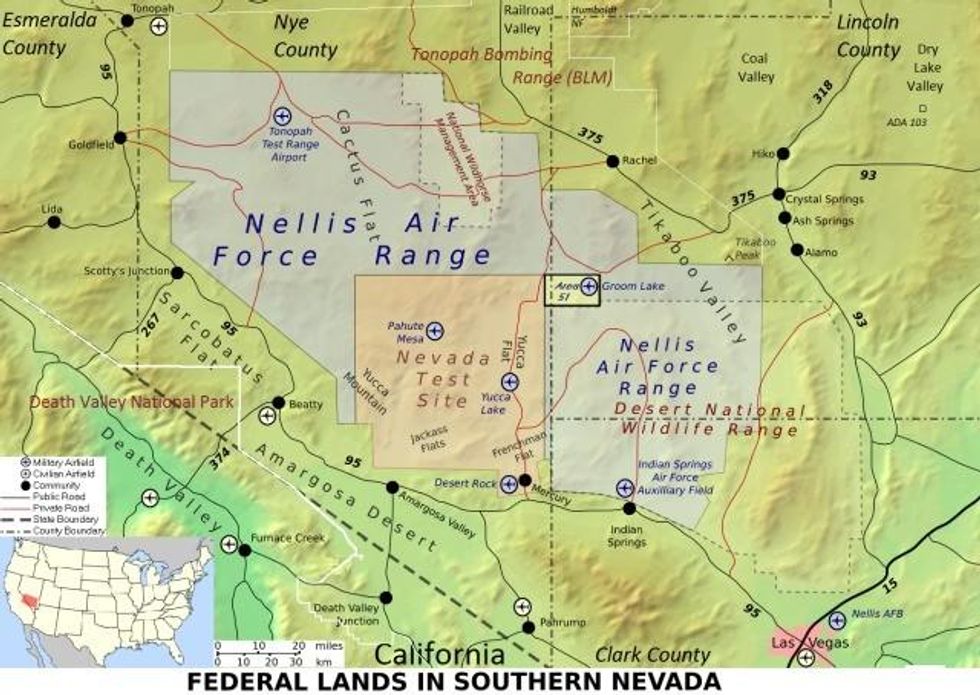
The U.S. House Armed Services Committee (HASC) added a rider late Wednesday evening to the National Defense Authorization Act (NDAA) that transfers control of more than half of Nevada's sprawling Desert National Wildlife Refuge to the U.S. Air Force.
"Here we go again on Desert National Wildlife Refuge," said Defenders of Wildlife president and CEO Jamie Rappaport Clark. "Another rider added last night undermines management of our largest national wildlife refuge in the lower 48 by transferring primary jurisdiction of more than 800,000 acres to the Air Force, a responsibility the Department of Defense has neither requested nor is necessary for continued training exercises on and adjacent to the refuge."
Committee members offered no explanation for the measure, and maps show that Air Force ranges are already within the refuge's borders.
The overreaching rider is part of a trend: this is only the latest attempt by the House Armed Services committee, long dominated by Republicans, to demolish endangered species protections through the NDAA, the annual "must-pass" legislation that authorizes annual military spending.
Indeed, last year the committee made the very same attempt to put the Air Force in charge of half of the Desert National Wildlife Refuge--but the rider was stripped from the bill before it was sent to the U.S. Senate.
Another damaging rider included in the bill "overturns a public planning process to conserve greater sage-grouse and blocks their protection under the Endangered Species Act (ESA) for at least a decade," writes Defenders of Wildlife. "Another rider passed as an amendment during the committee markup yesterday blocks ESA protections for the imperiled lesser prairie-chicken and the critically endangered American burying beetle."
Rappaport Clark decried the attempt to degrade wildlife protections:
The Department of Defense does not want these anti-wildlife riders and our men and women in uniform will not benefit from them. This is yet another assault on America's wildlife and conservation legacy by extractive industries and other extreme special interests. Last year, these controversial riders were sticking points that held up negotiations on the NDAA and these same interests are at it again. These opportunistic policy riders are a wasteful and disgraceful use of the legislative process that will further endanger imperiled species and, in the case of the sage-grouse, squander nearly $50 million spent on a broad scale federal conservation effort. Attacks on America's wildlife are un-American and do not belong in a defense authorization bill.
Department of Defense officials themselves sent letters to the HASC earlier this week assuring its members that the sage grouse poses no threats to military activity and should continue to be protected as an endangered species, Reuters reports, but it appears such appeals fell on deaf ears.
Democrat Niki Tsongas of Massachusetts made a last-minute attempt to add an amendment to the NDAA early Thursday morning that would have ensured the sage grouse keeps its protection under the Endangered Species Act, but Tsongas' proposal was voted down.
"We've seen proposed a parade of egregious anti-environmental riders that'd serve to undermine the crucial protections in place for our wildlife, our wild lands, and the climate" in NDAA negotiations in recent years, writes the Natural Resource Defense Council's Bobby McEnaney. "These activities show no signs of abating. [...] This should be an instrument to set defense policy, not wipe vulnerable species from the planet or transfer pristine public lands to private interests."
Besides attempting to destroy decades of conservation efforts, this year's NDAA also calls for an additional $18 billion in military spending and forces a "war-budget increase on the next presidential administration," Defense News reports, a measure Democratic Rep. Adam Smith of Washington described as "a very high-stakes game."
The NDAA is now headed to the House for a floor vote.
The U.S. House Armed Services Committee (HASC) added a rider late Wednesday evening to the National Defense Authorization Act (NDAA) that transfers control of more than half of Nevada's sprawling Desert National Wildlife Refuge to the U.S. Air Force.
"Here we go again on Desert National Wildlife Refuge," said Defenders of Wildlife president and CEO Jamie Rappaport Clark. "Another rider added last night undermines management of our largest national wildlife refuge in the lower 48 by transferring primary jurisdiction of more than 800,000 acres to the Air Force, a responsibility the Department of Defense has neither requested nor is necessary for continued training exercises on and adjacent to the refuge."
Committee members offered no explanation for the measure, and maps show that Air Force ranges are already within the refuge's borders.
The overreaching rider is part of a trend: this is only the latest attempt by the House Armed Services committee, long dominated by Republicans, to demolish endangered species protections through the NDAA, the annual "must-pass" legislation that authorizes annual military spending.
Indeed, last year the committee made the very same attempt to put the Air Force in charge of half of the Desert National Wildlife Refuge--but the rider was stripped from the bill before it was sent to the U.S. Senate.
Another damaging rider included in the bill "overturns a public planning process to conserve greater sage-grouse and blocks their protection under the Endangered Species Act (ESA) for at least a decade," writes Defenders of Wildlife. "Another rider passed as an amendment during the committee markup yesterday blocks ESA protections for the imperiled lesser prairie-chicken and the critically endangered American burying beetle."
Rappaport Clark decried the attempt to degrade wildlife protections:
The Department of Defense does not want these anti-wildlife riders and our men and women in uniform will not benefit from them. This is yet another assault on America's wildlife and conservation legacy by extractive industries and other extreme special interests. Last year, these controversial riders were sticking points that held up negotiations on the NDAA and these same interests are at it again. These opportunistic policy riders are a wasteful and disgraceful use of the legislative process that will further endanger imperiled species and, in the case of the sage-grouse, squander nearly $50 million spent on a broad scale federal conservation effort. Attacks on America's wildlife are un-American and do not belong in a defense authorization bill.
Department of Defense officials themselves sent letters to the HASC earlier this week assuring its members that the sage grouse poses no threats to military activity and should continue to be protected as an endangered species, Reuters reports, but it appears such appeals fell on deaf ears.
Democrat Niki Tsongas of Massachusetts made a last-minute attempt to add an amendment to the NDAA early Thursday morning that would have ensured the sage grouse keeps its protection under the Endangered Species Act, but Tsongas' proposal was voted down.
"We've seen proposed a parade of egregious anti-environmental riders that'd serve to undermine the crucial protections in place for our wildlife, our wild lands, and the climate" in NDAA negotiations in recent years, writes the Natural Resource Defense Council's Bobby McEnaney. "These activities show no signs of abating. [...] This should be an instrument to set defense policy, not wipe vulnerable species from the planet or transfer pristine public lands to private interests."
Besides attempting to destroy decades of conservation efforts, this year's NDAA also calls for an additional $18 billion in military spending and forces a "war-budget increase on the next presidential administration," Defense News reports, a measure Democratic Rep. Adam Smith of Washington described as "a very high-stakes game."
The NDAA is now headed to the House for a floor vote.
The U.S. House Armed Services Committee (HASC) added a rider late Wednesday evening to the National Defense Authorization Act (NDAA) that transfers control of more than half of Nevada's sprawling Desert National Wildlife Refuge to the U.S. Air Force.
"Here we go again on Desert National Wildlife Refuge," said Defenders of Wildlife president and CEO Jamie Rappaport Clark. "Another rider added last night undermines management of our largest national wildlife refuge in the lower 48 by transferring primary jurisdiction of more than 800,000 acres to the Air Force, a responsibility the Department of Defense has neither requested nor is necessary for continued training exercises on and adjacent to the refuge."
Committee members offered no explanation for the measure, and maps show that Air Force ranges are already within the refuge's borders.
The overreaching rider is part of a trend: this is only the latest attempt by the House Armed Services committee, long dominated by Republicans, to demolish endangered species protections through the NDAA, the annual "must-pass" legislation that authorizes annual military spending.
Indeed, last year the committee made the very same attempt to put the Air Force in charge of half of the Desert National Wildlife Refuge--but the rider was stripped from the bill before it was sent to the U.S. Senate.
Another damaging rider included in the bill "overturns a public planning process to conserve greater sage-grouse and blocks their protection under the Endangered Species Act (ESA) for at least a decade," writes Defenders of Wildlife. "Another rider passed as an amendment during the committee markup yesterday blocks ESA protections for the imperiled lesser prairie-chicken and the critically endangered American burying beetle."
Rappaport Clark decried the attempt to degrade wildlife protections:
The Department of Defense does not want these anti-wildlife riders and our men and women in uniform will not benefit from them. This is yet another assault on America's wildlife and conservation legacy by extractive industries and other extreme special interests. Last year, these controversial riders were sticking points that held up negotiations on the NDAA and these same interests are at it again. These opportunistic policy riders are a wasteful and disgraceful use of the legislative process that will further endanger imperiled species and, in the case of the sage-grouse, squander nearly $50 million spent on a broad scale federal conservation effort. Attacks on America's wildlife are un-American and do not belong in a defense authorization bill.
Department of Defense officials themselves sent letters to the HASC earlier this week assuring its members that the sage grouse poses no threats to military activity and should continue to be protected as an endangered species, Reuters reports, but it appears such appeals fell on deaf ears.
Democrat Niki Tsongas of Massachusetts made a last-minute attempt to add an amendment to the NDAA early Thursday morning that would have ensured the sage grouse keeps its protection under the Endangered Species Act, but Tsongas' proposal was voted down.
"We've seen proposed a parade of egregious anti-environmental riders that'd serve to undermine the crucial protections in place for our wildlife, our wild lands, and the climate" in NDAA negotiations in recent years, writes the Natural Resource Defense Council's Bobby McEnaney. "These activities show no signs of abating. [...] This should be an instrument to set defense policy, not wipe vulnerable species from the planet or transfer pristine public lands to private interests."
Besides attempting to destroy decades of conservation efforts, this year's NDAA also calls for an additional $18 billion in military spending and forces a "war-budget increase on the next presidential administration," Defense News reports, a measure Democratic Rep. Adam Smith of Washington described as "a very high-stakes game."
The NDAA is now headed to the House for a floor vote.