SUBSCRIBE TO OUR FREE NEWSLETTER
Daily news & progressive opinion—funded by the people, not the corporations—delivered straight to your inbox.
5
#000000
#FFFFFF
To donate by check, phone, or other method, see our More Ways to Give page.
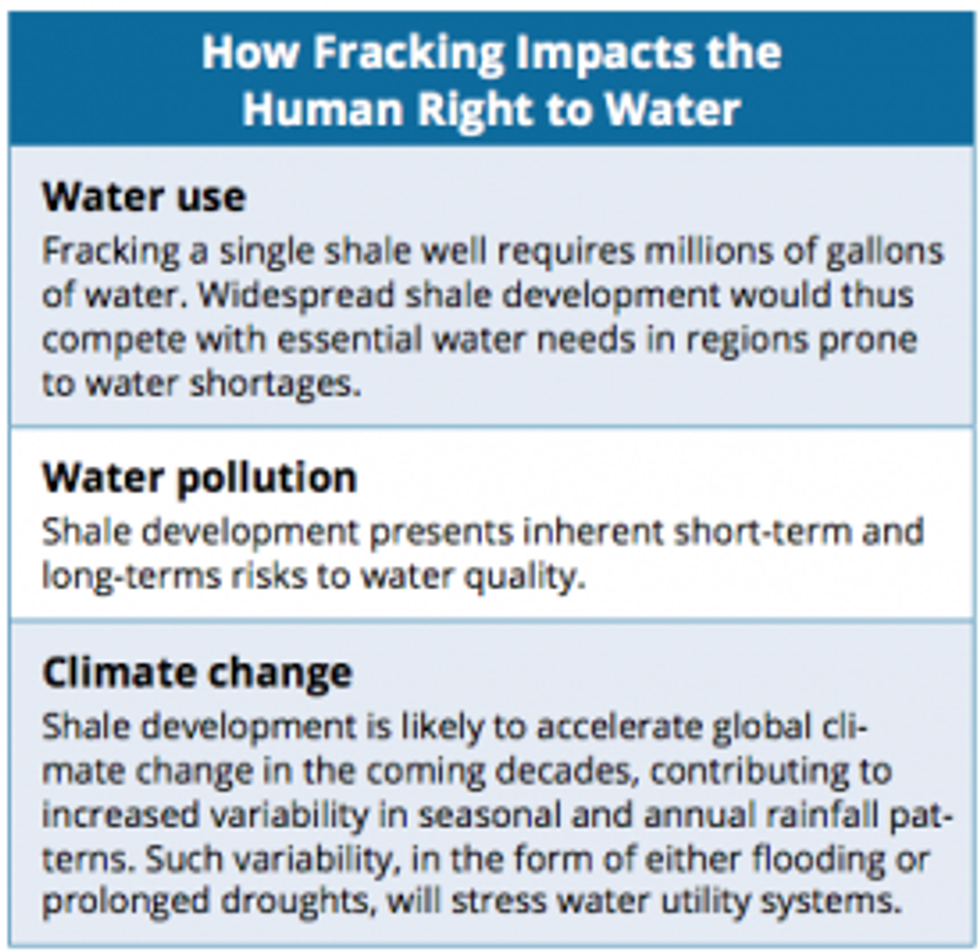
As the oil and gas industry heads more towards hydraulic fracturing, also known as fracking, to access resources, a new report out today from Food & Water Watch states that the process may become a global environmental and public health threat. Numerous communities in the U.S. where fracking has occurred have suffered long-term damage to their public water, as gas and oil companies leave a legacy of carcinogens and climate damage in their wake. The group says that the worldwide community must heed the warnings out of stricken communities in the U.S. and ban the practice.
Wenonah Hauter, Executive Director of Food & Water Watch, states:
"Fracking is a dangerous American export that should be viewed critically by countries just starting to engage in the practice. Modern drilling and fracking have caused widespread environmental and public health problems, as well as posed serious, long-term risks to vital water resources."
"While the oil and gas industry is profiting off of this technology, it has been a disaster for Americans exposed to its pollution. They have dealt with everything from mysterious ailments likely caused by hazardous air pollution to well water contamination that has left rural communities unable to use their water for washing, brushing their teeth or cooking--much less drinking," adds Hauter. "Does the rest of the world want to live this nightmare?"
In 2009, Pennsylvania regulators ordered the Cabot Oil and Gas Corporation to cease all fracking in Susquehanna County after three spills at one well within a week polluted a wetland and caused a fishkill in a local creek. The spills leaked 8,420 gallons of fracking fluid containing a Halliburton-manufactured lubricant that is a potential carcinogen. Fracking had so polluted water wells that some families could no longer drink from their taps. Pennsylvania fined Cabot more than $240,000, but it cost more than $10 million to transport safe water to the affected homeowners. In December 2010, Cabot paid $4.1 million to 19 families that contended that Cabot's fracking had contaminated their groundwater with methane. In 2012, the U.S. EPA began providing clean drinking water to these families after Cabot had been released of its obligation to do so by the state of Pennsylvania.
Fracking pollution hasn't been limited to water; it has also caused air pollution near fracking sites, the report states:
Hazardous air pollutants found near fracking sites include methanol, formaldehyde and carbon disulfide. Volatile organic compounds, including nitrogen oxides, benzene and toluene, are also discharged during fracking. These compounds mix with emissions from heavy-duty truck traffic, large generators and compressors at well sites to form ground-level ozone that can, in turn, combine with particulate matter to form smog. [...]
In Wyoming, drilling and fracking have caused ground-level ozone pollution to exceed amounts recorded in Los Angeles, affecting the quality of life for Wyoming residents.
Methane, a key greenhouse gas, is also implicated in fracking, showing that heading towards fracking means heading toward more climate change:
Recent scientific studies have demonstrated that, due to the amount of fugitive methane released during modern shale gas development as compared to during conventional gas development, any increased use of shale gas instead of coal may actually accelerate climate change in the coming decades, not reduce climate change impacts.
Food & Water Watch shows that the natural gas and oil industry have had their eyes worldwide to expand fracking, with some countries showing tremendous resistance to it:
[C]ountries around the world are grappling with how to address the push to drill and frack. In Europe, whileFrance and Bulgaria have banned fracking in the face of strong public opposition, Poland has welcomed the industry. In China and Argentina, shale gas extraction is being developed with government support. In South Africa, pending an environmental review, a subsidiary of Royal Dutch Shell may be granted permission to extract shale gas.
These countries would be wise, Food & Watch believes, to learn the lessons of communities in the U.S. that have had their water and environment damaged by fracking.
The report concludes:
Taken together, spills of toxic fracking fluid and fracking wastewater, water well contamination from the underground migration of methane and toxic fracking fluid, local and regional air pollution problems from shale development, explosions at the sites of shale wells, and substantial emissions of the global warming pollutant methane during drilling and fracking make the dangers of shale development clear.
Countries not yet exposed to the risks and costs of drilling and fracking have an opportunity to choose a different path, one that "meets the needs of the present without compromising the ability of future generations to meet their own needs." Enacting a national ban on fracking and investing in the deployment of energy efficiency and renewable energy technologies will set a sustainable course.
As the oil and gas industry heads more towards hydraulic fracturing, also known as fracking, to access resources, a new report out today from Food & Water Watch states that the process may become a global environmental and public health threat. Numerous communities in the U.S. where fracking has occurred have suffered long-term damage to their public water, as gas and oil companies leave a legacy of carcinogens and climate damage in their wake. The group says that the worldwide community must heed the warnings out of stricken communities in the U.S. and ban the practice.
Wenonah Hauter, Executive Director of Food & Water Watch, states:
"Fracking is a dangerous American export that should be viewed critically by countries just starting to engage in the practice. Modern drilling and fracking have caused widespread environmental and public health problems, as well as posed serious, long-term risks to vital water resources."
"While the oil and gas industry is profiting off of this technology, it has been a disaster for Americans exposed to its pollution. They have dealt with everything from mysterious ailments likely caused by hazardous air pollution to well water contamination that has left rural communities unable to use their water for washing, brushing their teeth or cooking--much less drinking," adds Hauter. "Does the rest of the world want to live this nightmare?"
In 2009, Pennsylvania regulators ordered the Cabot Oil and Gas Corporation to cease all fracking in Susquehanna County after three spills at one well within a week polluted a wetland and caused a fishkill in a local creek. The spills leaked 8,420 gallons of fracking fluid containing a Halliburton-manufactured lubricant that is a potential carcinogen. Fracking had so polluted water wells that some families could no longer drink from their taps. Pennsylvania fined Cabot more than $240,000, but it cost more than $10 million to transport safe water to the affected homeowners. In December 2010, Cabot paid $4.1 million to 19 families that contended that Cabot's fracking had contaminated their groundwater with methane. In 2012, the U.S. EPA began providing clean drinking water to these families after Cabot had been released of its obligation to do so by the state of Pennsylvania.
Fracking pollution hasn't been limited to water; it has also caused air pollution near fracking sites, the report states:
Hazardous air pollutants found near fracking sites include methanol, formaldehyde and carbon disulfide. Volatile organic compounds, including nitrogen oxides, benzene and toluene, are also discharged during fracking. These compounds mix with emissions from heavy-duty truck traffic, large generators and compressors at well sites to form ground-level ozone that can, in turn, combine with particulate matter to form smog. [...]
In Wyoming, drilling and fracking have caused ground-level ozone pollution to exceed amounts recorded in Los Angeles, affecting the quality of life for Wyoming residents.
Methane, a key greenhouse gas, is also implicated in fracking, showing that heading towards fracking means heading toward more climate change:
Recent scientific studies have demonstrated that, due to the amount of fugitive methane released during modern shale gas development as compared to during conventional gas development, any increased use of shale gas instead of coal may actually accelerate climate change in the coming decades, not reduce climate change impacts.
Food & Water Watch shows that the natural gas and oil industry have had their eyes worldwide to expand fracking, with some countries showing tremendous resistance to it:
[C]ountries around the world are grappling with how to address the push to drill and frack. In Europe, whileFrance and Bulgaria have banned fracking in the face of strong public opposition, Poland has welcomed the industry. In China and Argentina, shale gas extraction is being developed with government support. In South Africa, pending an environmental review, a subsidiary of Royal Dutch Shell may be granted permission to extract shale gas.
These countries would be wise, Food & Watch believes, to learn the lessons of communities in the U.S. that have had their water and environment damaged by fracking.
The report concludes:
Taken together, spills of toxic fracking fluid and fracking wastewater, water well contamination from the underground migration of methane and toxic fracking fluid, local and regional air pollution problems from shale development, explosions at the sites of shale wells, and substantial emissions of the global warming pollutant methane during drilling and fracking make the dangers of shale development clear.
Countries not yet exposed to the risks and costs of drilling and fracking have an opportunity to choose a different path, one that "meets the needs of the present without compromising the ability of future generations to meet their own needs." Enacting a national ban on fracking and investing in the deployment of energy efficiency and renewable energy technologies will set a sustainable course.
As the oil and gas industry heads more towards hydraulic fracturing, also known as fracking, to access resources, a new report out today from Food & Water Watch states that the process may become a global environmental and public health threat. Numerous communities in the U.S. where fracking has occurred have suffered long-term damage to their public water, as gas and oil companies leave a legacy of carcinogens and climate damage in their wake. The group says that the worldwide community must heed the warnings out of stricken communities in the U.S. and ban the practice.
Wenonah Hauter, Executive Director of Food & Water Watch, states:
"Fracking is a dangerous American export that should be viewed critically by countries just starting to engage in the practice. Modern drilling and fracking have caused widespread environmental and public health problems, as well as posed serious, long-term risks to vital water resources."
"While the oil and gas industry is profiting off of this technology, it has been a disaster for Americans exposed to its pollution. They have dealt with everything from mysterious ailments likely caused by hazardous air pollution to well water contamination that has left rural communities unable to use their water for washing, brushing their teeth or cooking--much less drinking," adds Hauter. "Does the rest of the world want to live this nightmare?"
In 2009, Pennsylvania regulators ordered the Cabot Oil and Gas Corporation to cease all fracking in Susquehanna County after three spills at one well within a week polluted a wetland and caused a fishkill in a local creek. The spills leaked 8,420 gallons of fracking fluid containing a Halliburton-manufactured lubricant that is a potential carcinogen. Fracking had so polluted water wells that some families could no longer drink from their taps. Pennsylvania fined Cabot more than $240,000, but it cost more than $10 million to transport safe water to the affected homeowners. In December 2010, Cabot paid $4.1 million to 19 families that contended that Cabot's fracking had contaminated their groundwater with methane. In 2012, the U.S. EPA began providing clean drinking water to these families after Cabot had been released of its obligation to do so by the state of Pennsylvania.
Fracking pollution hasn't been limited to water; it has also caused air pollution near fracking sites, the report states:
Hazardous air pollutants found near fracking sites include methanol, formaldehyde and carbon disulfide. Volatile organic compounds, including nitrogen oxides, benzene and toluene, are also discharged during fracking. These compounds mix with emissions from heavy-duty truck traffic, large generators and compressors at well sites to form ground-level ozone that can, in turn, combine with particulate matter to form smog. [...]
In Wyoming, drilling and fracking have caused ground-level ozone pollution to exceed amounts recorded in Los Angeles, affecting the quality of life for Wyoming residents.
Methane, a key greenhouse gas, is also implicated in fracking, showing that heading towards fracking means heading toward more climate change:
Recent scientific studies have demonstrated that, due to the amount of fugitive methane released during modern shale gas development as compared to during conventional gas development, any increased use of shale gas instead of coal may actually accelerate climate change in the coming decades, not reduce climate change impacts.
Food & Water Watch shows that the natural gas and oil industry have had their eyes worldwide to expand fracking, with some countries showing tremendous resistance to it:
[C]ountries around the world are grappling with how to address the push to drill and frack. In Europe, whileFrance and Bulgaria have banned fracking in the face of strong public opposition, Poland has welcomed the industry. In China and Argentina, shale gas extraction is being developed with government support. In South Africa, pending an environmental review, a subsidiary of Royal Dutch Shell may be granted permission to extract shale gas.
These countries would be wise, Food & Watch believes, to learn the lessons of communities in the U.S. that have had their water and environment damaged by fracking.
The report concludes:
Taken together, spills of toxic fracking fluid and fracking wastewater, water well contamination from the underground migration of methane and toxic fracking fluid, local and regional air pollution problems from shale development, explosions at the sites of shale wells, and substantial emissions of the global warming pollutant methane during drilling and fracking make the dangers of shale development clear.
Countries not yet exposed to the risks and costs of drilling and fracking have an opportunity to choose a different path, one that "meets the needs of the present without compromising the ability of future generations to meet their own needs." Enacting a national ban on fracking and investing in the deployment of energy efficiency and renewable energy technologies will set a sustainable course.