SUBSCRIBE TO OUR FREE NEWSLETTER
Daily news & progressive opinion—funded by the people, not the corporations—delivered straight to your inbox.
5
#000000
#FFFFFF
To donate by check, phone, or other method, see our More Ways to Give page.
Daily news & progressive opinion—funded by the people, not the corporations—delivered straight to your inbox.
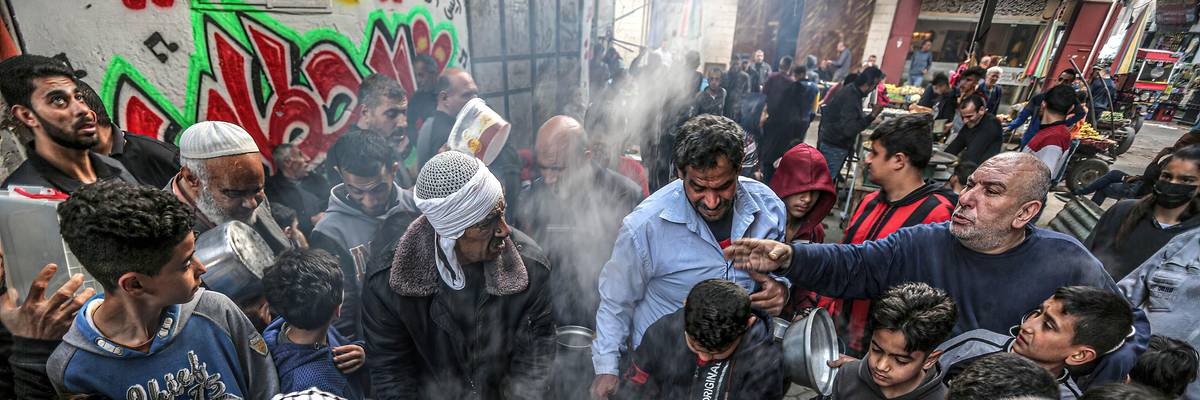
Palestinians receive free soup during Ramadan at the Shejaiya neighborhood in Gaza City. (Photo: Yousef Masoud/SOPA Images/LightRocket via Getty Images)
A friend, a young journalist in Gaza, Mohammed Rafik Mhawesh, told me that food prices in the besieged Strip have skyrocketed in recent weeks and that many already impoverished families are struggling to put food on the table.
Gaza has been under an Israeli economic blockade for many years, and food that Israel allows to the Strip is rationed and manipulated by Israel as an act of collective punishment.
"Food prices are dramatically surging," he said, "particularly since the beginning of the Russia-Ukraine war." Essential food prices, like wheat and meat, have nearly doubled. The price of a chicken, for example, which was only accessible to a small segment of Gaza's population, has increased from 20 shekels (approx. $6) to 45 (approx. $14).
These price hikes may seem manageable in some parts of the world but in an already impoverished place, which has been under a hermetic Israeli military siege for 15 years, a humanitarian crisis of great proportions is certainly forthcoming.
In fact, this was also the warning of the international charity group Oxfam, which on April 11 reported that food prices throughout Palestine jumped by 25% but, more alarmingly, wheat flour reserves in the Occupied Territories could be "exhausted within three weeks."
The impact of the Russia-Ukraine war has been felt in every part of the world, some places more than others. African and Middle Eastern countries, which have been battling pre-existing problems of poverty, hunger and unemployment, are most affected. However, Palestine is a whole different story. It is an occupied country that is almost entirely reliant on the action of an occupying power, Israel, which refuses to adhere to international and humanitarian laws.
For Palestinians the issue is complex, yet almost every aspect of it is somehow linked to Israel.
Gaza has been under an Israeli economic blockade for many years, and food that Israel allows to the Strip is rationed and manipulated by Israel as an act of collective punishment. In its report on Israeli apartheid published last February, Amnesty International detailed Israeli restrictions on Palestinian food and gas supplies. According to the rights group, Israel uses "mathematical formulas to determine how much food to allow into Gaza", limiting supplies to what Tel Aviv deems "essential for the survival of the civilian population".
Aside from many infrastructure issues resulting from the siege--lack of clean water, electricity, farming equipment, etc.--Gaza has also lost much of its arable land to the Israeli military zone established across border areas throughout the Strip.
The West Bank is not much better off. Most Palestinians in the Occupied Territories are feeling the growing burden--the Israeli occupation, compounded with the devastating impact of the Covid-19 pandemic and structural weaknesses within the Palestinian Authority, rife with corruption and mismanagement.
The PA imports 95% of its wheat, Oxfam says, and owns no storage facilities whatsoever. All of such imports are transported via Israel, which controls all of Palestine's access to the outside world. Since Israel itself imports nearly half of its grains and cereals from Ukraine, Palestinians are, therefore, hostage to this very mechanism.
Israel, however, has been amassing food and is largely energy independent, while Palestinians are struggling at all levels. While the PA should shoulder part of the blame for investing in its 'security' apparatus at the expense of food security, Israel holds most of the keys to Palestinian survival.
With hundreds of Israeli military checkpoints dotting the occupied West Bank, cutting off communities from one another and farmers from agricultural land, sustainable agriculture in Palestine is nearly impossible.
Two major issues complicate an already difficult picture: one, the hundreds of kilometers long so-called 'Separation Wall', which actually does not 'separate' between Israelis and Palestinians but, instead, unlawfully deprives Palestinians from large tracts of their land, mostly farming areas; and two, the outright robbery of Palestinian water from the West Bank's acquifers. While many Palestinian communities struggle to find drinking water in the summer, Israel never experiences any water shortage throughout the year.
So-called Area C, which constitutes nearly 60% of the total size of the West Bank, is under complete Israeli military control. Though sparsely populated in comparison, it contains most of the region's agricultural land, especially areas located in the very fertile Jordan Valley. Though Israel has postponed, under international pressure, its official annexation of Area C, the area is practically annexed, and Palestinians are slowly being driven out and replaced by a growing population of illegal Israeli Jewish settlers.
The rapidly rising food prices are hurting the very farmers and herders who are responsible for filling the massive gaps caused by the global food insecurity as a result of war. According to Oxfam, the cost of animal feed is up by 60% in the West Bank, which adds to the "existing burden" faced by herders, including "worsening violent attacks by Israeli settlers" and "forced displacement", as in ethnic cleansing resulting from Israeli annexation policies.
Though it may bring partial relief, even a halt to the Russia-Ukraine war will not end Palestine's food insecurity, as this issue is instigated and prolonged by specific Israeli policies. In the case of Gaza, the crisis is, in fact, fully manufactured by Israel with specific political designs in mind. The infamous comments by former Israeli government advisor, Dov Weisglass in 2006, explaining Israel's motives behind the siege on Gaza, remain the guiding principle of Israel's attitude towards the Strip. "The idea is to put the Palestinians on a diet, but not to make them die of hunger," he said.
Palestine needs immediate attention to stave off a major food crisis. Gaza's pre-existing extreme poverty and high unemployment leaves it with no margins whatsoever to accommodate any more calamities. However, anything done now can only be a short-term fix. A serious conversation involving Palestinians, Arab countries, the United Nations Food and Agriculture Organization and other parties must take place to discuss and resolve Palestine's food insecurity. For Palestinians, this is the real existential threat.
Dear Common Dreams reader, It’s been nearly 30 years since I co-founded Common Dreams with my late wife, Lina Newhouser. We had the radical notion that journalism should serve the public good, not corporate profits. It was clear to us from the outset what it would take to build such a project. No paid advertisements. No corporate sponsors. No millionaire publisher telling us what to think or do. Many people said we wouldn't last a year, but we proved those doubters wrong. Together with a tremendous team of journalists and dedicated staff, we built an independent media outlet free from the constraints of profits and corporate control. Our mission has always been simple: To inform. To inspire. To ignite change for the common good. Building Common Dreams was not easy. Our survival was never guaranteed. When you take on the most powerful forces—Wall Street greed, fossil fuel industry destruction, Big Tech lobbyists, and uber-rich oligarchs who have spent billions upon billions rigging the economy and democracy in their favor—the only bulwark you have is supporters who believe in your work. But here’s the urgent message from me today. It's never been this bad out there. And it's never been this hard to keep us going. At the very moment Common Dreams is most needed, the threats we face are intensifying. We need your support now more than ever. We don't accept corporate advertising and never will. We don't have a paywall because we don't think people should be blocked from critical news based on their ability to pay. Everything we do is funded by the donations of readers like you. When everyone does the little they can afford, we are strong. But if that support retreats or dries up, so do we. Will you donate now to make sure Common Dreams not only survives but thrives? —Craig Brown, Co-founder |
A friend, a young journalist in Gaza, Mohammed Rafik Mhawesh, told me that food prices in the besieged Strip have skyrocketed in recent weeks and that many already impoverished families are struggling to put food on the table.
Gaza has been under an Israeli economic blockade for many years, and food that Israel allows to the Strip is rationed and manipulated by Israel as an act of collective punishment.
"Food prices are dramatically surging," he said, "particularly since the beginning of the Russia-Ukraine war." Essential food prices, like wheat and meat, have nearly doubled. The price of a chicken, for example, which was only accessible to a small segment of Gaza's population, has increased from 20 shekels (approx. $6) to 45 (approx. $14).
These price hikes may seem manageable in some parts of the world but in an already impoverished place, which has been under a hermetic Israeli military siege for 15 years, a humanitarian crisis of great proportions is certainly forthcoming.
In fact, this was also the warning of the international charity group Oxfam, which on April 11 reported that food prices throughout Palestine jumped by 25% but, more alarmingly, wheat flour reserves in the Occupied Territories could be "exhausted within three weeks."
The impact of the Russia-Ukraine war has been felt in every part of the world, some places more than others. African and Middle Eastern countries, which have been battling pre-existing problems of poverty, hunger and unemployment, are most affected. However, Palestine is a whole different story. It is an occupied country that is almost entirely reliant on the action of an occupying power, Israel, which refuses to adhere to international and humanitarian laws.
For Palestinians the issue is complex, yet almost every aspect of it is somehow linked to Israel.
Gaza has been under an Israeli economic blockade for many years, and food that Israel allows to the Strip is rationed and manipulated by Israel as an act of collective punishment. In its report on Israeli apartheid published last February, Amnesty International detailed Israeli restrictions on Palestinian food and gas supplies. According to the rights group, Israel uses "mathematical formulas to determine how much food to allow into Gaza", limiting supplies to what Tel Aviv deems "essential for the survival of the civilian population".
Aside from many infrastructure issues resulting from the siege--lack of clean water, electricity, farming equipment, etc.--Gaza has also lost much of its arable land to the Israeli military zone established across border areas throughout the Strip.
The West Bank is not much better off. Most Palestinians in the Occupied Territories are feeling the growing burden--the Israeli occupation, compounded with the devastating impact of the Covid-19 pandemic and structural weaknesses within the Palestinian Authority, rife with corruption and mismanagement.
The PA imports 95% of its wheat, Oxfam says, and owns no storage facilities whatsoever. All of such imports are transported via Israel, which controls all of Palestine's access to the outside world. Since Israel itself imports nearly half of its grains and cereals from Ukraine, Palestinians are, therefore, hostage to this very mechanism.
Israel, however, has been amassing food and is largely energy independent, while Palestinians are struggling at all levels. While the PA should shoulder part of the blame for investing in its 'security' apparatus at the expense of food security, Israel holds most of the keys to Palestinian survival.
With hundreds of Israeli military checkpoints dotting the occupied West Bank, cutting off communities from one another and farmers from agricultural land, sustainable agriculture in Palestine is nearly impossible.
Two major issues complicate an already difficult picture: one, the hundreds of kilometers long so-called 'Separation Wall', which actually does not 'separate' between Israelis and Palestinians but, instead, unlawfully deprives Palestinians from large tracts of their land, mostly farming areas; and two, the outright robbery of Palestinian water from the West Bank's acquifers. While many Palestinian communities struggle to find drinking water in the summer, Israel never experiences any water shortage throughout the year.
So-called Area C, which constitutes nearly 60% of the total size of the West Bank, is under complete Israeli military control. Though sparsely populated in comparison, it contains most of the region's agricultural land, especially areas located in the very fertile Jordan Valley. Though Israel has postponed, under international pressure, its official annexation of Area C, the area is practically annexed, and Palestinians are slowly being driven out and replaced by a growing population of illegal Israeli Jewish settlers.
The rapidly rising food prices are hurting the very farmers and herders who are responsible for filling the massive gaps caused by the global food insecurity as a result of war. According to Oxfam, the cost of animal feed is up by 60% in the West Bank, which adds to the "existing burden" faced by herders, including "worsening violent attacks by Israeli settlers" and "forced displacement", as in ethnic cleansing resulting from Israeli annexation policies.
Though it may bring partial relief, even a halt to the Russia-Ukraine war will not end Palestine's food insecurity, as this issue is instigated and prolonged by specific Israeli policies. In the case of Gaza, the crisis is, in fact, fully manufactured by Israel with specific political designs in mind. The infamous comments by former Israeli government advisor, Dov Weisglass in 2006, explaining Israel's motives behind the siege on Gaza, remain the guiding principle of Israel's attitude towards the Strip. "The idea is to put the Palestinians on a diet, but not to make them die of hunger," he said.
Palestine needs immediate attention to stave off a major food crisis. Gaza's pre-existing extreme poverty and high unemployment leaves it with no margins whatsoever to accommodate any more calamities. However, anything done now can only be a short-term fix. A serious conversation involving Palestinians, Arab countries, the United Nations Food and Agriculture Organization and other parties must take place to discuss and resolve Palestine's food insecurity. For Palestinians, this is the real existential threat.
A friend, a young journalist in Gaza, Mohammed Rafik Mhawesh, told me that food prices in the besieged Strip have skyrocketed in recent weeks and that many already impoverished families are struggling to put food on the table.
Gaza has been under an Israeli economic blockade for many years, and food that Israel allows to the Strip is rationed and manipulated by Israel as an act of collective punishment.
"Food prices are dramatically surging," he said, "particularly since the beginning of the Russia-Ukraine war." Essential food prices, like wheat and meat, have nearly doubled. The price of a chicken, for example, which was only accessible to a small segment of Gaza's population, has increased from 20 shekels (approx. $6) to 45 (approx. $14).
These price hikes may seem manageable in some parts of the world but in an already impoverished place, which has been under a hermetic Israeli military siege for 15 years, a humanitarian crisis of great proportions is certainly forthcoming.
In fact, this was also the warning of the international charity group Oxfam, which on April 11 reported that food prices throughout Palestine jumped by 25% but, more alarmingly, wheat flour reserves in the Occupied Territories could be "exhausted within three weeks."
The impact of the Russia-Ukraine war has been felt in every part of the world, some places more than others. African and Middle Eastern countries, which have been battling pre-existing problems of poverty, hunger and unemployment, are most affected. However, Palestine is a whole different story. It is an occupied country that is almost entirely reliant on the action of an occupying power, Israel, which refuses to adhere to international and humanitarian laws.
For Palestinians the issue is complex, yet almost every aspect of it is somehow linked to Israel.
Gaza has been under an Israeli economic blockade for many years, and food that Israel allows to the Strip is rationed and manipulated by Israel as an act of collective punishment. In its report on Israeli apartheid published last February, Amnesty International detailed Israeli restrictions on Palestinian food and gas supplies. According to the rights group, Israel uses "mathematical formulas to determine how much food to allow into Gaza", limiting supplies to what Tel Aviv deems "essential for the survival of the civilian population".
Aside from many infrastructure issues resulting from the siege--lack of clean water, electricity, farming equipment, etc.--Gaza has also lost much of its arable land to the Israeli military zone established across border areas throughout the Strip.
The West Bank is not much better off. Most Palestinians in the Occupied Territories are feeling the growing burden--the Israeli occupation, compounded with the devastating impact of the Covid-19 pandemic and structural weaknesses within the Palestinian Authority, rife with corruption and mismanagement.
The PA imports 95% of its wheat, Oxfam says, and owns no storage facilities whatsoever. All of such imports are transported via Israel, which controls all of Palestine's access to the outside world. Since Israel itself imports nearly half of its grains and cereals from Ukraine, Palestinians are, therefore, hostage to this very mechanism.
Israel, however, has been amassing food and is largely energy independent, while Palestinians are struggling at all levels. While the PA should shoulder part of the blame for investing in its 'security' apparatus at the expense of food security, Israel holds most of the keys to Palestinian survival.
With hundreds of Israeli military checkpoints dotting the occupied West Bank, cutting off communities from one another and farmers from agricultural land, sustainable agriculture in Palestine is nearly impossible.
Two major issues complicate an already difficult picture: one, the hundreds of kilometers long so-called 'Separation Wall', which actually does not 'separate' between Israelis and Palestinians but, instead, unlawfully deprives Palestinians from large tracts of their land, mostly farming areas; and two, the outright robbery of Palestinian water from the West Bank's acquifers. While many Palestinian communities struggle to find drinking water in the summer, Israel never experiences any water shortage throughout the year.
So-called Area C, which constitutes nearly 60% of the total size of the West Bank, is under complete Israeli military control. Though sparsely populated in comparison, it contains most of the region's agricultural land, especially areas located in the very fertile Jordan Valley. Though Israel has postponed, under international pressure, its official annexation of Area C, the area is practically annexed, and Palestinians are slowly being driven out and replaced by a growing population of illegal Israeli Jewish settlers.
The rapidly rising food prices are hurting the very farmers and herders who are responsible for filling the massive gaps caused by the global food insecurity as a result of war. According to Oxfam, the cost of animal feed is up by 60% in the West Bank, which adds to the "existing burden" faced by herders, including "worsening violent attacks by Israeli settlers" and "forced displacement", as in ethnic cleansing resulting from Israeli annexation policies.
Though it may bring partial relief, even a halt to the Russia-Ukraine war will not end Palestine's food insecurity, as this issue is instigated and prolonged by specific Israeli policies. In the case of Gaza, the crisis is, in fact, fully manufactured by Israel with specific political designs in mind. The infamous comments by former Israeli government advisor, Dov Weisglass in 2006, explaining Israel's motives behind the siege on Gaza, remain the guiding principle of Israel's attitude towards the Strip. "The idea is to put the Palestinians on a diet, but not to make them die of hunger," he said.
Palestine needs immediate attention to stave off a major food crisis. Gaza's pre-existing extreme poverty and high unemployment leaves it with no margins whatsoever to accommodate any more calamities. However, anything done now can only be a short-term fix. A serious conversation involving Palestinians, Arab countries, the United Nations Food and Agriculture Organization and other parties must take place to discuss and resolve Palestine's food insecurity. For Palestinians, this is the real existential threat.