SUBSCRIBE TO OUR FREE NEWSLETTER
Daily news & progressive opinion—funded by the people, not the corporations—delivered straight to your inbox.
5
#000000
#FFFFFF
To donate by check, phone, or other method, see our More Ways to Give page.
Daily news & progressive opinion—funded by the people, not the corporations—delivered straight to your inbox.
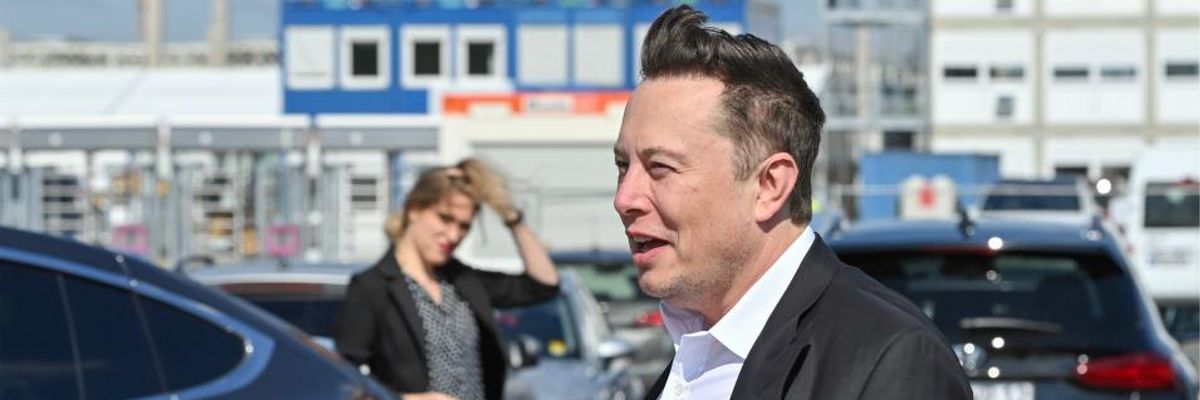
Billionaire Elon Musk, founder of Tesla and currently the world's richest person with an estimated fortune of $220 billion, pictured in 2020. (Photo: Patrick Pleul/dpa-Zentralbild/ZB)
We are in a historic (and potentially very brief!) political moment when progressives have a real shot at winning a path-breaking tax on the nation's super-wealthy.
"The 400 wealthiest U.S. billionaires paid an average income tax rate of just 8 percent between 2010 and 2018, much lower than most teachers and firefighters."
Just over the past week, a billionaire wealth tax proposal has suddenly moved from the edge to the very center of the negotiating table for President Biden's sweeping Build Back Better agenda.
What explains the shift? The reasons are both negative and positive.
On the negative side: Kyrsten Sinema.
Last week, the Arizona Senator took a break from high-roller fundraising to inform her colleagues that she opposes even partially undoing the tax rate cuts on corporations and wealthy individuals that Republicans enacted (and she voted against) in 2017. This sent Democrats scrambling for new revenue sources, and Senator Elizabeth Warren and others are sounding optimistic that Sinema might be open to a billionaire tax.
Again on the negative side: pandemic profiteering.
U.S. billionaires have run wild during the crisis, making themselves nearly impossible to defend. Since March 2020, their combined wealth has ballooned by over $2.1 trillion, a gain of 70 percent, according to research by Americans for Tax Fairness and the Institute for Policy Studies. And instead of deploying their fortunes for good on this planet, billionaires have captured headlines with their outer space adventures.
In the positive side: activists taking on the billionaire class.
Many groups that once focused exclusively on poverty are now tackling the top end of the inequality problem and demanding that the rich pay their fair share of expanded child tax credits, universal pre-K, affordable home care, and the many other vital investments in the Build Back Better plan.
Poor People's Campaign Co-Chair Rev. William J. Barber II, for example, recently excoriated Senator Joe Manchin for denigrating proposed education and health care investments for low-income Americans as wasteful "entitlements" while "treating billionaires like they have the entitlement to make $2 trillion during the pandemic."
Again on the positive side: explosive investigative research.
An avalanche of new data underscores the need for a tax crackdown on the ultra-wealthy. A new Bloomberg blockbuster shows how Nike founder Phil Knight's tax games have shrunk his IRS bills by the billions. ProPublica revealed earlier this year that America's two richest men -- Jeff Bezos and Elon Musk -- have paid zero in federal income taxes some years. And White House economists recently reported that the 400 wealthiest U.S. billionaires paid an average income tax rate of just 8 percent between 2010 and 2018, much lower than most teachers and firefighters.
So how would a billionaire wealth tax work?
Senate Finance Chair Ron Wyden is expected to release the details shortly, but we know that his plan makes billionaires pay annual taxes on their increased wealth. This is key, since the ultra-rich get the vast bulk of their money from investments rather than from paychecks like most of the rest of us.
The tax is expected to target people with $1 billion in assets or more than $100 million in income three years in a row. Every year the tiny fraction of Americans in this elite group would pay a tax on the increase in value of stock and other tradable financial assets. They would owe a tax on gains from real estate and other less liquid assets when they sell them, along with annual interest fees.
The proposal could raise hundreds of billions of dollars over a decade but not enough to cover the full Build Back Better plan. Given our country's many pressing needs, we must keep up the heat on conservative Democrats to embrace a full fair tax toolbox. These should include raising top income and corporate tax rates, closing loopholes, and other innovative reforms on the table, such as a surtax on mega-millionaires and excise taxes to discourage excessive CEO pay and wasteful corporate stock buybacks.
But the billionaire wealth tax merits an extra push since it is the most powerful tool on the table for tackling the wealthy inequality that is undermining our economy and threatening our democracy. Americans for Tax Fairness has set up a handy one-stop site with billionaire tax fact sheets, polling, and other action tools.
Democratic leaders are saying that such a tax is "likely" to be in the Build Back Better legislation. But lobbyists for the ultra-rich will be fighting to whack it out before the final votes, which could come as soon as this week.
The window is narrow. But it is open.
Dear Common Dreams reader, It’s been nearly 30 years since I co-founded Common Dreams with my late wife, Lina Newhouser. We had the radical notion that journalism should serve the public good, not corporate profits. It was clear to us from the outset what it would take to build such a project. No paid advertisements. No corporate sponsors. No millionaire publisher telling us what to think or do. Many people said we wouldn't last a year, but we proved those doubters wrong. Together with a tremendous team of journalists and dedicated staff, we built an independent media outlet free from the constraints of profits and corporate control. Our mission has always been simple: To inform. To inspire. To ignite change for the common good. Building Common Dreams was not easy. Our survival was never guaranteed. When you take on the most powerful forces—Wall Street greed, fossil fuel industry destruction, Big Tech lobbyists, and uber-rich oligarchs who have spent billions upon billions rigging the economy and democracy in their favor—the only bulwark you have is supporters who believe in your work. But here’s the urgent message from me today. It's never been this bad out there. And it's never been this hard to keep us going. At the very moment Common Dreams is most needed, the threats we face are intensifying. We need your support now more than ever. We don't accept corporate advertising and never will. We don't have a paywall because we don't think people should be blocked from critical news based on their ability to pay. Everything we do is funded by the donations of readers like you. When everyone does the little they can afford, we are strong. But if that support retreats or dries up, so do we. Will you donate now to make sure Common Dreams not only survives but thrives? —Craig Brown, Co-founder |
We are in a historic (and potentially very brief!) political moment when progressives have a real shot at winning a path-breaking tax on the nation's super-wealthy.
"The 400 wealthiest U.S. billionaires paid an average income tax rate of just 8 percent between 2010 and 2018, much lower than most teachers and firefighters."
Just over the past week, a billionaire wealth tax proposal has suddenly moved from the edge to the very center of the negotiating table for President Biden's sweeping Build Back Better agenda.
What explains the shift? The reasons are both negative and positive.
On the negative side: Kyrsten Sinema.
Last week, the Arizona Senator took a break from high-roller fundraising to inform her colleagues that she opposes even partially undoing the tax rate cuts on corporations and wealthy individuals that Republicans enacted (and she voted against) in 2017. This sent Democrats scrambling for new revenue sources, and Senator Elizabeth Warren and others are sounding optimistic that Sinema might be open to a billionaire tax.
Again on the negative side: pandemic profiteering.
U.S. billionaires have run wild during the crisis, making themselves nearly impossible to defend. Since March 2020, their combined wealth has ballooned by over $2.1 trillion, a gain of 70 percent, according to research by Americans for Tax Fairness and the Institute for Policy Studies. And instead of deploying their fortunes for good on this planet, billionaires have captured headlines with their outer space adventures.
In the positive side: activists taking on the billionaire class.
Many groups that once focused exclusively on poverty are now tackling the top end of the inequality problem and demanding that the rich pay their fair share of expanded child tax credits, universal pre-K, affordable home care, and the many other vital investments in the Build Back Better plan.
Poor People's Campaign Co-Chair Rev. William J. Barber II, for example, recently excoriated Senator Joe Manchin for denigrating proposed education and health care investments for low-income Americans as wasteful "entitlements" while "treating billionaires like they have the entitlement to make $2 trillion during the pandemic."
Again on the positive side: explosive investigative research.
An avalanche of new data underscores the need for a tax crackdown on the ultra-wealthy. A new Bloomberg blockbuster shows how Nike founder Phil Knight's tax games have shrunk his IRS bills by the billions. ProPublica revealed earlier this year that America's two richest men -- Jeff Bezos and Elon Musk -- have paid zero in federal income taxes some years. And White House economists recently reported that the 400 wealthiest U.S. billionaires paid an average income tax rate of just 8 percent between 2010 and 2018, much lower than most teachers and firefighters.
So how would a billionaire wealth tax work?
Senate Finance Chair Ron Wyden is expected to release the details shortly, but we know that his plan makes billionaires pay annual taxes on their increased wealth. This is key, since the ultra-rich get the vast bulk of their money from investments rather than from paychecks like most of the rest of us.
The tax is expected to target people with $1 billion in assets or more than $100 million in income three years in a row. Every year the tiny fraction of Americans in this elite group would pay a tax on the increase in value of stock and other tradable financial assets. They would owe a tax on gains from real estate and other less liquid assets when they sell them, along with annual interest fees.
The proposal could raise hundreds of billions of dollars over a decade but not enough to cover the full Build Back Better plan. Given our country's many pressing needs, we must keep up the heat on conservative Democrats to embrace a full fair tax toolbox. These should include raising top income and corporate tax rates, closing loopholes, and other innovative reforms on the table, such as a surtax on mega-millionaires and excise taxes to discourage excessive CEO pay and wasteful corporate stock buybacks.
But the billionaire wealth tax merits an extra push since it is the most powerful tool on the table for tackling the wealthy inequality that is undermining our economy and threatening our democracy. Americans for Tax Fairness has set up a handy one-stop site with billionaire tax fact sheets, polling, and other action tools.
Democratic leaders are saying that such a tax is "likely" to be in the Build Back Better legislation. But lobbyists for the ultra-rich will be fighting to whack it out before the final votes, which could come as soon as this week.
The window is narrow. But it is open.
We are in a historic (and potentially very brief!) political moment when progressives have a real shot at winning a path-breaking tax on the nation's super-wealthy.
"The 400 wealthiest U.S. billionaires paid an average income tax rate of just 8 percent between 2010 and 2018, much lower than most teachers and firefighters."
Just over the past week, a billionaire wealth tax proposal has suddenly moved from the edge to the very center of the negotiating table for President Biden's sweeping Build Back Better agenda.
What explains the shift? The reasons are both negative and positive.
On the negative side: Kyrsten Sinema.
Last week, the Arizona Senator took a break from high-roller fundraising to inform her colleagues that she opposes even partially undoing the tax rate cuts on corporations and wealthy individuals that Republicans enacted (and she voted against) in 2017. This sent Democrats scrambling for new revenue sources, and Senator Elizabeth Warren and others are sounding optimistic that Sinema might be open to a billionaire tax.
Again on the negative side: pandemic profiteering.
U.S. billionaires have run wild during the crisis, making themselves nearly impossible to defend. Since March 2020, their combined wealth has ballooned by over $2.1 trillion, a gain of 70 percent, according to research by Americans for Tax Fairness and the Institute for Policy Studies. And instead of deploying their fortunes for good on this planet, billionaires have captured headlines with their outer space adventures.
In the positive side: activists taking on the billionaire class.
Many groups that once focused exclusively on poverty are now tackling the top end of the inequality problem and demanding that the rich pay their fair share of expanded child tax credits, universal pre-K, affordable home care, and the many other vital investments in the Build Back Better plan.
Poor People's Campaign Co-Chair Rev. William J. Barber II, for example, recently excoriated Senator Joe Manchin for denigrating proposed education and health care investments for low-income Americans as wasteful "entitlements" while "treating billionaires like they have the entitlement to make $2 trillion during the pandemic."
Again on the positive side: explosive investigative research.
An avalanche of new data underscores the need for a tax crackdown on the ultra-wealthy. A new Bloomberg blockbuster shows how Nike founder Phil Knight's tax games have shrunk his IRS bills by the billions. ProPublica revealed earlier this year that America's two richest men -- Jeff Bezos and Elon Musk -- have paid zero in federal income taxes some years. And White House economists recently reported that the 400 wealthiest U.S. billionaires paid an average income tax rate of just 8 percent between 2010 and 2018, much lower than most teachers and firefighters.
So how would a billionaire wealth tax work?
Senate Finance Chair Ron Wyden is expected to release the details shortly, but we know that his plan makes billionaires pay annual taxes on their increased wealth. This is key, since the ultra-rich get the vast bulk of their money from investments rather than from paychecks like most of the rest of us.
The tax is expected to target people with $1 billion in assets or more than $100 million in income three years in a row. Every year the tiny fraction of Americans in this elite group would pay a tax on the increase in value of stock and other tradable financial assets. They would owe a tax on gains from real estate and other less liquid assets when they sell them, along with annual interest fees.
The proposal could raise hundreds of billions of dollars over a decade but not enough to cover the full Build Back Better plan. Given our country's many pressing needs, we must keep up the heat on conservative Democrats to embrace a full fair tax toolbox. These should include raising top income and corporate tax rates, closing loopholes, and other innovative reforms on the table, such as a surtax on mega-millionaires and excise taxes to discourage excessive CEO pay and wasteful corporate stock buybacks.
But the billionaire wealth tax merits an extra push since it is the most powerful tool on the table for tackling the wealthy inequality that is undermining our economy and threatening our democracy. Americans for Tax Fairness has set up a handy one-stop site with billionaire tax fact sheets, polling, and other action tools.
Democratic leaders are saying that such a tax is "likely" to be in the Build Back Better legislation. But lobbyists for the ultra-rich will be fighting to whack it out before the final votes, which could come as soon as this week.
The window is narrow. But it is open.