

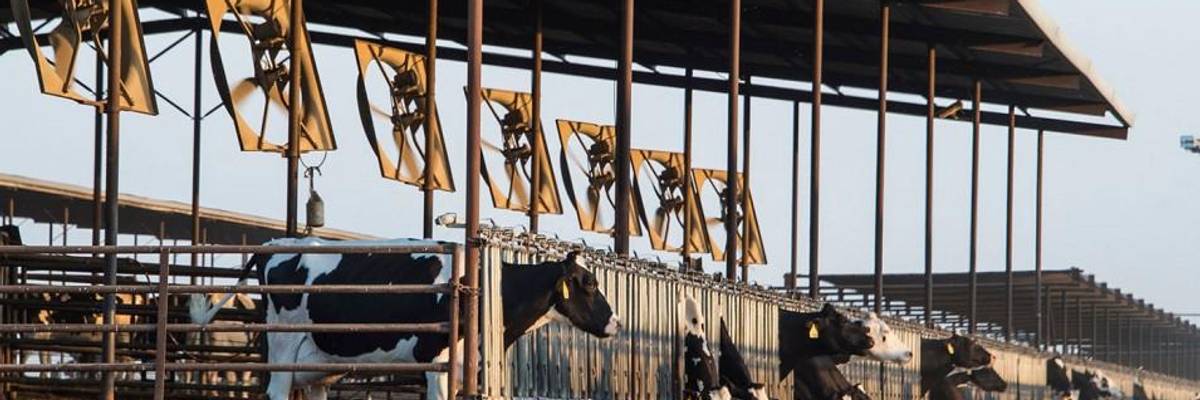
We need to break this vicious cycle of factory farms polluting water and driving climate change, which causes water crises for people and the environment. (Photo: Robyn Beck/AFP/Getty Images)
It's Time for an Urgent Intervention in the Food System Ruining Our Climate
“No force on earth can stop an idea whose time has come,” Victor Hugo once said. The time for the Farm System Reform Act is now. We can’t afford to continue the downward spiral from an unsustainable food system. Here’s how we must change it.
Wildfires, heatwaves, hurricanes and droughts: the deadly impacts of climate change are becoming more intense and devastating. While the transition to a real, renewable energy system is imperative to a livable climate future, it's just as urgent to address the destructive impacts of our industrial food system. The current system is highly concentrated and exploitative, and it's driving climate change and water shortages.
The first step is passing the Farm System Reform Act.
To address the climate crisis we must break up the big food monopolies and stop the practice of concentrating large numbers of animals on factory farms. The first step is passing the Farm System Reform Act.
The Relationship Between Factory Farms and Climate Change
Factory farms drive climate change. Raising cows and pigs on factory farms accounts for 14.5% of all human-induced greenhouse gas emissions, the vast majority coming from producing corn and soy to feed factory-farmed animals. In fact, the top 20 meat and dairy corporations together contribute more greenhouse gases than the entire country of Germany, and together the top five contribute more than fossil fuel giants Exxon, Shell, or BP. These meat and dairy corporations are pushing factory farm expansion, further driving up greenhouse gas emissions, while family-scale livestock farms struggle to survive.
Further, while factory farms drive water shortages through climate-induced droughts, they also directly poison vast quantities of freshwater across the country through the waste they produce.
Agriculture is the leading known cause of pollution in U.S. rivers and streams and is the second-largest known contributor to the contamination of wetlands. Pollution from animal feeding operations threatens or impairs over 13,000 miles of U.S. rivers and streams and 60,000 acres of lakes and ponds. In one stark example, nearly 500,000 dairy cows on factory farms in Tulare County, California produce more manure waste than the human residents of the Los Angeles metropolitan area.
We need to break this vicious cycle of factory farms polluting water and driving climate change, which causes water crises for people and the environment.
An Even More Urgent Case For a Ban on Factory Farms
Food & Water Watch called for a ban on factory farms in early 2018 because we knew the fragility of our food system. For years, our team has been educating and organizing against extensive corporate control and how it harms family farmers, rural communities, food chain workers and consumers. We knew that in order to avoid the worst impacts of climate change we must address industrial agriculture.
Less than two years later we were proud to work with lead sponsors Senator Cory Booker and Representative Ro Khanna to introduce the Farm System Reform Act in U.S. Congress, a visionary bill that includes a ban on new and expanding factory farms and a phaseout of existing facilities by 2040. Originally introduced in the Senate in December of 2019 and in the House in March of 2020, the Farm System Reform Act helped people to see that a better way is possible--and in fact critical--if we are to protect our water and climate as well as protect food chain workers, and ensure a safe and plentiful food supply.
And now we're doing it again--even bigger and bolder than last time.
Introducing the Farm System Reform Act in 2021
In July 2021, Senator Cory Booker and Representative Ro Khanna reintroduced the Farm System Reform Act in the new Congress with three original Senate co-sponsors and a number of new House co-sponsors. The bill is endorsed by a broad coalition of organizations including Food & Water Watch and Food & Water Action, the American Society of Prevention of Cruelty to Animals, Family Farm Action, the United Food and Commercial Workers Union, and Johns Hopkins Center for a Livable Future. Over 100 individual farmers have also already signed a letter in support of the bill, with more joining every day.
This groundbreaking bill has quickly become the north star of the movement to ban factory farms and end corporate control of our food system and should be a key pillar of national efforts to address climate change. In addition to an immediate ban on new and expanding large factory farms and a phase-out of existing facilities by 2040, the Farm System Reform Act would also:
- Create a transition program to allow farmers to escape the contract model and shift to more sustainable forms of agriculture
- Enact a series of market reforms that would make it possible for small growers to compete
- Hold corporations responsible for their pollution
The Farm System Reform Act is a bold and yet commonsense approach that would move us toward a food and farm system that works for us--instead of wealthy corporations only concerned with their own bottom lines. It would help to build the kind of resilient, regionally-based food system that we advocate for in our new report, Well-Fed. It would level the playing field for family-scale farms and help rebuild rural America. And it would provide a real solution to addressing the climate impacts of industrial agriculture--instead of more false solutions like factory farm gas (biogas) or carbon markets.
We are at a crossroads
This country and this world are at a monumental crossroads. In a few short weeks, US voters will have an opportunity to beat back the forces of fascism and confront the billionaires who are rigging the economy, our media system, and our democracy, making it increasingly impossible for ordinary people to get by. We’re not just talking about the election. We’re talking about what must be done once these fascist elements are vanquished from power. We need a bolder set of solutions than what either major party has so far been willing to offer and a working-class movement ready to fight like hell for it. Trump didn't emerge from nowhere. The conditions that fueled MAGA authoritarianism were created by decades of radical neoliberal economic policies and a corrupt political system dominated by corporate interests. They slashed taxes on the super-rich, promising that the benefits would trickle down. They said giveaways to the corporate titans would make life more affordable for the rest of us. It was all bullshit. And when a bitter, betrayed populace searches for someone to blame, right-wing demagogues have little trouble finding scapegoats. People know when they're being lied to, but you won't hear any of this from the corporate media. Only independent journalism—powered and funded by people who believe in building a better world—can deliver truly trustworthy daily news. Our Fall Campaign is underway, and we need your help. To power our newsroom through the rest of the year, we need to raise $125,000 by midnight on October 31. So if you share our vision, please contribute whatever you can to sustain our work. |
Wildfires, heatwaves, hurricanes and droughts: the deadly impacts of climate change are becoming more intense and devastating. While the transition to a real, renewable energy system is imperative to a livable climate future, it's just as urgent to address the destructive impacts of our industrial food system. The current system is highly concentrated and exploitative, and it's driving climate change and water shortages.
The first step is passing the Farm System Reform Act.
To address the climate crisis we must break up the big food monopolies and stop the practice of concentrating large numbers of animals on factory farms. The first step is passing the Farm System Reform Act.
The Relationship Between Factory Farms and Climate Change
Factory farms drive climate change. Raising cows and pigs on factory farms accounts for 14.5% of all human-induced greenhouse gas emissions, the vast majority coming from producing corn and soy to feed factory-farmed animals. In fact, the top 20 meat and dairy corporations together contribute more greenhouse gases than the entire country of Germany, and together the top five contribute more than fossil fuel giants Exxon, Shell, or BP. These meat and dairy corporations are pushing factory farm expansion, further driving up greenhouse gas emissions, while family-scale livestock farms struggle to survive.
Further, while factory farms drive water shortages through climate-induced droughts, they also directly poison vast quantities of freshwater across the country through the waste they produce.
Agriculture is the leading known cause of pollution in U.S. rivers and streams and is the second-largest known contributor to the contamination of wetlands. Pollution from animal feeding operations threatens or impairs over 13,000 miles of U.S. rivers and streams and 60,000 acres of lakes and ponds. In one stark example, nearly 500,000 dairy cows on factory farms in Tulare County, California produce more manure waste than the human residents of the Los Angeles metropolitan area.
We need to break this vicious cycle of factory farms polluting water and driving climate change, which causes water crises for people and the environment.
An Even More Urgent Case For a Ban on Factory Farms
Food & Water Watch called for a ban on factory farms in early 2018 because we knew the fragility of our food system. For years, our team has been educating and organizing against extensive corporate control and how it harms family farmers, rural communities, food chain workers and consumers. We knew that in order to avoid the worst impacts of climate change we must address industrial agriculture.
Less than two years later we were proud to work with lead sponsors Senator Cory Booker and Representative Ro Khanna to introduce the Farm System Reform Act in U.S. Congress, a visionary bill that includes a ban on new and expanding factory farms and a phaseout of existing facilities by 2040. Originally introduced in the Senate in December of 2019 and in the House in March of 2020, the Farm System Reform Act helped people to see that a better way is possible--and in fact critical--if we are to protect our water and climate as well as protect food chain workers, and ensure a safe and plentiful food supply.
And now we're doing it again--even bigger and bolder than last time.
Introducing the Farm System Reform Act in 2021
In July 2021, Senator Cory Booker and Representative Ro Khanna reintroduced the Farm System Reform Act in the new Congress with three original Senate co-sponsors and a number of new House co-sponsors. The bill is endorsed by a broad coalition of organizations including Food & Water Watch and Food & Water Action, the American Society of Prevention of Cruelty to Animals, Family Farm Action, the United Food and Commercial Workers Union, and Johns Hopkins Center for a Livable Future. Over 100 individual farmers have also already signed a letter in support of the bill, with more joining every day.
This groundbreaking bill has quickly become the north star of the movement to ban factory farms and end corporate control of our food system and should be a key pillar of national efforts to address climate change. In addition to an immediate ban on new and expanding large factory farms and a phase-out of existing facilities by 2040, the Farm System Reform Act would also:
- Create a transition program to allow farmers to escape the contract model and shift to more sustainable forms of agriculture
- Enact a series of market reforms that would make it possible for small growers to compete
- Hold corporations responsible for their pollution
The Farm System Reform Act is a bold and yet commonsense approach that would move us toward a food and farm system that works for us--instead of wealthy corporations only concerned with their own bottom lines. It would help to build the kind of resilient, regionally-based food system that we advocate for in our new report, Well-Fed. It would level the playing field for family-scale farms and help rebuild rural America. And it would provide a real solution to addressing the climate impacts of industrial agriculture--instead of more false solutions like factory farm gas (biogas) or carbon markets.
Wildfires, heatwaves, hurricanes and droughts: the deadly impacts of climate change are becoming more intense and devastating. While the transition to a real, renewable energy system is imperative to a livable climate future, it's just as urgent to address the destructive impacts of our industrial food system. The current system is highly concentrated and exploitative, and it's driving climate change and water shortages.
The first step is passing the Farm System Reform Act.
To address the climate crisis we must break up the big food monopolies and stop the practice of concentrating large numbers of animals on factory farms. The first step is passing the Farm System Reform Act.
The Relationship Between Factory Farms and Climate Change
Factory farms drive climate change. Raising cows and pigs on factory farms accounts for 14.5% of all human-induced greenhouse gas emissions, the vast majority coming from producing corn and soy to feed factory-farmed animals. In fact, the top 20 meat and dairy corporations together contribute more greenhouse gases than the entire country of Germany, and together the top five contribute more than fossil fuel giants Exxon, Shell, or BP. These meat and dairy corporations are pushing factory farm expansion, further driving up greenhouse gas emissions, while family-scale livestock farms struggle to survive.
Further, while factory farms drive water shortages through climate-induced droughts, they also directly poison vast quantities of freshwater across the country through the waste they produce.
Agriculture is the leading known cause of pollution in U.S. rivers and streams and is the second-largest known contributor to the contamination of wetlands. Pollution from animal feeding operations threatens or impairs over 13,000 miles of U.S. rivers and streams and 60,000 acres of lakes and ponds. In one stark example, nearly 500,000 dairy cows on factory farms in Tulare County, California produce more manure waste than the human residents of the Los Angeles metropolitan area.
We need to break this vicious cycle of factory farms polluting water and driving climate change, which causes water crises for people and the environment.
An Even More Urgent Case For a Ban on Factory Farms
Food & Water Watch called for a ban on factory farms in early 2018 because we knew the fragility of our food system. For years, our team has been educating and organizing against extensive corporate control and how it harms family farmers, rural communities, food chain workers and consumers. We knew that in order to avoid the worst impacts of climate change we must address industrial agriculture.
Less than two years later we were proud to work with lead sponsors Senator Cory Booker and Representative Ro Khanna to introduce the Farm System Reform Act in U.S. Congress, a visionary bill that includes a ban on new and expanding factory farms and a phaseout of existing facilities by 2040. Originally introduced in the Senate in December of 2019 and in the House in March of 2020, the Farm System Reform Act helped people to see that a better way is possible--and in fact critical--if we are to protect our water and climate as well as protect food chain workers, and ensure a safe and plentiful food supply.
And now we're doing it again--even bigger and bolder than last time.
Introducing the Farm System Reform Act in 2021
In July 2021, Senator Cory Booker and Representative Ro Khanna reintroduced the Farm System Reform Act in the new Congress with three original Senate co-sponsors and a number of new House co-sponsors. The bill is endorsed by a broad coalition of organizations including Food & Water Watch and Food & Water Action, the American Society of Prevention of Cruelty to Animals, Family Farm Action, the United Food and Commercial Workers Union, and Johns Hopkins Center for a Livable Future. Over 100 individual farmers have also already signed a letter in support of the bill, with more joining every day.
This groundbreaking bill has quickly become the north star of the movement to ban factory farms and end corporate control of our food system and should be a key pillar of national efforts to address climate change. In addition to an immediate ban on new and expanding large factory farms and a phase-out of existing facilities by 2040, the Farm System Reform Act would also:
- Create a transition program to allow farmers to escape the contract model and shift to more sustainable forms of agriculture
- Enact a series of market reforms that would make it possible for small growers to compete
- Hold corporations responsible for their pollution
The Farm System Reform Act is a bold and yet commonsense approach that would move us toward a food and farm system that works for us--instead of wealthy corporations only concerned with their own bottom lines. It would help to build the kind of resilient, regionally-based food system that we advocate for in our new report, Well-Fed. It would level the playing field for family-scale farms and help rebuild rural America. And it would provide a real solution to addressing the climate impacts of industrial agriculture--instead of more false solutions like factory farm gas (biogas) or carbon markets.