SUBSCRIBE TO OUR FREE NEWSLETTER
Daily news & progressive opinion—funded by the people, not the corporations—delivered straight to your inbox.
5
#000000
#FFFFFF
To donate by check, phone, or other method, see our More Ways to Give page.
Daily news & progressive opinion—funded by the people, not the corporations—delivered straight to your inbox.
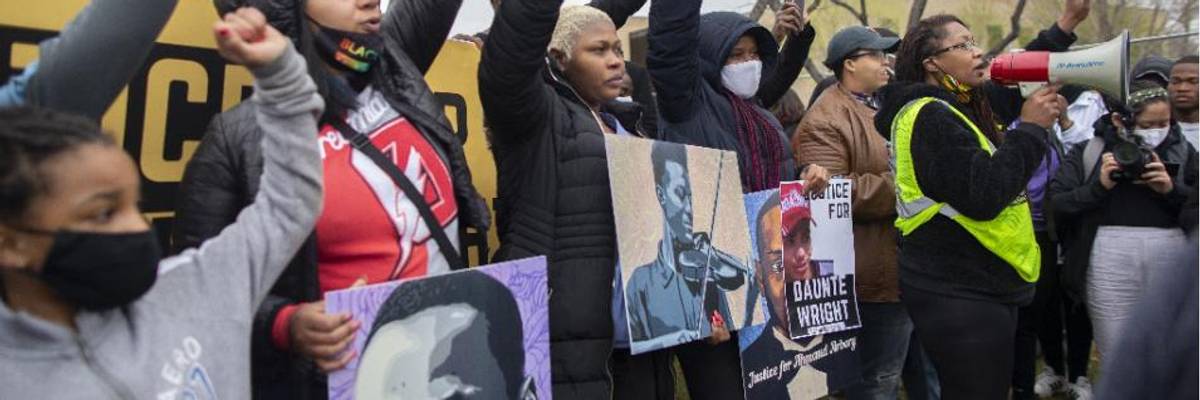
Activist Nola Darling talks on the megaphone in front of the Brooklyn Center police station at a protest over the police killing of Daunte Wright in Brooklyn Center, Minnesota, U.S., on April 13, 2021.
Even as Derek Chauvin is on trial for the murder of George Floyd, police 10 miles away fatally shot an African American man, Duante Wright, after pulling him over for an alleged traffic violation.
That triggered protests that led to confrontations with police, despite Wright's family pleading for non-violence. The Washington Post reports that 985 people have been shot and killed by police in the past year, with blacks more than two times as likely to be shot and killed than whites. Fundamental reform is long overdue.
Now the House of Representatives has passed the George Floyd Justice in Policing Act for the second time. The act, drawn up by Rep. Karen Bass and Judiciary Committee Chair Rep. Jerry Hudson, has been endorsed by leading civil rights and criminal justice groups, pushed by the Congressional Black Caucus, and hailed by George Floyd's family and attorneys.
"The movement that mobilized after the horrific killing of George Floyd has begun to spark reforms across the country. I urge the civil rights and criminal justice community to unite to push the Senate to pass the George Floyd Act as a first step."
The act would set national standards for police behavior. It bans the use of chokeholds of various sorts, like that used to kill George Floyd. It bans no-knock warrants that led to the shooting of Breonna Taylor in Louisville. It restricts the transfer of military weaponry to police forces. Federal assistance would be conditioned on local police forces requiring the use of body and car cameras, as well as anti-discrimination policies and training. It restricts the qualified immunity doctrine that shields police from civil liability.
Joe Biden has called on the Senate to pass the measure and promised to sign it into law. These commonsense reforms should have bipartisan support, but sadly the bill received only one vote from Republicans when it passed the House in February.
The reforms are far from complete. The Movement for Black Lives, the collection of 150 civil rights groups that helped organize the unprecedented protest movement across the country after George Floyd's death, praises the creation of federal standards, a ban on chokeholds and restriction of the immunity doctrine but says that the bill goes "nowhere near far enough." It calls for investments upfront in communities and people, addressing mass incarceration and systemic racism, and making police accountable to communities. The leaders worry that passage of the George Floyd Act would exhaust reform efforts, not simply be the first step toward reform.
Surely the M4BL is right: sensible police reforms are necessary but not sufficient. Renewed investment in communities and greater community control over the police are essential. The plague of mass incarceration must be ended. The George Floyd Act, however, need not be in conflict with broader reforms.
Conservative Democrats fret that the M4BL slogan -- Defund the police -- alienates voters. Certainly, most African Americans want protection from crime and violence. They don't want to get rid of the police, they want to turn them from a threat to an ally. Many police officers agree that we've loaded police with too many responsibilities -- from dealing with domestic disputes to handling the mentally unstable -- because social services have been starved in poor communities. Police reforms will never work unless accompanied by and embedded in rebuilding and empowering communities.
The movement that mobilized after the horrific killing of George Floyd has begun to spark reforms across the country. I urge the civil rights and criminal justice community to unite to push the Senate to pass the George Floyd Act as a first step, to be accompanied by state and local efforts to transform police and federal resources to invest in communities and create new lines of accountability.
The vibrant movement for justice that the M4BL has helped to trigger will not stop there. The unprecedented outpouring of support must continue to mobilize, to demand accountability, to protest police violence, and to keep the pressure on for broader reform. The movement can't let the perfect be enemy of the good, nor allow partial reforms to slake the need for more action, more experimentation, and greater community control.
Dear Common Dreams reader, It’s been nearly 30 years since I co-founded Common Dreams with my late wife, Lina Newhouser. We had the radical notion that journalism should serve the public good, not corporate profits. It was clear to us from the outset what it would take to build such a project. No paid advertisements. No corporate sponsors. No millionaire publisher telling us what to think or do. Many people said we wouldn't last a year, but we proved those doubters wrong. Together with a tremendous team of journalists and dedicated staff, we built an independent media outlet free from the constraints of profits and corporate control. Our mission has always been simple: To inform. To inspire. To ignite change for the common good. Building Common Dreams was not easy. Our survival was never guaranteed. When you take on the most powerful forces—Wall Street greed, fossil fuel industry destruction, Big Tech lobbyists, and uber-rich oligarchs who have spent billions upon billions rigging the economy and democracy in their favor—the only bulwark you have is supporters who believe in your work. But here’s the urgent message from me today. It's never been this bad out there. And it's never been this hard to keep us going. At the very moment Common Dreams is most needed, the threats we face are intensifying. We need your support now more than ever. We don't accept corporate advertising and never will. We don't have a paywall because we don't think people should be blocked from critical news based on their ability to pay. Everything we do is funded by the donations of readers like you. When everyone does the little they can afford, we are strong. But if that support retreats or dries up, so do we. Will you donate now to make sure Common Dreams not only survives but thrives? —Craig Brown, Co-founder |
Even as Derek Chauvin is on trial for the murder of George Floyd, police 10 miles away fatally shot an African American man, Duante Wright, after pulling him over for an alleged traffic violation.
That triggered protests that led to confrontations with police, despite Wright's family pleading for non-violence. The Washington Post reports that 985 people have been shot and killed by police in the past year, with blacks more than two times as likely to be shot and killed than whites. Fundamental reform is long overdue.
Now the House of Representatives has passed the George Floyd Justice in Policing Act for the second time. The act, drawn up by Rep. Karen Bass and Judiciary Committee Chair Rep. Jerry Hudson, has been endorsed by leading civil rights and criminal justice groups, pushed by the Congressional Black Caucus, and hailed by George Floyd's family and attorneys.
"The movement that mobilized after the horrific killing of George Floyd has begun to spark reforms across the country. I urge the civil rights and criminal justice community to unite to push the Senate to pass the George Floyd Act as a first step."
The act would set national standards for police behavior. It bans the use of chokeholds of various sorts, like that used to kill George Floyd. It bans no-knock warrants that led to the shooting of Breonna Taylor in Louisville. It restricts the transfer of military weaponry to police forces. Federal assistance would be conditioned on local police forces requiring the use of body and car cameras, as well as anti-discrimination policies and training. It restricts the qualified immunity doctrine that shields police from civil liability.
Joe Biden has called on the Senate to pass the measure and promised to sign it into law. These commonsense reforms should have bipartisan support, but sadly the bill received only one vote from Republicans when it passed the House in February.
The reforms are far from complete. The Movement for Black Lives, the collection of 150 civil rights groups that helped organize the unprecedented protest movement across the country after George Floyd's death, praises the creation of federal standards, a ban on chokeholds and restriction of the immunity doctrine but says that the bill goes "nowhere near far enough." It calls for investments upfront in communities and people, addressing mass incarceration and systemic racism, and making police accountable to communities. The leaders worry that passage of the George Floyd Act would exhaust reform efforts, not simply be the first step toward reform.
Surely the M4BL is right: sensible police reforms are necessary but not sufficient. Renewed investment in communities and greater community control over the police are essential. The plague of mass incarceration must be ended. The George Floyd Act, however, need not be in conflict with broader reforms.
Conservative Democrats fret that the M4BL slogan -- Defund the police -- alienates voters. Certainly, most African Americans want protection from crime and violence. They don't want to get rid of the police, they want to turn them from a threat to an ally. Many police officers agree that we've loaded police with too many responsibilities -- from dealing with domestic disputes to handling the mentally unstable -- because social services have been starved in poor communities. Police reforms will never work unless accompanied by and embedded in rebuilding and empowering communities.
The movement that mobilized after the horrific killing of George Floyd has begun to spark reforms across the country. I urge the civil rights and criminal justice community to unite to push the Senate to pass the George Floyd Act as a first step, to be accompanied by state and local efforts to transform police and federal resources to invest in communities and create new lines of accountability.
The vibrant movement for justice that the M4BL has helped to trigger will not stop there. The unprecedented outpouring of support must continue to mobilize, to demand accountability, to protest police violence, and to keep the pressure on for broader reform. The movement can't let the perfect be enemy of the good, nor allow partial reforms to slake the need for more action, more experimentation, and greater community control.
Even as Derek Chauvin is on trial for the murder of George Floyd, police 10 miles away fatally shot an African American man, Duante Wright, after pulling him over for an alleged traffic violation.
That triggered protests that led to confrontations with police, despite Wright's family pleading for non-violence. The Washington Post reports that 985 people have been shot and killed by police in the past year, with blacks more than two times as likely to be shot and killed than whites. Fundamental reform is long overdue.
Now the House of Representatives has passed the George Floyd Justice in Policing Act for the second time. The act, drawn up by Rep. Karen Bass and Judiciary Committee Chair Rep. Jerry Hudson, has been endorsed by leading civil rights and criminal justice groups, pushed by the Congressional Black Caucus, and hailed by George Floyd's family and attorneys.
"The movement that mobilized after the horrific killing of George Floyd has begun to spark reforms across the country. I urge the civil rights and criminal justice community to unite to push the Senate to pass the George Floyd Act as a first step."
The act would set national standards for police behavior. It bans the use of chokeholds of various sorts, like that used to kill George Floyd. It bans no-knock warrants that led to the shooting of Breonna Taylor in Louisville. It restricts the transfer of military weaponry to police forces. Federal assistance would be conditioned on local police forces requiring the use of body and car cameras, as well as anti-discrimination policies and training. It restricts the qualified immunity doctrine that shields police from civil liability.
Joe Biden has called on the Senate to pass the measure and promised to sign it into law. These commonsense reforms should have bipartisan support, but sadly the bill received only one vote from Republicans when it passed the House in February.
The reforms are far from complete. The Movement for Black Lives, the collection of 150 civil rights groups that helped organize the unprecedented protest movement across the country after George Floyd's death, praises the creation of federal standards, a ban on chokeholds and restriction of the immunity doctrine but says that the bill goes "nowhere near far enough." It calls for investments upfront in communities and people, addressing mass incarceration and systemic racism, and making police accountable to communities. The leaders worry that passage of the George Floyd Act would exhaust reform efforts, not simply be the first step toward reform.
Surely the M4BL is right: sensible police reforms are necessary but not sufficient. Renewed investment in communities and greater community control over the police are essential. The plague of mass incarceration must be ended. The George Floyd Act, however, need not be in conflict with broader reforms.
Conservative Democrats fret that the M4BL slogan -- Defund the police -- alienates voters. Certainly, most African Americans want protection from crime and violence. They don't want to get rid of the police, they want to turn them from a threat to an ally. Many police officers agree that we've loaded police with too many responsibilities -- from dealing with domestic disputes to handling the mentally unstable -- because social services have been starved in poor communities. Police reforms will never work unless accompanied by and embedded in rebuilding and empowering communities.
The movement that mobilized after the horrific killing of George Floyd has begun to spark reforms across the country. I urge the civil rights and criminal justice community to unite to push the Senate to pass the George Floyd Act as a first step, to be accompanied by state and local efforts to transform police and federal resources to invest in communities and create new lines of accountability.
The vibrant movement for justice that the M4BL has helped to trigger will not stop there. The unprecedented outpouring of support must continue to mobilize, to demand accountability, to protest police violence, and to keep the pressure on for broader reform. The movement can't let the perfect be enemy of the good, nor allow partial reforms to slake the need for more action, more experimentation, and greater community control.