SUBSCRIBE TO OUR FREE NEWSLETTER
Daily news & progressive opinion—funded by the people, not the corporations—delivered straight to your inbox.
5
#000000
#FFFFFF
To donate by check, phone, or other method, see our More Ways to Give page.
Daily news & progressive opinion—funded by the people, not the corporations—delivered straight to your inbox.
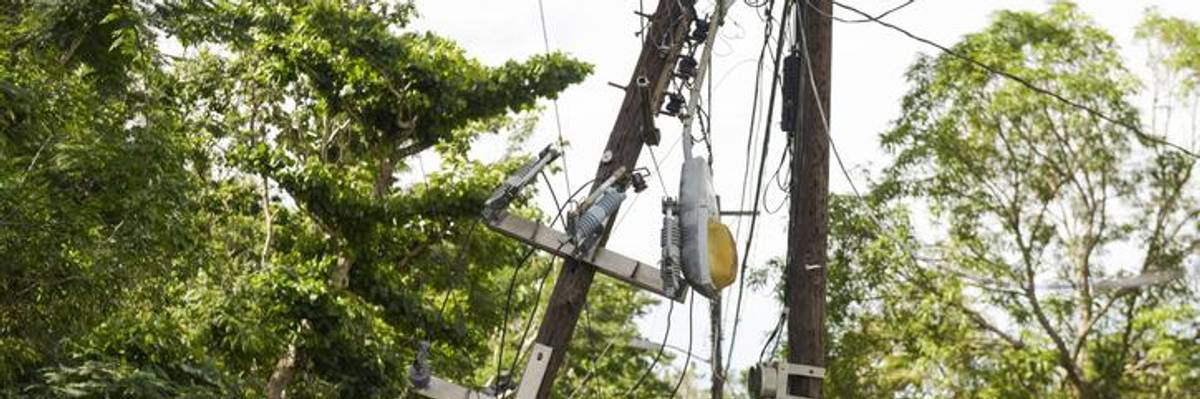
Dangerous power lines and power pole dangle over street traffic in Vega Alta, Puerto Rico after Hurricane Maria. (Photo: Getty/Stock Photo/alejandrophotography)
The heart-wrenching stories coming out of Texas after the devastating winter storm brought me back to 2017, when Hurricane Maria slammed into the islands of Puerto Rico. I was born there and moved with my parents to the United States when I was eight, leaving my grandparents, aunts, uncles and countless cousins. As the storm swept over the islands, I worried for their safety from afar.
As in Texas, the failure in Puerto Rico to upgrade essential infrastructure to meet the threats of the climate crisis led to unrelenting suffering, including the loss of thousands of lives, widespread lack of electricity and fresh water, and logistical nightmares at hospitals. Whether in Texas, Puerto Rico or anywhere else, utilities--like electricity, phone and internet connections--are essential and inextricably linked. When the power goes out, it can take communications out too. And when communications go down, electrical-recovery efforts are frustrated. It's not surprising that when Texas' privatized, deregulated and detached power grid failed, it left hundreds of thousands without connectivity.
The text messages I sent to family members after Hurricane Maria went unanswered for what felt like an eternity. I now realize how fortunate I was to receive messages just a few hours later confirming that everyone was OK: minimal damage to homes, no power, dismal connectivity, flooding, trees down and roads impassable. Turns out that it was sheer luck that my family was able to get any cell service.
My search for answers about what led to the near-total collapse of communications on the islands converged with my job as a racial-justice advocate focused on broadband and tech policies. According to the FCC, the storm knocked 95 percent of cell sites out of service. At the same time, the agency was moving to repeal or gut its communications policies with no consideration of how these changes would harm Black people, Latinx people and other marginalized communities.
I traveled to the islands six months after the storm with former FCC Commissioner and fellow Puerto Rican Gloria Tristani and then-FCC Commissioner--and now-Acting FCC Chairwoman--Jessica Rosenworcel. We saw firsthand how the lack of reliable communications was a man-made disaster that exacerbated the problems with the recovery effort.
Telecommunications companies must take the climate crisis into consideration when building their networks--and be held accountable when appropriate measures aren't put in place.
We spoke with people living in Toa Baja, an area of Puerto Rico that experienced extreme flooding. We listened to stories of survival and learned about the isolation and fear people felt when they couldn't call emergency services or find out whether loved ones were safe. We witnessed broken street lights, giant potholes, uprooted trees, buildings with massive structural damage, and hundreds of houses with blue tarps in place of roofs--an unforgettable image that was visible as our plane descended toward San Juan's airport.
Rosenworcel demanded answers and so did Free Press, the organization that I work for. But the Trump-led FCC ignored our repeated requests to fully investigate what led to this communications blackout. Years later, so many basic questions remain unanswered.
Without a thorough investigation and efforts to mitigate future disasters like those that struck Puerto Rico in 2017 and Texas in 2021, we will all be paying the cost for this neglect. The injustice and barriers getting in the way of people trying to stay connected are nearly identical to the injustices woven into our electrical grids. And Rosenworcel was absolutely right when she asserted that it's "time for the FCC to fundamentally refresh our playbook for disaster response."
Last year, my colleague Joseph Torres testified before Congress about several pieces of legislation that would help prevent communications failures during future disasters. The bills focused on network- and backup-power resiliency and coordination among providers and between agencies to ensure that people can stay connected before, during and after a disaster strikes.
For example, shifting the current industry-led and wholly voluntary resiliency regime for wireless providers to a mandatory one would safeguard against many of the failures we saw in both places. Rep. Doris Matsui (D-California) also recently introduced the Emergency Reporting Act, which would "improve the resiliency of communications networks during emergencies."
Telecommunications companies must take the climate crisis into consideration when building their networks--and be held accountable when appropriate measures aren't put in place. We've seen time and again that inadequate preparation and vulnerable networks leave customers and communities to fend for themselves.
The climate crisis heightens the urgency of taking action now. How many more deadly and man-made disasters must we endure before we recognize the importance of connectivity? Utilities like broadband are essential to surviving a crisis, and it's time to put words into action and make these essential networks resilient.
Dear Common Dreams reader, It’s been nearly 30 years since I co-founded Common Dreams with my late wife, Lina Newhouser. We had the radical notion that journalism should serve the public good, not corporate profits. It was clear to us from the outset what it would take to build such a project. No paid advertisements. No corporate sponsors. No millionaire publisher telling us what to think or do. Many people said we wouldn't last a year, but we proved those doubters wrong. Together with a tremendous team of journalists and dedicated staff, we built an independent media outlet free from the constraints of profits and corporate control. Our mission has always been simple: To inform. To inspire. To ignite change for the common good. Building Common Dreams was not easy. Our survival was never guaranteed. When you take on the most powerful forces—Wall Street greed, fossil fuel industry destruction, Big Tech lobbyists, and uber-rich oligarchs who have spent billions upon billions rigging the economy and democracy in their favor—the only bulwark you have is supporters who believe in your work. But here’s the urgent message from me today. It's never been this bad out there. And it's never been this hard to keep us going. At the very moment Common Dreams is most needed, the threats we face are intensifying. We need your support now more than ever. We don't accept corporate advertising and never will. We don't have a paywall because we don't think people should be blocked from critical news based on their ability to pay. Everything we do is funded by the donations of readers like you. When everyone does the little they can afford, we are strong. But if that support retreats or dries up, so do we. Will you donate now to make sure Common Dreams not only survives but thrives? —Craig Brown, Co-founder |
The heart-wrenching stories coming out of Texas after the devastating winter storm brought me back to 2017, when Hurricane Maria slammed into the islands of Puerto Rico. I was born there and moved with my parents to the United States when I was eight, leaving my grandparents, aunts, uncles and countless cousins. As the storm swept over the islands, I worried for their safety from afar.
As in Texas, the failure in Puerto Rico to upgrade essential infrastructure to meet the threats of the climate crisis led to unrelenting suffering, including the loss of thousands of lives, widespread lack of electricity and fresh water, and logistical nightmares at hospitals. Whether in Texas, Puerto Rico or anywhere else, utilities--like electricity, phone and internet connections--are essential and inextricably linked. When the power goes out, it can take communications out too. And when communications go down, electrical-recovery efforts are frustrated. It's not surprising that when Texas' privatized, deregulated and detached power grid failed, it left hundreds of thousands without connectivity.
The text messages I sent to family members after Hurricane Maria went unanswered for what felt like an eternity. I now realize how fortunate I was to receive messages just a few hours later confirming that everyone was OK: minimal damage to homes, no power, dismal connectivity, flooding, trees down and roads impassable. Turns out that it was sheer luck that my family was able to get any cell service.
My search for answers about what led to the near-total collapse of communications on the islands converged with my job as a racial-justice advocate focused on broadband and tech policies. According to the FCC, the storm knocked 95 percent of cell sites out of service. At the same time, the agency was moving to repeal or gut its communications policies with no consideration of how these changes would harm Black people, Latinx people and other marginalized communities.
I traveled to the islands six months after the storm with former FCC Commissioner and fellow Puerto Rican Gloria Tristani and then-FCC Commissioner--and now-Acting FCC Chairwoman--Jessica Rosenworcel. We saw firsthand how the lack of reliable communications was a man-made disaster that exacerbated the problems with the recovery effort.
Telecommunications companies must take the climate crisis into consideration when building their networks--and be held accountable when appropriate measures aren't put in place.
We spoke with people living in Toa Baja, an area of Puerto Rico that experienced extreme flooding. We listened to stories of survival and learned about the isolation and fear people felt when they couldn't call emergency services or find out whether loved ones were safe. We witnessed broken street lights, giant potholes, uprooted trees, buildings with massive structural damage, and hundreds of houses with blue tarps in place of roofs--an unforgettable image that was visible as our plane descended toward San Juan's airport.
Rosenworcel demanded answers and so did Free Press, the organization that I work for. But the Trump-led FCC ignored our repeated requests to fully investigate what led to this communications blackout. Years later, so many basic questions remain unanswered.
Without a thorough investigation and efforts to mitigate future disasters like those that struck Puerto Rico in 2017 and Texas in 2021, we will all be paying the cost for this neglect. The injustice and barriers getting in the way of people trying to stay connected are nearly identical to the injustices woven into our electrical grids. And Rosenworcel was absolutely right when she asserted that it's "time for the FCC to fundamentally refresh our playbook for disaster response."
Last year, my colleague Joseph Torres testified before Congress about several pieces of legislation that would help prevent communications failures during future disasters. The bills focused on network- and backup-power resiliency and coordination among providers and between agencies to ensure that people can stay connected before, during and after a disaster strikes.
For example, shifting the current industry-led and wholly voluntary resiliency regime for wireless providers to a mandatory one would safeguard against many of the failures we saw in both places. Rep. Doris Matsui (D-California) also recently introduced the Emergency Reporting Act, which would "improve the resiliency of communications networks during emergencies."
Telecommunications companies must take the climate crisis into consideration when building their networks--and be held accountable when appropriate measures aren't put in place. We've seen time and again that inadequate preparation and vulnerable networks leave customers and communities to fend for themselves.
The climate crisis heightens the urgency of taking action now. How many more deadly and man-made disasters must we endure before we recognize the importance of connectivity? Utilities like broadband are essential to surviving a crisis, and it's time to put words into action and make these essential networks resilient.
The heart-wrenching stories coming out of Texas after the devastating winter storm brought me back to 2017, when Hurricane Maria slammed into the islands of Puerto Rico. I was born there and moved with my parents to the United States when I was eight, leaving my grandparents, aunts, uncles and countless cousins. As the storm swept over the islands, I worried for their safety from afar.
As in Texas, the failure in Puerto Rico to upgrade essential infrastructure to meet the threats of the climate crisis led to unrelenting suffering, including the loss of thousands of lives, widespread lack of electricity and fresh water, and logistical nightmares at hospitals. Whether in Texas, Puerto Rico or anywhere else, utilities--like electricity, phone and internet connections--are essential and inextricably linked. When the power goes out, it can take communications out too. And when communications go down, electrical-recovery efforts are frustrated. It's not surprising that when Texas' privatized, deregulated and detached power grid failed, it left hundreds of thousands without connectivity.
The text messages I sent to family members after Hurricane Maria went unanswered for what felt like an eternity. I now realize how fortunate I was to receive messages just a few hours later confirming that everyone was OK: minimal damage to homes, no power, dismal connectivity, flooding, trees down and roads impassable. Turns out that it was sheer luck that my family was able to get any cell service.
My search for answers about what led to the near-total collapse of communications on the islands converged with my job as a racial-justice advocate focused on broadband and tech policies. According to the FCC, the storm knocked 95 percent of cell sites out of service. At the same time, the agency was moving to repeal or gut its communications policies with no consideration of how these changes would harm Black people, Latinx people and other marginalized communities.
I traveled to the islands six months after the storm with former FCC Commissioner and fellow Puerto Rican Gloria Tristani and then-FCC Commissioner--and now-Acting FCC Chairwoman--Jessica Rosenworcel. We saw firsthand how the lack of reliable communications was a man-made disaster that exacerbated the problems with the recovery effort.
Telecommunications companies must take the climate crisis into consideration when building their networks--and be held accountable when appropriate measures aren't put in place.
We spoke with people living in Toa Baja, an area of Puerto Rico that experienced extreme flooding. We listened to stories of survival and learned about the isolation and fear people felt when they couldn't call emergency services or find out whether loved ones were safe. We witnessed broken street lights, giant potholes, uprooted trees, buildings with massive structural damage, and hundreds of houses with blue tarps in place of roofs--an unforgettable image that was visible as our plane descended toward San Juan's airport.
Rosenworcel demanded answers and so did Free Press, the organization that I work for. But the Trump-led FCC ignored our repeated requests to fully investigate what led to this communications blackout. Years later, so many basic questions remain unanswered.
Without a thorough investigation and efforts to mitigate future disasters like those that struck Puerto Rico in 2017 and Texas in 2021, we will all be paying the cost for this neglect. The injustice and barriers getting in the way of people trying to stay connected are nearly identical to the injustices woven into our electrical grids. And Rosenworcel was absolutely right when she asserted that it's "time for the FCC to fundamentally refresh our playbook for disaster response."
Last year, my colleague Joseph Torres testified before Congress about several pieces of legislation that would help prevent communications failures during future disasters. The bills focused on network- and backup-power resiliency and coordination among providers and between agencies to ensure that people can stay connected before, during and after a disaster strikes.
For example, shifting the current industry-led and wholly voluntary resiliency regime for wireless providers to a mandatory one would safeguard against many of the failures we saw in both places. Rep. Doris Matsui (D-California) also recently introduced the Emergency Reporting Act, which would "improve the resiliency of communications networks during emergencies."
Telecommunications companies must take the climate crisis into consideration when building their networks--and be held accountable when appropriate measures aren't put in place. We've seen time and again that inadequate preparation and vulnerable networks leave customers and communities to fend for themselves.
The climate crisis heightens the urgency of taking action now. How many more deadly and man-made disasters must we endure before we recognize the importance of connectivity? Utilities like broadband are essential to surviving a crisis, and it's time to put words into action and make these essential networks resilient.