SUBSCRIBE TO OUR FREE NEWSLETTER
Daily news & progressive opinion—funded by the people, not the corporations—delivered straight to your inbox.
5
#000000
#FFFFFF
To donate by check, phone, or other method, see our More Ways to Give page.
Daily news & progressive opinion—funded by the people, not the corporations—delivered straight to your inbox.
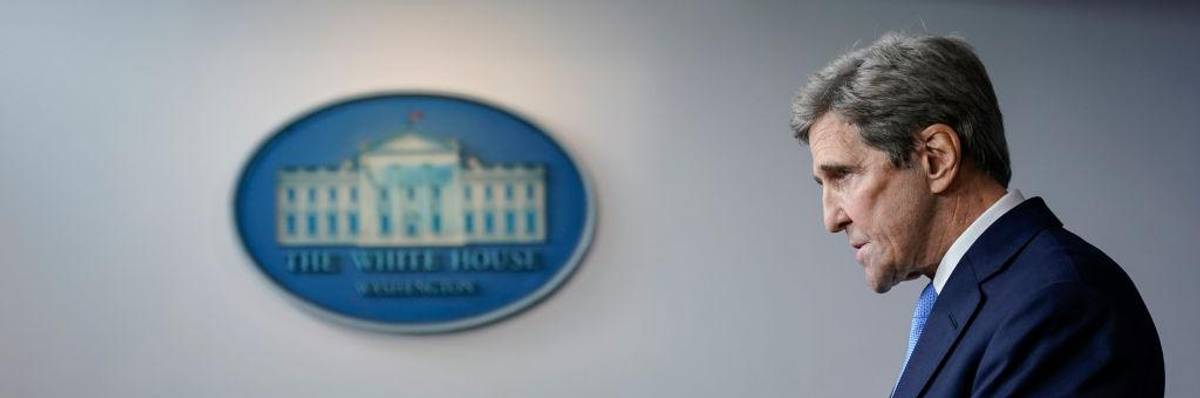
Special Presidential Envoy for Climate John Kerry speaks during a press briefing at the White House on January 27, 2021 in Washington, DC. Kerry and McCarthy took questions from reporters about the Biden administration's plans and agenda on climate change issues. (Photo by Drew Angerer/Getty Images)
What a difference two years make. This week witnesses one of the most influential and largest oil industry conferences take place, called CERAWeek. Normally, the creme de la cremeof the oil industry descend on Houston for a pro-fossil fuel frenzy.
But this year, due to COVID-19, the event is virtual. And due to COVID-19, the mood is suddenly very different.
Two years ago, at the height of the Trump Administration's assault on the environment and denial of climate change, former U.S. Secretary of State Mike Pompeo took the stage to declare an age of U.S. dominance, due to the rapid expansion of shale, which the Trump Administration could use to shape global policy within its "American First" agenda.
"We're not just exporting American energy, we're exporting our commercial value system to our friends and to our partners", said Pompeo. He implored his audience to "Come follow America's energy blueprint, which is to innovate, not subjugate; to contribute, not to coerce; to allow markets to command the heights."
It was an unashamed call for more drilling. He finished by stating that "at least for the rest of my lifetime, the world will need oil and gas and petrochemicals to produce gasoline, to produce jet fuel, fertilizers, and pharmaceuticals."
The fundamentally flawed speech reflected the denial policies of the Trump Administration and the complete denial of the growing climate crisis.
Two years on, Trump and Pompeo are gone and COVID-19 has ripped up the energy landscape.
As Reuters reported, "two years later, the oil industry is recovering from the worst recession it has ever experienced after measures to contain coronavirus stopped billions of people from traveling and wiped out one-fifth of worldwide demand for fuel. The U.S. fossil fuel industry is still reeling after tens of thousands of jobs were lost."
The pandemic has "accelerated the energy transition", from which "oil demand may never recover," added Reuters.
Suddenly, after decades of denial, the industry is talking about energy transition. "The tone is different: There's one theme that permeates the entire conference and that is energy transition," CERAWeek Founder Dan Yergin, vice chair of IHS Markit told Reuters.
One of those speaking today is John Kerry, who is Joe Biden's special envoy on climate change. "The fossil fuel industry could clearly do a lot more into being a full fledged energy companies that are embracing these new technologies," said Kerry.
"Predictions are by 2050 we're going to have $6 trillion of economic transfer a year to clean energy," Kerry continued. "It's the market of the future, and you're already seeing massive allocations. The marketplace is making a critical decision, and I think this is going to race ahead."
He warned the industry that they "don't want to be sitting there with stranded assets. That fight is useless. You're going to end up on the wrong side of this battle."
Kerry also said that rather than be a leader in exporting fossil fuels, the Biden Administration wants to be a leader on climate change, although whether they achieve that remains to be seen.
Another speaker, Andy Jassy of Amazon, said the industry is better off helping to shape the energy transition than wishing it away. "They have to avoid fighting gravity," he told the delegates.
For some in the oil industry, though, the denial continues. And they continue to fight gravity. "We don't think peak oil is around the corner--we see oil demand growing for the next 10 years," John Hess, CEO of Hess Corp reportedly said. "We're not investing enough to grow oil and gas in the future."
Hess is still fighting gravity. He is ignoring the growing reality. Yesterday leading energy experts outlined how renewable energy could also be the sole source for the world's heating, cooling, and transport industries by 2035.
A hundred per cent renewable energy system is not only possible but also has the potential to "save money, create jobs and wealth, and save lives," argues Tony Seba, CEO of RethinkX, one of the authors of a visionary declaration by the Global 100% RE Strategy Group, which has just been issued.
The Strategy Group argues that a "world based on 100% Renewable Energy is possible" by 2035 "and we are able to transform the energy system fast enough to avoid the climate catastrophe."
How many oil execs are listening remains to be seen.
Dear Common Dreams reader, It’s been nearly 30 years since I co-founded Common Dreams with my late wife, Lina Newhouser. We had the radical notion that journalism should serve the public good, not corporate profits. It was clear to us from the outset what it would take to build such a project. No paid advertisements. No corporate sponsors. No millionaire publisher telling us what to think or do. Many people said we wouldn't last a year, but we proved those doubters wrong. Together with a tremendous team of journalists and dedicated staff, we built an independent media outlet free from the constraints of profits and corporate control. Our mission has always been simple: To inform. To inspire. To ignite change for the common good. Building Common Dreams was not easy. Our survival was never guaranteed. When you take on the most powerful forces—Wall Street greed, fossil fuel industry destruction, Big Tech lobbyists, and uber-rich oligarchs who have spent billions upon billions rigging the economy and democracy in their favor—the only bulwark you have is supporters who believe in your work. But here’s the urgent message from me today. It's never been this bad out there. And it's never been this hard to keep us going. At the very moment Common Dreams is most needed, the threats we face are intensifying. We need your support now more than ever. We don't accept corporate advertising and never will. We don't have a paywall because we don't think people should be blocked from critical news based on their ability to pay. Everything we do is funded by the donations of readers like you. When everyone does the little they can afford, we are strong. But if that support retreats or dries up, so do we. Will you donate now to make sure Common Dreams not only survives but thrives? —Craig Brown, Co-founder |
What a difference two years make. This week witnesses one of the most influential and largest oil industry conferences take place, called CERAWeek. Normally, the creme de la cremeof the oil industry descend on Houston for a pro-fossil fuel frenzy.
But this year, due to COVID-19, the event is virtual. And due to COVID-19, the mood is suddenly very different.
Two years ago, at the height of the Trump Administration's assault on the environment and denial of climate change, former U.S. Secretary of State Mike Pompeo took the stage to declare an age of U.S. dominance, due to the rapid expansion of shale, which the Trump Administration could use to shape global policy within its "American First" agenda.
"We're not just exporting American energy, we're exporting our commercial value system to our friends and to our partners", said Pompeo. He implored his audience to "Come follow America's energy blueprint, which is to innovate, not subjugate; to contribute, not to coerce; to allow markets to command the heights."
It was an unashamed call for more drilling. He finished by stating that "at least for the rest of my lifetime, the world will need oil and gas and petrochemicals to produce gasoline, to produce jet fuel, fertilizers, and pharmaceuticals."
The fundamentally flawed speech reflected the denial policies of the Trump Administration and the complete denial of the growing climate crisis.
Two years on, Trump and Pompeo are gone and COVID-19 has ripped up the energy landscape.
As Reuters reported, "two years later, the oil industry is recovering from the worst recession it has ever experienced after measures to contain coronavirus stopped billions of people from traveling and wiped out one-fifth of worldwide demand for fuel. The U.S. fossil fuel industry is still reeling after tens of thousands of jobs were lost."
The pandemic has "accelerated the energy transition", from which "oil demand may never recover," added Reuters.
Suddenly, after decades of denial, the industry is talking about energy transition. "The tone is different: There's one theme that permeates the entire conference and that is energy transition," CERAWeek Founder Dan Yergin, vice chair of IHS Markit told Reuters.
One of those speaking today is John Kerry, who is Joe Biden's special envoy on climate change. "The fossil fuel industry could clearly do a lot more into being a full fledged energy companies that are embracing these new technologies," said Kerry.
"Predictions are by 2050 we're going to have $6 trillion of economic transfer a year to clean energy," Kerry continued. "It's the market of the future, and you're already seeing massive allocations. The marketplace is making a critical decision, and I think this is going to race ahead."
He warned the industry that they "don't want to be sitting there with stranded assets. That fight is useless. You're going to end up on the wrong side of this battle."
Kerry also said that rather than be a leader in exporting fossil fuels, the Biden Administration wants to be a leader on climate change, although whether they achieve that remains to be seen.
Another speaker, Andy Jassy of Amazon, said the industry is better off helping to shape the energy transition than wishing it away. "They have to avoid fighting gravity," he told the delegates.
For some in the oil industry, though, the denial continues. And they continue to fight gravity. "We don't think peak oil is around the corner--we see oil demand growing for the next 10 years," John Hess, CEO of Hess Corp reportedly said. "We're not investing enough to grow oil and gas in the future."
Hess is still fighting gravity. He is ignoring the growing reality. Yesterday leading energy experts outlined how renewable energy could also be the sole source for the world's heating, cooling, and transport industries by 2035.
A hundred per cent renewable energy system is not only possible but also has the potential to "save money, create jobs and wealth, and save lives," argues Tony Seba, CEO of RethinkX, one of the authors of a visionary declaration by the Global 100% RE Strategy Group, which has just been issued.
The Strategy Group argues that a "world based on 100% Renewable Energy is possible" by 2035 "and we are able to transform the energy system fast enough to avoid the climate catastrophe."
How many oil execs are listening remains to be seen.
What a difference two years make. This week witnesses one of the most influential and largest oil industry conferences take place, called CERAWeek. Normally, the creme de la cremeof the oil industry descend on Houston for a pro-fossil fuel frenzy.
But this year, due to COVID-19, the event is virtual. And due to COVID-19, the mood is suddenly very different.
Two years ago, at the height of the Trump Administration's assault on the environment and denial of climate change, former U.S. Secretary of State Mike Pompeo took the stage to declare an age of U.S. dominance, due to the rapid expansion of shale, which the Trump Administration could use to shape global policy within its "American First" agenda.
"We're not just exporting American energy, we're exporting our commercial value system to our friends and to our partners", said Pompeo. He implored his audience to "Come follow America's energy blueprint, which is to innovate, not subjugate; to contribute, not to coerce; to allow markets to command the heights."
It was an unashamed call for more drilling. He finished by stating that "at least for the rest of my lifetime, the world will need oil and gas and petrochemicals to produce gasoline, to produce jet fuel, fertilizers, and pharmaceuticals."
The fundamentally flawed speech reflected the denial policies of the Trump Administration and the complete denial of the growing climate crisis.
Two years on, Trump and Pompeo are gone and COVID-19 has ripped up the energy landscape.
As Reuters reported, "two years later, the oil industry is recovering from the worst recession it has ever experienced after measures to contain coronavirus stopped billions of people from traveling and wiped out one-fifth of worldwide demand for fuel. The U.S. fossil fuel industry is still reeling after tens of thousands of jobs were lost."
The pandemic has "accelerated the energy transition", from which "oil demand may never recover," added Reuters.
Suddenly, after decades of denial, the industry is talking about energy transition. "The tone is different: There's one theme that permeates the entire conference and that is energy transition," CERAWeek Founder Dan Yergin, vice chair of IHS Markit told Reuters.
One of those speaking today is John Kerry, who is Joe Biden's special envoy on climate change. "The fossil fuel industry could clearly do a lot more into being a full fledged energy companies that are embracing these new technologies," said Kerry.
"Predictions are by 2050 we're going to have $6 trillion of economic transfer a year to clean energy," Kerry continued. "It's the market of the future, and you're already seeing massive allocations. The marketplace is making a critical decision, and I think this is going to race ahead."
He warned the industry that they "don't want to be sitting there with stranded assets. That fight is useless. You're going to end up on the wrong side of this battle."
Kerry also said that rather than be a leader in exporting fossil fuels, the Biden Administration wants to be a leader on climate change, although whether they achieve that remains to be seen.
Another speaker, Andy Jassy of Amazon, said the industry is better off helping to shape the energy transition than wishing it away. "They have to avoid fighting gravity," he told the delegates.
For some in the oil industry, though, the denial continues. And they continue to fight gravity. "We don't think peak oil is around the corner--we see oil demand growing for the next 10 years," John Hess, CEO of Hess Corp reportedly said. "We're not investing enough to grow oil and gas in the future."
Hess is still fighting gravity. He is ignoring the growing reality. Yesterday leading energy experts outlined how renewable energy could also be the sole source for the world's heating, cooling, and transport industries by 2035.
A hundred per cent renewable energy system is not only possible but also has the potential to "save money, create jobs and wealth, and save lives," argues Tony Seba, CEO of RethinkX, one of the authors of a visionary declaration by the Global 100% RE Strategy Group, which has just been issued.
The Strategy Group argues that a "world based on 100% Renewable Energy is possible" by 2035 "and we are able to transform the energy system fast enough to avoid the climate catastrophe."
How many oil execs are listening remains to be seen.