
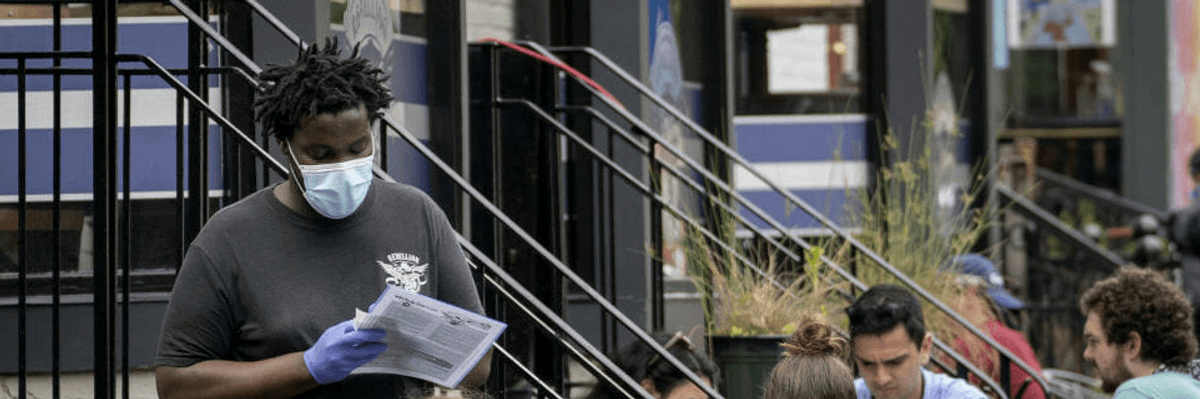
While employers are technically supposed to make up the difference if workers don't earn enough in tips to reach the current $7.25 federal minimum, this rule is largely unenforced. And studies have long found a racial bias in tipping. (Photo: Getty Images)
Ending the Subminimum Tipped Wage Will Lift Up Black Workers and Benefit All Workers
"If we are committed to ending systemic racism in the workplace, passing a living wage bill for tipped and non-tipped low-wage workers is essential to reducing inequality," says racial justice champion Tanya Wallace-Gobern.
President Joe Biden's Covid relief proposal would raise the wage floor for all U.S. workers and give a particularly long overdue raise to restaurant servers, taxi drivers, manicurists, and other tipped workers.
For Black worker advocate Tanya Wallace-Gobern, getting rid of the subminimum wage for tipped workers is a matter of racial justice.
"If we are committed to ending systemic racism in the workplace, passing a living wage bill for tipped and non-tipped low-wage workers is essential to reducing inequality," she said in a recent briefing.
As the Executive Director of the National Black Worker Center Project, Wallace-Gobern oversees a network of eight centers across the country that aim to build power and transform working conditions for Black workers. The subminimum federal wage for tipped workers, which has been stuck at $2.13 since 1991, is a clear barrier to their goals.
While employers are technically supposed to make up the difference if workers don't earn enough in tips to reach the current $7.25 federal minimum, this rule is largely unenforced. And studies have long found a racial bias in tipping.
A survey by One Fair Wage found that prior to the pandemic, Black tipped workers' income, including tips, was already substantially lower than their white counterparts' earnings, with 60 percent of them reporting earning less than $15 per hour, compared to 43 percent of white workers. Since the pandemic, 88 percent of Black tipped workers, compared to just 68 percent of all workers surveyed, have seen their tips plunge by half or more.
The legislative vehicle for the Biden plan, the Raise the Wage Act, would boost the federal minimum wage for tipped workers to $4.95 this year and then by $2 per year until it is equal to a $15 federal minimum wage by 2026. The overall federal minimum wage would increase to $15 by 2025. The Economic Policy Institute estimates that 31 percent of all Black workers would get a raise under the bill
Eliminating the subminimum tipped wage would also eliminate a shameful relic of slavery. Tipping became prevalent in the United States after the Civil War, when restaurants and railway companies embraced the practice because it meant they didn't have to pay wages to recently freed slaves.
That past hangs heavily over many Black workers.
"Let's face it," Wallace-Gobern told Inequality.org, "50 years after President Lyndon B. Johnson declared a war on poverty, Black people in the South still contend with economic hardships, persistent poverty, and the enduring legacy of slavery. We believe that in order for there to be justice for all workers, we must expand the capacity of Black workers, and for us that means that our work has to be concentrated in the South."
Currently based in Raleigh, North Carolina, Wallace-Gobern began her organizing work in Chicago as a student at Loyola University. Her work on a range of racial justice issues, from combatting racist stereotypes and attacks on Black students to fighting for Black professors to receive tenure, caught the eye of labor movement recruiters. When they offered her a job, she said she would only do it if she could organize Black people -- and Black women in particular.
"Black workers are the canaries in the economic coalmine of our country," Wallace-Gobern told Inequality.org. "When the canary died, that was a signal that the conditions were bad for the miners. That's the role Black workers play. If you improve their working conditions, that will lift all workers."
She became the first executive director of National Black Worker Center Project three years ago, after stints with the Amalgamated Clothing and Textile Workers Union (a predecessor of UNITE HERE), the AFL-CIO's Historical Black College Recruitment program, and the Coalition of Kaiser Permanente Unions
Wallace-Gobern's aim now is to strengthen the capacity of Black worker centers to win progressive policies like minimum wage increases, build up a cadre of Civil Rights 2.0 organizers, and advance a Southern strategy on racial justice and democratic freedoms.
The challenges are many. Particularly in the south, worker advocates are up against anti-union "right to work" laws and "pre-emption" restrictions that block cities from improving labor protections at the local level.
But Wallace-Gobern is optimistic about the future.
"Young people are not turning their back on the legacy of the civil rights movement, but they are ready to lead if we step aside and give them space," she remarked. "I welcome the opportunity for them to stand on our shoulders and take us to heights that I and my grandparents could never imagine."
We are at a crossroads
This country and this world are at a monumental crossroads. In a few short weeks, US voters will have an opportunity to beat back the forces of fascism and confront the billionaires who are rigging the economy, our media system, and our democracy, making it increasingly impossible for ordinary people to get by. We’re not just talking about the election. We’re talking about what must be done once these fascist elements are vanquished from power. We need a bolder set of solutions than what either major party has so far been willing to offer and a working-class movement ready to fight like hell for it. Trump didn't emerge from nowhere. The conditions that fueled MAGA authoritarianism were created by decades of radical neoliberal economic policies and a corrupt political system dominated by corporate interests. They slashed taxes on the super-rich, promising that the benefits would trickle down. They said giveaways to the corporate titans would make life more affordable for the rest of us. It was all bullshit. And when a bitter, betrayed populace searches for someone to blame, right-wing demagogues have little trouble finding scapegoats. People know when they're being lied to, but you won't hear any of this from the corporate media. Only independent journalism—powered and funded by people who believe in building a better world—can deliver truly trustworthy daily news. Our Fall Campaign is underway, and we need your help. To power our newsroom through the rest of the year, we need to raise $125,000 by midnight on October 31. So if you share our vision, please contribute whatever you can to sustain our work. |
President Joe Biden's Covid relief proposal would raise the wage floor for all U.S. workers and give a particularly long overdue raise to restaurant servers, taxi drivers, manicurists, and other tipped workers.
For Black worker advocate Tanya Wallace-Gobern, getting rid of the subminimum wage for tipped workers is a matter of racial justice.
"If we are committed to ending systemic racism in the workplace, passing a living wage bill for tipped and non-tipped low-wage workers is essential to reducing inequality," she said in a recent briefing.
As the Executive Director of the National Black Worker Center Project, Wallace-Gobern oversees a network of eight centers across the country that aim to build power and transform working conditions for Black workers. The subminimum federal wage for tipped workers, which has been stuck at $2.13 since 1991, is a clear barrier to their goals.
While employers are technically supposed to make up the difference if workers don't earn enough in tips to reach the current $7.25 federal minimum, this rule is largely unenforced. And studies have long found a racial bias in tipping.
A survey by One Fair Wage found that prior to the pandemic, Black tipped workers' income, including tips, was already substantially lower than their white counterparts' earnings, with 60 percent of them reporting earning less than $15 per hour, compared to 43 percent of white workers. Since the pandemic, 88 percent of Black tipped workers, compared to just 68 percent of all workers surveyed, have seen their tips plunge by half or more.
The legislative vehicle for the Biden plan, the Raise the Wage Act, would boost the federal minimum wage for tipped workers to $4.95 this year and then by $2 per year until it is equal to a $15 federal minimum wage by 2026. The overall federal minimum wage would increase to $15 by 2025. The Economic Policy Institute estimates that 31 percent of all Black workers would get a raise under the bill
Eliminating the subminimum tipped wage would also eliminate a shameful relic of slavery. Tipping became prevalent in the United States after the Civil War, when restaurants and railway companies embraced the practice because it meant they didn't have to pay wages to recently freed slaves.
That past hangs heavily over many Black workers.
"Let's face it," Wallace-Gobern told Inequality.org, "50 years after President Lyndon B. Johnson declared a war on poverty, Black people in the South still contend with economic hardships, persistent poverty, and the enduring legacy of slavery. We believe that in order for there to be justice for all workers, we must expand the capacity of Black workers, and for us that means that our work has to be concentrated in the South."
Currently based in Raleigh, North Carolina, Wallace-Gobern began her organizing work in Chicago as a student at Loyola University. Her work on a range of racial justice issues, from combatting racist stereotypes and attacks on Black students to fighting for Black professors to receive tenure, caught the eye of labor movement recruiters. When they offered her a job, she said she would only do it if she could organize Black people -- and Black women in particular.
"Black workers are the canaries in the economic coalmine of our country," Wallace-Gobern told Inequality.org. "When the canary died, that was a signal that the conditions were bad for the miners. That's the role Black workers play. If you improve their working conditions, that will lift all workers."
She became the first executive director of National Black Worker Center Project three years ago, after stints with the Amalgamated Clothing and Textile Workers Union (a predecessor of UNITE HERE), the AFL-CIO's Historical Black College Recruitment program, and the Coalition of Kaiser Permanente Unions
Wallace-Gobern's aim now is to strengthen the capacity of Black worker centers to win progressive policies like minimum wage increases, build up a cadre of Civil Rights 2.0 organizers, and advance a Southern strategy on racial justice and democratic freedoms.
The challenges are many. Particularly in the south, worker advocates are up against anti-union "right to work" laws and "pre-emption" restrictions that block cities from improving labor protections at the local level.
But Wallace-Gobern is optimistic about the future.
"Young people are not turning their back on the legacy of the civil rights movement, but they are ready to lead if we step aside and give them space," she remarked. "I welcome the opportunity for them to stand on our shoulders and take us to heights that I and my grandparents could never imagine."
President Joe Biden's Covid relief proposal would raise the wage floor for all U.S. workers and give a particularly long overdue raise to restaurant servers, taxi drivers, manicurists, and other tipped workers.
For Black worker advocate Tanya Wallace-Gobern, getting rid of the subminimum wage for tipped workers is a matter of racial justice.
"If we are committed to ending systemic racism in the workplace, passing a living wage bill for tipped and non-tipped low-wage workers is essential to reducing inequality," she said in a recent briefing.
As the Executive Director of the National Black Worker Center Project, Wallace-Gobern oversees a network of eight centers across the country that aim to build power and transform working conditions for Black workers. The subminimum federal wage for tipped workers, which has been stuck at $2.13 since 1991, is a clear barrier to their goals.
While employers are technically supposed to make up the difference if workers don't earn enough in tips to reach the current $7.25 federal minimum, this rule is largely unenforced. And studies have long found a racial bias in tipping.
A survey by One Fair Wage found that prior to the pandemic, Black tipped workers' income, including tips, was already substantially lower than their white counterparts' earnings, with 60 percent of them reporting earning less than $15 per hour, compared to 43 percent of white workers. Since the pandemic, 88 percent of Black tipped workers, compared to just 68 percent of all workers surveyed, have seen their tips plunge by half or more.
The legislative vehicle for the Biden plan, the Raise the Wage Act, would boost the federal minimum wage for tipped workers to $4.95 this year and then by $2 per year until it is equal to a $15 federal minimum wage by 2026. The overall federal minimum wage would increase to $15 by 2025. The Economic Policy Institute estimates that 31 percent of all Black workers would get a raise under the bill
Eliminating the subminimum tipped wage would also eliminate a shameful relic of slavery. Tipping became prevalent in the United States after the Civil War, when restaurants and railway companies embraced the practice because it meant they didn't have to pay wages to recently freed slaves.
That past hangs heavily over many Black workers.
"Let's face it," Wallace-Gobern told Inequality.org, "50 years after President Lyndon B. Johnson declared a war on poverty, Black people in the South still contend with economic hardships, persistent poverty, and the enduring legacy of slavery. We believe that in order for there to be justice for all workers, we must expand the capacity of Black workers, and for us that means that our work has to be concentrated in the South."
Currently based in Raleigh, North Carolina, Wallace-Gobern began her organizing work in Chicago as a student at Loyola University. Her work on a range of racial justice issues, from combatting racist stereotypes and attacks on Black students to fighting for Black professors to receive tenure, caught the eye of labor movement recruiters. When they offered her a job, she said she would only do it if she could organize Black people -- and Black women in particular.
"Black workers are the canaries in the economic coalmine of our country," Wallace-Gobern told Inequality.org. "When the canary died, that was a signal that the conditions were bad for the miners. That's the role Black workers play. If you improve their working conditions, that will lift all workers."
She became the first executive director of National Black Worker Center Project three years ago, after stints with the Amalgamated Clothing and Textile Workers Union (a predecessor of UNITE HERE), the AFL-CIO's Historical Black College Recruitment program, and the Coalition of Kaiser Permanente Unions
Wallace-Gobern's aim now is to strengthen the capacity of Black worker centers to win progressive policies like minimum wage increases, build up a cadre of Civil Rights 2.0 organizers, and advance a Southern strategy on racial justice and democratic freedoms.
The challenges are many. Particularly in the south, worker advocates are up against anti-union "right to work" laws and "pre-emption" restrictions that block cities from improving labor protections at the local level.
But Wallace-Gobern is optimistic about the future.
"Young people are not turning their back on the legacy of the civil rights movement, but they are ready to lead if we step aside and give them space," she remarked. "I welcome the opportunity for them to stand on our shoulders and take us to heights that I and my grandparents could never imagine."