SUBSCRIBE TO OUR FREE NEWSLETTER
Daily news & progressive opinion—funded by the people, not the corporations—delivered straight to your inbox.
5
#000000
#FFFFFF
To donate by check, phone, or other method, see our More Ways to Give page.
Daily news & progressive opinion—funded by the people, not the corporations—delivered straight to your inbox.
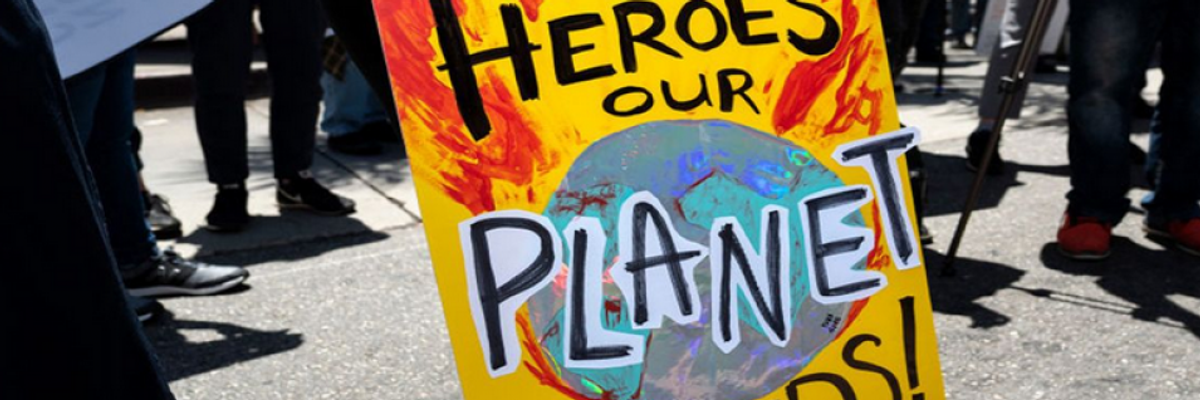
The United States, writes Whitehouse, "must adopt a recovery plan that addresses the intersecting crises of economy, climate, and justice through policies that speed the transition to clean energy, train unemployed workers for jobs in energy efficiency and renewable energy, make communities healthier and more resilient, promote smart growth and electric transit in cities, and restore biodiversity and soil health in rural areas." (Photo: Ronen Tivony / SOPA Images / LightRocket via Getty Images)
One of the very few welcome effects of the coronavirus epidemic was the decline in air pollution worldwide as factories shuttered and cars stayed parked. The respite allowed residents of usually smog-choked cities to breathe cleaner air for a change. By early April in the United States, carbon dioxide emissions had fallen 17% from the same time last year.
Unfortunately, while both the virus and the crushing economic effects of the shutdown remain with us, the gradual reopening of economies caused emissions to rebound. Meanwhile, total carbon dioxide in the atmosphere reached 417.1 parts per billion in May, the highest level in human history and likely the highest in 3 million years.
It can be hard for governments and people to stay focused on a long-term crisis like climate change when faced with immediate concerns like a pandemic, an explosion in unemployment and, most recently, new instances of police violence rooted in racism. It can be harder still to recognize how all of these crises are connected. Yet they are--and moreover, we will be successful in bringing the economy back from recession only if we address these problems together.
"If every crisis presents an opportunity, then these crises present an ultimatum."
Much has been written about the disproportionate impact of Covid-19 on racial minorities. The Centers for Disease Control reports higher rates of illness and death for Black and Hispanic persons than for white and Asian persons. This greater vulnerability results in part from higher rates of underlying diseases caused or exacerbated by air pollution, like asthma and diseases of the heart and lungs. These high rates are directly linked to our legacy of economic inequality and environmental racism, as facilities that cause air pollution are often built in low-income and minority neighborhoods.
It's also no secret that the economic fallout from the shutdowns has hit low-income and minority workers hardest. Overall, almost 40% of lower income Americans lost their jobs by early April, while only 13% of workers in households with income over $100,000 were similarly affected. At the end of May the unemployment rate for Black workers stood four percentage points higher than for white workers; for Hispanic workers, the gap was five percentage points. Among the results that experts predict are a housing crisis for low-wage earners and the exacerbation of income inequality.
These facts all point to the same conclusion: as the U.S. government strives to put the economy back on its feet, it won't be able to return to business as usual, and it should not try. Business as usual has propelled us towards ecological disaster and societal breakdown. We can do much better.
The U.S. must adopt a recovery plan that addresses the intersecting crises of economy, climate, and justice through policies that speed the transition to clean energy, train unemployed workers for jobs in energy efficiency and renewable energy, make communities healthier and more resilient, promote smart growth and electric transit in cities, and restore biodiversity and soil health in rural areas.
These policies directly respond to the crises facing society and the environment; they also make economic sense. State and local governments that are reeling from the coronavirus crisis should still recognize the wisdom of investing in the energy transition. Wind and solar are already cheaper than fossil fuels in most of the country, even before factoring in the toll that fossil fuels take on our health. Energy efficiency and building weatherization reduce energy costs and make buildings healthier. These technologies employ local workers at all skill levels, who can be trained at community colleges or on the job.
This is also the right time to begin redesigning our communities around people, not automobiles. Commerce, too, must become more human-centered, creating jobs in industries that don't depend for their success on harming the environment, workers, or powerless members of society. We must replace throwaway products with durable goods that are reused and recycled. We must keep fossil fuels in the ground. We must educate our children for jobs that allow them to support themselves with dignity.
These investments are critical to our prosperity and the habitability of the planet, but they won't happen by themselves--or at the pace we need to match the urgency of the crises we face--unless government takes the initiative. State and local leaders can only do so much; Congress must act.
In acting, however, we cannot forget our public servants. The Trump administration maintained three years of relentless assaults on public servants, attacking their credibility, motivations, and driving them from government. In doing so, the administration has cripple our country's ability to address not just the COVID-19 pandemic but all future crises.
If every crisis presents an opportunity, then these crises present an ultimatum: we have to address climate change, the economy, justice reforms, and rebuilding our government together, and we have to do it now.
Dear Common Dreams reader, It’s been nearly 30 years since I co-founded Common Dreams with my late wife, Lina Newhouser. We had the radical notion that journalism should serve the public good, not corporate profits. It was clear to us from the outset what it would take to build such a project. No paid advertisements. No corporate sponsors. No millionaire publisher telling us what to think or do. Many people said we wouldn't last a year, but we proved those doubters wrong. Together with a tremendous team of journalists and dedicated staff, we built an independent media outlet free from the constraints of profits and corporate control. Our mission has always been simple: To inform. To inspire. To ignite change for the common good. Building Common Dreams was not easy. Our survival was never guaranteed. When you take on the most powerful forces—Wall Street greed, fossil fuel industry destruction, Big Tech lobbyists, and uber-rich oligarchs who have spent billions upon billions rigging the economy and democracy in their favor—the only bulwark you have is supporters who believe in your work. But here’s the urgent message from me today. It's never been this bad out there. And it's never been this hard to keep us going. At the very moment Common Dreams is most needed, the threats we face are intensifying. We need your support now more than ever. We don't accept corporate advertising and never will. We don't have a paywall because we don't think people should be blocked from critical news based on their ability to pay. Everything we do is funded by the donations of readers like you. When everyone does the little they can afford, we are strong. But if that support retreats or dries up, so do we. Will you donate now to make sure Common Dreams not only survives but thrives? —Craig Brown, Co-founder |
One of the very few welcome effects of the coronavirus epidemic was the decline in air pollution worldwide as factories shuttered and cars stayed parked. The respite allowed residents of usually smog-choked cities to breathe cleaner air for a change. By early April in the United States, carbon dioxide emissions had fallen 17% from the same time last year.
Unfortunately, while both the virus and the crushing economic effects of the shutdown remain with us, the gradual reopening of economies caused emissions to rebound. Meanwhile, total carbon dioxide in the atmosphere reached 417.1 parts per billion in May, the highest level in human history and likely the highest in 3 million years.
It can be hard for governments and people to stay focused on a long-term crisis like climate change when faced with immediate concerns like a pandemic, an explosion in unemployment and, most recently, new instances of police violence rooted in racism. It can be harder still to recognize how all of these crises are connected. Yet they are--and moreover, we will be successful in bringing the economy back from recession only if we address these problems together.
"If every crisis presents an opportunity, then these crises present an ultimatum."
Much has been written about the disproportionate impact of Covid-19 on racial minorities. The Centers for Disease Control reports higher rates of illness and death for Black and Hispanic persons than for white and Asian persons. This greater vulnerability results in part from higher rates of underlying diseases caused or exacerbated by air pollution, like asthma and diseases of the heart and lungs. These high rates are directly linked to our legacy of economic inequality and environmental racism, as facilities that cause air pollution are often built in low-income and minority neighborhoods.
It's also no secret that the economic fallout from the shutdowns has hit low-income and minority workers hardest. Overall, almost 40% of lower income Americans lost their jobs by early April, while only 13% of workers in households with income over $100,000 were similarly affected. At the end of May the unemployment rate for Black workers stood four percentage points higher than for white workers; for Hispanic workers, the gap was five percentage points. Among the results that experts predict are a housing crisis for low-wage earners and the exacerbation of income inequality.
These facts all point to the same conclusion: as the U.S. government strives to put the economy back on its feet, it won't be able to return to business as usual, and it should not try. Business as usual has propelled us towards ecological disaster and societal breakdown. We can do much better.
The U.S. must adopt a recovery plan that addresses the intersecting crises of economy, climate, and justice through policies that speed the transition to clean energy, train unemployed workers for jobs in energy efficiency and renewable energy, make communities healthier and more resilient, promote smart growth and electric transit in cities, and restore biodiversity and soil health in rural areas.
These policies directly respond to the crises facing society and the environment; they also make economic sense. State and local governments that are reeling from the coronavirus crisis should still recognize the wisdom of investing in the energy transition. Wind and solar are already cheaper than fossil fuels in most of the country, even before factoring in the toll that fossil fuels take on our health. Energy efficiency and building weatherization reduce energy costs and make buildings healthier. These technologies employ local workers at all skill levels, who can be trained at community colleges or on the job.
This is also the right time to begin redesigning our communities around people, not automobiles. Commerce, too, must become more human-centered, creating jobs in industries that don't depend for their success on harming the environment, workers, or powerless members of society. We must replace throwaway products with durable goods that are reused and recycled. We must keep fossil fuels in the ground. We must educate our children for jobs that allow them to support themselves with dignity.
These investments are critical to our prosperity and the habitability of the planet, but they won't happen by themselves--or at the pace we need to match the urgency of the crises we face--unless government takes the initiative. State and local leaders can only do so much; Congress must act.
In acting, however, we cannot forget our public servants. The Trump administration maintained three years of relentless assaults on public servants, attacking their credibility, motivations, and driving them from government. In doing so, the administration has cripple our country's ability to address not just the COVID-19 pandemic but all future crises.
If every crisis presents an opportunity, then these crises present an ultimatum: we have to address climate change, the economy, justice reforms, and rebuilding our government together, and we have to do it now.
One of the very few welcome effects of the coronavirus epidemic was the decline in air pollution worldwide as factories shuttered and cars stayed parked. The respite allowed residents of usually smog-choked cities to breathe cleaner air for a change. By early April in the United States, carbon dioxide emissions had fallen 17% from the same time last year.
Unfortunately, while both the virus and the crushing economic effects of the shutdown remain with us, the gradual reopening of economies caused emissions to rebound. Meanwhile, total carbon dioxide in the atmosphere reached 417.1 parts per billion in May, the highest level in human history and likely the highest in 3 million years.
It can be hard for governments and people to stay focused on a long-term crisis like climate change when faced with immediate concerns like a pandemic, an explosion in unemployment and, most recently, new instances of police violence rooted in racism. It can be harder still to recognize how all of these crises are connected. Yet they are--and moreover, we will be successful in bringing the economy back from recession only if we address these problems together.
"If every crisis presents an opportunity, then these crises present an ultimatum."
Much has been written about the disproportionate impact of Covid-19 on racial minorities. The Centers for Disease Control reports higher rates of illness and death for Black and Hispanic persons than for white and Asian persons. This greater vulnerability results in part from higher rates of underlying diseases caused or exacerbated by air pollution, like asthma and diseases of the heart and lungs. These high rates are directly linked to our legacy of economic inequality and environmental racism, as facilities that cause air pollution are often built in low-income and minority neighborhoods.
It's also no secret that the economic fallout from the shutdowns has hit low-income and minority workers hardest. Overall, almost 40% of lower income Americans lost their jobs by early April, while only 13% of workers in households with income over $100,000 were similarly affected. At the end of May the unemployment rate for Black workers stood four percentage points higher than for white workers; for Hispanic workers, the gap was five percentage points. Among the results that experts predict are a housing crisis for low-wage earners and the exacerbation of income inequality.
These facts all point to the same conclusion: as the U.S. government strives to put the economy back on its feet, it won't be able to return to business as usual, and it should not try. Business as usual has propelled us towards ecological disaster and societal breakdown. We can do much better.
The U.S. must adopt a recovery plan that addresses the intersecting crises of economy, climate, and justice through policies that speed the transition to clean energy, train unemployed workers for jobs in energy efficiency and renewable energy, make communities healthier and more resilient, promote smart growth and electric transit in cities, and restore biodiversity and soil health in rural areas.
These policies directly respond to the crises facing society and the environment; they also make economic sense. State and local governments that are reeling from the coronavirus crisis should still recognize the wisdom of investing in the energy transition. Wind and solar are already cheaper than fossil fuels in most of the country, even before factoring in the toll that fossil fuels take on our health. Energy efficiency and building weatherization reduce energy costs and make buildings healthier. These technologies employ local workers at all skill levels, who can be trained at community colleges or on the job.
This is also the right time to begin redesigning our communities around people, not automobiles. Commerce, too, must become more human-centered, creating jobs in industries that don't depend for their success on harming the environment, workers, or powerless members of society. We must replace throwaway products with durable goods that are reused and recycled. We must keep fossil fuels in the ground. We must educate our children for jobs that allow them to support themselves with dignity.
These investments are critical to our prosperity and the habitability of the planet, but they won't happen by themselves--or at the pace we need to match the urgency of the crises we face--unless government takes the initiative. State and local leaders can only do so much; Congress must act.
In acting, however, we cannot forget our public servants. The Trump administration maintained three years of relentless assaults on public servants, attacking their credibility, motivations, and driving them from government. In doing so, the administration has cripple our country's ability to address not just the COVID-19 pandemic but all future crises.
If every crisis presents an opportunity, then these crises present an ultimatum: we have to address climate change, the economy, justice reforms, and rebuilding our government together, and we have to do it now.