

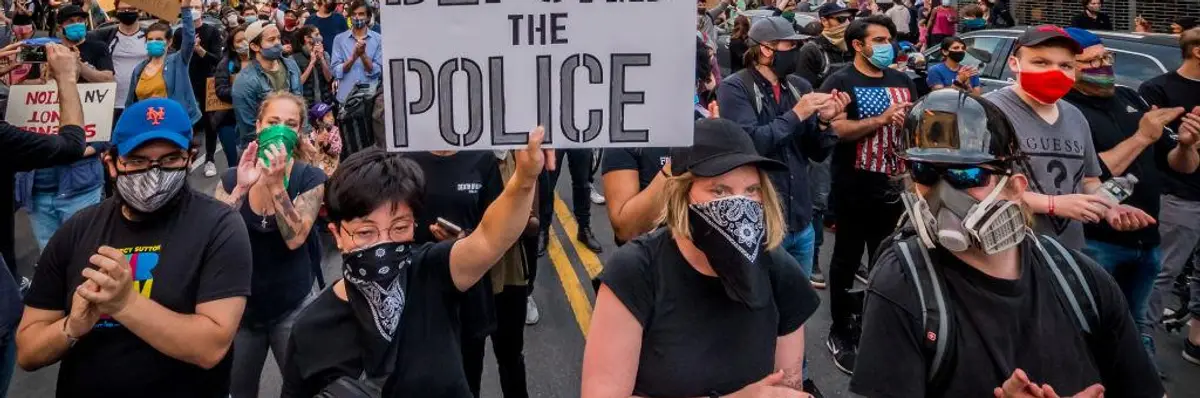
Climate justice is about far more than reducing emissions. It is about building a fairer and more just world. (Photo by Erik McGregor/LightRocket via Getty Images)
Caring About the Climate Crisis Means Supporting the Demand to Defund the Police
As anger rages across the country at the brutal killings of black and brown people, the climate movement must join the call to divest from the police and invest in communities.
Anyone who has watched the footage of a white police officer digging his knee into the neck of George Floyd should be able to understand the fury that is erupting across this country at the systemic devaluation of Black lives. But we need to do much more than simply understand it. Each of us needs to figure out what we, as individuals, as members of our own communities, as representatives of organizations, can actually do to meaningfully support the demands for change that are coming from the Movement for Black Lives.
Over the past weeks, months, and years, the Movement for Black Lives and many others have coalesced around a set of demands. One of them is that we should defund police departments across the country and invest those resources in community-based programs. This is a demand that all people and organizations that purport to support climate justice should be throwing their organizing weight behind.
When we choose to fund the police there are so many other things that we are choosing to not fund.Cities across the United States spend a mind-boggling portion of their overall budgets on policing. In dozens of cities across the country one in every three of our tax-payer dollars is spent on policing. In Minneapolis policing accounts for 35.8% of the city budget; in Oakland it's over 40%. In Baltimore, the average resident contributes $772 a year to the funding of the police; in Chicago, your personal tab for a heavily militarized police force is $537.
Few documents say more about who we are than our budgets. Budgets are an expression of our values and our priorities. Budgets are moral documents. When we talk about defunding the police, the question isn't simply should we be funding the police at the current exorbitant levels. The question is every bit as much about what we -- as a society, a city, a county, a state, a nation -- should be spending our money on.
In 2017, the City of Seattle, where I live, set aside $54 million to address the housing crisis. That's about 12% of the $410 million that the City gives to the Seattle Police Department every year. At the time there were more than 11,000 people experiencing houselessness in the Seattle region; a figure that hasn't budged much since. I think it is safe to say that had the Seattle's Police Department budget been 12% of what Seattle had dedicated to providing housing for those experiencing homelessness -- and not the other way around -- we would have seen better results.
When we choose to fund the police there are so many other things that we are choosing to not fund. To give just one example: The City of Seattle currently spends a paltry $11.5 million a year on the Office of Sustainability and Environment, which is the department charged with managing all of the city's work to address the climate crisis. That is to say that the City of Seattle currently spends thirty-five times more on policing than it does on programs to address the climate crisis.
Climate activists could do well to remember that every dollar we spend on funding the police is a dollar not spent on mental health programs, social workers, rehabilitation programs, education, the arts, and funding local Green New Deal programs.
The fact that the City of Seattle (like almost every other city in the country) spends more on police than on either the homelessness crisis or the climate crisis is, of course, only made more galling when you consider that the Seattle Police Department has been charged with systemic racial bias and constitutional violations regarding police violence, and has been responsible for the murders of multiple people over the last decade, including pregnant 30-year-old African American mother Charleena Lyles, and Native American woodcarver, John T. Williams, to name just two
All of this would make so much more sense if it actually worked. Yet, much of the evidence suggests that more cops does not result in less crime being committed.
It was, after all, our nation's militarized police force that brutalized nonviolent Indigenous water protectors and climate activists at Standing Rock. As a climate movement, we must also be clear-eyed about the role that the police play in defending fossil fuel companies that are hell-bent on pushing us toward climate collapse. It was, after all, our nation's militarized police force that brutalized nonviolent Indigenous water protectors and climate activists at Standing Rock. The unlawful arrests, the police brutality, and the indiscriminate use of tear gas that we are witnessing nightly right now: all have also been put to use defending the right of the fossil fuel industry to lock us into climate chaos.
There may be those that will say that calling for the defunding of police is a distraction for organizations focused on tackling the climate crisis. "We just need to focus on the emissions," they might say. This is not only myopic, it's damaging to the movement. Not only is calling for the defunding of police and for investments in programs that benefit communities -- and especially Black, Brown and Native communities -- absolutely the right and just thing to do, it is one very real way that the climate movement can work to build the broad, multiracial base that it needs to win.
Climate justice is about far more than reducing emissions. It is about building a fairer and more just world. It's about following the leadership of those that are most impacted by injustice. And right now, the climate movement has an opportunity to just that. It can start by getting behind the demand to defund the police.
We are at a crossroads
This country and this world are at a monumental crossroads. In a few short weeks, US voters will have an opportunity to beat back the forces of fascism and confront the billionaires who are rigging the economy, our media system, and our democracy, making it increasingly impossible for ordinary people to get by. We’re not just talking about the election. We’re talking about what must be done once these fascist elements are vanquished from power. We need a bolder set of solutions than what either major party has so far been willing to offer and a working-class movement ready to fight like hell for it. Trump didn't emerge from nowhere. The conditions that fueled MAGA authoritarianism were created by decades of radical neoliberal economic policies and a corrupt political system dominated by corporate interests. They slashed taxes on the super-rich, promising that the benefits would trickle down. They said giveaways to the corporate titans would make life more affordable for the rest of us. It was all bullshit. And when a bitter, betrayed populace searches for someone to blame, right-wing demagogues have little trouble finding scapegoats. People know when they're being lied to, but you won't hear any of this from the corporate media. Only independent journalism—powered and funded by people who believe in building a better world—can deliver truly trustworthy daily news. Our Fall Campaign is underway, and we need your help. To power our newsroom through the rest of the year, we need to raise $125,000 by midnight on October 31. So if you share our vision, please contribute whatever you can to sustain our work. |
Anyone who has watched the footage of a white police officer digging his knee into the neck of George Floyd should be able to understand the fury that is erupting across this country at the systemic devaluation of Black lives. But we need to do much more than simply understand it. Each of us needs to figure out what we, as individuals, as members of our own communities, as representatives of organizations, can actually do to meaningfully support the demands for change that are coming from the Movement for Black Lives.
Over the past weeks, months, and years, the Movement for Black Lives and many others have coalesced around a set of demands. One of them is that we should defund police departments across the country and invest those resources in community-based programs. This is a demand that all people and organizations that purport to support climate justice should be throwing their organizing weight behind.
When we choose to fund the police there are so many other things that we are choosing to not fund.Cities across the United States spend a mind-boggling portion of their overall budgets on policing. In dozens of cities across the country one in every three of our tax-payer dollars is spent on policing. In Minneapolis policing accounts for 35.8% of the city budget; in Oakland it's over 40%. In Baltimore, the average resident contributes $772 a year to the funding of the police; in Chicago, your personal tab for a heavily militarized police force is $537.
Few documents say more about who we are than our budgets. Budgets are an expression of our values and our priorities. Budgets are moral documents. When we talk about defunding the police, the question isn't simply should we be funding the police at the current exorbitant levels. The question is every bit as much about what we -- as a society, a city, a county, a state, a nation -- should be spending our money on.
In 2017, the City of Seattle, where I live, set aside $54 million to address the housing crisis. That's about 12% of the $410 million that the City gives to the Seattle Police Department every year. At the time there were more than 11,000 people experiencing houselessness in the Seattle region; a figure that hasn't budged much since. I think it is safe to say that had the Seattle's Police Department budget been 12% of what Seattle had dedicated to providing housing for those experiencing homelessness -- and not the other way around -- we would have seen better results.
When we choose to fund the police there are so many other things that we are choosing to not fund. To give just one example: The City of Seattle currently spends a paltry $11.5 million a year on the Office of Sustainability and Environment, which is the department charged with managing all of the city's work to address the climate crisis. That is to say that the City of Seattle currently spends thirty-five times more on policing than it does on programs to address the climate crisis.
Climate activists could do well to remember that every dollar we spend on funding the police is a dollar not spent on mental health programs, social workers, rehabilitation programs, education, the arts, and funding local Green New Deal programs.
The fact that the City of Seattle (like almost every other city in the country) spends more on police than on either the homelessness crisis or the climate crisis is, of course, only made more galling when you consider that the Seattle Police Department has been charged with systemic racial bias and constitutional violations regarding police violence, and has been responsible for the murders of multiple people over the last decade, including pregnant 30-year-old African American mother Charleena Lyles, and Native American woodcarver, John T. Williams, to name just two
All of this would make so much more sense if it actually worked. Yet, much of the evidence suggests that more cops does not result in less crime being committed.
It was, after all, our nation's militarized police force that brutalized nonviolent Indigenous water protectors and climate activists at Standing Rock. As a climate movement, we must also be clear-eyed about the role that the police play in defending fossil fuel companies that are hell-bent on pushing us toward climate collapse. It was, after all, our nation's militarized police force that brutalized nonviolent Indigenous water protectors and climate activists at Standing Rock. The unlawful arrests, the police brutality, and the indiscriminate use of tear gas that we are witnessing nightly right now: all have also been put to use defending the right of the fossil fuel industry to lock us into climate chaos.
There may be those that will say that calling for the defunding of police is a distraction for organizations focused on tackling the climate crisis. "We just need to focus on the emissions," they might say. This is not only myopic, it's damaging to the movement. Not only is calling for the defunding of police and for investments in programs that benefit communities -- and especially Black, Brown and Native communities -- absolutely the right and just thing to do, it is one very real way that the climate movement can work to build the broad, multiracial base that it needs to win.
Climate justice is about far more than reducing emissions. It is about building a fairer and more just world. It's about following the leadership of those that are most impacted by injustice. And right now, the climate movement has an opportunity to just that. It can start by getting behind the demand to defund the police.
Anyone who has watched the footage of a white police officer digging his knee into the neck of George Floyd should be able to understand the fury that is erupting across this country at the systemic devaluation of Black lives. But we need to do much more than simply understand it. Each of us needs to figure out what we, as individuals, as members of our own communities, as representatives of organizations, can actually do to meaningfully support the demands for change that are coming from the Movement for Black Lives.
Over the past weeks, months, and years, the Movement for Black Lives and many others have coalesced around a set of demands. One of them is that we should defund police departments across the country and invest those resources in community-based programs. This is a demand that all people and organizations that purport to support climate justice should be throwing their organizing weight behind.
When we choose to fund the police there are so many other things that we are choosing to not fund.Cities across the United States spend a mind-boggling portion of their overall budgets on policing. In dozens of cities across the country one in every three of our tax-payer dollars is spent on policing. In Minneapolis policing accounts for 35.8% of the city budget; in Oakland it's over 40%. In Baltimore, the average resident contributes $772 a year to the funding of the police; in Chicago, your personal tab for a heavily militarized police force is $537.
Few documents say more about who we are than our budgets. Budgets are an expression of our values and our priorities. Budgets are moral documents. When we talk about defunding the police, the question isn't simply should we be funding the police at the current exorbitant levels. The question is every bit as much about what we -- as a society, a city, a county, a state, a nation -- should be spending our money on.
In 2017, the City of Seattle, where I live, set aside $54 million to address the housing crisis. That's about 12% of the $410 million that the City gives to the Seattle Police Department every year. At the time there were more than 11,000 people experiencing houselessness in the Seattle region; a figure that hasn't budged much since. I think it is safe to say that had the Seattle's Police Department budget been 12% of what Seattle had dedicated to providing housing for those experiencing homelessness -- and not the other way around -- we would have seen better results.
When we choose to fund the police there are so many other things that we are choosing to not fund. To give just one example: The City of Seattle currently spends a paltry $11.5 million a year on the Office of Sustainability and Environment, which is the department charged with managing all of the city's work to address the climate crisis. That is to say that the City of Seattle currently spends thirty-five times more on policing than it does on programs to address the climate crisis.
Climate activists could do well to remember that every dollar we spend on funding the police is a dollar not spent on mental health programs, social workers, rehabilitation programs, education, the arts, and funding local Green New Deal programs.
The fact that the City of Seattle (like almost every other city in the country) spends more on police than on either the homelessness crisis or the climate crisis is, of course, only made more galling when you consider that the Seattle Police Department has been charged with systemic racial bias and constitutional violations regarding police violence, and has been responsible for the murders of multiple people over the last decade, including pregnant 30-year-old African American mother Charleena Lyles, and Native American woodcarver, John T. Williams, to name just two
All of this would make so much more sense if it actually worked. Yet, much of the evidence suggests that more cops does not result in less crime being committed.
It was, after all, our nation's militarized police force that brutalized nonviolent Indigenous water protectors and climate activists at Standing Rock. As a climate movement, we must also be clear-eyed about the role that the police play in defending fossil fuel companies that are hell-bent on pushing us toward climate collapse. It was, after all, our nation's militarized police force that brutalized nonviolent Indigenous water protectors and climate activists at Standing Rock. The unlawful arrests, the police brutality, and the indiscriminate use of tear gas that we are witnessing nightly right now: all have also been put to use defending the right of the fossil fuel industry to lock us into climate chaos.
There may be those that will say that calling for the defunding of police is a distraction for organizations focused on tackling the climate crisis. "We just need to focus on the emissions," they might say. This is not only myopic, it's damaging to the movement. Not only is calling for the defunding of police and for investments in programs that benefit communities -- and especially Black, Brown and Native communities -- absolutely the right and just thing to do, it is one very real way that the climate movement can work to build the broad, multiracial base that it needs to win.
Climate justice is about far more than reducing emissions. It is about building a fairer and more just world. It's about following the leadership of those that are most impacted by injustice. And right now, the climate movement has an opportunity to just that. It can start by getting behind the demand to defund the police.