SUBSCRIBE TO OUR FREE NEWSLETTER
Daily news & progressive opinion—funded by the people, not the corporations—delivered straight to your inbox.
5
#000000
#FFFFFF
To donate by check, phone, or other method, see our More Ways to Give page.
Daily news & progressive opinion—funded by the people, not the corporations—delivered straight to your inbox.
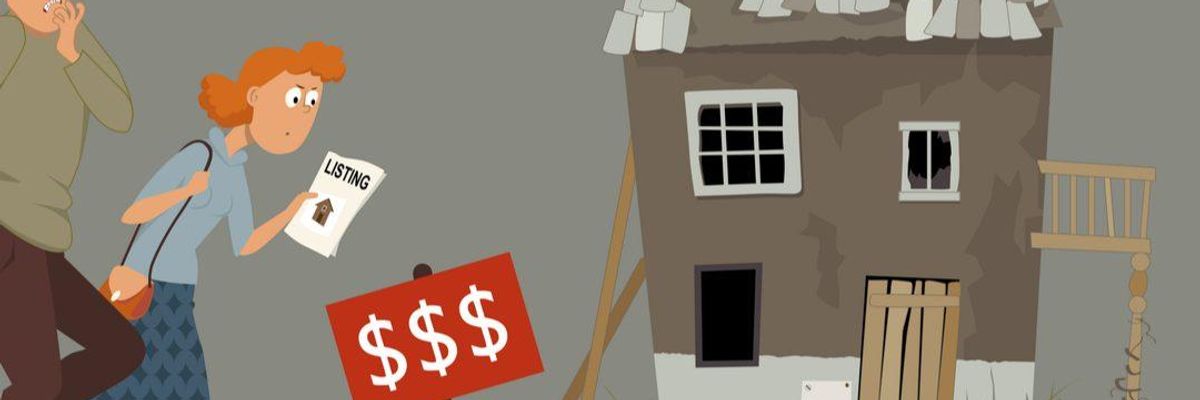
The good news is that housing is finally being addressed as the national crisis it is. (Photo: Shutterstock)
When I came of age in Flint, Michigan, homeownership was a crucial part of the American dream.
Often one income was sufficient to buy into this dream -- union GM jobs paid enough to buy a home and to support a family. Some of my friends' parents were even able to buy a second home, often a "cottage up north" in Michigan, where workers enjoyed weekends off.
Those days are long gone.
Where workers with high school educations once had a path to a first -- and even a second -- home, an advanced degree hasn't done the same for me. I'm a college professor, yet the fear of being homeless haunts me.
While many people are unhoused, a small number of wealthy people own multiple homes--including luxury houses and condos that just sit empty.
In 2013, I tried to buy a small home for under $100,000, but my student loan debt and low adjunct wages made it impossible.
I've spent my adult life working hard at multiple jobs, raising my son singlehandedly, and working toward an education I'd been led to believe would eventually pay off. So at almost 53 -- rent-burdened and insecure -- this failure to buy a home of my own was devastating.
But I'm not alone. Globally, the U.S. now ranks just 42nd in homeownership.
Every day, I hear housing nightmare stories across the country. Folks like me who can't buy a home because of student debt. Working people who are homeless because they can't afford high rents and/or property taxes. Women in abusive situations who can't afford to live on their own.
The traditional financial advice is not to spend more than 30 percent of your income on housing. This is a pipe dream. Recent research has shown that it's impossible to afford a two-bedroom apartment anywhere in the United States while working even full-time at minimum wage.
Yet while many people are unhoused, a small number of wealthy people own multiple homes -- including luxury houses and condos that just sit empty. And in many jurisdictions, housing laws benefit greedy landlords and house flippers, rather than ordinary people trying to find a roof.
In the words of Elena Herrada, a Detroit activist and educator who noted this trend in her hometown: "Now ten families live in one house and one person owns ten houses."
The good news is that housing is finally being addressed as the national crisis it is.
Senator Elizabeth Warren, for example, has noted with concern how the federal government has helped big investors outbid ordinary families trying to buy homes. "Over the last 10 years," she notes, "the Federal Housing Administration has helped massive private equity firms like Blackstone buy up over 200,000 single-family homes with the purpose of renting them. This has caused rents (and evictions) to increase in markets like Atlanta, Nashville, and elsewhere."
Meanwhile, Senator Bernie Sanders and Rep. Alexandria Ocasio-Cortez have teamed up to address both the climate crisis and the housing crisis. They envision transforming public housing into pleasant, safe, and environmentally sound spaces -- and dramatically expanding it.
This "Green New Deal for housing," the New York Times reports, involves "fundamental changes in how the housing market functions" -- including new national rent control protections and taxes on house flippers and land speculators who drive up housing costs for everyone else.
As anyone from Flint and Detroit could tell you, the American dream of owning a home is no longer possible for many of us. However, now a growing number of policymakers understand this is a policy shame -- not a personal one.
I doubt I'll ever own a home in my lifetime. But it's my hope that younger generations will be able to find a place to call their own.
Dear Common Dreams reader, It’s been nearly 30 years since I co-founded Common Dreams with my late wife, Lina Newhouser. We had the radical notion that journalism should serve the public good, not corporate profits. It was clear to us from the outset what it would take to build such a project. No paid advertisements. No corporate sponsors. No millionaire publisher telling us what to think or do. Many people said we wouldn't last a year, but we proved those doubters wrong. Together with a tremendous team of journalists and dedicated staff, we built an independent media outlet free from the constraints of profits and corporate control. Our mission has always been simple: To inform. To inspire. To ignite change for the common good. Building Common Dreams was not easy. Our survival was never guaranteed. When you take on the most powerful forces—Wall Street greed, fossil fuel industry destruction, Big Tech lobbyists, and uber-rich oligarchs who have spent billions upon billions rigging the economy and democracy in their favor—the only bulwark you have is supporters who believe in your work. But here’s the urgent message from me today. It's never been this bad out there. And it's never been this hard to keep us going. At the very moment Common Dreams is most needed, the threats we face are intensifying. We need your support now more than ever. We don't accept corporate advertising and never will. We don't have a paywall because we don't think people should be blocked from critical news based on their ability to pay. Everything we do is funded by the donations of readers like you. When everyone does the little they can afford, we are strong. But if that support retreats or dries up, so do we. Will you donate now to make sure Common Dreams not only survives but thrives? —Craig Brown, Co-founder |
When I came of age in Flint, Michigan, homeownership was a crucial part of the American dream.
Often one income was sufficient to buy into this dream -- union GM jobs paid enough to buy a home and to support a family. Some of my friends' parents were even able to buy a second home, often a "cottage up north" in Michigan, where workers enjoyed weekends off.
Those days are long gone.
Where workers with high school educations once had a path to a first -- and even a second -- home, an advanced degree hasn't done the same for me. I'm a college professor, yet the fear of being homeless haunts me.
While many people are unhoused, a small number of wealthy people own multiple homes--including luxury houses and condos that just sit empty.
In 2013, I tried to buy a small home for under $100,000, but my student loan debt and low adjunct wages made it impossible.
I've spent my adult life working hard at multiple jobs, raising my son singlehandedly, and working toward an education I'd been led to believe would eventually pay off. So at almost 53 -- rent-burdened and insecure -- this failure to buy a home of my own was devastating.
But I'm not alone. Globally, the U.S. now ranks just 42nd in homeownership.
Every day, I hear housing nightmare stories across the country. Folks like me who can't buy a home because of student debt. Working people who are homeless because they can't afford high rents and/or property taxes. Women in abusive situations who can't afford to live on their own.
The traditional financial advice is not to spend more than 30 percent of your income on housing. This is a pipe dream. Recent research has shown that it's impossible to afford a two-bedroom apartment anywhere in the United States while working even full-time at minimum wage.
Yet while many people are unhoused, a small number of wealthy people own multiple homes -- including luxury houses and condos that just sit empty. And in many jurisdictions, housing laws benefit greedy landlords and house flippers, rather than ordinary people trying to find a roof.
In the words of Elena Herrada, a Detroit activist and educator who noted this trend in her hometown: "Now ten families live in one house and one person owns ten houses."
The good news is that housing is finally being addressed as the national crisis it is.
Senator Elizabeth Warren, for example, has noted with concern how the federal government has helped big investors outbid ordinary families trying to buy homes. "Over the last 10 years," she notes, "the Federal Housing Administration has helped massive private equity firms like Blackstone buy up over 200,000 single-family homes with the purpose of renting them. This has caused rents (and evictions) to increase in markets like Atlanta, Nashville, and elsewhere."
Meanwhile, Senator Bernie Sanders and Rep. Alexandria Ocasio-Cortez have teamed up to address both the climate crisis and the housing crisis. They envision transforming public housing into pleasant, safe, and environmentally sound spaces -- and dramatically expanding it.
This "Green New Deal for housing," the New York Times reports, involves "fundamental changes in how the housing market functions" -- including new national rent control protections and taxes on house flippers and land speculators who drive up housing costs for everyone else.
As anyone from Flint and Detroit could tell you, the American dream of owning a home is no longer possible for many of us. However, now a growing number of policymakers understand this is a policy shame -- not a personal one.
I doubt I'll ever own a home in my lifetime. But it's my hope that younger generations will be able to find a place to call their own.
When I came of age in Flint, Michigan, homeownership was a crucial part of the American dream.
Often one income was sufficient to buy into this dream -- union GM jobs paid enough to buy a home and to support a family. Some of my friends' parents were even able to buy a second home, often a "cottage up north" in Michigan, where workers enjoyed weekends off.
Those days are long gone.
Where workers with high school educations once had a path to a first -- and even a second -- home, an advanced degree hasn't done the same for me. I'm a college professor, yet the fear of being homeless haunts me.
While many people are unhoused, a small number of wealthy people own multiple homes--including luxury houses and condos that just sit empty.
In 2013, I tried to buy a small home for under $100,000, but my student loan debt and low adjunct wages made it impossible.
I've spent my adult life working hard at multiple jobs, raising my son singlehandedly, and working toward an education I'd been led to believe would eventually pay off. So at almost 53 -- rent-burdened and insecure -- this failure to buy a home of my own was devastating.
But I'm not alone. Globally, the U.S. now ranks just 42nd in homeownership.
Every day, I hear housing nightmare stories across the country. Folks like me who can't buy a home because of student debt. Working people who are homeless because they can't afford high rents and/or property taxes. Women in abusive situations who can't afford to live on their own.
The traditional financial advice is not to spend more than 30 percent of your income on housing. This is a pipe dream. Recent research has shown that it's impossible to afford a two-bedroom apartment anywhere in the United States while working even full-time at minimum wage.
Yet while many people are unhoused, a small number of wealthy people own multiple homes -- including luxury houses and condos that just sit empty. And in many jurisdictions, housing laws benefit greedy landlords and house flippers, rather than ordinary people trying to find a roof.
In the words of Elena Herrada, a Detroit activist and educator who noted this trend in her hometown: "Now ten families live in one house and one person owns ten houses."
The good news is that housing is finally being addressed as the national crisis it is.
Senator Elizabeth Warren, for example, has noted with concern how the federal government has helped big investors outbid ordinary families trying to buy homes. "Over the last 10 years," she notes, "the Federal Housing Administration has helped massive private equity firms like Blackstone buy up over 200,000 single-family homes with the purpose of renting them. This has caused rents (and evictions) to increase in markets like Atlanta, Nashville, and elsewhere."
Meanwhile, Senator Bernie Sanders and Rep. Alexandria Ocasio-Cortez have teamed up to address both the climate crisis and the housing crisis. They envision transforming public housing into pleasant, safe, and environmentally sound spaces -- and dramatically expanding it.
This "Green New Deal for housing," the New York Times reports, involves "fundamental changes in how the housing market functions" -- including new national rent control protections and taxes on house flippers and land speculators who drive up housing costs for everyone else.
As anyone from Flint and Detroit could tell you, the American dream of owning a home is no longer possible for many of us. However, now a growing number of policymakers understand this is a policy shame -- not a personal one.
I doubt I'll ever own a home in my lifetime. But it's my hope that younger generations will be able to find a place to call their own.