SUBSCRIBE TO OUR FREE NEWSLETTER
Daily news & progressive opinion—funded by the people, not the corporations—delivered straight to your inbox.
5
#000000
#FFFFFF
To donate by check, phone, or other method, see our More Ways to Give page.
Daily news & progressive opinion—funded by the people, not the corporations—delivered straight to your inbox.
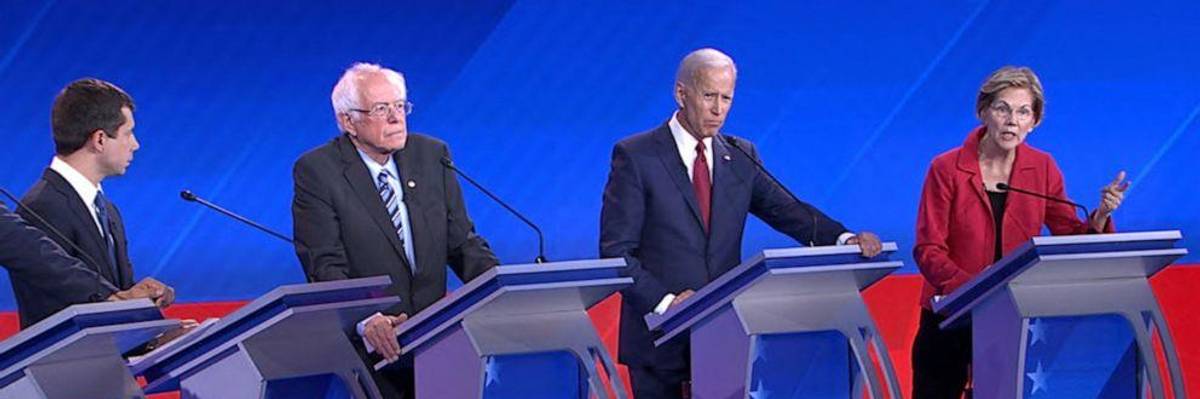
Democratic presidential candidates (from left) Pete Buttigieg, Bernie Sanders, Joe Biden, and Elizabeth Warren. (Photo: ABC News/Univision)
After CNN's remarkably substantive and thoughtful town hall on the climate crisis (9/4/19), we wrote that the following debates now had a solid foundation from which to go deeper on climate for a larger audience (FAIR.org, 9/6/19). Unfortunately, ABC (9/12/19) took it as an opportunity to do even less on the crisis than previous debates.
Only three climate questions were asked, by Univision anchor Jorge Ramos. The first, a query to vegan candidate Cory Booker about whether "more Americans [should] follow your diet," was not even a policy question.
The second, to Beto O'Rourke, ostensibly came from a viewer: "What meaningful action will you take to reverse the effect of climate change? And can we count on you to follow through if your donors are against it?" While the question appeared to allude to O'Rourke's history of coziness with the fossil fuel industry, the lack of any further context allowed him to answer it with his boilerplate climate plan language. Shouldn't we be beyond this by now, after two debates and a town hall?
The candidates were eager to talk more, but ABC apparently felt its work was basically done, as Ramos made clear: "Many of you want to comment. Let's see if we can go very fast. Senator Klobuchar?" The only remaining question--a brief yes or no, but still perhaps the most substantive of the batch--went to Elizabeth Warren: "Should American foreign policy be based around the principle of climate change?"
Ramos wrapped it up by giving Kamala Harris and then Andrew Yang the floor, and, without being pinned down on any policy in particular, Harris spoke about "courageous leadership" and Yang about giving everyone $100 to give to candidates and causes in order to "wash out the lobbyist cash."
In the section reserved for foreign policy and national security issues, the moderators displayed a hawkish agenda, continually pushing the candidates to take a more adversarial and militant line with other countries. This was most obvious in David Muir's line of questions on Afghanistan, which he prefaced by saying: "Many of you on this stage have said you'd bring the troops home in your first term. Others have said in your first year." He then asked Warren, "Would you keep that promise to bring the troops home starting right now with no deal with the Taliban?"
When Warren gave the only possible answer to that question--yes--George Stephanopoulos broke in to make it clear that that was the wrong one:
Top US leaders, military leaders on the ground in Afghanistan, told me you can't do it without a deal with the Taliban. You just said you would, you would bring them home. What if they told you that? Would you listen to their advice?
The same assumption that civilian presidents should normally defer to the judgment of the military was the basis for the next question, to Pete Buttigieg, which cited the authority of Joint Chiefs of Staff chair Gen. Joseph Dunford: "If he's not even using the word withdrawal, would you put your promise to bring troops home in the first year on hold to follow the advice?"
Joe Biden and Sanders were given versions of the question of whether they would "pull out US troops too quickly from Afghanistan"--meaning after 19 years, which is how long the US would have occupied the country by the time either would be sworn in as president. (See FAIR.org, 9/11/19, on media's obsession with a "premature" withdrawal from Afghanistan.)
On Latin America, which as Jorge Ramos noted had not been asked about in the previous debates, the focus was on why Sanders hadn't called Venezuelan President Nicolas Maduro a "dictator," with some gratuitous redbaiting thrown in as the Vermont senator was challenged to distinguish his brand of socialism from that "being imposed" in Venezuela, Cuba and Nicaragua. (As Alan MacLeod has noted, "dictator" is a word reserved in US media for governments out of favor with Washington--FAIR.org, 4/11/19.)
Trade, which was the other major focus of the foreign policy section, was given a similarly bellicose treatment. If Andrew Yang repealed the tariffs imposed by Trump, asked Stephanopoulos, "would you risk losing leverage in our trade relationship with China?" Is Trump right, he asked Buttigieg, that "the Chinese are just going to wait him out so that they can get a Democrat who they can take advantage of"? Julian Castro was reminded that he had previously "identified China as the most serious national security threat to our country."
The ABC debate was held at Texas Southern University, a historically black university, and the network--explicitly noting this--raised race-related issues second in the debate, after healthcare. What the network seemed to forget was that half of people of color are women, who face issues like access to reproductive healthcare and lack of gender equity to even greater degrees than white women.
For instance, white female full-time workers earn 81.5% of white male earnings; black women earn 65.3% and Hispanic women earn 61.6% of white male earnings. And while white men aged 18-64 average nearly $29,000 in wealth, white women average just over $15,000--but their black and Hispanic female counterparts average $200 and $100, respectively.
But ABC asked exactly zero questions about such issues.
You can send messages to ABC News here (or via Twitter: @ABC). Please remember that respectful communication is the most effective. Feel free to leave a copy of your message in the comments thread.
Dear Common Dreams reader, It’s been nearly 30 years since I co-founded Common Dreams with my late wife, Lina Newhouser. We had the radical notion that journalism should serve the public good, not corporate profits. It was clear to us from the outset what it would take to build such a project. No paid advertisements. No corporate sponsors. No millionaire publisher telling us what to think or do. Many people said we wouldn't last a year, but we proved those doubters wrong. Together with a tremendous team of journalists and dedicated staff, we built an independent media outlet free from the constraints of profits and corporate control. Our mission has always been simple: To inform. To inspire. To ignite change for the common good. Building Common Dreams was not easy. Our survival was never guaranteed. When you take on the most powerful forces—Wall Street greed, fossil fuel industry destruction, Big Tech lobbyists, and uber-rich oligarchs who have spent billions upon billions rigging the economy and democracy in their favor—the only bulwark you have is supporters who believe in your work. But here’s the urgent message from me today. It's never been this bad out there. And it's never been this hard to keep us going. At the very moment Common Dreams is most needed, the threats we face are intensifying. We need your support now more than ever. We don't accept corporate advertising and never will. We don't have a paywall because we don't think people should be blocked from critical news based on their ability to pay. Everything we do is funded by the donations of readers like you. When everyone does the little they can afford, we are strong. But if that support retreats or dries up, so do we. Will you donate now to make sure Common Dreams not only survives but thrives? —Craig Brown, Co-founder |
After CNN's remarkably substantive and thoughtful town hall on the climate crisis (9/4/19), we wrote that the following debates now had a solid foundation from which to go deeper on climate for a larger audience (FAIR.org, 9/6/19). Unfortunately, ABC (9/12/19) took it as an opportunity to do even less on the crisis than previous debates.
Only three climate questions were asked, by Univision anchor Jorge Ramos. The first, a query to vegan candidate Cory Booker about whether "more Americans [should] follow your diet," was not even a policy question.
The second, to Beto O'Rourke, ostensibly came from a viewer: "What meaningful action will you take to reverse the effect of climate change? And can we count on you to follow through if your donors are against it?" While the question appeared to allude to O'Rourke's history of coziness with the fossil fuel industry, the lack of any further context allowed him to answer it with his boilerplate climate plan language. Shouldn't we be beyond this by now, after two debates and a town hall?
The candidates were eager to talk more, but ABC apparently felt its work was basically done, as Ramos made clear: "Many of you want to comment. Let's see if we can go very fast. Senator Klobuchar?" The only remaining question--a brief yes or no, but still perhaps the most substantive of the batch--went to Elizabeth Warren: "Should American foreign policy be based around the principle of climate change?"
Ramos wrapped it up by giving Kamala Harris and then Andrew Yang the floor, and, without being pinned down on any policy in particular, Harris spoke about "courageous leadership" and Yang about giving everyone $100 to give to candidates and causes in order to "wash out the lobbyist cash."
In the section reserved for foreign policy and national security issues, the moderators displayed a hawkish agenda, continually pushing the candidates to take a more adversarial and militant line with other countries. This was most obvious in David Muir's line of questions on Afghanistan, which he prefaced by saying: "Many of you on this stage have said you'd bring the troops home in your first term. Others have said in your first year." He then asked Warren, "Would you keep that promise to bring the troops home starting right now with no deal with the Taliban?"
When Warren gave the only possible answer to that question--yes--George Stephanopoulos broke in to make it clear that that was the wrong one:
Top US leaders, military leaders on the ground in Afghanistan, told me you can't do it without a deal with the Taliban. You just said you would, you would bring them home. What if they told you that? Would you listen to their advice?
The same assumption that civilian presidents should normally defer to the judgment of the military was the basis for the next question, to Pete Buttigieg, which cited the authority of Joint Chiefs of Staff chair Gen. Joseph Dunford: "If he's not even using the word withdrawal, would you put your promise to bring troops home in the first year on hold to follow the advice?"
Joe Biden and Sanders were given versions of the question of whether they would "pull out US troops too quickly from Afghanistan"--meaning after 19 years, which is how long the US would have occupied the country by the time either would be sworn in as president. (See FAIR.org, 9/11/19, on media's obsession with a "premature" withdrawal from Afghanistan.)
On Latin America, which as Jorge Ramos noted had not been asked about in the previous debates, the focus was on why Sanders hadn't called Venezuelan President Nicolas Maduro a "dictator," with some gratuitous redbaiting thrown in as the Vermont senator was challenged to distinguish his brand of socialism from that "being imposed" in Venezuela, Cuba and Nicaragua. (As Alan MacLeod has noted, "dictator" is a word reserved in US media for governments out of favor with Washington--FAIR.org, 4/11/19.)
Trade, which was the other major focus of the foreign policy section, was given a similarly bellicose treatment. If Andrew Yang repealed the tariffs imposed by Trump, asked Stephanopoulos, "would you risk losing leverage in our trade relationship with China?" Is Trump right, he asked Buttigieg, that "the Chinese are just going to wait him out so that they can get a Democrat who they can take advantage of"? Julian Castro was reminded that he had previously "identified China as the most serious national security threat to our country."
The ABC debate was held at Texas Southern University, a historically black university, and the network--explicitly noting this--raised race-related issues second in the debate, after healthcare. What the network seemed to forget was that half of people of color are women, who face issues like access to reproductive healthcare and lack of gender equity to even greater degrees than white women.
For instance, white female full-time workers earn 81.5% of white male earnings; black women earn 65.3% and Hispanic women earn 61.6% of white male earnings. And while white men aged 18-64 average nearly $29,000 in wealth, white women average just over $15,000--but their black and Hispanic female counterparts average $200 and $100, respectively.
But ABC asked exactly zero questions about such issues.
You can send messages to ABC News here (or via Twitter: @ABC). Please remember that respectful communication is the most effective. Feel free to leave a copy of your message in the comments thread.
After CNN's remarkably substantive and thoughtful town hall on the climate crisis (9/4/19), we wrote that the following debates now had a solid foundation from which to go deeper on climate for a larger audience (FAIR.org, 9/6/19). Unfortunately, ABC (9/12/19) took it as an opportunity to do even less on the crisis than previous debates.
Only three climate questions were asked, by Univision anchor Jorge Ramos. The first, a query to vegan candidate Cory Booker about whether "more Americans [should] follow your diet," was not even a policy question.
The second, to Beto O'Rourke, ostensibly came from a viewer: "What meaningful action will you take to reverse the effect of climate change? And can we count on you to follow through if your donors are against it?" While the question appeared to allude to O'Rourke's history of coziness with the fossil fuel industry, the lack of any further context allowed him to answer it with his boilerplate climate plan language. Shouldn't we be beyond this by now, after two debates and a town hall?
The candidates were eager to talk more, but ABC apparently felt its work was basically done, as Ramos made clear: "Many of you want to comment. Let's see if we can go very fast. Senator Klobuchar?" The only remaining question--a brief yes or no, but still perhaps the most substantive of the batch--went to Elizabeth Warren: "Should American foreign policy be based around the principle of climate change?"
Ramos wrapped it up by giving Kamala Harris and then Andrew Yang the floor, and, without being pinned down on any policy in particular, Harris spoke about "courageous leadership" and Yang about giving everyone $100 to give to candidates and causes in order to "wash out the lobbyist cash."
In the section reserved for foreign policy and national security issues, the moderators displayed a hawkish agenda, continually pushing the candidates to take a more adversarial and militant line with other countries. This was most obvious in David Muir's line of questions on Afghanistan, which he prefaced by saying: "Many of you on this stage have said you'd bring the troops home in your first term. Others have said in your first year." He then asked Warren, "Would you keep that promise to bring the troops home starting right now with no deal with the Taliban?"
When Warren gave the only possible answer to that question--yes--George Stephanopoulos broke in to make it clear that that was the wrong one:
Top US leaders, military leaders on the ground in Afghanistan, told me you can't do it without a deal with the Taliban. You just said you would, you would bring them home. What if they told you that? Would you listen to their advice?
The same assumption that civilian presidents should normally defer to the judgment of the military was the basis for the next question, to Pete Buttigieg, which cited the authority of Joint Chiefs of Staff chair Gen. Joseph Dunford: "If he's not even using the word withdrawal, would you put your promise to bring troops home in the first year on hold to follow the advice?"
Joe Biden and Sanders were given versions of the question of whether they would "pull out US troops too quickly from Afghanistan"--meaning after 19 years, which is how long the US would have occupied the country by the time either would be sworn in as president. (See FAIR.org, 9/11/19, on media's obsession with a "premature" withdrawal from Afghanistan.)
On Latin America, which as Jorge Ramos noted had not been asked about in the previous debates, the focus was on why Sanders hadn't called Venezuelan President Nicolas Maduro a "dictator," with some gratuitous redbaiting thrown in as the Vermont senator was challenged to distinguish his brand of socialism from that "being imposed" in Venezuela, Cuba and Nicaragua. (As Alan MacLeod has noted, "dictator" is a word reserved in US media for governments out of favor with Washington--FAIR.org, 4/11/19.)
Trade, which was the other major focus of the foreign policy section, was given a similarly bellicose treatment. If Andrew Yang repealed the tariffs imposed by Trump, asked Stephanopoulos, "would you risk losing leverage in our trade relationship with China?" Is Trump right, he asked Buttigieg, that "the Chinese are just going to wait him out so that they can get a Democrat who they can take advantage of"? Julian Castro was reminded that he had previously "identified China as the most serious national security threat to our country."
The ABC debate was held at Texas Southern University, a historically black university, and the network--explicitly noting this--raised race-related issues second in the debate, after healthcare. What the network seemed to forget was that half of people of color are women, who face issues like access to reproductive healthcare and lack of gender equity to even greater degrees than white women.
For instance, white female full-time workers earn 81.5% of white male earnings; black women earn 65.3% and Hispanic women earn 61.6% of white male earnings. And while white men aged 18-64 average nearly $29,000 in wealth, white women average just over $15,000--but their black and Hispanic female counterparts average $200 and $100, respectively.
But ABC asked exactly zero questions about such issues.
You can send messages to ABC News here (or via Twitter: @ABC). Please remember that respectful communication is the most effective. Feel free to leave a copy of your message in the comments thread.