SUBSCRIBE TO OUR FREE NEWSLETTER
Daily news & progressive opinion—funded by the people, not the corporations—delivered straight to your inbox.
5
#000000
#FFFFFF
To donate by check, phone, or other method, see our More Ways to Give page.

Thomas Edsall's demographic analysis is almost always misleading (FAIR.org, 2/10/15, 10/9/15, 6/5/16, 3/30/18, 7/24/19)--and his latest column for the New York Times (8/28/19) is no exception.
"We Aren't Seeing White Support for Trump for What It Is," the headline complains--with the subhead explaining, "A crucial part of his coalition is made up of better-off white people who did not graduate from college."
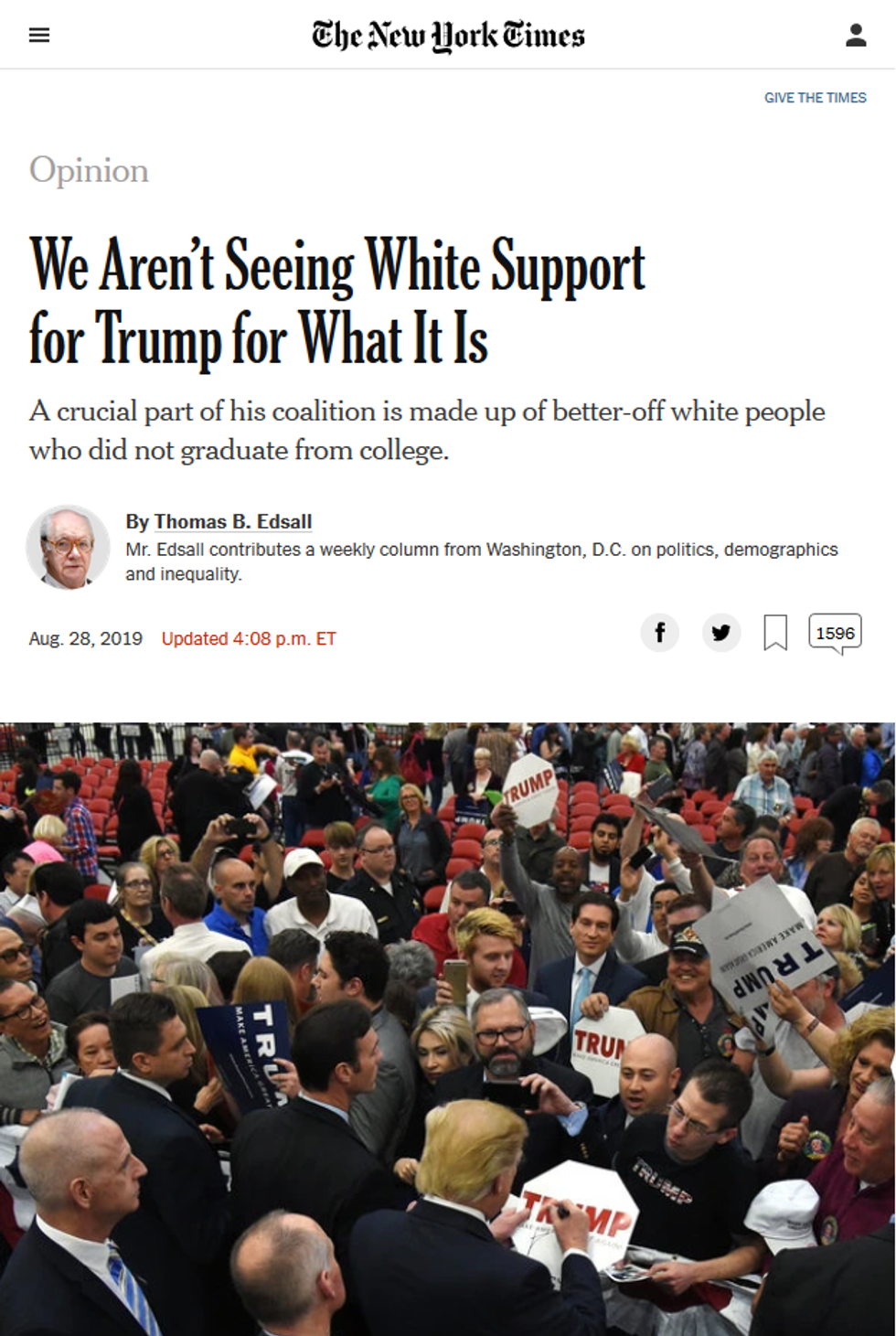
Why does this matter? Edsall's column is largely a write-up of a paper by two political scientists, Herbert Kitschelt and Philipp Rehm, who note that better-off whites without college degrees "tend to endorse authoritarian noneconomic policies and tend to oppose progressive economic policies," and are therefore "a constituency that is now decisively committed to the Republican Party." (By "authoritarian policies," the researchers are mainly talking about racism and xenophobia.) Low-income, low-education whites, by contrast, "tend to support progressive economic policies and tend to endorse authoritarian policies on the noneconomic dimension," and are therefore "conflicted in their partisan allegiance."
What's at stake in presenting one of these constituencies as "crucial" is how you approach the task of defeating Trump: If he's turning out his key supporters through race-baiting and immigrant-bashing, the argument goes, then Democrats need to take care not to be too outspoken on issues of race and immigration. And so Edsall confidently concludes:
The 2020 election will be fought over the current loss of certainty--the absolute lack of consensus--on the issue of "race."... Democrats are convinced of the justness of the liberal, humanistic, enlightenment tradition of expanding rights for racial and ethnic minorities. Republicans, less so.... If Democrats want to give themselves the best shot of getting Trump out of the White House...they must make concerted efforts at pragmatic diplomacy and persuasion--and show a new level of empathy.
(This is an argument Edsall has made before--see "What's a Non-Racist Way to Appeal to Working-Class Whites? NYT's Edsall Can't Think of Any," FAIR.org, 3/30/18.)
But there's an entirely different conclusion that one can draw from the 21st century political terrain--one that is better supported by the data presented in Edsall's column. Take a close look at the graphic he presents depicting "the shifting voting patterns of whites":
Bear in mind that these are not equal slices of the electorate: As Edsall notes, the low-income, low-education voters are about 40% of white voters; the high-income, low-education voters are 22%; the low-income, high-education group is 14%; and the high-income, high-education make up 26% of the white vote.
So the supposedly "crucial" better-off white non-college grads are about half as plentiful as their poorer counterparts--and they have been voting Republican fairly consistently since 1972, through good years for Republicans and bad. What was actually crucial to Trump's 2016 success is that the larger group of poorer less-educated whites, which traditionally leans Democratic or splits its vote, went decisively Republican.
And while this group was susceptible to Trump's racist appeals, equally important (according to Edsall's political scientist sources) was his "repeated campaign promise to protect Medicare and Social Security." The false impression that Trump was a moderate Republican on economic issues "removed cognitive dissonance and inhibitions" that might deter such voters from supporting an economic conservative, leaving them free to be swayed by Trump's appeal to a white racial identity.
If that's the truly crucial group, then Democrats will not win the 2020 election by embracing, as Edsall seems to suggest, an agnosticism on the issue of race (or "the issue of 'race,'" as he puts it), but rather by advancing a strongly progressive, redistributionist economic message. It's political common sense that if the voters who are up for grabs are those who are socially conservative and economically progressive, then Democrats should emphasize left-wing economics and Republicans should stress right-wing social policies--while crucially reassuring their bases that they maintain their commitments to a progressive social agenda or a conservative economic program, respectively. (See FAIR.org, 6/20/17.)
But this common sense runs against the New York Times' historic role of guiding the Democratic Party away from positions that threaten the wealthy. This is why Adolph Ochs, great-great-grandfather of the current Times publisher, was bankrolled by bankers to buy the paper in 1896 (FAIR.org, 10/28/17), and it's why the paper today has an editorial page editor who proudly declares, "The New York Times is in favor of capitalism" (FAIR.org, 3/1/18). Edsall, it seems, has the task of providing the intellectual arguments for why the Democrats should not adopt the progressive economic agenda that would benefit them electorally--a job that necessarily involves a great deal of doubletalk and hand-waving.
Thomas Edsall's demographic analysis is almost always misleading (FAIR.org, 2/10/15, 10/9/15, 6/5/16, 3/30/18, 7/24/19)--and his latest column for the New York Times (8/28/19) is no exception.
"We Aren't Seeing White Support for Trump for What It Is," the headline complains--with the subhead explaining, "A crucial part of his coalition is made up of better-off white people who did not graduate from college."
Why does this matter? Edsall's column is largely a write-up of a paper by two political scientists, Herbert Kitschelt and Philipp Rehm, who note that better-off whites without college degrees "tend to endorse authoritarian noneconomic policies and tend to oppose progressive economic policies," and are therefore "a constituency that is now decisively committed to the Republican Party." (By "authoritarian policies," the researchers are mainly talking about racism and xenophobia.) Low-income, low-education whites, by contrast, "tend to support progressive economic policies and tend to endorse authoritarian policies on the noneconomic dimension," and are therefore "conflicted in their partisan allegiance."
What's at stake in presenting one of these constituencies as "crucial" is how you approach the task of defeating Trump: If he's turning out his key supporters through race-baiting and immigrant-bashing, the argument goes, then Democrats need to take care not to be too outspoken on issues of race and immigration. And so Edsall confidently concludes:
The 2020 election will be fought over the current loss of certainty--the absolute lack of consensus--on the issue of "race."... Democrats are convinced of the justness of the liberal, humanistic, enlightenment tradition of expanding rights for racial and ethnic minorities. Republicans, less so.... If Democrats want to give themselves the best shot of getting Trump out of the White House...they must make concerted efforts at pragmatic diplomacy and persuasion--and show a new level of empathy.
(This is an argument Edsall has made before--see "What's a Non-Racist Way to Appeal to Working-Class Whites? NYT's Edsall Can't Think of Any," FAIR.org, 3/30/18.)
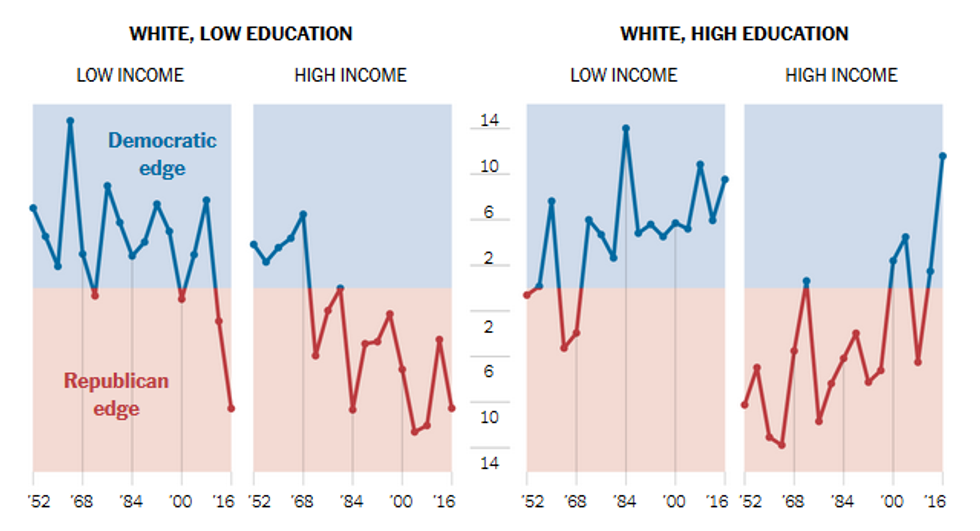
But there's an entirely different conclusion that one can draw from the 21st century political terrain--one that is better supported by the data presented in Edsall's column. Take a close look at the graphic he presents depicting "the shifting voting patterns of whites":
Bear in mind that these are not equal slices of the electorate: As Edsall notes, the low-income, low-education voters are about 40% of white voters; the high-income, low-education voters are 22%; the low-income, high-education group is 14%; and the high-income, high-education make up 26% of the white vote.
So the supposedly "crucial" better-off white non-college grads are about half as plentiful as their poorer counterparts--and they have been voting Republican fairly consistently since 1972, through good years for Republicans and bad. What was actually crucial to Trump's 2016 success is that the larger group of poorer less-educated whites, which traditionally leans Democratic or splits its vote, went decisively Republican.
And while this group was susceptible to Trump's racist appeals, equally important (according to Edsall's political scientist sources) was his "repeated campaign promise to protect Medicare and Social Security." The false impression that Trump was a moderate Republican on economic issues "removed cognitive dissonance and inhibitions" that might deter such voters from supporting an economic conservative, leaving them free to be swayed by Trump's appeal to a white racial identity.
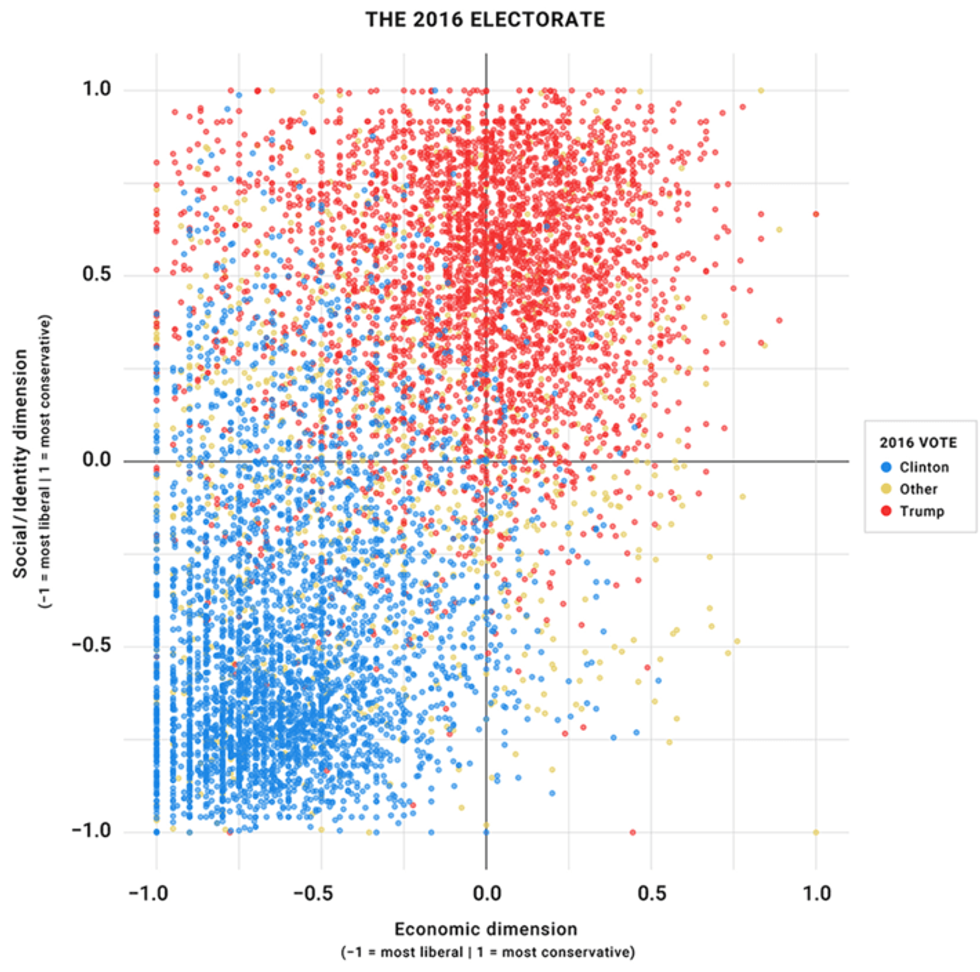
If that's the truly crucial group, then Democrats will not win the 2020 election by embracing, as Edsall seems to suggest, an agnosticism on the issue of race (or "the issue of 'race,'" as he puts it), but rather by advancing a strongly progressive, redistributionist economic message. It's political common sense that if the voters who are up for grabs are those who are socially conservative and economically progressive, then Democrats should emphasize left-wing economics and Republicans should stress right-wing social policies--while crucially reassuring their bases that they maintain their commitments to a progressive social agenda or a conservative economic program, respectively. (See FAIR.org, 6/20/17.)
But this common sense runs against the New York Times' historic role of guiding the Democratic Party away from positions that threaten the wealthy. This is why Adolph Ochs, great-great-grandfather of the current Times publisher, was bankrolled by bankers to buy the paper in 1896 (FAIR.org, 10/28/17), and it's why the paper today has an editorial page editor who proudly declares, "The New York Times is in favor of capitalism" (FAIR.org, 3/1/18). Edsall, it seems, has the task of providing the intellectual arguments for why the Democrats should not adopt the progressive economic agenda that would benefit them electorally--a job that necessarily involves a great deal of doubletalk and hand-waving.
Thomas Edsall's demographic analysis is almost always misleading (FAIR.org, 2/10/15, 10/9/15, 6/5/16, 3/30/18, 7/24/19)--and his latest column for the New York Times (8/28/19) is no exception.
"We Aren't Seeing White Support for Trump for What It Is," the headline complains--with the subhead explaining, "A crucial part of his coalition is made up of better-off white people who did not graduate from college."
Why does this matter? Edsall's column is largely a write-up of a paper by two political scientists, Herbert Kitschelt and Philipp Rehm, who note that better-off whites without college degrees "tend to endorse authoritarian noneconomic policies and tend to oppose progressive economic policies," and are therefore "a constituency that is now decisively committed to the Republican Party." (By "authoritarian policies," the researchers are mainly talking about racism and xenophobia.) Low-income, low-education whites, by contrast, "tend to support progressive economic policies and tend to endorse authoritarian policies on the noneconomic dimension," and are therefore "conflicted in their partisan allegiance."
What's at stake in presenting one of these constituencies as "crucial" is how you approach the task of defeating Trump: If he's turning out his key supporters through race-baiting and immigrant-bashing, the argument goes, then Democrats need to take care not to be too outspoken on issues of race and immigration. And so Edsall confidently concludes:
The 2020 election will be fought over the current loss of certainty--the absolute lack of consensus--on the issue of "race."... Democrats are convinced of the justness of the liberal, humanistic, enlightenment tradition of expanding rights for racial and ethnic minorities. Republicans, less so.... If Democrats want to give themselves the best shot of getting Trump out of the White House...they must make concerted efforts at pragmatic diplomacy and persuasion--and show a new level of empathy.
(This is an argument Edsall has made before--see "What's a Non-Racist Way to Appeal to Working-Class Whites? NYT's Edsall Can't Think of Any," FAIR.org, 3/30/18.)
But there's an entirely different conclusion that one can draw from the 21st century political terrain--one that is better supported by the data presented in Edsall's column. Take a close look at the graphic he presents depicting "the shifting voting patterns of whites":
Bear in mind that these are not equal slices of the electorate: As Edsall notes, the low-income, low-education voters are about 40% of white voters; the high-income, low-education voters are 22%; the low-income, high-education group is 14%; and the high-income, high-education make up 26% of the white vote.
So the supposedly "crucial" better-off white non-college grads are about half as plentiful as their poorer counterparts--and they have been voting Republican fairly consistently since 1972, through good years for Republicans and bad. What was actually crucial to Trump's 2016 success is that the larger group of poorer less-educated whites, which traditionally leans Democratic or splits its vote, went decisively Republican.
And while this group was susceptible to Trump's racist appeals, equally important (according to Edsall's political scientist sources) was his "repeated campaign promise to protect Medicare and Social Security." The false impression that Trump was a moderate Republican on economic issues "removed cognitive dissonance and inhibitions" that might deter such voters from supporting an economic conservative, leaving them free to be swayed by Trump's appeal to a white racial identity.
If that's the truly crucial group, then Democrats will not win the 2020 election by embracing, as Edsall seems to suggest, an agnosticism on the issue of race (or "the issue of 'race,'" as he puts it), but rather by advancing a strongly progressive, redistributionist economic message. It's political common sense that if the voters who are up for grabs are those who are socially conservative and economically progressive, then Democrats should emphasize left-wing economics and Republicans should stress right-wing social policies--while crucially reassuring their bases that they maintain their commitments to a progressive social agenda or a conservative economic program, respectively. (See FAIR.org, 6/20/17.)
But this common sense runs against the New York Times' historic role of guiding the Democratic Party away from positions that threaten the wealthy. This is why Adolph Ochs, great-great-grandfather of the current Times publisher, was bankrolled by bankers to buy the paper in 1896 (FAIR.org, 10/28/17), and it's why the paper today has an editorial page editor who proudly declares, "The New York Times is in favor of capitalism" (FAIR.org, 3/1/18). Edsall, it seems, has the task of providing the intellectual arguments for why the Democrats should not adopt the progressive economic agenda that would benefit them electorally--a job that necessarily involves a great deal of doubletalk and hand-waving.