

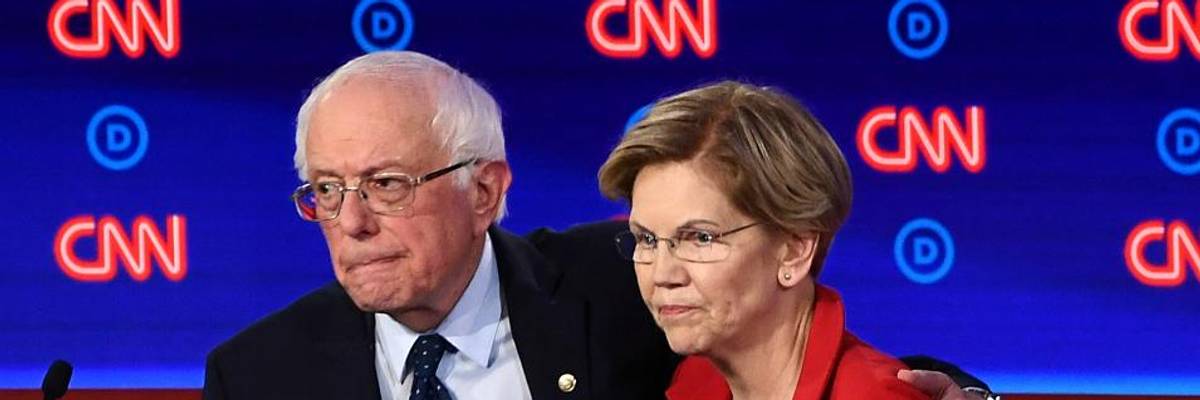
In this file photo taken on July 30, 2019 Democratic presidential hopefuls US Senator from Vermont Bernie Sanders (L) and US Senator from Massachusetts Elizabeth Warren hug after participating in the first round of the second Democratic primary debate of the 2020 presidential campaign season in Detroit, Michigan. (Photo: Brendan Smialowski / AFP / Getty Images)
With Sanders and Warren Surging, Is Wall Street's 2020 Nightmare Coming True?
The very biggest fear among corporate elites is that Warren or Sanders could win—and then use the presidency to push back against oligarchy.
For plutocrats, this summer has gotten a bit scary. Two feared candidates are rising. Trusted candidates are underperforming. The 2020 presidential election could turn out to be a real-life horror movie: A Nightmare on Wall Street.
"Wall Street executives who want Trump out," Politico reported in January, "list a consistent roster of appealing nominees that includes former Vice President Joe Biden and Sens. Cory Booker of New Jersey, Kirsten Gillibrand of New York and Kamala Harris of California."
But seven months later, those "appealing nominees" don't seem appealing to a lot of voters. Biden's frontrunner status is looking shaky, while other Wall Street favorites no longer inspire investor confidence: Harris is stuck in single digits, Booker is several points below her, and Gillibrand just dropped out of the race.
Meanwhile, Sens. Bernie Sanders and Elizabeth Warren are drawing large crowds and rising in polls. In pivotal early states like Iowa and especially New Hampshire, reputable poll averages indicate that Biden is scarcely ahead.
"Bankers' biggest fear" is that "the nomination goes to an anti-Wall Street crusader" like Warren or Sanders, Politico reported, quoting the CEO of a "giant bank" who said: "It can't be Warren and it can't be Sanders. It has to be someone centrist and someone who can win."
But the very biggest fear among corporate elites is that Warren or Sanders could win--and then use the presidency to push back against oligarchy. If Biden can't be propped up, there's no candidate looking strong enough to stop them.
Biden, Warren and Sanders, as the New York Times reported on Wednesday, are "a threesome that seems to have separated from the rest of the primary field." In fourth place, national polling averages show, Harris is far behind.
Biden's distinguished record of servicing corporate America spans five decades. He is eager to continue that work from the Oval Office, but can he get there? A week ago, a Times headline noted reasons for doubt: "Joe Biden's Poll Numbers Mask an Enthusiasm Challenge." Enthusiasm for Biden has been high among Democratic-aligned elites, but not among Democratic-aligned voters.
While corporate news organizations--and corporate-enmeshed "public" outlets like NPR News and the PBS NewsHour--evade primary contradictions, Sanders directly hammers at how huge corporations are propelling media bias and undermining democracy.
Even though he has inspired media onslaughts--such as the now-notorious 16 anti-Sanders articles published by the Washington Post in a pivotal 16-hour period during the 2016 primary contest--the Sanders campaign is so enormous that even overtly hostile outlets must give him some space. In an op-ed piece he wrote that the Post published seven weeks ago, Sanders confronted Biden's wealth-fondling approach.
Under the headline "The Straightest Path to Racial Equality Is Through the One Percent," Sanders quoted a statement from Biden: "I don't think 500 billionaires are the reason why we're in trouble." Sanders responded, "I respectfully disagree"--and he went on to say: "It is my view that any presidential candidate who claims to believe that black lives matter has to take on the institutions that have continually exploited black lives."
Such insight about systemic exploitation is sacrilege to the secular faith of wealth accumulation that touts reaching billionaire status as a kind of divine ascension. Yet Sanders boldly challenges that kind of hollowness, shedding a fierce light on realities of corporate capitalism.
"Structural problems require structural solutions," Sanders pointed out in his Post article, "and promises of mere 'access' have never guaranteed black Americans equality in this country. . . . 'Access' to health care is an empty promise when you can't afford high premiums, co-pays or deductibles. And an 'opportunity' for an equal education is an opportunity in name only when you can't afford to live in a good school district or to pay college tuition. Jobs, health care, criminal justice and education are linked, and progress will not be made unless we address the economic systems that oppress Americans at their root."
Like many other progressives, I continue to actively support Sanders as a candidate who bypasses euphemisms, names ultra-powerful villains--and directly challenges those in power who've been warping and gaming the economic systems against working-class people.
Those systems are working quite nicely for the ultra-rich, like the giant bank CEO who told Politico that "it can't be Warren and it can't be Sanders." That's the decision from Wall Street. The decision from Main Street is yet to be heard.
An Urgent Message From Our Co-Founder
Dear Common Dreams reader, It’s been nearly 30 years since I co-founded Common Dreams with my late wife, Lina Newhouser. We had the radical notion that journalism should serve the public good, not corporate profits. It was clear to us from the outset what it would take to build such a project. No paid advertisements. No corporate sponsors. No millionaire publisher telling us what to think or do. Many people said we wouldn't last a year, but we proved those doubters wrong. Together with a tremendous team of journalists and dedicated staff, we built an independent media outlet free from the constraints of profits and corporate control. Our mission has always been simple: To inform. To inspire. To ignite change for the common good. Building Common Dreams was not easy. Our survival was never guaranteed. When you take on the most powerful forces—Wall Street greed, fossil fuel industry destruction, Big Tech lobbyists, and uber-rich oligarchs who have spent billions upon billions rigging the economy and democracy in their favor—the only bulwark you have is supporters who believe in your work. But here’s the urgent message from me today. It's never been this bad out there. And it's never been this hard to keep us going. At the very moment Common Dreams is most needed, the threats we face are intensifying. We need your support now more than ever. We don't accept corporate advertising and never will. We don't have a paywall because we don't think people should be blocked from critical news based on their ability to pay. Everything we do is funded by the donations of readers like you. When everyone does the little they can afford, we are strong. But if that support retreats or dries up, so do we. Will you donate now to make sure Common Dreams not only survives but thrives? —Craig Brown, Co-founder |
Norman Solomon is the national director of RootsAction.org and executive director of the Institute for Public Accuracy. The paperback edition of his latest book, War Made Invisible: How America Hides the Human Toll of Its Military Machine, includes an afterword about the Gaza war.
For plutocrats, this summer has gotten a bit scary. Two feared candidates are rising. Trusted candidates are underperforming. The 2020 presidential election could turn out to be a real-life horror movie: A Nightmare on Wall Street.
"Wall Street executives who want Trump out," Politico reported in January, "list a consistent roster of appealing nominees that includes former Vice President Joe Biden and Sens. Cory Booker of New Jersey, Kirsten Gillibrand of New York and Kamala Harris of California."
But seven months later, those "appealing nominees" don't seem appealing to a lot of voters. Biden's frontrunner status is looking shaky, while other Wall Street favorites no longer inspire investor confidence: Harris is stuck in single digits, Booker is several points below her, and Gillibrand just dropped out of the race.
Meanwhile, Sens. Bernie Sanders and Elizabeth Warren are drawing large crowds and rising in polls. In pivotal early states like Iowa and especially New Hampshire, reputable poll averages indicate that Biden is scarcely ahead.
"Bankers' biggest fear" is that "the nomination goes to an anti-Wall Street crusader" like Warren or Sanders, Politico reported, quoting the CEO of a "giant bank" who said: "It can't be Warren and it can't be Sanders. It has to be someone centrist and someone who can win."
But the very biggest fear among corporate elites is that Warren or Sanders could win--and then use the presidency to push back against oligarchy. If Biden can't be propped up, there's no candidate looking strong enough to stop them.
Biden, Warren and Sanders, as the New York Times reported on Wednesday, are "a threesome that seems to have separated from the rest of the primary field." In fourth place, national polling averages show, Harris is far behind.
Biden's distinguished record of servicing corporate America spans five decades. He is eager to continue that work from the Oval Office, but can he get there? A week ago, a Times headline noted reasons for doubt: "Joe Biden's Poll Numbers Mask an Enthusiasm Challenge." Enthusiasm for Biden has been high among Democratic-aligned elites, but not among Democratic-aligned voters.
While corporate news organizations--and corporate-enmeshed "public" outlets like NPR News and the PBS NewsHour--evade primary contradictions, Sanders directly hammers at how huge corporations are propelling media bias and undermining democracy.
Even though he has inspired media onslaughts--such as the now-notorious 16 anti-Sanders articles published by the Washington Post in a pivotal 16-hour period during the 2016 primary contest--the Sanders campaign is so enormous that even overtly hostile outlets must give him some space. In an op-ed piece he wrote that the Post published seven weeks ago, Sanders confronted Biden's wealth-fondling approach.
Under the headline "The Straightest Path to Racial Equality Is Through the One Percent," Sanders quoted a statement from Biden: "I don't think 500 billionaires are the reason why we're in trouble." Sanders responded, "I respectfully disagree"--and he went on to say: "It is my view that any presidential candidate who claims to believe that black lives matter has to take on the institutions that have continually exploited black lives."
Such insight about systemic exploitation is sacrilege to the secular faith of wealth accumulation that touts reaching billionaire status as a kind of divine ascension. Yet Sanders boldly challenges that kind of hollowness, shedding a fierce light on realities of corporate capitalism.
"Structural problems require structural solutions," Sanders pointed out in his Post article, "and promises of mere 'access' have never guaranteed black Americans equality in this country. . . . 'Access' to health care is an empty promise when you can't afford high premiums, co-pays or deductibles. And an 'opportunity' for an equal education is an opportunity in name only when you can't afford to live in a good school district or to pay college tuition. Jobs, health care, criminal justice and education are linked, and progress will not be made unless we address the economic systems that oppress Americans at their root."
Like many other progressives, I continue to actively support Sanders as a candidate who bypasses euphemisms, names ultra-powerful villains--and directly challenges those in power who've been warping and gaming the economic systems against working-class people.
Those systems are working quite nicely for the ultra-rich, like the giant bank CEO who told Politico that "it can't be Warren and it can't be Sanders." That's the decision from Wall Street. The decision from Main Street is yet to be heard.
Norman Solomon is the national director of RootsAction.org and executive director of the Institute for Public Accuracy. The paperback edition of his latest book, War Made Invisible: How America Hides the Human Toll of Its Military Machine, includes an afterword about the Gaza war.
For plutocrats, this summer has gotten a bit scary. Two feared candidates are rising. Trusted candidates are underperforming. The 2020 presidential election could turn out to be a real-life horror movie: A Nightmare on Wall Street.
"Wall Street executives who want Trump out," Politico reported in January, "list a consistent roster of appealing nominees that includes former Vice President Joe Biden and Sens. Cory Booker of New Jersey, Kirsten Gillibrand of New York and Kamala Harris of California."
But seven months later, those "appealing nominees" don't seem appealing to a lot of voters. Biden's frontrunner status is looking shaky, while other Wall Street favorites no longer inspire investor confidence: Harris is stuck in single digits, Booker is several points below her, and Gillibrand just dropped out of the race.
Meanwhile, Sens. Bernie Sanders and Elizabeth Warren are drawing large crowds and rising in polls. In pivotal early states like Iowa and especially New Hampshire, reputable poll averages indicate that Biden is scarcely ahead.
"Bankers' biggest fear" is that "the nomination goes to an anti-Wall Street crusader" like Warren or Sanders, Politico reported, quoting the CEO of a "giant bank" who said: "It can't be Warren and it can't be Sanders. It has to be someone centrist and someone who can win."
But the very biggest fear among corporate elites is that Warren or Sanders could win--and then use the presidency to push back against oligarchy. If Biden can't be propped up, there's no candidate looking strong enough to stop them.
Biden, Warren and Sanders, as the New York Times reported on Wednesday, are "a threesome that seems to have separated from the rest of the primary field." In fourth place, national polling averages show, Harris is far behind.
Biden's distinguished record of servicing corporate America spans five decades. He is eager to continue that work from the Oval Office, but can he get there? A week ago, a Times headline noted reasons for doubt: "Joe Biden's Poll Numbers Mask an Enthusiasm Challenge." Enthusiasm for Biden has been high among Democratic-aligned elites, but not among Democratic-aligned voters.
While corporate news organizations--and corporate-enmeshed "public" outlets like NPR News and the PBS NewsHour--evade primary contradictions, Sanders directly hammers at how huge corporations are propelling media bias and undermining democracy.
Even though he has inspired media onslaughts--such as the now-notorious 16 anti-Sanders articles published by the Washington Post in a pivotal 16-hour period during the 2016 primary contest--the Sanders campaign is so enormous that even overtly hostile outlets must give him some space. In an op-ed piece he wrote that the Post published seven weeks ago, Sanders confronted Biden's wealth-fondling approach.
Under the headline "The Straightest Path to Racial Equality Is Through the One Percent," Sanders quoted a statement from Biden: "I don't think 500 billionaires are the reason why we're in trouble." Sanders responded, "I respectfully disagree"--and he went on to say: "It is my view that any presidential candidate who claims to believe that black lives matter has to take on the institutions that have continually exploited black lives."
Such insight about systemic exploitation is sacrilege to the secular faith of wealth accumulation that touts reaching billionaire status as a kind of divine ascension. Yet Sanders boldly challenges that kind of hollowness, shedding a fierce light on realities of corporate capitalism.
"Structural problems require structural solutions," Sanders pointed out in his Post article, "and promises of mere 'access' have never guaranteed black Americans equality in this country. . . . 'Access' to health care is an empty promise when you can't afford high premiums, co-pays or deductibles. And an 'opportunity' for an equal education is an opportunity in name only when you can't afford to live in a good school district or to pay college tuition. Jobs, health care, criminal justice and education are linked, and progress will not be made unless we address the economic systems that oppress Americans at their root."
Like many other progressives, I continue to actively support Sanders as a candidate who bypasses euphemisms, names ultra-powerful villains--and directly challenges those in power who've been warping and gaming the economic systems against working-class people.
Those systems are working quite nicely for the ultra-rich, like the giant bank CEO who told Politico that "it can't be Warren and it can't be Sanders." That's the decision from Wall Street. The decision from Main Street is yet to be heard.