SUBSCRIBE TO OUR FREE NEWSLETTER
Daily news & progressive opinion—funded by the people, not the corporations—delivered straight to your inbox.
5
#000000
#FFFFFF
To donate by check, phone, or other method, see our More Ways to Give page.
Daily news & progressive opinion—funded by the people, not the corporations—delivered straight to your inbox.
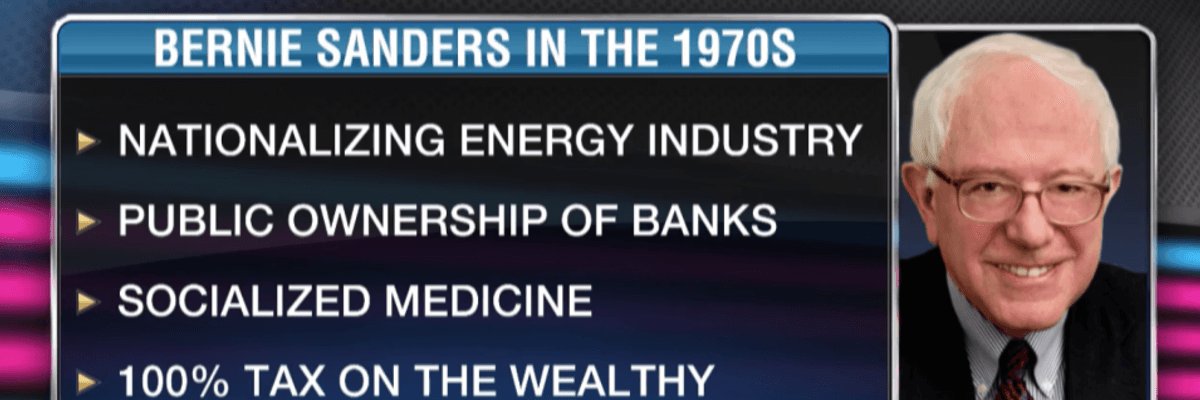
A screenshot of a Fox News segment which picked up CNN's story about how presidential candidate Sen. Bernie Sanders (I-Vt.) position in the 1970s that many major industries should be nationalized in order to better serve the public interest and the overall economy. (Image: Screenshot/Fox News)
On the same day moderate Texas Democrat Beto O'Rourke declared his candidacy for president, CNN published an exclusive report: Bernie Sanders in the 1970s urged nationalization of most major industries.
"I favor the public ownership of utilities, banks and major industries," Sen. Sanders told the Burlington Free Press in 1976, according to CNN. "We need public control over capital; and the capital must be put to use for public need, not for the advancement of those who made the investments."
The CNN reporters who broke the story made it clear why they thought it was such a scoop.
"Many of the positions he held at the time...could provide fodder for moderate Democrats and Republicans looking to cast the Democratic presidential candidate and his beliefs as a fringe form of socialism that would be harmful to the country," CNN reporters Andrew Kaczynski and Nathan McDermott wrote.
It is virtually certain that Sanders will be asked to disavow these comments at some future public forum, debate, or town hall meeting. But the Left shouldn't allow our enemies to use Bernie's 1976 third party campaign platform against him. The ideas Sanders articulated back then are potent potential solutions to many of the major social problems still facing U.S. society today.
Democratic ownership of the economy may not be a mainstream talking point right now, mostly because the collapse of the Soviet Union combined with a weak American labor movement has made talk of nationalizing industry politically untenable, at least according to conventional wisdom.
But as Sanders has pointed out ever since announcing his 2020 candidacy for president, Medicare-for-All, a $15/hour minimum wage, and free college tuition weren't considered politically realistic policies until very recently either--not until after his 2016 campaign and years of movement demands in the streets elevated them in the public discourse.
Today, the mainstream debate over corporate control of our economic system (and therefore, our political system) is mostly limited to labor law and progressive tax reform--and tougher antitrust enforcement.
These are sorely needed, but they won't, on their own, end inequality. The next best thing to breaking up the largest multinational conglomerates might just be public ownership of them. Especially if nationalization is paired with a strong public-sector labor movement that can exert independent worker control over the entire industry, and force government into a co-management arrangement from across the table.
The Bernie Sanders of 1976 had other good ideas. Eighteen years before NAFTA, Bernie proposed a solution to globalization, capital flight, and deindustrialization that is virtually never talked about today.
"We have got to begin to deal with the fact that corporations do not have the god-given right to disrupt the lives of their workers or the economic foundation of their towns simply because they wish to move elsewhere to earn a higher rate of profit," Sanders said.
Sanders' plan would require large businesses attempting to leave cities to get permission from the towns and the workers in them. If the company did not get that approval they would be required by law to pay a guaranteed two years of severance for workers and 10 years of taxes for the town.
Nationally, Sanders said, legislation corporations leaving cities would have to be dealt with by turning the means of production over to the workers.
"In the long run, the problem of the fleeing corporations must be dealt with on the national level by legislation which will bring about the public ownership of the major means of production and their conversion into worker-controlled enterprises," he said.
This may all sound great to many Common Dreams readers and progressives more broadly, but CNN didn't print this story to help the political revolution. It was published to help fuel attack ads against Bernie and the democratic socialist movement. It is probable that the new archive of Liberty Union Party material at the University of Vermont will continue to be mined by establishment Democrats, Republicans, and the corporate media alike for even more ammunition to use against Sanders in the days and weeks to come.
But by doing so, outlets like CNN are also opening the door for supposedly out-of-mainstream policies like democratic control of the economy to re-enter the realm of acceptable opinion. That's an opportunity the Left should take advantage of. By doing so, we can play rearguard defense, watch Bernie's back, and turn the tables on reactionary Democrats with an embrace of the seemingly off limits, pushing the envelope of what is possible forward even more.
Dear Common Dreams reader, It’s been nearly 30 years since I co-founded Common Dreams with my late wife, Lina Newhouser. We had the radical notion that journalism should serve the public good, not corporate profits. It was clear to us from the outset what it would take to build such a project. No paid advertisements. No corporate sponsors. No millionaire publisher telling us what to think or do. Many people said we wouldn't last a year, but we proved those doubters wrong. Together with a tremendous team of journalists and dedicated staff, we built an independent media outlet free from the constraints of profits and corporate control. Our mission has always been simple: To inform. To inspire. To ignite change for the common good. Building Common Dreams was not easy. Our survival was never guaranteed. When you take on the most powerful forces—Wall Street greed, fossil fuel industry destruction, Big Tech lobbyists, and uber-rich oligarchs who have spent billions upon billions rigging the economy and democracy in their favor—the only bulwark you have is supporters who believe in your work. But here’s the urgent message from me today. It's never been this bad out there. And it's never been this hard to keep us going. At the very moment Common Dreams is most needed, the threats we face are intensifying. We need your support now more than ever. We don't accept corporate advertising and never will. We don't have a paywall because we don't think people should be blocked from critical news based on their ability to pay. Everything we do is funded by the donations of readers like you. When everyone does the little they can afford, we are strong. But if that support retreats or dries up, so do we. Will you donate now to make sure Common Dreams not only survives but thrives? —Craig Brown, Co-founder |
On the same day moderate Texas Democrat Beto O'Rourke declared his candidacy for president, CNN published an exclusive report: Bernie Sanders in the 1970s urged nationalization of most major industries.
"I favor the public ownership of utilities, banks and major industries," Sen. Sanders told the Burlington Free Press in 1976, according to CNN. "We need public control over capital; and the capital must be put to use for public need, not for the advancement of those who made the investments."
The CNN reporters who broke the story made it clear why they thought it was such a scoop.
"Many of the positions he held at the time...could provide fodder for moderate Democrats and Republicans looking to cast the Democratic presidential candidate and his beliefs as a fringe form of socialism that would be harmful to the country," CNN reporters Andrew Kaczynski and Nathan McDermott wrote.
It is virtually certain that Sanders will be asked to disavow these comments at some future public forum, debate, or town hall meeting. But the Left shouldn't allow our enemies to use Bernie's 1976 third party campaign platform against him. The ideas Sanders articulated back then are potent potential solutions to many of the major social problems still facing U.S. society today.
Democratic ownership of the economy may not be a mainstream talking point right now, mostly because the collapse of the Soviet Union combined with a weak American labor movement has made talk of nationalizing industry politically untenable, at least according to conventional wisdom.
But as Sanders has pointed out ever since announcing his 2020 candidacy for president, Medicare-for-All, a $15/hour minimum wage, and free college tuition weren't considered politically realistic policies until very recently either--not until after his 2016 campaign and years of movement demands in the streets elevated them in the public discourse.
Today, the mainstream debate over corporate control of our economic system (and therefore, our political system) is mostly limited to labor law and progressive tax reform--and tougher antitrust enforcement.
These are sorely needed, but they won't, on their own, end inequality. The next best thing to breaking up the largest multinational conglomerates might just be public ownership of them. Especially if nationalization is paired with a strong public-sector labor movement that can exert independent worker control over the entire industry, and force government into a co-management arrangement from across the table.
The Bernie Sanders of 1976 had other good ideas. Eighteen years before NAFTA, Bernie proposed a solution to globalization, capital flight, and deindustrialization that is virtually never talked about today.
"We have got to begin to deal with the fact that corporations do not have the god-given right to disrupt the lives of their workers or the economic foundation of their towns simply because they wish to move elsewhere to earn a higher rate of profit," Sanders said.
Sanders' plan would require large businesses attempting to leave cities to get permission from the towns and the workers in them. If the company did not get that approval they would be required by law to pay a guaranteed two years of severance for workers and 10 years of taxes for the town.
Nationally, Sanders said, legislation corporations leaving cities would have to be dealt with by turning the means of production over to the workers.
"In the long run, the problem of the fleeing corporations must be dealt with on the national level by legislation which will bring about the public ownership of the major means of production and their conversion into worker-controlled enterprises," he said.
This may all sound great to many Common Dreams readers and progressives more broadly, but CNN didn't print this story to help the political revolution. It was published to help fuel attack ads against Bernie and the democratic socialist movement. It is probable that the new archive of Liberty Union Party material at the University of Vermont will continue to be mined by establishment Democrats, Republicans, and the corporate media alike for even more ammunition to use against Sanders in the days and weeks to come.
But by doing so, outlets like CNN are also opening the door for supposedly out-of-mainstream policies like democratic control of the economy to re-enter the realm of acceptable opinion. That's an opportunity the Left should take advantage of. By doing so, we can play rearguard defense, watch Bernie's back, and turn the tables on reactionary Democrats with an embrace of the seemingly off limits, pushing the envelope of what is possible forward even more.
On the same day moderate Texas Democrat Beto O'Rourke declared his candidacy for president, CNN published an exclusive report: Bernie Sanders in the 1970s urged nationalization of most major industries.
"I favor the public ownership of utilities, banks and major industries," Sen. Sanders told the Burlington Free Press in 1976, according to CNN. "We need public control over capital; and the capital must be put to use for public need, not for the advancement of those who made the investments."
The CNN reporters who broke the story made it clear why they thought it was such a scoop.
"Many of the positions he held at the time...could provide fodder for moderate Democrats and Republicans looking to cast the Democratic presidential candidate and his beliefs as a fringe form of socialism that would be harmful to the country," CNN reporters Andrew Kaczynski and Nathan McDermott wrote.
It is virtually certain that Sanders will be asked to disavow these comments at some future public forum, debate, or town hall meeting. But the Left shouldn't allow our enemies to use Bernie's 1976 third party campaign platform against him. The ideas Sanders articulated back then are potent potential solutions to many of the major social problems still facing U.S. society today.
Democratic ownership of the economy may not be a mainstream talking point right now, mostly because the collapse of the Soviet Union combined with a weak American labor movement has made talk of nationalizing industry politically untenable, at least according to conventional wisdom.
But as Sanders has pointed out ever since announcing his 2020 candidacy for president, Medicare-for-All, a $15/hour minimum wage, and free college tuition weren't considered politically realistic policies until very recently either--not until after his 2016 campaign and years of movement demands in the streets elevated them in the public discourse.
Today, the mainstream debate over corporate control of our economic system (and therefore, our political system) is mostly limited to labor law and progressive tax reform--and tougher antitrust enforcement.
These are sorely needed, but they won't, on their own, end inequality. The next best thing to breaking up the largest multinational conglomerates might just be public ownership of them. Especially if nationalization is paired with a strong public-sector labor movement that can exert independent worker control over the entire industry, and force government into a co-management arrangement from across the table.
The Bernie Sanders of 1976 had other good ideas. Eighteen years before NAFTA, Bernie proposed a solution to globalization, capital flight, and deindustrialization that is virtually never talked about today.
"We have got to begin to deal with the fact that corporations do not have the god-given right to disrupt the lives of their workers or the economic foundation of their towns simply because they wish to move elsewhere to earn a higher rate of profit," Sanders said.
Sanders' plan would require large businesses attempting to leave cities to get permission from the towns and the workers in them. If the company did not get that approval they would be required by law to pay a guaranteed two years of severance for workers and 10 years of taxes for the town.
Nationally, Sanders said, legislation corporations leaving cities would have to be dealt with by turning the means of production over to the workers.
"In the long run, the problem of the fleeing corporations must be dealt with on the national level by legislation which will bring about the public ownership of the major means of production and their conversion into worker-controlled enterprises," he said.
This may all sound great to many Common Dreams readers and progressives more broadly, but CNN didn't print this story to help the political revolution. It was published to help fuel attack ads against Bernie and the democratic socialist movement. It is probable that the new archive of Liberty Union Party material at the University of Vermont will continue to be mined by establishment Democrats, Republicans, and the corporate media alike for even more ammunition to use against Sanders in the days and weeks to come.
But by doing so, outlets like CNN are also opening the door for supposedly out-of-mainstream policies like democratic control of the economy to re-enter the realm of acceptable opinion. That's an opportunity the Left should take advantage of. By doing so, we can play rearguard defense, watch Bernie's back, and turn the tables on reactionary Democrats with an embrace of the seemingly off limits, pushing the envelope of what is possible forward even more.