SUBSCRIBE TO OUR FREE NEWSLETTER
Daily news & progressive opinion—funded by the people, not the corporations—delivered straight to your inbox.
5
#000000
#FFFFFF
To donate by check, phone, or other method, see our More Ways to Give page.
Daily news & progressive opinion—funded by the people, not the corporations—delivered straight to your inbox.
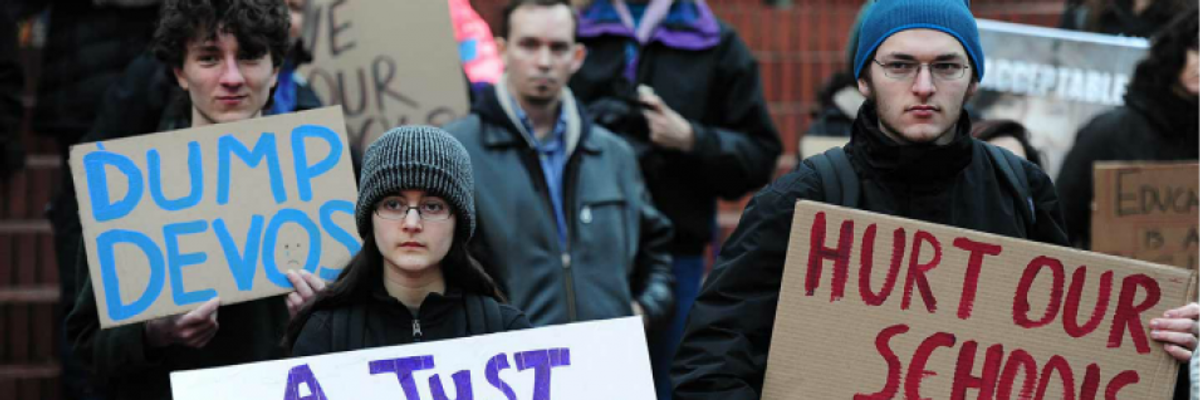
"While the nation's education debt expands, the accumulated wealth of the richest Americans continues to grow," Bryant writes. (Photo: Alex Milan Tracy/AP)
News about wealthy folks giving millions to education draw both praise and criticism. But two new reports by public education advocacy groups reveal the real impact rich people have on schools and how they've chosen to leverage their money to influence the system.
The first report, "Confronting the Education Debt" from the Alliance to Reclaim Our Schools, examines the nation's "education debt" - the historic funding shortfall for school systems that educate black and brown children. The authors find that through a combination of multiple factors - including funding rollbacks, tax cuts, and diversions of public money to private entities - the schools educating the nation's poorest children have been shorted billions in funding.
One funding source alone, the federal dollars owed to states for educating low-income children and children with disabilities, shorted schools $580 billion, between 2005 and 2017, in what the government is lawfully required to fund schools through the provisions of Title I of the Elementary and Secondary Education Act (ESSA) and the Individuals with Disabilities Education Act (IDEA).
The impact of not fully funding Title I is startling. At full funding, the nation's highest-poverty schools could provide health and mental health services for every student - including dental and vision services - and these schools would have the money to hire a full-time nurse, a full-time librarian, and either an additional full-time counselor or a full-time teaching assistant for every classroom.
State and local governments contribute to underfunding too by keeping in place tax systems that chronically short schools, particularly those that educate low-income students, mostly of color. Two school districts in Illinois are highlighted - one where 80 percent of students are low-income and gets about $7,808 per pupil in total expenditures, while another, where 3 percent of students are low-income, spends $26,074 per student.
The disparities were made worse after the Great Recession in 2008, when most states slashed taxes for funding schools and often gave bigger tax cuts to corporations and the wealthy, while many local governments rolled out tax abatement programs that exclude corporations and developers from paying taxes that fund public schools.
In the meantime, while the nation's education debt expands, the accumulated wealth of the richest Americans continues to grow. During that time period the federal government was shorting schools billions, the personal net worth of the nation's 400 wealthiest individuals grew by $1.57 trillion, the report notes.
"There is a direct correlation between dwindling resources for public schools and the ongoing political proclivity for transferring public dollars to the nation's wealthiest individuals and corporations," the report declares. "The rich are getting richer. Our schools are broke on purpose."
While wealthier Americans are being increasingly unburdened of the expense of educating the nation's children, many of those same individuals have decided to spend their dollars on education politics instead.
In its report, "Hijacked by Billionaires: How the Super Rich Buy Elections to Undermine Public Schools," the Network for Public Education examines state and local elections that affect education policy the most - such as school board, mayor, ballot referendums, state superintendent, and governor - and finds, "Some of America's wealthiest individuals collaborate to hijack the democratic process by pouring millions of dollars into state and local races, often in places where they do not live."
The report spotlights 9 case studies of state and local elections, accompanied by 10 interactive maps (two for Louisiana), that show the intricate networks of dark money activated by the US Supreme Court's Citizens United ruling and state election loopholes.
What motivates these wealthy people from exerting their will in the electoral process varies. They are bipartisan politically. Some are directly connected to the charter school industry. Others have expressed disdain for democratically controlled schools and argue, instead, for school governance to transfer to unelected boards. Some are motivated by their hatred of teachers' unions. While others believe strongly that public education needs to be opened up to market competition from charters.
But what billionaire donors all have in common, the report authors write, is their devotion to blaming schools and educators for problems posed by educating low-income children. Instead of using their political donations to advocate for more direct aid to schools serving low-income kids, wealthy donors "distract us from policy changes that would really help children," the report argues, "such as increasing the equity and adequacy of school funding, reducing class sizes, providing medical care and nutrition for students, and other specific efforts to meet the needs of children and families."
Of course, those policy changes would require wealthier folks to pay more in taxes.
"Rich people are playing a double game," writes Anand Giridharadas in his new book Winners Take All: The Elite Charade of Changing the World. "On one hand, there's no question they're giving away more money than has ever been given away in history ... But I also argue that we have one of the more predatory elites in history, despite that philanthropy."
In a recent interview with NPR's Steve Inskeep, Giridharadas derides the "win-win" game wealthy folks play, insisting they can keep their huge sums of money sequestered from taxation while donating for "social change that offers a kickback to the winners."
Giridharadas accuses the nation's billionaire class of "peddling a lot of pseudochange instead of actually fixing the American opportunity structure, instead of actually repairing the American dream over the last 30 to 40 years."
Instead of attacking structural inequity in the system, something that would likely require the wealthy to pay more taxes, "they offer a light facsimile of change," says Giridharadas. "They offer change that doesn't change anything fundamental."
Although Giridharadas doesn't mention it in the interview (I've yet to read the book), nowhere is this charade played out by the wealthy more evident than in public education, where rich people have steered public policy to minimize their taxes, which would fund school programs and resources low-income kids really need, while they peddle false promises like charter schools.
"A move that America's plutocrats have been making for a long time," he argues, is that "the arsonists are the best firefighters."
They're certainly doing a good job of burning down public education.
Dear Common Dreams reader, It’s been nearly 30 years since I co-founded Common Dreams with my late wife, Lina Newhouser. We had the radical notion that journalism should serve the public good, not corporate profits. It was clear to us from the outset what it would take to build such a project. No paid advertisements. No corporate sponsors. No millionaire publisher telling us what to think or do. Many people said we wouldn't last a year, but we proved those doubters wrong. Together with a tremendous team of journalists and dedicated staff, we built an independent media outlet free from the constraints of profits and corporate control. Our mission has always been simple: To inform. To inspire. To ignite change for the common good. Building Common Dreams was not easy. Our survival was never guaranteed. When you take on the most powerful forces—Wall Street greed, fossil fuel industry destruction, Big Tech lobbyists, and uber-rich oligarchs who have spent billions upon billions rigging the economy and democracy in their favor—the only bulwark you have is supporters who believe in your work. But here’s the urgent message from me today. It's never been this bad out there. And it's never been this hard to keep us going. At the very moment Common Dreams is most needed, the threats we face are intensifying. We need your support now more than ever. We don't accept corporate advertising and never will. We don't have a paywall because we don't think people should be blocked from critical news based on their ability to pay. Everything we do is funded by the donations of readers like you. When everyone does the little they can afford, we are strong. But if that support retreats or dries up, so do we. Will you donate now to make sure Common Dreams not only survives but thrives? —Craig Brown, Co-founder |
News about wealthy folks giving millions to education draw both praise and criticism. But two new reports by public education advocacy groups reveal the real impact rich people have on schools and how they've chosen to leverage their money to influence the system.
The first report, "Confronting the Education Debt" from the Alliance to Reclaim Our Schools, examines the nation's "education debt" - the historic funding shortfall for school systems that educate black and brown children. The authors find that through a combination of multiple factors - including funding rollbacks, tax cuts, and diversions of public money to private entities - the schools educating the nation's poorest children have been shorted billions in funding.
One funding source alone, the federal dollars owed to states for educating low-income children and children with disabilities, shorted schools $580 billion, between 2005 and 2017, in what the government is lawfully required to fund schools through the provisions of Title I of the Elementary and Secondary Education Act (ESSA) and the Individuals with Disabilities Education Act (IDEA).
The impact of not fully funding Title I is startling. At full funding, the nation's highest-poverty schools could provide health and mental health services for every student - including dental and vision services - and these schools would have the money to hire a full-time nurse, a full-time librarian, and either an additional full-time counselor or a full-time teaching assistant for every classroom.
State and local governments contribute to underfunding too by keeping in place tax systems that chronically short schools, particularly those that educate low-income students, mostly of color. Two school districts in Illinois are highlighted - one where 80 percent of students are low-income and gets about $7,808 per pupil in total expenditures, while another, where 3 percent of students are low-income, spends $26,074 per student.
The disparities were made worse after the Great Recession in 2008, when most states slashed taxes for funding schools and often gave bigger tax cuts to corporations and the wealthy, while many local governments rolled out tax abatement programs that exclude corporations and developers from paying taxes that fund public schools.
In the meantime, while the nation's education debt expands, the accumulated wealth of the richest Americans continues to grow. During that time period the federal government was shorting schools billions, the personal net worth of the nation's 400 wealthiest individuals grew by $1.57 trillion, the report notes.
"There is a direct correlation between dwindling resources for public schools and the ongoing political proclivity for transferring public dollars to the nation's wealthiest individuals and corporations," the report declares. "The rich are getting richer. Our schools are broke on purpose."
While wealthier Americans are being increasingly unburdened of the expense of educating the nation's children, many of those same individuals have decided to spend their dollars on education politics instead.
In its report, "Hijacked by Billionaires: How the Super Rich Buy Elections to Undermine Public Schools," the Network for Public Education examines state and local elections that affect education policy the most - such as school board, mayor, ballot referendums, state superintendent, and governor - and finds, "Some of America's wealthiest individuals collaborate to hijack the democratic process by pouring millions of dollars into state and local races, often in places where they do not live."
The report spotlights 9 case studies of state and local elections, accompanied by 10 interactive maps (two for Louisiana), that show the intricate networks of dark money activated by the US Supreme Court's Citizens United ruling and state election loopholes.
What motivates these wealthy people from exerting their will in the electoral process varies. They are bipartisan politically. Some are directly connected to the charter school industry. Others have expressed disdain for democratically controlled schools and argue, instead, for school governance to transfer to unelected boards. Some are motivated by their hatred of teachers' unions. While others believe strongly that public education needs to be opened up to market competition from charters.
But what billionaire donors all have in common, the report authors write, is their devotion to blaming schools and educators for problems posed by educating low-income children. Instead of using their political donations to advocate for more direct aid to schools serving low-income kids, wealthy donors "distract us from policy changes that would really help children," the report argues, "such as increasing the equity and adequacy of school funding, reducing class sizes, providing medical care and nutrition for students, and other specific efforts to meet the needs of children and families."
Of course, those policy changes would require wealthier folks to pay more in taxes.
"Rich people are playing a double game," writes Anand Giridharadas in his new book Winners Take All: The Elite Charade of Changing the World. "On one hand, there's no question they're giving away more money than has ever been given away in history ... But I also argue that we have one of the more predatory elites in history, despite that philanthropy."
In a recent interview with NPR's Steve Inskeep, Giridharadas derides the "win-win" game wealthy folks play, insisting they can keep their huge sums of money sequestered from taxation while donating for "social change that offers a kickback to the winners."
Giridharadas accuses the nation's billionaire class of "peddling a lot of pseudochange instead of actually fixing the American opportunity structure, instead of actually repairing the American dream over the last 30 to 40 years."
Instead of attacking structural inequity in the system, something that would likely require the wealthy to pay more taxes, "they offer a light facsimile of change," says Giridharadas. "They offer change that doesn't change anything fundamental."
Although Giridharadas doesn't mention it in the interview (I've yet to read the book), nowhere is this charade played out by the wealthy more evident than in public education, where rich people have steered public policy to minimize their taxes, which would fund school programs and resources low-income kids really need, while they peddle false promises like charter schools.
"A move that America's plutocrats have been making for a long time," he argues, is that "the arsonists are the best firefighters."
They're certainly doing a good job of burning down public education.
News about wealthy folks giving millions to education draw both praise and criticism. But two new reports by public education advocacy groups reveal the real impact rich people have on schools and how they've chosen to leverage their money to influence the system.
The first report, "Confronting the Education Debt" from the Alliance to Reclaim Our Schools, examines the nation's "education debt" - the historic funding shortfall for school systems that educate black and brown children. The authors find that through a combination of multiple factors - including funding rollbacks, tax cuts, and diversions of public money to private entities - the schools educating the nation's poorest children have been shorted billions in funding.
One funding source alone, the federal dollars owed to states for educating low-income children and children with disabilities, shorted schools $580 billion, between 2005 and 2017, in what the government is lawfully required to fund schools through the provisions of Title I of the Elementary and Secondary Education Act (ESSA) and the Individuals with Disabilities Education Act (IDEA).
The impact of not fully funding Title I is startling. At full funding, the nation's highest-poverty schools could provide health and mental health services for every student - including dental and vision services - and these schools would have the money to hire a full-time nurse, a full-time librarian, and either an additional full-time counselor or a full-time teaching assistant for every classroom.
State and local governments contribute to underfunding too by keeping in place tax systems that chronically short schools, particularly those that educate low-income students, mostly of color. Two school districts in Illinois are highlighted - one where 80 percent of students are low-income and gets about $7,808 per pupil in total expenditures, while another, where 3 percent of students are low-income, spends $26,074 per student.
The disparities were made worse after the Great Recession in 2008, when most states slashed taxes for funding schools and often gave bigger tax cuts to corporations and the wealthy, while many local governments rolled out tax abatement programs that exclude corporations and developers from paying taxes that fund public schools.
In the meantime, while the nation's education debt expands, the accumulated wealth of the richest Americans continues to grow. During that time period the federal government was shorting schools billions, the personal net worth of the nation's 400 wealthiest individuals grew by $1.57 trillion, the report notes.
"There is a direct correlation between dwindling resources for public schools and the ongoing political proclivity for transferring public dollars to the nation's wealthiest individuals and corporations," the report declares. "The rich are getting richer. Our schools are broke on purpose."
While wealthier Americans are being increasingly unburdened of the expense of educating the nation's children, many of those same individuals have decided to spend their dollars on education politics instead.
In its report, "Hijacked by Billionaires: How the Super Rich Buy Elections to Undermine Public Schools," the Network for Public Education examines state and local elections that affect education policy the most - such as school board, mayor, ballot referendums, state superintendent, and governor - and finds, "Some of America's wealthiest individuals collaborate to hijack the democratic process by pouring millions of dollars into state and local races, often in places where they do not live."
The report spotlights 9 case studies of state and local elections, accompanied by 10 interactive maps (two for Louisiana), that show the intricate networks of dark money activated by the US Supreme Court's Citizens United ruling and state election loopholes.
What motivates these wealthy people from exerting their will in the electoral process varies. They are bipartisan politically. Some are directly connected to the charter school industry. Others have expressed disdain for democratically controlled schools and argue, instead, for school governance to transfer to unelected boards. Some are motivated by their hatred of teachers' unions. While others believe strongly that public education needs to be opened up to market competition from charters.
But what billionaire donors all have in common, the report authors write, is their devotion to blaming schools and educators for problems posed by educating low-income children. Instead of using their political donations to advocate for more direct aid to schools serving low-income kids, wealthy donors "distract us from policy changes that would really help children," the report argues, "such as increasing the equity and adequacy of school funding, reducing class sizes, providing medical care and nutrition for students, and other specific efforts to meet the needs of children and families."
Of course, those policy changes would require wealthier folks to pay more in taxes.
"Rich people are playing a double game," writes Anand Giridharadas in his new book Winners Take All: The Elite Charade of Changing the World. "On one hand, there's no question they're giving away more money than has ever been given away in history ... But I also argue that we have one of the more predatory elites in history, despite that philanthropy."
In a recent interview with NPR's Steve Inskeep, Giridharadas derides the "win-win" game wealthy folks play, insisting they can keep their huge sums of money sequestered from taxation while donating for "social change that offers a kickback to the winners."
Giridharadas accuses the nation's billionaire class of "peddling a lot of pseudochange instead of actually fixing the American opportunity structure, instead of actually repairing the American dream over the last 30 to 40 years."
Instead of attacking structural inequity in the system, something that would likely require the wealthy to pay more taxes, "they offer a light facsimile of change," says Giridharadas. "They offer change that doesn't change anything fundamental."
Although Giridharadas doesn't mention it in the interview (I've yet to read the book), nowhere is this charade played out by the wealthy more evident than in public education, where rich people have steered public policy to minimize their taxes, which would fund school programs and resources low-income kids really need, while they peddle false promises like charter schools.
"A move that America's plutocrats have been making for a long time," he argues, is that "the arsonists are the best firefighters."
They're certainly doing a good job of burning down public education.