SUBSCRIBE TO OUR FREE NEWSLETTER
Daily news & progressive opinion—funded by the people, not the corporations—delivered straight to your inbox.
5
#000000
#FFFFFF
To donate by check, phone, or other method, see our More Ways to Give page.


Daily news & progressive opinion—funded by the people, not the corporations—delivered straight to your inbox.

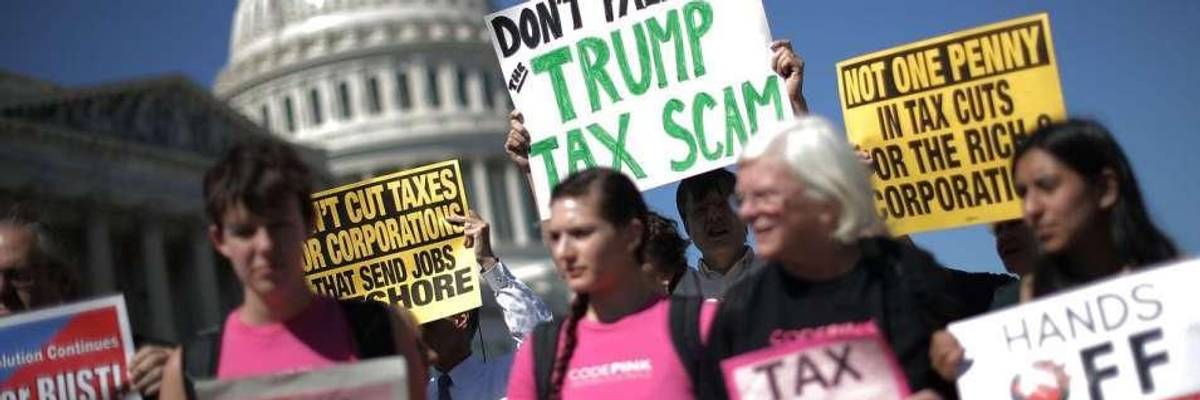
Representatives of progressive political activist groups join members of the Congressional Progressive Caucus for a news conference outside the U.S. Capitol in Washington, D.C. on Oct. 4, 2017. (Photo by Chip Somodevilla/Getty Images)
How much did your paychecks total last year? You know the answer, of course. So does the Social Security Administration. The totals for every American's paycheck income are sitting in Social Security's computers.
Once every year, Social Security does a serious data dump out of those computers to let us know just how much working Americans are actually making. The latest totals -- covering 2016 -- have just appeared. Most of us, the new numbers show, are simply not making all that much.
In fact, nearly half of our nation's employed -- 49.3 percent -- earned less than $30,000 in 2016. A good many of these Americans lived in poverty. In 2016, families of four that earned less than $24,339 ranked as officially poor.
We don't have an "official" figure for middle class status. But the Economic Policy Institute has calculated how much maintaining a no-frills middle class existence happens to cost in various parts of the United States. In Houston, one of our nation's cheaper major cities, a family of four needed $62,544 in 2016 to live a bare-bones middle class lifestyle.
Nationally, according to the new Social Security payroll income numbers, over three-quarters of working Americans -- 76.9 percent -- took home less than $60,000 in 2016.
Some Americans, on the other hand, took home a great deal more. The Social Security Administration counts 133,119 Americans who pocketed over $1 million in paycheck income last year.
Now which of these two groups -- the millionaires or the under-$60,000 crowd -- do you think paid a greater share of its income in Social Security tax?
The millionaires could certainly afford to pay the bigger share. But they didn't. Individuals who took home $1 million in 2016 had $16,265 deducted from their paychecks for Social Security and Medicare. Those deductions totaled a meager 1.6 percent of their paycheck income.
Working Americans making $60,000 last year, by contrast, had 7.65 percent of their take-home deducted for Social Security and Medicare. In other words, Americans making $60,000 paid over four times more of their income for Social Security and Medicare than Americans who made $1 million.
How could that be? Our tax code currently has a ceiling on earnings subject to Social Security tax. That ceiling this year rests at $127,200. All paycheck income up to that level faces a 6.2 percent tax for Social Security and a 1.45 percent tax for Medicare. Income above that ceiling faces no Social Security tax at all.
Until the Obama years, income above the earnings ceiling faced no payroll tax for Medicare either. But President Obama did succeed in getting that changed. Individual income over $200,000 now faces an additional 0.9 percent Medicare tax. If all income over $200,000 faced a Social Security tax as well, we'd have enough new revenue to significantly improve Social Security benefits.
The Trump administration is moving in the exact opposite direction. Earlier this year, the White House tried and failed to get the Obama Medicare tax on the rich repealed. Now the administration is pushing a tax "reform" that totally ignores the unfairness of the current Social Security payroll tax and instead hands America's wealthiest a stunningly generous assortment of tax giveaways.
If this Trump tax plan passes, Americans making $60,000 will still be paying over four times more of their income in payroll taxes than Americans who make $1 million. And America's millionaire-packed top 1 percent will also be enjoying, the Tax Policy Center calculates, 80 percent of the new tax cuts the Trump tax plan puts in place by 2027.
The Trump tax plan, in other words, makes the U.S. tax code even more rich people-friendly than the current code. The White House calls that "reform." The rest of us ought to call it an outrage.
Dear Common Dreams reader, It’s been nearly 30 years since I co-founded Common Dreams with my late wife, Lina Newhouser. We had the radical notion that journalism should serve the public good, not corporate profits. It was clear to us from the outset what it would take to build such a project. No paid advertisements. No corporate sponsors. No millionaire publisher telling us what to think or do. Many people said we wouldn't last a year, but we proved those doubters wrong. Together with a tremendous team of journalists and dedicated staff, we built an independent media outlet free from the constraints of profits and corporate control. Our mission has always been simple: To inform. To inspire. To ignite change for the common good. Building Common Dreams was not easy. Our survival was never guaranteed. When you take on the most powerful forces—Wall Street greed, fossil fuel industry destruction, Big Tech lobbyists, and uber-rich oligarchs who have spent billions upon billions rigging the economy and democracy in their favor—the only bulwark you have is supporters who believe in your work. But here’s the urgent message from me today. It's never been this bad out there. And it's never been this hard to keep us going. At the very moment Common Dreams is most needed, the threats we face are intensifying. We need your support now more than ever. We don't accept corporate advertising and never will. We don't have a paywall because we don't think people should be blocked from critical news based on their ability to pay. Everything we do is funded by the donations of readers like you. When everyone does the little they can afford, we are strong. But if that support retreats or dries up, so do we. Will you donate now to make sure Common Dreams not only survives but thrives? —Craig Brown, Co-founder |
How much did your paychecks total last year? You know the answer, of course. So does the Social Security Administration. The totals for every American's paycheck income are sitting in Social Security's computers.
Once every year, Social Security does a serious data dump out of those computers to let us know just how much working Americans are actually making. The latest totals -- covering 2016 -- have just appeared. Most of us, the new numbers show, are simply not making all that much.
In fact, nearly half of our nation's employed -- 49.3 percent -- earned less than $30,000 in 2016. A good many of these Americans lived in poverty. In 2016, families of four that earned less than $24,339 ranked as officially poor.
We don't have an "official" figure for middle class status. But the Economic Policy Institute has calculated how much maintaining a no-frills middle class existence happens to cost in various parts of the United States. In Houston, one of our nation's cheaper major cities, a family of four needed $62,544 in 2016 to live a bare-bones middle class lifestyle.
Nationally, according to the new Social Security payroll income numbers, over three-quarters of working Americans -- 76.9 percent -- took home less than $60,000 in 2016.
Some Americans, on the other hand, took home a great deal more. The Social Security Administration counts 133,119 Americans who pocketed over $1 million in paycheck income last year.
Now which of these two groups -- the millionaires or the under-$60,000 crowd -- do you think paid a greater share of its income in Social Security tax?
The millionaires could certainly afford to pay the bigger share. But they didn't. Individuals who took home $1 million in 2016 had $16,265 deducted from their paychecks for Social Security and Medicare. Those deductions totaled a meager 1.6 percent of their paycheck income.
Working Americans making $60,000 last year, by contrast, had 7.65 percent of their take-home deducted for Social Security and Medicare. In other words, Americans making $60,000 paid over four times more of their income for Social Security and Medicare than Americans who made $1 million.
How could that be? Our tax code currently has a ceiling on earnings subject to Social Security tax. That ceiling this year rests at $127,200. All paycheck income up to that level faces a 6.2 percent tax for Social Security and a 1.45 percent tax for Medicare. Income above that ceiling faces no Social Security tax at all.
Until the Obama years, income above the earnings ceiling faced no payroll tax for Medicare either. But President Obama did succeed in getting that changed. Individual income over $200,000 now faces an additional 0.9 percent Medicare tax. If all income over $200,000 faced a Social Security tax as well, we'd have enough new revenue to significantly improve Social Security benefits.
The Trump administration is moving in the exact opposite direction. Earlier this year, the White House tried and failed to get the Obama Medicare tax on the rich repealed. Now the administration is pushing a tax "reform" that totally ignores the unfairness of the current Social Security payroll tax and instead hands America's wealthiest a stunningly generous assortment of tax giveaways.
If this Trump tax plan passes, Americans making $60,000 will still be paying over four times more of their income in payroll taxes than Americans who make $1 million. And America's millionaire-packed top 1 percent will also be enjoying, the Tax Policy Center calculates, 80 percent of the new tax cuts the Trump tax plan puts in place by 2027.
The Trump tax plan, in other words, makes the U.S. tax code even more rich people-friendly than the current code. The White House calls that "reform." The rest of us ought to call it an outrage.
How much did your paychecks total last year? You know the answer, of course. So does the Social Security Administration. The totals for every American's paycheck income are sitting in Social Security's computers.
Once every year, Social Security does a serious data dump out of those computers to let us know just how much working Americans are actually making. The latest totals -- covering 2016 -- have just appeared. Most of us, the new numbers show, are simply not making all that much.
In fact, nearly half of our nation's employed -- 49.3 percent -- earned less than $30,000 in 2016. A good many of these Americans lived in poverty. In 2016, families of four that earned less than $24,339 ranked as officially poor.
We don't have an "official" figure for middle class status. But the Economic Policy Institute has calculated how much maintaining a no-frills middle class existence happens to cost in various parts of the United States. In Houston, one of our nation's cheaper major cities, a family of four needed $62,544 in 2016 to live a bare-bones middle class lifestyle.
Nationally, according to the new Social Security payroll income numbers, over three-quarters of working Americans -- 76.9 percent -- took home less than $60,000 in 2016.
Some Americans, on the other hand, took home a great deal more. The Social Security Administration counts 133,119 Americans who pocketed over $1 million in paycheck income last year.
Now which of these two groups -- the millionaires or the under-$60,000 crowd -- do you think paid a greater share of its income in Social Security tax?
The millionaires could certainly afford to pay the bigger share. But they didn't. Individuals who took home $1 million in 2016 had $16,265 deducted from their paychecks for Social Security and Medicare. Those deductions totaled a meager 1.6 percent of their paycheck income.
Working Americans making $60,000 last year, by contrast, had 7.65 percent of their take-home deducted for Social Security and Medicare. In other words, Americans making $60,000 paid over four times more of their income for Social Security and Medicare than Americans who made $1 million.
How could that be? Our tax code currently has a ceiling on earnings subject to Social Security tax. That ceiling this year rests at $127,200. All paycheck income up to that level faces a 6.2 percent tax for Social Security and a 1.45 percent tax for Medicare. Income above that ceiling faces no Social Security tax at all.
Until the Obama years, income above the earnings ceiling faced no payroll tax for Medicare either. But President Obama did succeed in getting that changed. Individual income over $200,000 now faces an additional 0.9 percent Medicare tax. If all income over $200,000 faced a Social Security tax as well, we'd have enough new revenue to significantly improve Social Security benefits.
The Trump administration is moving in the exact opposite direction. Earlier this year, the White House tried and failed to get the Obama Medicare tax on the rich repealed. Now the administration is pushing a tax "reform" that totally ignores the unfairness of the current Social Security payroll tax and instead hands America's wealthiest a stunningly generous assortment of tax giveaways.
If this Trump tax plan passes, Americans making $60,000 will still be paying over four times more of their income in payroll taxes than Americans who make $1 million. And America's millionaire-packed top 1 percent will also be enjoying, the Tax Policy Center calculates, 80 percent of the new tax cuts the Trump tax plan puts in place by 2027.
The Trump tax plan, in other words, makes the U.S. tax code even more rich people-friendly than the current code. The White House calls that "reform." The rest of us ought to call it an outrage.