SUBSCRIBE TO OUR FREE NEWSLETTER
Daily news & progressive opinion—funded by the people, not the corporations—delivered straight to your inbox.
5
#000000
#FFFFFF
To donate by check, phone, or other method, see our More Ways to Give page.
Daily news & progressive opinion—funded by the people, not the corporations—delivered straight to your inbox.
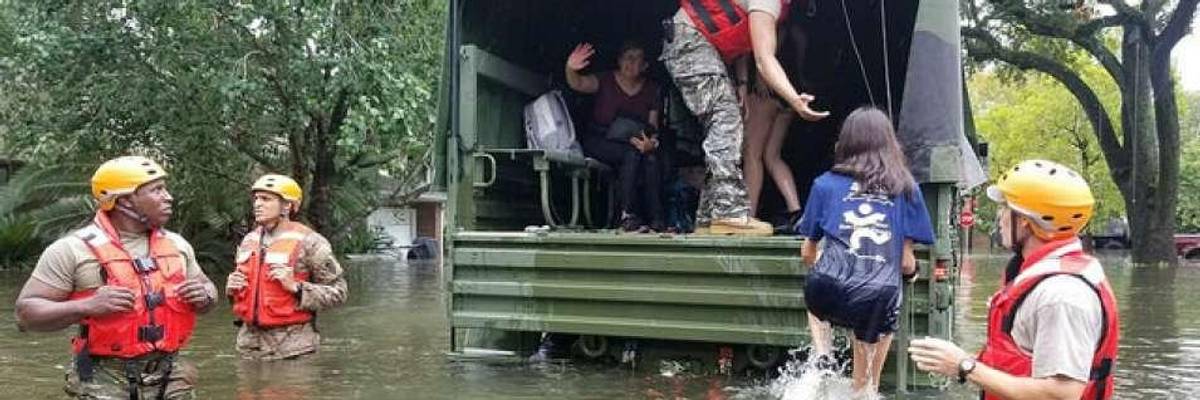
Based on the experiences of those who lived through Hurricane Katrina and its aftermath, Quigley offers victims of the latest mega-storms some warnings as they start to rebuild. (Photo: Flickr/Texas Military Department/CC)
Dear Fellow Hurricane Survivors:
Our hearts go out to you as you try to return to and fix your homes and lives. Based on our experiences, here are a few things you should watch out for as you rebuild your communities.
One. Rents are going to skyrocket and waves of evictions are likely. With so many houses damaged and so many highly paid contractors coming into your region whose companies will pay anything to house them, landlords are going to start evicting people to make way for higher paying occupants. Work with local organizations to enact a moratorium on evictions and a freeze on rents to allow working and low income people to come home and have a place to stay.
Two. Rip off contractors and vulture businesses are probably already on the scene. Don't give money to anyone unless you know and trust them and do not pay for everything in advance!
Three. Take pictures of everything that was damaged and hold onto all receipts for all your disaster expenses. Get a special binder and keep all your papers in it. Sadly, the process of getting assistance is going to last for years for many people and you will need to prove what damage you.
Four. Right after a disaster there is an outpouring of compassion, support and solidarity. Take what you need for your community.But realize the window of compassion and support shuts much quicker than it should. Then people will start blaming the victims.
Five. Insist on transparency, accountability and participation in all public and private funding sources for disaster relief. The government is yours and ours. We need them in times of disaster but they can also be the biggest obstacle to a just recovery. Demand they tell the public what is going on and consult with all parts of our communities, not just the rich and well connected usual suspects. Same problems arise when dealing with the private relief organizations from the biggest private disaster relief organization to many other smaller groups.
Six. Insist on telling your own story. Your truth is a jewel that shines brightest in your own hands. If you are going to work with journalists or others make sure the real truth is told, not just the sensational or heart rending stories of poor, powerless victims. You may have been victimized by the hurricane but you are a powerful survivor!
Seven. Unless you are rich enough to try to go this alone, you have to join together with others to make your voice heard. Many voices together are loud enough to force those in power to listen. Groups of people are far more effective than individual voices. Neighborhood organizations, church organizations, community organizations, join and work with others!
Eight. Work in statewide coalitions. Statewide coalitions are very important because many disaster relief decisions are made on the state level. You have to be able to influence those decisions.
Nine. Identify members of Congress who you can work with. Many decisions are being made on the federal level. You have to make sure your voice is heard. After Katrina, the best voice for poor people in New Orleans was Congresswoman Maxine Waters from California! Now well known nationally as Superwoman, she was terrific advocate for and with us.
Ten. Prioritize the voices of women. Men push to the front when the cameras are on and when the resources are being handed out. But in the long run, it is usually the women who are the most reliable family anchors.
Eleven. Don't allow those in power to forget about the people whose voices are never heard. People in nursing homes, people in hospitals, the elderly, the disabled, children, the working poor, renters, people of color, immigrants and prisoners. There is no need to be a voice for the voiceless, because all these people have voices, they are just not listened to. Help lift their voices and their stories up because the voices of business and industry and people with money and connections will do just fine. It is our other sisters and brothers who are always pushed to the back of the line. Stand with them as they struggle to reclaim their rightful place.
Twelve. Realize that you have human rights to return to your community and to be made whole. Protect your human rights and the human rights of others.
Dear Common Dreams reader, It’s been nearly 30 years since I co-founded Common Dreams with my late wife, Lina Newhouser. We had the radical notion that journalism should serve the public good, not corporate profits. It was clear to us from the outset what it would take to build such a project. No paid advertisements. No corporate sponsors. No millionaire publisher telling us what to think or do. Many people said we wouldn't last a year, but we proved those doubters wrong. Together with a tremendous team of journalists and dedicated staff, we built an independent media outlet free from the constraints of profits and corporate control. Our mission has always been simple: To inform. To inspire. To ignite change for the common good. Building Common Dreams was not easy. Our survival was never guaranteed. When you take on the most powerful forces—Wall Street greed, fossil fuel industry destruction, Big Tech lobbyists, and uber-rich oligarchs who have spent billions upon billions rigging the economy and democracy in their favor—the only bulwark you have is supporters who believe in your work. But here’s the urgent message from me today. It's never been this bad out there. And it's never been this hard to keep us going. At the very moment Common Dreams is most needed, the threats we face are intensifying. We need your support now more than ever. We don't accept corporate advertising and never will. We don't have a paywall because we don't think people should be blocked from critical news based on their ability to pay. Everything we do is funded by the donations of readers like you. When everyone does the little they can afford, we are strong. But if that support retreats or dries up, so do we. Will you donate now to make sure Common Dreams not only survives but thrives? —Craig Brown, Co-founder |
Dear Fellow Hurricane Survivors:
Our hearts go out to you as you try to return to and fix your homes and lives. Based on our experiences, here are a few things you should watch out for as you rebuild your communities.
One. Rents are going to skyrocket and waves of evictions are likely. With so many houses damaged and so many highly paid contractors coming into your region whose companies will pay anything to house them, landlords are going to start evicting people to make way for higher paying occupants. Work with local organizations to enact a moratorium on evictions and a freeze on rents to allow working and low income people to come home and have a place to stay.
Two. Rip off contractors and vulture businesses are probably already on the scene. Don't give money to anyone unless you know and trust them and do not pay for everything in advance!
Three. Take pictures of everything that was damaged and hold onto all receipts for all your disaster expenses. Get a special binder and keep all your papers in it. Sadly, the process of getting assistance is going to last for years for many people and you will need to prove what damage you.
Four. Right after a disaster there is an outpouring of compassion, support and solidarity. Take what you need for your community.But realize the window of compassion and support shuts much quicker than it should. Then people will start blaming the victims.
Five. Insist on transparency, accountability and participation in all public and private funding sources for disaster relief. The government is yours and ours. We need them in times of disaster but they can also be the biggest obstacle to a just recovery. Demand they tell the public what is going on and consult with all parts of our communities, not just the rich and well connected usual suspects. Same problems arise when dealing with the private relief organizations from the biggest private disaster relief organization to many other smaller groups.
Six. Insist on telling your own story. Your truth is a jewel that shines brightest in your own hands. If you are going to work with journalists or others make sure the real truth is told, not just the sensational or heart rending stories of poor, powerless victims. You may have been victimized by the hurricane but you are a powerful survivor!
Seven. Unless you are rich enough to try to go this alone, you have to join together with others to make your voice heard. Many voices together are loud enough to force those in power to listen. Groups of people are far more effective than individual voices. Neighborhood organizations, church organizations, community organizations, join and work with others!
Eight. Work in statewide coalitions. Statewide coalitions are very important because many disaster relief decisions are made on the state level. You have to be able to influence those decisions.
Nine. Identify members of Congress who you can work with. Many decisions are being made on the federal level. You have to make sure your voice is heard. After Katrina, the best voice for poor people in New Orleans was Congresswoman Maxine Waters from California! Now well known nationally as Superwoman, she was terrific advocate for and with us.
Ten. Prioritize the voices of women. Men push to the front when the cameras are on and when the resources are being handed out. But in the long run, it is usually the women who are the most reliable family anchors.
Eleven. Don't allow those in power to forget about the people whose voices are never heard. People in nursing homes, people in hospitals, the elderly, the disabled, children, the working poor, renters, people of color, immigrants and prisoners. There is no need to be a voice for the voiceless, because all these people have voices, they are just not listened to. Help lift their voices and their stories up because the voices of business and industry and people with money and connections will do just fine. It is our other sisters and brothers who are always pushed to the back of the line. Stand with them as they struggle to reclaim their rightful place.
Twelve. Realize that you have human rights to return to your community and to be made whole. Protect your human rights and the human rights of others.
Dear Fellow Hurricane Survivors:
Our hearts go out to you as you try to return to and fix your homes and lives. Based on our experiences, here are a few things you should watch out for as you rebuild your communities.
One. Rents are going to skyrocket and waves of evictions are likely. With so many houses damaged and so many highly paid contractors coming into your region whose companies will pay anything to house them, landlords are going to start evicting people to make way for higher paying occupants. Work with local organizations to enact a moratorium on evictions and a freeze on rents to allow working and low income people to come home and have a place to stay.
Two. Rip off contractors and vulture businesses are probably already on the scene. Don't give money to anyone unless you know and trust them and do not pay for everything in advance!
Three. Take pictures of everything that was damaged and hold onto all receipts for all your disaster expenses. Get a special binder and keep all your papers in it. Sadly, the process of getting assistance is going to last for years for many people and you will need to prove what damage you.
Four. Right after a disaster there is an outpouring of compassion, support and solidarity. Take what you need for your community.But realize the window of compassion and support shuts much quicker than it should. Then people will start blaming the victims.
Five. Insist on transparency, accountability and participation in all public and private funding sources for disaster relief. The government is yours and ours. We need them in times of disaster but they can also be the biggest obstacle to a just recovery. Demand they tell the public what is going on and consult with all parts of our communities, not just the rich and well connected usual suspects. Same problems arise when dealing with the private relief organizations from the biggest private disaster relief organization to many other smaller groups.
Six. Insist on telling your own story. Your truth is a jewel that shines brightest in your own hands. If you are going to work with journalists or others make sure the real truth is told, not just the sensational or heart rending stories of poor, powerless victims. You may have been victimized by the hurricane but you are a powerful survivor!
Seven. Unless you are rich enough to try to go this alone, you have to join together with others to make your voice heard. Many voices together are loud enough to force those in power to listen. Groups of people are far more effective than individual voices. Neighborhood organizations, church organizations, community organizations, join and work with others!
Eight. Work in statewide coalitions. Statewide coalitions are very important because many disaster relief decisions are made on the state level. You have to be able to influence those decisions.
Nine. Identify members of Congress who you can work with. Many decisions are being made on the federal level. You have to make sure your voice is heard. After Katrina, the best voice for poor people in New Orleans was Congresswoman Maxine Waters from California! Now well known nationally as Superwoman, she was terrific advocate for and with us.
Ten. Prioritize the voices of women. Men push to the front when the cameras are on and when the resources are being handed out. But in the long run, it is usually the women who are the most reliable family anchors.
Eleven. Don't allow those in power to forget about the people whose voices are never heard. People in nursing homes, people in hospitals, the elderly, the disabled, children, the working poor, renters, people of color, immigrants and prisoners. There is no need to be a voice for the voiceless, because all these people have voices, they are just not listened to. Help lift their voices and their stories up because the voices of business and industry and people with money and connections will do just fine. It is our other sisters and brothers who are always pushed to the back of the line. Stand with them as they struggle to reclaim their rightful place.
Twelve. Realize that you have human rights to return to your community and to be made whole. Protect your human rights and the human rights of others.