SUBSCRIBE TO OUR FREE NEWSLETTER
Daily news & progressive opinion—funded by the people, not the corporations—delivered straight to your inbox.
5
#000000
#FFFFFF
To donate by check, phone, or other method, see our More Ways to Give page.
Daily news & progressive opinion—funded by the people, not the corporations—delivered straight to your inbox.
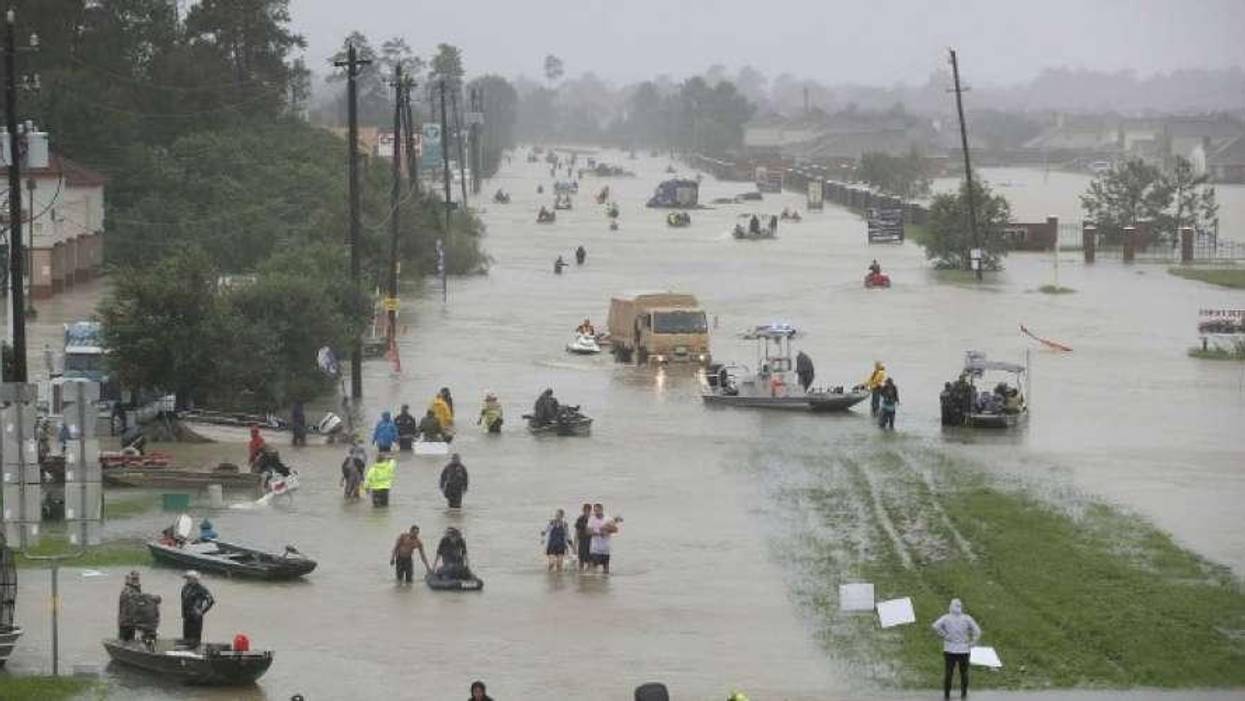
After Hurricane Harvey damaged or destroyed nearly 135,000 homes, killed eighty-eight people, and led to the deliberate flooding of west Houston as two main reservoirs threatened to fail, what did the city of Houston do? It did the least possible it could get away with, and then casually moved on with business as usual.
As floodwaters from September's Tropical Storm Imelda still drain from the streets of my hometown , I observe a discourse on Harvey's two-year anniversary constrained by a presumed opposition between the needs of humanity and the forces of nature, as though the two were in mortal combat. In a city well-known for its antipathy to responsible planning, discussions of urban resilience and "making space" for water, as well as the benefits of green versus gray infrastructure, are just now bubbling to the surface, but remain well outside the scope of broad public awareness.

Houston, America's "energy capital," may find it more challenging than other cities to move beyond relying on the market to solve problems. But for all communities facing climate change-induced threats, the future lies in rethinking basic assumptions about how cities work, especially for those most vulnerable.
Harris County, which includes Houston, did manage in 2018 to pass a $2.5 billion flood control bond, a mere drop in the bucket toward the $30 billion estimated to be needed just to protect against a 100-year flood. For reference, Harvey was considered a 500-year flood--and it was Houston's third in three years. The roughly 240 projects funded by the bond sound impressive, until one considers that most are microscopic improvements: widening and repairing existing channels, or upgrading detention ponds and retention sinks. Many agree they won't prevent future flooding. Houston's "flood czar," developer Stephen Costello, had a staff of zero before Harvey, and was given a staff of one after the hurricane. Now the recovery czar, his main task so far appears to be maximizing compensation from FEMA.
Harris County's new judge (an executive position, despite its name), twenty-eight-year-old Colombian-born Lina Hidalgo, aspires to confront the problem by picking "low-hanging fruit," such as warning and communication systems, but so far has not challenged the nexus of powers behind the city's pell-mell development.
Even according to its own shrunken metrics of "recovery," Houston is failing: FEMA has denied applications for aid from many African Americans in ruined neighborhoods like Kashmere Gardens and part of the Fifth Ward. These areas of Houston were devastated before Harvey, and remain so afterward: aging infrastructure, including overflowing open drains, are unchanged from the past. It's easy to imagine that at its current pace any flood bond improvements would take a decade or more to reach residents in these areas.
On other fronts, the scene is just as desultory. Houston is having trouble buying out homes in the most obvious floodplains; only a few hundred have agreed to sell and relocate. Predictably, developers are vigorously contesting even minimal new requirements for housing elevation and building in the floodplains. Mayor Sylvester Turner advocates a hard coastal barrier (the "Ike Dike") constructed off Galveston, a project more in the realm of fantasy than anything that might help vulnerable people in the next large hurricane. A third major reservoir, to supplement the two overwhelmed by Harvey, is unlikely to come to the rescue.
Instead, runaway climate change has been blamed for the intensity of the storm and the devastation in its wake, against which the mayor and city council--mere mortals--are presented as helpless. Attention has thus been successfully diverted from the man-made elements of the disaster to focus on the awesome power of fifteen trillion gallons of water and up to fifty inches of rain.
There have been no legal charges filed against any city officials for spurning any flood mitigation efforts commensurate with the rampant development going on for the last twenty years. And this is despite Tropical Storm Allison offering a preview in 2001 of what was to come. If anything, Harvey has been solicited to boost the city's mythology of hardscrabble frontiersmanship and volunteerism operating under minimalist regulation.
There is yet to be an accounting of the fact that Houston recklessly paved over essential wetlands, and added magnitudes of impermeability at an unsustainable pace. Even in the recent years before Harvey, there were multiple 100-year and even 500-year floods, such as the Memorial Day flood of 2015 and the Tax Day flood of 2016, both of which personally affected me worse than did Harvey. These storms inundated large parts of the city including prosperous middle-class suburbs like Meyerland, Pearland, Friendswood, Kingwood, and Katy. And only a few weeks ago, Tropical Storm Imelda hit, flooding at least 1,700 homes in the area.
At the least, city officials--including recent mayors Annise Parker, Bill White, and Lee Brown--should be scrutinized for ignoring standard flood control measures, and their past deliberations over such measures should be made open and public, and subject to possible legal action. Anna Clark, in her brilliant new book, The Poisoned City: Flint's Water and the American Urban Tragedy, has described the residents there filing legal charges, including for involuntary manslaughter, against officials who ignored conventional measures for protecting residents' health. This should be a standard template residents everywhere should consider, when officials show such abysmal failure.
Houston sought to build its image, with full media cooperation, as a city of freelance heroes taking out their boats (or air mattresses) to rescue stranded neighbors, the spirit of voluntarism, rather than government intervention.
It is instructive to compare the media frame which encompassed the aftermath of Hurricane Katrina in New Orleans, where that city, in tune with its pathological national image, was described as beyond help, its mostly African American residents presented as looters, shysters, rapists, and even murderers delivered from their miserable lives by the hurricane's timely intervention. It offered "slum clearance" for those who couldn't wait to get their neoliberal tentacles into the city's free-floating political economy.
In contrast, Houston sought to build its image, with full media cooperation, as a city of freelance heroes taking out their boats (or air mattresses) to rescue stranded neighbors, the spirit of voluntarism, rather than government intervention, its ultimate grace. Houston Texans star J.J. Watt, and Jim McIngvale ("Mattress Mack"), owner of celebrated Gallery Furniture, have been lauded as philanthropists assisting "recovery," making self-obsessed pastor Joel Osteen's initial reluctance to open up his Lakewood Church to displaced residents appear in quite bad taste.
So, what could have been done? Urban flood planning is a well-developed art, with an elaborate multi-dimensional perspective about preserving and enhancing wetlands and other sinks and barriers, encouraging permeable rather than impermeable surfaces, and the astute management of retention sinks and detention ponds, among other measures designed to minimize flooding. An impressive range of urban flood planning measures is practiced in countries from Mozambique to Bangladesh, not to mention in the Netherlands with its "room for the rivers" approach.
"Resilience" has become a favorite buzzword among many city and state officials, but the concept, as the discourse surrounding Harvey's aftermath makes clear, is often deployed in narrow, adversarial terms, treating natural processes as enemies, the approach easily blending into the theory of resistance to nature it originally sought to replace.
Resilience tends to divide urban areas into wanted and unwanted zones: those unfortunate or poor enough to live within floodplains, or low-lying areas, somehow needing to be coaxed out of their voluntary servitude to nature's barbarism when it decides to go full-on Biblical. Resilience presumes that the division between poor and rich must remain untouched, while it engineers levees, seawalls, and catchment basins, big infrastructure approaches that often only strengthen the existing structure of inequality.
It is a never-ending game, because resilience fights enemies that are evanescent and transmogrifying, only aided by our current urban development archetype. How can we even understand floodplains, involving the precise mapping of 100 or 500-year flood zones, when Houston flooded well outside these zones in all the recent floods? How can we understand vulnerability in New Orleans from a purely engineering standpoint, when the victims of that cataclysmic event were always barred from politics?
One indication of a different model is that followed in China's Chengdu Urban Revitalization, which granted relocated residents new social and property rights after resettlement. Elements of the increasingly popular SUDS (sustainable urban drainage systems) are gaining traction in China and other parts of the world, and include such eminently practicable measures as rainwater harvesting and reconstructing wetlands, treating nature as an ally rather than an enemy. Flood planning, in this perspective, starts becoming part of a healthy reinterpretation of the city's relationship with nature (including rooftop catchments and widespread urban gardening), rather than an abstracted confrontation.
The problem with current conceptions of resilience, and much of American planning, though, is that the city--or rather the particular economic interests it serves--still comes first, and nature is treated as secondary, if it is considered at all, never for its own sake. As long as this faulty paradigm reigns, so-called catastrophes will continue to be magnified in the context of no-zoning, no-planning, acutely segregated urban landscapes. Houston has not dared to imagine itself within its regional topography, including wetlands, prairie, forest, desert, and coast, and instead embraces growing magnitudes of asphalt.
Imagine, instead of a city imposed on a given topography, the natural elements of a place being granted equal footing. Urbanism would then work around what existed, rather than rooting it out and creating a perpetual, unwinnable war against nature. The most important consequence of this different way of imagining cities is that it would transform the whole psychology of subservience. The aftermath of a Katrina or a Harvey only too clearly reveals who is immune from disaster, and who really suffers from dislocation and displacement. Regardless of all the talk of resilience, if urban planning does not address segregation and inequality as part of its responses to flood control and disaster preparedness, the city remains a perpetual inequality machine. The city of the future, by embracing its natural surroundings and giving it its due, could become a playing field for equality.
While many lawmakers and pundits continue to complain that the cost of an ambitious Green New Deal would be "too expensive," a new nonpartisan government agency report on Wednesday details the billions upon billions of dollars the U.S. is spending each year as the climate crisis continues to intensify.
The Government Accountability Office (GAO) released its bienniel "High Risk" report Wednesday and presented its findings to the House and Senate. The study details waste, mismanagement, abuse, and fraud in government agencies and programs, and found that federal inaction regarding climate change is costing U.S. taxpayers tens of billions of dollars annually.
According to the GAO, taxpayer funds spent on disaster relief could be saved if more effort and spending went into mitigating the climate crisis that is intensifying the frequency of extreme weather events and natural disasters.
"Continuing to in the wrong direction will not only impose mounting costs on taxpayers, but could also jeopardize the health, safety, and livelihoods of people around the country." --Rachel Cleetus, UCS
"We found that federal investments in resilience could be more effective if post-disaster hazard mitigation efforts were balanced with resources for pre-disaster hazard mitigation," the report reads (pdf).
The U.S. government spent nearly half a trillion dollars on disaster relief since 2005, the GAO reported, "most recently for catastrophic hurricanes, flooding, wildfires, and other losses in 2017 and 2018"--and such disasters are expected to cost more each year "as extreme weather events become more frequent and intense due to climate change."
"Beginning in 2017, the administration revoked policies that had identified addressing climate change as a priority," the GAO added--making it highly unlikely that the Trump administration will give serious consideration to the office's warnings.
Critics demanded that the Trump administration take the report seriously "for the sake of communities on the frontlines of climate risks."
The report pointed to President Donald Trump's elimination of the Federal Flood Risk Management in August 2017--days before Hurricane Harvey hit Houston--as one example of how the president has increased "federal fiscal exposure," making it more likely that the U.S. will have to spend hundreds of billions of dollars on disaster relief when infrastructure is damaged by flooding.
The Obama-era standard had ordered builders to ensure that infrastructure can withstand rising sea levels and heavier downpours.
Trump's failure to reform national flood insurance and federal crop insurance programs also indicate his disinterest in admitting that the climate crisis is having an impact on farms and coastal communities vulnerable to flooding and in tackling the effects of climate crisis, the Union of Concerned Scientists (UCS) said in a statement about the report.
"The report cites the failure to reform the national flood insurance and federal crop insurance programs and account for climate risks to federally funded infrastructure as evidence that the U.S. government urgently needs to develop an adequate, comprehensive response to climate change," said Rachel Cleetus, lead economist for UCS's Climate and Energy Program.
"Continuing to [go] in the wrong direction will not only impose mounting costs on taxpayers, but could also jeopardize the health, safety, and livelihoods of people around the country," she added.
Cleetus cited a recent study by the National Institute of Building Sciences, which bolstered the GAO's case that the government must develop a wide-ranging strategy to invest in climate-resilient infrastructure as well as sustainable energy to significantly reduce the united states' fossil fuel dependence.
"A recent study shows the nation can save $6 in future disaster costs, for every $1 spent on pre-hazard mitigation," she said.
"In light of growing extreme weather and climate-related disaster costs, the federal government must invest ahead of time to help communities prepare instead of just picking up the pieces after disasters strike," Cleetus added.
President Donald Trump's Environmental Protection Agency and Texas state officials rejected an offer from NASA scientists in 2017 to use their state-of-the-art flying laboratory to evaluate air quality in Houston after Hurricane Harvey, new reporting by the Los Angeles Times reveals.
"This is disturbing," said Lina Hidalgo, judge for Texas's Harris County.
Harvey brought historic rainfall, catastrophic flooding, and triggered potentially dangerous environmental and public health impacts: Houston's many refineries and petrochemical released pollutants into the air and waters, and area residents began to complain of worrisome smells and toxic sights near the facilities, as well as symptoms including headaches. The EPA asserted that the air quality posed no threat.
NASA, it turned out, was in a good position to gather data on air quality in the area with its DC-8. The jet, whose ability to ability to gather data dwarfs that of the EPA's air pollution plane or the hand-held devices used by Texas state officials, was already set up for testing because of a scheduled six-hour test flight to Lamont, Oklahoma on Sept. 14.
The response to NASA's offer? Thanks but no thanks.
Susanne Rust and Louis Sahagun reported for the Times:
On Sept. 9, David Gray, the EPA's deputy regional administrator in Texas and leader of the agency's emergency response, wrote to NASA and Texas officials that he was "hesitant" to have the jet "collect additional information that overlaps our existing efforts" until he learned more about the mission. He noted that media and nongovernmental organizations were releasing data that was "conflicting" with the state and EPA's.
The NASA scientists offered assurances that their fact-finding would not get in the way, but noted that the data would eventually be seen by the public. Texas and the EPA were unmoved.
The state-level response came from director of toxicology Michael Honeycutt, who now heads EPA's Science Advisory Board and is known for expressing views well out of the reach of mainstream science, such as the idea that lowering ozone would be bad for public health.
On Sept. 11, Honeycutt wrote in an email to NASA and EPA officials that state data showed no sign for concern, and "we don't think your data would be useful for source identification while industry continues to restart their operations."
Gray agreed with Honeycutt: "EPA concurs with your assessment and we will not plan to ask NASA to conduct this mission."
Associated Press reporter Frank Bajak noted that the new investigation adds weight to his own news agency's previous reporting showing that "Texas environmental regulators had little interest in exposing most post-Harvey industrial contamination."
Reacting to the reporting on Twitter, Dr. Chelsea Thompson, a research scientist in atmospheric chemistry, wrote, "It's worth noting that, over a year later now, all of us involved are still stunned by how this played out."
Another scientist, air pollution expert Nick Vizenor, who said he was part of lab team preparing for the potential mission over Houston, said the new investigation shows the "EPA and the state of Texas did not want to have all the information it could to try and help and protect the citizens of Houston."
"This is yet another story that shows how little the current administration cares about [its] citizens and the environment," he said.
"EPA and the Texas Commission on Environmental Quality knew air pollution was one of the unseen dangers of Hurricane Harvey, but according to news reports they deliberately chose not to use every available tool to discover it," added Elena Craft, senior health scientist with Environmental Defense Fund. "Their rejection of NASA's plan to fly a pollution-spotting plane over Houston after the storm is an abdication of responsibility and part of a disturbing trend of willful ignorance."
"Their action," she continued, "caused unnecessary risk to the health and safety of Texas families."
While scientists warn that the climate crisis will continue to cause increasingly damaging weather events and disasters in U.S. communities, President Donald Trump made clear Friday his focus on a separate, invented "crisis" as he ordered officials to consider redirecting billions of dollars in disaster relief funds to pay for a wall at the southern U.S. border.
According to the Associated Press, the White House asked the Army Corps of Engineers to examine its budget, including $13.9 billion in emergency funds, to determine how much money it could spend to help build the wall Trump promised his supporters.
The emergency funds had been set aside for California in the wake of devastating wildfires that tore through 1.8 million acres in the state this year, as well as Puerto Rico, Texas, and Florida as they continue to recover from 2017 and 2018's hurricanes and prepare for similar storms in the coming years.
Rep. Nydia Velazquez (D-N.Y.) was among those who condemned the reports of Trump's plans.
"Siphoning funding from real disasters to pay for a crisis manufactured by the president is wholly unacceptable and the American people won't fall for it," said Velazquez in a statement. "My Democratic colleagues in Congress and I will fight such a move with every ounce of energy we have."
According to the Houston Chronicle, the report of Trump's plans left city and county officials "scrambling to figure out how local flood control plans would be affected" by the White House proposal, a year and a half after Hurricane Harvey devastated parts of Houston.
Trump indicated Thursday during a trip to the border that he was planning to declare a national emergency in order to free up funds to build the wall, which is supported by only 41 percent of Americans, according to a recent Reuters-Ipsos poll. Democrats in Congress have refused to approve a spending bill that includes the $5.7 billion Trump has demanded for the wall.
As the president toyed with the idea of taking badly-needed funds to pay for the effects of the climate crisis--which he has denied exists--and Senate Majority Leader Mitch McConnell blocked Democrats' attempts to take up legislation to reopen the government, 800,000 Americans were continued to cope with the various and negative impacts of the shutdown. On Friday, those government employees on furlough or working without pay received no paycheck even as hundreds of thousands of them continue to report for work.
A year ago I wrote about the problems in Houston, I wrote with great frustration about political expedience, poor planning, and supreme errors in judgment coupled with selfishness, but things have gotten so much worse.
In Houston Trump knew that he should wait, the lesson was clear, and he pledged to stay away until he could visit without disrupting relief efforts, but he couldn't wait to get his pictures and applaud himself, calling the response "a wonderful thing." Then he did the same thing in Puerto Rico, 10 out of 10 he said... a year later he still gives an "A-plus" to the disaster, actually claiming the Democrats jiggered the figures to make him look bad. He naturally continues to say his people kept the death toll to fewer than 20 when all the scientists put the tragic number at 2,975 people. Trump has shown significant racist hatred toward Hispanic and Latin populations, unfortunately it is difficult to determine if or when a poor response to a disaster is intentional or a result of incompetence since he shows incompetence in so many aspects of his Presidency.
A year later, and like clockwork, "a disaster is at the doorstep." Hurricane Florence has hit the Carolinas and the lessons are still being ignored. Expertise on disaster management is very clear. The four most important, and controllable, details are the availability and mobilization of resources, the robustness of system strength, the redundancy of alternatives, and the rapidity of responses. Failure in any of these areas can have significant consequences. Spoiler alert: the racist-in-chief has overseen $9.8 million diverted from FEMA to ICE detention centers, he has prioritized family detention and separation over Emergency Management, he will give himself credit for a great job (again) but nothing in the response will be an improvement unless it's pure innovation by an underfunded but highly skilled FEMA.
To call it shameful is to give too much credit and to ignore the willful wrongdoing of this disaster-in-chief. George W. Bush and Barack Obama both showcased the ability to delay trips, and learn from mistakes. Flyovers, for example, allow the President to visit without disrupting relief efforts. But, Trump will make sure he gets more feet-on-the-ground photo-ops, his undeniable narcissism, his awkward paper towel tossing photos are just too irresistible... Trump has shown an absolute unwillingness to be honest, his 7.6 lies a day are only increasing, and his inability to admit to mistakes presents him with no room for growth. So Americans are left in the position of having their lives placed in mortal risk in order for the President to protect his ego despite utter and abject failure.
To blame Trump as the sole problem is also a mistake. Despite his unprecedented and un-presidential thousands of lies, 32% of American voters believe Trump is honest and 84% of Republicans approve of the job he is doing. So it really isn't a surprise that chances to address continued and increasing risks and threats from natural disasters and global climate change are avoided and ignored. I do not wish hardship on anyone, but it is hard to ignore the irony in North Carolina's intentional near-sightedness and climate change denial, in 2012 North Carolina legislators banned "the state from basing coastal policies on the latest scientific predictions of how much the sea level will rise." Stephen Colbert's mockery back then was well deserved, "If your science gives you a result you don't like, pass a law saying the result is illegal. Problem solved..." but, in the coming days reminders of this willful ignorance will feel like salt in the wounds.
There are clear democratic solutions to the human-caused parts of these disasters. First, people need to vote. The 43 percent of Americans (about 100 million people) who didn't vote in 2016, for example, could make huge differences. Those numbers could keep incompetence out of elected office and could force politicians to stop ignoring science. Currently big businesses are able to push forward climate denial agendas, because it is good for their short-term profits, but the vote is a chance to put people ahead of dollar signs. Second, people can exercise their right to petition their leaders; you do not have to silently sit back and wait for change, if you are tired of the threat these elected officials pose to you, your families and communities, and the whole planet--say something, tell Trump to resign! Third, recognize human caused global warming. There is virtually unanimous scientific consensus, and the conclusions are clear. The frequency and intensity of these weather events will continue to increase. There is no ambiguity in the science: an increase in temperature causes an increase in water in the atmosphere, an increase in the sea surface temperature combined with increased atmospheric water equals stronger tropical storms. We can all examine our footprints, work to be more conscientious in our daily living, and prepared for future disasters.
Like I wrote last year, and will again next year: Hurricanes are as predictable as presidential photo ops, and they both have warnings; Trump knows that he should stay at home, and we know that we are causing climate change. If we don't take responsibility things will only get worse, and Trump has completely shoved his head in the sand, so it is up to everyone else now.
As Hurricane Florence officially made landfall Friday, and forecasters warn of "life-threatening, catastrophic flash flooding," some attention has turned to residents across mandatory evacuation zones in the Carolinas and Virginia who chose to stay or were unable to leave, and how the poorest often pay the highest price when faced with a natural disaster.
Responding to a New York Times report in which an Edenton, North Carolina man who cares for his father--a cancer patient with whom he shares a double-wide trailer--explained that his family doesn't have the resources to leave, author and activist Naomi Klein tweeted Friday, "These disasters drag into the light exactly who is already being thrown away."
Climate chaos is a justice issue. Economic justice. Racial justice. Migrant justice. Gender justice. Justice for the disabled and elderly. Justice for prisoners. These disasters drag into the light exactly who is already being thrown away. #FlorenceHurricane2018 https://t.co/4uF8lKYfIg
-- Naomi Klein (@NaomiAKlein) September 14, 2018
" Poverty lies in the path of Hurricane Florence in eastern N.C.," the Asheville Citizen Times declared Thursday. "Some people are getting out of town, but that's not an option for me. I have no money, no job, no connections," Tony Clower, a 39-year-old homeless man living in Kinston, told the newspaper. "I want to cry. All I can do is put my hands together and ask God to keep me safe."
A Vox article outlining common reasons people don't always abide by evacuations orders noted that "there are people who don't leave due to disabilities--they simply can't get out of their homes and don't have anyone to help them." Some don't want to leave behind their pets, and can't find a shelter or hotel that will allow animals.
Others may underestimate the threat or not receive timely storm updates--though Vox pointed out, "in an age when warnings can be blasted out via radio, TV, and smartphones, and through old-fashioned door-to-door notifications, this is becoming less likely." And then there are those who fear their home will be looted, or those like Clower, who cannot afford to travel and stay somewhere safe.
Kathy Sexton, a 56-year-old resident of Myrtle Beach, South Carolina, spoke with the Washington Post about the various reasons she is trying to ride out the storm in her two-story townhouse:
[She] had thought about staying with relatives who live six hours away, but the long drive would be detrimental to her elderly mother, whose damaged spine keeps her from being able to sit for extended periods. She would've booked a hotel further inland, she said, but she couldn't afford the cost. She would've stayed at one of the emergency shelters, but pets aren't allowed there, she said. Sexton has two 15-year-old cats that both need medication, and she said there's no place to board them. Even if there was one, she doesn't trust anyone else to take care of them. "They're like family. There's just no way," she said.
Emergency rescues already have begun for those who wouldn't or couldn't evacuate, after coastal communities were struck by the outer bands of the storm on Thursday. In New Bern, North Carolina, as of 2:27am local time, about 150 residents were still waiting on assistance from FEMA crews, according to the city's Twitter account.
"People surrounding me are under water. They have been trapped in their attics," New Bern resident Tonya Moore told NBC News while awaiting rescue with her mother, husband, and five children. "Every road is flooded. There's nowhere to get out over here."
As Florence continued its crawl along the Southeast, FEMA on Friday cut off vouchers for 987 American families living in hotel rooms across the country after being displaced from their homes in Puerto Rico because of Hurricane Maria, which ravaged the U.S. territory last September. FEMA offered them one-way tickets back to the island--which is still struggling with widely ridiculed recovery efforts--but that offer also expires Friday.
Some of these families spoke with NBC News about their difficulties finding longer-term housing they can afford. Vimarie Cardona is a single mother of three who has lived in an Orlando hotel with her children since November. Now working as a housekeeper at Disney World, Cardona explained that landlords have refused to rent her one-bedroom apartments because of the size of her family, and two-bedroom options are outside of her price range.
"I started looking for apartments. Even before they said [the voucher payments] would end I started looking," she said Wednesday. "From day one it was hell."
Florence also comes just days after the conclusion of a multi-week nationwide prison strike to demand improved living conditions and an end to "modern day slavery" that was organized in response to an April riot at Lee Correctional Institution in South Carolina, where guards waited several hours intervene in violence that killed seven priosners and injured more than dozen.
As the hurricane approached this week, multiple other South Carolina detention facilities made headlines for refusing to evacuate inmates despite being located in a mandatory evacuation zones. Spokesmen insisted to VICE and BuzzFeed News that the facilities can safely withstand the storm.
However, as VICE outlined, there is a long history of inmates facing dangerous conditions after officials decline to evacuate due to a hurricane--or prisoners being abandoned altogether:
Inmates left behind at a federal prison near Houston following Hurricane Harvey in August 2017 reported food shortages, no drinking water, and sewage flooding. Many inmates weathered the storm still locked in their cells. And as Puerto Rico reeled in the devastated aftermath of Hurricane Maria, the U.S. Bureau of Prisons began evacuating inmates from its easternmost facility in Rio Grande due to sustained power outages. During the chaos of the relocation process after the hurricane, 13 inmates escaped.
City officials also reportedly abandoned inmates at the New Orleans Parish Prison during Hurricane Katrina in 2005. Human Rights Watch reported that correctional officers left more than 600 inmates in one building without supervision to weather the storm. Some inmates say they were left locked in their cells for days as flood water seeped into the jail, eventually reaching chest level, before they were evacuated.
Ahead of the storm on Wednesday, a group of prison reform activists gathered outside of the South Carolina statehouse to protest against the decision to keep inmates in facilities located within evacuation zones, pointing to post-Katrina conditions as well as prisoners who have died even when there isn't a hurricane forcing so many others to flee.
"In perfect conditions we see people dying," activist Stephanie Serna told The State, a local newspaper. "What makes us think that in an emergency situation they'll do better without any accountability?"
Chemical manufacturers must immediately comply with the Chemical Disaster Rule, a set of requirements aimed at keeping communities safe from toxic disasters, following a federal court ruling on Friday which called the Trump administration's delay of the rule "arbitrary" and illegal.
"This is a victory first and foremost for the neighborhoods most susceptible to dangerous and toxic chemical releases. Families who live under the shadows of chemical facilities deserve safer practices to prevent future disasters," said Andrew Rosenberg, director of the Center for Science and Democracy at the Union of Concerned Scientists.
President Donald Trump delayed implementation of the rule, which had been developed by the Obama administration, when he entered office. The regulations required the chemical industry to coordinate with emergency responders ahead of a likely emergency, to maintain transparency with their surrounding communities regarding possible chemical threats, to fully investigate disasters, and to assess whether the use of different technologies by their facilities could prevent chemical emergencies.
The Union of Concerned Scientists noted earlier this year that the delay of the rule likely exacerbated disasters including the Arkema plant explosion outside Houston last August after Hurricane Harvey hit.
"The rule would have begun to prevent and reduce chemical disasters in communities near over 12,500 facilities nationwide if the Trump administration had not abruptly suspended it one year ago, in March 2017," wrote Gretchen Goldman.
The court's decision came "not a moment to soon," for the 177 million Americans who live in places where their safety could be put at grave risk in the event of a chemical emergency, said the climate action group Earthjustice.
"The government cannot withdraw critical safety rules based on political whim--people's lives should come first," said Gordon Sommers, an attorney with Earthjustice. "The court's order means industry will have to start implementing these critical safety measures immediately--with the new hurricane season underway, there is no time to wait."
Others also applauded the ruling, including some who noted that it was just the latest recent blow to the Trump administration's pro-industry agenda--one that has consistently put the bottom line of the chemical and fossil fuel industries over the safety of Americans.
Seven months after Hurricane Harvey bombarded Houston, Texas for four days, becoming one of the costliest storms in U.S. history, an investigation has begun to uncover the extent of the toxic impact that the hurricane had on the area--home to hundreds of chemical plants and thousands of miles of pipeline as well as 4.7 million residents.
According to the Associated Press and the Houston Chronicle, Harvey unleashed an "environmental assault" on the Houston area, sending millions of gallons of toxic wastewater mixed with storm water into residential neighborhoods--but lax oversight of the energy industry in the area has left residents in the dark about their potential exposure to toxins.
In January, state environmental quality commissioner Bryan Shaw refused to disclose the most destructive spills and their locations to a legislative committee, saying he could not publicly discuss any damage until his staff completed a review.
At the time of the hurricane, regulators publicized just two industrial incidents in the area--an explosion at the Arkema chemical plant in Crosby, Texas, and the damage done to a Superfund site containing dioxin. But those disasters represented just a tiny fraction of the environmental impact of Hurricane Harvey.
A spill at another chemical plant in Baytown, east of the city, caused nearly half a billion gallons of wastewater to flow into surrounding neighborhoods and waterways, while dangerous levels of the carcinogen benzene were released into the atmosphere near a Valero Energy refinery.
A city official's pleas to the Environmental Protection Agency to monitor the air near the Valero facility and determine risks for residents were ignored in early September as the area recovered from the storm, according to the report.
Vinyl chloride and butadiene were also among the chemicals that were released into residential areas as a result of more than 100 toxic spills catalogued by the AP and the Chronicle.
"The public will probably never know the extent of what happened to the environment after Harvey. But the individual companies of course know," Rock Owens, environmental attorney for Harris County, told the news outlets.
In the months following the storm, reads the report, efforts to measure contamination have contrasted sharply with those taken by regulators in 2008 after Hurricane Ike, also in Texas, and in 2005 after Hurricane Katrina.
After the former, "state regulators collected 85 sediment samples to measure the contamination; more than a dozen violations were identified and cleanups were carried out, according to a state review," wrote Frank Bajak and Lise Olsen. Nearly 2,000 soil samples were taken in the months that followed Katrina.
In comparison, "local officials say the state's industry-friendly approach has weakened efforts by the city of Houston and surrounding Harris County to build cases against and force cleanup by the companies, many of them repeat environmental offenders," wrote the reporters.
State and federal regulators have limited their contamination testing mainly to Superfund sites, and have not announced any new regulations to limit future contamination.
"People are left in a state of limbo of not knowing if they were exposed or not--or if they were, what the implications are for their health," said Dr. Nicole Lurie, who has overseen other federal public health responses at the Department of Health and Human Services.

Devastating hurricanes and wildfires--fueled in part by anthropogenic climate change--contributed to more than $300 billion in disaster-related damage across the United States last year, making 2017 the costliest year on record for extreme weather events, according to a government report released Monday.
"We can expect extreme weather events and economic losses and costs associated with them to continue increasing unless we make dramatic reductions in greenhouse gas emissions."
--James McCarthy, climate expert
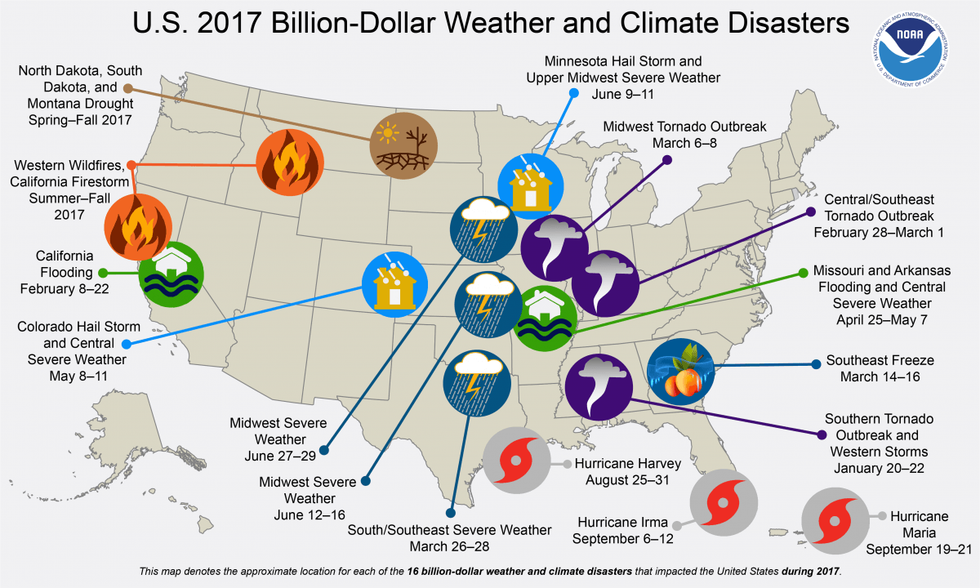
"During 2017, the U.S. experienced a historic year of weather and climate disasters," according to the National Oceanic and Atmospheric Administration's (NOAA) National Climatic Data Center. "In total, the U.S. was impacted by 16 separate billion-dollar disaster events."
"The cumulative damage of these 16 U.S. events during 2017 is $306.2 billion, which shatters the previous U.S. annual record cost of $214.8 billion," NOAA notes. The previous record--adjusted for inflation--was set in 2005, following Hurricanes Dennis, Katrina, Rita, and Wilma. Last year saw Hurricanes Harvey, Maria, and Irma produce the most expensive hurricane season ever recorded, at $265 billion, while the raging wildfires in California contributed to a record $18 billion in fire damage.
NOAA mapped 2017's billion-dollar disasters, which included not only fires and hurricanes, but also flooding, a freeze, a drought, tornadoes, and general severe weather:
The human cost may not be fully recognized in the NOAA report, which claims, "overall, these events resulted in the deaths of 362 people." In contrast, news reports from Puerto Rico--a U.S. territory devastated by the 2017 hurricane season--indicate the post-hurricane death toll on the island alone could exceed 1,000 Americans.
Though alarming on its own, Ashley Siefert, communications director for the Union of Concerned Scientists (UCS), said NOAA's new report "is even more staggering when reviewed alongside recent reports from the insurance industry, as well as the latest attribution studies examining the connection between climate change and specific extreme weather events."
Rachel Cleetus, UCS's lead economist and climate policy manager, outlined in a blog post how the NOAA report echoes reports from the insurance industry.
"Last week, Munich Re, one of the world's leading reinsurers, stated that the costs to the insurance industry from Harvey, Irma, and Maria, and other 2017 disasters, are expected to reach $135 billion globally, the highest ever, with the U.S. share dominating at 50 percent of these costs. Overall economic losses, including uninsured losses, will amount to $330 billion, the second highest ever for a single year," she writes. "Last month, Swiss Re released a similar report stating that global insured losses for 2017 were $136 billion, and total economic losses are estimated to be $306 billion."
"First and foremost, we must do more to prepare and protect communities ahead of time by investing in risk reduction and disaster preparedness, and by ensuring that our federal, state, and local policies are guided by the best available science."
--Rachel Cleetus, Union of Concerned Scientists
This "historic and unprecedented year of disastrous extremes" reinforces "the fact that climate change is a threat to our health, and also a threat to our economy," Cleetus concludes, emphasizing that in order to mitigate the impacts, "first and foremost, we must do more to prepare and protect communities ahead of time by investing in risk reduction and disaster preparedness, and by ensuring that our federal, state, and local policies are guided by the best available science."
Although NOAA experts who held a media call to discuss the report declined to comment on the extent to which they believe climate change is impacting natural disasters, according to the Washington Post, climate experts were quick to weigh in.
"Hurricanes, wildfires, floods, and severe weather events occur naturally. However, the data shows an overall increased frequency in these events, and an associated increase in intensity," said Robert Watson, the former chairman of the United Nations' Intergovernmental Panel on Climate Change, who co-authored a recent report on the economic consequences of extreme weather disasters influenced by climate change.
"The precautionary principle would suggest," Watson added, "that we should assume a significant contribution from human activities, and prepare to adapt and mitigate."
Harvard oceanographer and climate expert James McCarthy, who co-authored the report with Watson, warned, "We can expect extreme weather events and economic losses and costs associated with them to continue increasing unless we make dramatic reductions in greenhouse gas emissions."
While 56 percent of Americans and the Pentagon hold that the deepening climate crisis is a serious threat to the country's safety, President Donald Trump left the issue out of his speech on his national security strategy on Monday--angering critics and green groups.
"Trump is not just ignoring science and public opinion about the dangers of the climate crisis, he's ignoring American generals and the Pentagon about what it takes to keep our military and our country safe," said Michael Brune, the executive director of Sierra Club, in a statement released after the president's speech.
Trump has regarded the efforts of every other country in the world to combat climate change as an endeavor that would harm American businesses and jobs--despite reports of a burgeoning job market in the renewable energy sector. Even in the Appalachian region, long dependent on the coal industry, Americans have expressed interest in moving on from the dangerous and pollution-causing reliance on mining the earth's natural resources.
The president focused his speech on familiar points--touting his promised border wall, pushing the need to deter North Korea from developing its nuclear capability, and pledging to ensure that economic partnerships with other countries benefit the U.S. first and foremost
The Department of Defense has considered climate change to be a threat at least since 2015, when it released a report on its security implications, arguing that rising global temperatures and its impacts including drought and famine could "aggravate problems such as poverty, social tensions, environmental degradation, ineffectual leadership, and weak political institutions that threaten stability in a number of countries."
"If we want to keep our country safe, Trump should take military advice from the military, not fossil fuel executives who are pushing to deny climate science and boost their profits at any cost," said Brune.
In recent months, the devastation wrought by Hurricane Harvey in Texas and Hurricanes Irma and Maria in the Caribbean offered a clear picture of the direct security threats of climate crisis. As the globe becomes warmer, climate scientists say, hurricanes risk becoming stronger and more frequent, as they did this past season.
On social media, Trump critics and national security experts alike denounced the president's decision to ignore climate change as one of the nation's greatest threats.