




SUBSCRIBE TO OUR FREE NEWSLETTER
Daily news & progressive opinion—funded by the people, not the corporations—delivered straight to your inbox.
5
#000000
#FFFFFF
To donate by check, phone, or other method, see our More Ways to Give page.
Daily news & progressive opinion—funded by the people, not the corporations—delivered straight to your inbox.
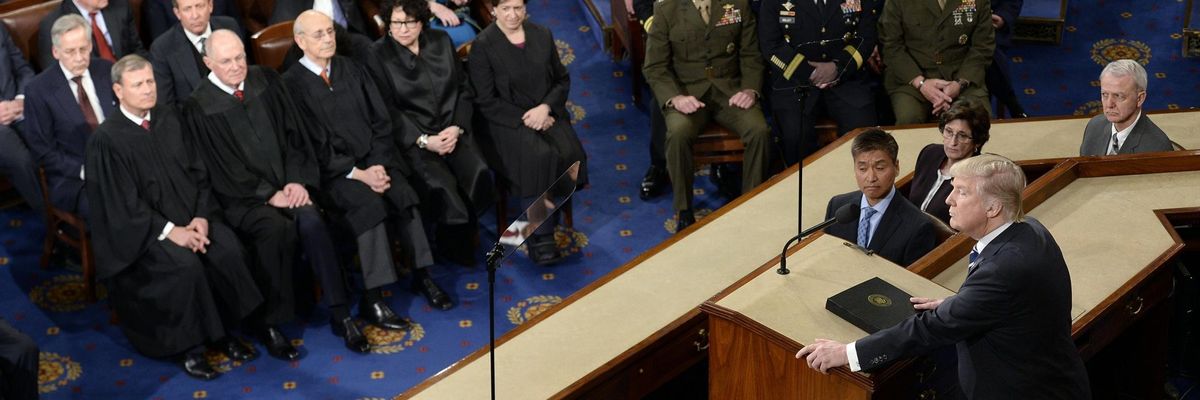
"Make no mistake," writes Certo, "Trump's lies are carefully told." (Photo: AP)
Donald Trump began his recent speech to Congress with a line seemingly designed to appease his critics. "As we mark the conclusion of our celebration of Black History Month," he said, "we are reminded of our nation's path toward civil rights and the work that still remains."
He went on to condemn "recent threats targeting Jewish Community Centers and vandalism of Jewish cemeteries, as well as last week's shooting in Kansas City" -- and, why not, "hate and evil in all its forms."
Some pundits, who apparently set a very low bar, applauded Trump for this "presidential" moment. Washington Post blogger Chris Cillizza, whom Trump himself once called "one of the dumber" pundits, praised Trump on Twitter for his "VERY nice grace note about our shared humanity."
Was it, though?
For context, Trump was referring to a wave of over 100 recent bomb threats that have been called into Jewish schools and community centers all over the country, as well as the vandalism of hundreds of Jewish graves at cemeteries in St. Louis and Philadelphia.
Meanwhile, in Kansas City, a drunken bar patron shouting "get out of my country!" recently shot two Indian immigrants, killing one. The shooter reportedly thought the men were Iranian, which would have put them on the list of banned migrants under Trump's seven-country "Muslim ban."
Investigations are ongoing, but many suspect that racist white nationalists are behind each of these incidents. Yet Trump never named those perpetrators. In the Kansas City case, in fact, he didn't even name the victims.
Worse still, when talking about the anti-Semitic incidents before his speech to Congress, he even implied they might've been a false flag operation -- carried out by his opponents "to make others look bad."
You can be sure this was no accident. Because when Trump talked about other so-called threats, he was extremely explicit.
He gestured for emphasis on every word as he promised to defend the country from "Radical Islamic Terror," which is capitalized in the speech's official transcript. And he falsely blamed "the vast majority" of "terrorism-related offenses since 9/11" on immigrants.
(Some factual asides: According to the New America Foundation, virtually all perpetrators were citizens or legal residents, and half of them were born here. And no Americans have ever been killed by refugees from any of the seven Muslim countries Trump has sought to ban.)
Moving on, Trump twice called out "vicious" crimes by "illegal gang members" before announcing the creation of a special agency to document alleged crimes by undocumented people. Yet numerous studies have confirmed that both documented and undocumented immigrants are less likely to commit crimes than native-born Americans.
Make no mistake, Trump's lies are carefully told to generate hostility toward Muslims and immigrants. Worse still, they conceal a growing threat the man obsessed with calling out "Radical Islamic Terror" won't even name.
Last month, the Southern Poverty Law Center counted over 1,000 active far-right and white nationalist groups in the United States. Groups like these, Foreign Policy magazine recently reported, "plan and carry out domestic attacks at a greater frequency than foreign terrorist groups."
Since 9/11, it adds, "anti-government groups have racked up a death toll on par with that of Islamist extremists."
No wonder authorities polled in a 2015 survey of 400 state, local, and federal law enforcement agencies listed far-right groups -- not Muslims -- as "the most severe threat of political violence that they face."
You don't have to read far between the lines to figure out that this speech was no "softer side" of a more "presidential" Trump. It was a barely coded message to the president's far-right followers that the administration's going to continue covering for their hate.
And it was a not-so-subtle threat to everyone else.
Donald Trump’s attacks on democracy, justice, and a free press are escalating — putting everything we stand for at risk. We believe a better world is possible, but we can’t get there without your support. Common Dreams stands apart. We answer only to you — our readers, activists, and changemakers — not to billionaires or corporations. Our independence allows us to cover the vital stories that others won’t, spotlighting movements for peace, equality, and human rights. Right now, our work faces unprecedented challenges. Misinformation is spreading, journalists are under attack, and financial pressures are mounting. As a reader-supported, nonprofit newsroom, your support is crucial to keep this journalism alive. Whatever you can give — $10, $25, or $100 — helps us stay strong and responsive when the world needs us most. Together, we’ll continue to build the independent, courageous journalism our movement relies on. Thank you for being part of this community. |
Donald Trump began his recent speech to Congress with a line seemingly designed to appease his critics. "As we mark the conclusion of our celebration of Black History Month," he said, "we are reminded of our nation's path toward civil rights and the work that still remains."
He went on to condemn "recent threats targeting Jewish Community Centers and vandalism of Jewish cemeteries, as well as last week's shooting in Kansas City" -- and, why not, "hate and evil in all its forms."
Some pundits, who apparently set a very low bar, applauded Trump for this "presidential" moment. Washington Post blogger Chris Cillizza, whom Trump himself once called "one of the dumber" pundits, praised Trump on Twitter for his "VERY nice grace note about our shared humanity."
Was it, though?
For context, Trump was referring to a wave of over 100 recent bomb threats that have been called into Jewish schools and community centers all over the country, as well as the vandalism of hundreds of Jewish graves at cemeteries in St. Louis and Philadelphia.
Meanwhile, in Kansas City, a drunken bar patron shouting "get out of my country!" recently shot two Indian immigrants, killing one. The shooter reportedly thought the men were Iranian, which would have put them on the list of banned migrants under Trump's seven-country "Muslim ban."
Investigations are ongoing, but many suspect that racist white nationalists are behind each of these incidents. Yet Trump never named those perpetrators. In the Kansas City case, in fact, he didn't even name the victims.
Worse still, when talking about the anti-Semitic incidents before his speech to Congress, he even implied they might've been a false flag operation -- carried out by his opponents "to make others look bad."
You can be sure this was no accident. Because when Trump talked about other so-called threats, he was extremely explicit.
He gestured for emphasis on every word as he promised to defend the country from "Radical Islamic Terror," which is capitalized in the speech's official transcript. And he falsely blamed "the vast majority" of "terrorism-related offenses since 9/11" on immigrants.
(Some factual asides: According to the New America Foundation, virtually all perpetrators were citizens or legal residents, and half of them were born here. And no Americans have ever been killed by refugees from any of the seven Muslim countries Trump has sought to ban.)
Moving on, Trump twice called out "vicious" crimes by "illegal gang members" before announcing the creation of a special agency to document alleged crimes by undocumented people. Yet numerous studies have confirmed that both documented and undocumented immigrants are less likely to commit crimes than native-born Americans.
Make no mistake, Trump's lies are carefully told to generate hostility toward Muslims and immigrants. Worse still, they conceal a growing threat the man obsessed with calling out "Radical Islamic Terror" won't even name.
Last month, the Southern Poverty Law Center counted over 1,000 active far-right and white nationalist groups in the United States. Groups like these, Foreign Policy magazine recently reported, "plan and carry out domestic attacks at a greater frequency than foreign terrorist groups."
Since 9/11, it adds, "anti-government groups have racked up a death toll on par with that of Islamist extremists."
No wonder authorities polled in a 2015 survey of 400 state, local, and federal law enforcement agencies listed far-right groups -- not Muslims -- as "the most severe threat of political violence that they face."
You don't have to read far between the lines to figure out that this speech was no "softer side" of a more "presidential" Trump. It was a barely coded message to the president's far-right followers that the administration's going to continue covering for their hate.
And it was a not-so-subtle threat to everyone else.
Donald Trump began his recent speech to Congress with a line seemingly designed to appease his critics. "As we mark the conclusion of our celebration of Black History Month," he said, "we are reminded of our nation's path toward civil rights and the work that still remains."
He went on to condemn "recent threats targeting Jewish Community Centers and vandalism of Jewish cemeteries, as well as last week's shooting in Kansas City" -- and, why not, "hate and evil in all its forms."
Some pundits, who apparently set a very low bar, applauded Trump for this "presidential" moment. Washington Post blogger Chris Cillizza, whom Trump himself once called "one of the dumber" pundits, praised Trump on Twitter for his "VERY nice grace note about our shared humanity."
Was it, though?
For context, Trump was referring to a wave of over 100 recent bomb threats that have been called into Jewish schools and community centers all over the country, as well as the vandalism of hundreds of Jewish graves at cemeteries in St. Louis and Philadelphia.
Meanwhile, in Kansas City, a drunken bar patron shouting "get out of my country!" recently shot two Indian immigrants, killing one. The shooter reportedly thought the men were Iranian, which would have put them on the list of banned migrants under Trump's seven-country "Muslim ban."
Investigations are ongoing, but many suspect that racist white nationalists are behind each of these incidents. Yet Trump never named those perpetrators. In the Kansas City case, in fact, he didn't even name the victims.
Worse still, when talking about the anti-Semitic incidents before his speech to Congress, he even implied they might've been a false flag operation -- carried out by his opponents "to make others look bad."
You can be sure this was no accident. Because when Trump talked about other so-called threats, he was extremely explicit.
He gestured for emphasis on every word as he promised to defend the country from "Radical Islamic Terror," which is capitalized in the speech's official transcript. And he falsely blamed "the vast majority" of "terrorism-related offenses since 9/11" on immigrants.
(Some factual asides: According to the New America Foundation, virtually all perpetrators were citizens or legal residents, and half of them were born here. And no Americans have ever been killed by refugees from any of the seven Muslim countries Trump has sought to ban.)
Moving on, Trump twice called out "vicious" crimes by "illegal gang members" before announcing the creation of a special agency to document alleged crimes by undocumented people. Yet numerous studies have confirmed that both documented and undocumented immigrants are less likely to commit crimes than native-born Americans.
Make no mistake, Trump's lies are carefully told to generate hostility toward Muslims and immigrants. Worse still, they conceal a growing threat the man obsessed with calling out "Radical Islamic Terror" won't even name.
Last month, the Southern Poverty Law Center counted over 1,000 active far-right and white nationalist groups in the United States. Groups like these, Foreign Policy magazine recently reported, "plan and carry out domestic attacks at a greater frequency than foreign terrorist groups."
Since 9/11, it adds, "anti-government groups have racked up a death toll on par with that of Islamist extremists."
No wonder authorities polled in a 2015 survey of 400 state, local, and federal law enforcement agencies listed far-right groups -- not Muslims -- as "the most severe threat of political violence that they face."
You don't have to read far between the lines to figure out that this speech was no "softer side" of a more "presidential" Trump. It was a barely coded message to the president's far-right followers that the administration's going to continue covering for their hate.
And it was a not-so-subtle threat to everyone else.