
Polls have since confirmed that Americans from across the political and ideological spectrum are overwhelmingly in favor of a substantial increase in the minimum wage. And election results are now confirming the sentiment.
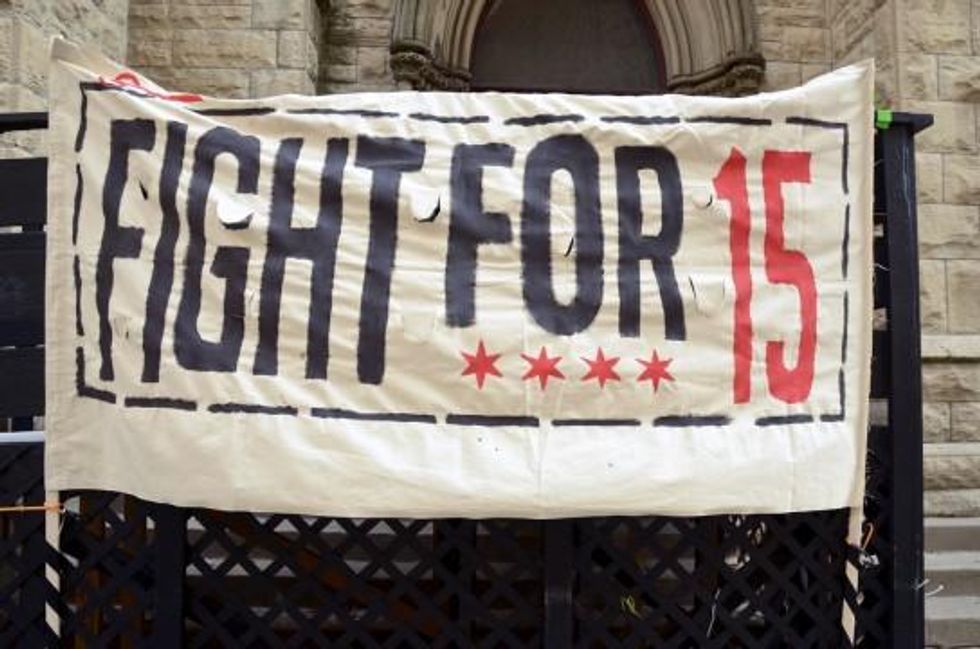
Even as they reelected Governor Chris Christie last fall, New Jersey voters gave landslide support to a measure that not only raised the state minimum wage to $9 an hour but indexed future increases to keep up with inflation. On the same day, voters in Sea-Tac, Washington, approved a $15 hourly wage, while voters in Seattle elected socialist Kshama Sawant on a "Fight for $15" platform.
Now comes a powerful signal from Chicago.
When voters in the city went to the polls to cast ballots in the Tuesday's statewide and local primary elections, thousands of them faced an economic question: Would they support a $15-an-hour minimum wage for large employers in the city?
The results were overwhelming. With 100 of the 103 precincts where the issue was on the ballot reporting, 87 percent of voters were backing the $15-an-hour wage. Just 13 percent voted against the advisory referendum. That huge level of support will strengthen the hand of activists who are encouraging the city council to consider a major wage hike.
The Chicago vote illustrates a phenomenon that is being seen in many of the nation's largest--and most expensive--urban areas.
"With inequality at record levels, more workers relying on public assistance just to afford the basics, and the federal minimum wage stalled at just $7.25, more and more cities are responding with higher minimum wages at the local level," says Paul Sonn, general counsel for the National Employment Law Project. "We're seeing this especially in high cost regions where the state-wide minimum wage just isn't enough."
According to NELP:
A growing number of localities across the country have already enacted minimum wages significantly above the federal and state level in an effort to address the impact of low-wage job growth and growing inequality throughout the post-recession recovery. Cities and counties that have enacted higher minimum wages in recent years include San Francisco ($10.74 per hour), Santa Fe ($10.66 per hour), San Jose ($10.15 per hour), Washington, DC ($11.50 by 2016), Montgomery County, MD ($11.50 by 2017), Prince George's County, MD ($11.50 by 2017), and SeaTac, WA ($15 for certain occupations).
In addition to Chicago, other cities that are pursuing higher minimum wages currently include Seattle ($15 per hour), San Francisco ($15 per hour), New York City; San Diego; Oakland; Portland, Maine; and Las Cruces, New Mexico, among others.
The Chicago vote also offers an insight into why Illinois Governor Pat Quinn has been making the minimum-wage issue central to his re-election run. Quinn is a Democrat who has a long history of working on issues of concern to low-wage workers and the communities where they live. But he also knows a winning issue.
Quinn told the crowd at his Tuesday night victory rally, "There is a principle as old as the Bible: If you work hard. If you're working 40 hours a week, and if you're doing your job, you should not have to live in poverty. You should get a decent wage. We believe in that and we're going to make it happen."
At the same time, Quinn's campaign began airing a fresh television ad ripping Republican nominee Bruce Rauner on the issue. A wealthy venture capitalist, who recently quipped that he was not just part of the 1 percent but "probably (the) 0.1 percent," Rauner financed much of his own primary campaign with contributions estimated at $6 million. Yet in the new Quinn ad he is seen proclaiming, "I am adamantly, adamantly against raising the minimum wage."
Rauner, whose GOP primary win was a narrow one, has been all over the place on the wage issue. He said early in the campaign that he would lower the state minimum wage from $8.25 an hour to the national rate of $7.25 an hour. Reports that one of the wealthiest men in the was state promising to cut wages for working Illinoisans did not go over well, and Rauner then suggested he might support raising the state rate if economic conditions were favorable.
Quinn has been far clearer when it comes to discussing wages--saying he favor an increase to at least $10 an hour this year--and the broader issue of economic inequality.
"I believe in everyday people. I think a governor has to have a heart," the governor declared on primary night. "I may not have nine mansions. I have one house. I'm not a billionaire. Never will be. I'm not part of the 1 percent and never will be there. I'm not even part of the 0.1 percent. But I'll tell you this. As long as I'm governor I'm going to fight hard for the 99.9 percent."
Polls have since confirmed that Americans from across the political and ideological spectrum are overwhelmingly in favor of a substantial increase in the minimum wage. And election results are now confirming the sentiment.
Even as they reelected Governor Chris Christie last fall, New Jersey voters gave landslide support to a measure that not only raised the state minimum wage to $9 an hour but indexed future increases to keep up with inflation. On the same day, voters in Sea-Tac, Washington, approved a $15 hourly wage, while voters in Seattle elected socialist Kshama Sawant on a "Fight for $15" platform.
Now comes a powerful signal from Chicago.
When voters in the city went to the polls to cast ballots in the Tuesday's statewide and local primary elections, thousands of them faced an economic question: Would they support a $15-an-hour minimum wage for large employers in the city?
The results were overwhelming. With 100 of the 103 precincts where the issue was on the ballot reporting, 87 percent of voters were backing the $15-an-hour wage. Just 13 percent voted against the advisory referendum. That huge level of support will strengthen the hand of activists who are encouraging the city council to consider a major wage hike.
The Chicago vote illustrates a phenomenon that is being seen in many of the nation's largest--and most expensive--urban areas.
"With inequality at record levels, more workers relying on public assistance just to afford the basics, and the federal minimum wage stalled at just $7.25, more and more cities are responding with higher minimum wages at the local level," says Paul Sonn, general counsel for the National Employment Law Project. "We're seeing this especially in high cost regions where the state-wide minimum wage just isn't enough."
According to NELP:
A growing number of localities across the country have already enacted minimum wages significantly above the federal and state level in an effort to address the impact of low-wage job growth and growing inequality throughout the post-recession recovery. Cities and counties that have enacted higher minimum wages in recent years include San Francisco ($10.74 per hour), Santa Fe ($10.66 per hour), San Jose ($10.15 per hour), Washington, DC ($11.50 by 2016), Montgomery County, MD ($11.50 by 2017), Prince George's County, MD ($11.50 by 2017), and SeaTac, WA ($15 for certain occupations).
In addition to Chicago, other cities that are pursuing higher minimum wages currently include Seattle ($15 per hour), San Francisco ($15 per hour), New York City; San Diego; Oakland; Portland, Maine; and Las Cruces, New Mexico, among others.
The Chicago vote also offers an insight into why Illinois Governor Pat Quinn has been making the minimum-wage issue central to his re-election run. Quinn is a Democrat who has a long history of working on issues of concern to low-wage workers and the communities where they live. But he also knows a winning issue.
Quinn told the crowd at his Tuesday night victory rally, "There is a principle as old as the Bible: If you work hard. If you're working 40 hours a week, and if you're doing your job, you should not have to live in poverty. You should get a decent wage. We believe in that and we're going to make it happen."
At the same time, Quinn's campaign began airing a fresh television ad ripping Republican nominee Bruce Rauner on the issue. A wealthy venture capitalist, who recently quipped that he was not just part of the 1 percent but "probably (the) 0.1 percent," Rauner financed much of his own primary campaign with contributions estimated at $6 million. Yet in the new Quinn ad he is seen proclaiming, "I am adamantly, adamantly against raising the minimum wage."
Rauner, whose GOP primary win was a narrow one, has been all over the place on the wage issue. He said early in the campaign that he would lower the state minimum wage from $8.25 an hour to the national rate of $7.25 an hour. Reports that one of the wealthiest men in the was state promising to cut wages for working Illinoisans did not go over well, and Rauner then suggested he might support raising the state rate if economic conditions were favorable.
Quinn has been far clearer when it comes to discussing wages--saying he favor an increase to at least $10 an hour this year--and the broader issue of economic inequality.
"I believe in everyday people. I think a governor has to have a heart," the governor declared on primary night. "I may not have nine mansions. I have one house. I'm not a billionaire. Never will be. I'm not part of the 1 percent and never will be there. I'm not even part of the 0.1 percent. But I'll tell you this. As long as I'm governor I'm going to fight hard for the 99.9 percent."
Polls have since confirmed that Americans from across the political and ideological spectrum are overwhelmingly in favor of a substantial increase in the minimum wage. And election results are now confirming the sentiment.
Even as they reelected Governor Chris Christie last fall, New Jersey voters gave landslide support to a measure that not only raised the state minimum wage to $9 an hour but indexed future increases to keep up with inflation. On the same day, voters in Sea-Tac, Washington, approved a $15 hourly wage, while voters in Seattle elected socialist Kshama Sawant on a "Fight for $15" platform.
Now comes a powerful signal from Chicago.
When voters in the city went to the polls to cast ballots in the Tuesday's statewide and local primary elections, thousands of them faced an economic question: Would they support a $15-an-hour minimum wage for large employers in the city?
The results were overwhelming. With 100 of the 103 precincts where the issue was on the ballot reporting, 87 percent of voters were backing the $15-an-hour wage. Just 13 percent voted against the advisory referendum. That huge level of support will strengthen the hand of activists who are encouraging the city council to consider a major wage hike.
The Chicago vote illustrates a phenomenon that is being seen in many of the nation's largest--and most expensive--urban areas.
"With inequality at record levels, more workers relying on public assistance just to afford the basics, and the federal minimum wage stalled at just $7.25, more and more cities are responding with higher minimum wages at the local level," says Paul Sonn, general counsel for the National Employment Law Project. "We're seeing this especially in high cost regions where the state-wide minimum wage just isn't enough."
According to NELP:
A growing number of localities across the country have already enacted minimum wages significantly above the federal and state level in an effort to address the impact of low-wage job growth and growing inequality throughout the post-recession recovery. Cities and counties that have enacted higher minimum wages in recent years include San Francisco ($10.74 per hour), Santa Fe ($10.66 per hour), San Jose ($10.15 per hour), Washington, DC ($11.50 by 2016), Montgomery County, MD ($11.50 by 2017), Prince George's County, MD ($11.50 by 2017), and SeaTac, WA ($15 for certain occupations).
In addition to Chicago, other cities that are pursuing higher minimum wages currently include Seattle ($15 per hour), San Francisco ($15 per hour), New York City; San Diego; Oakland; Portland, Maine; and Las Cruces, New Mexico, among others.
The Chicago vote also offers an insight into why Illinois Governor Pat Quinn has been making the minimum-wage issue central to his re-election run. Quinn is a Democrat who has a long history of working on issues of concern to low-wage workers and the communities where they live. But he also knows a winning issue.
Quinn told the crowd at his Tuesday night victory rally, "There is a principle as old as the Bible: If you work hard. If you're working 40 hours a week, and if you're doing your job, you should not have to live in poverty. You should get a decent wage. We believe in that and we're going to make it happen."
At the same time, Quinn's campaign began airing a fresh television ad ripping Republican nominee Bruce Rauner on the issue. A wealthy venture capitalist, who recently quipped that he was not just part of the 1 percent but "probably (the) 0.1 percent," Rauner financed much of his own primary campaign with contributions estimated at $6 million. Yet in the new Quinn ad he is seen proclaiming, "I am adamantly, adamantly against raising the minimum wage."
Rauner, whose GOP primary win was a narrow one, has been all over the place on the wage issue. He said early in the campaign that he would lower the state minimum wage from $8.25 an hour to the national rate of $7.25 an hour. Reports that one of the wealthiest men in the was state promising to cut wages for working Illinoisans did not go over well, and Rauner then suggested he might support raising the state rate if economic conditions were favorable.
Quinn has been far clearer when it comes to discussing wages--saying he favor an increase to at least $10 an hour this year--and the broader issue of economic inequality.
"I believe in everyday people. I think a governor has to have a heart," the governor declared on primary night. "I may not have nine mansions. I have one house. I'm not a billionaire. Never will be. I'm not part of the 1 percent and never will be there. I'm not even part of the 0.1 percent. But I'll tell you this. As long as I'm governor I'm going to fight hard for the 99.9 percent."