SUBSCRIBE TO OUR FREE NEWSLETTER
Daily news & progressive opinion—funded by the people, not the corporations—delivered straight to your inbox.
5
#000000
#FFFFFF
To donate by check, phone, or other method, see our More Ways to Give page.
In olden days, it used to be that the bad guys robbed the banks. Now it seems the bad guys are running the banks, at least the big ones, and robbing the rest of us. Nearly every day, newspapers have another disturbing report about how the largest and most influential banks managed to escape prosecution for their blatant fraud or else finagled outrageous subsidies and profits from their monopolistic dominance of the financial system. The worst that happens to privileged bankers who are "too big to fail" is an occasional scolding lecture from angry members of Congress.
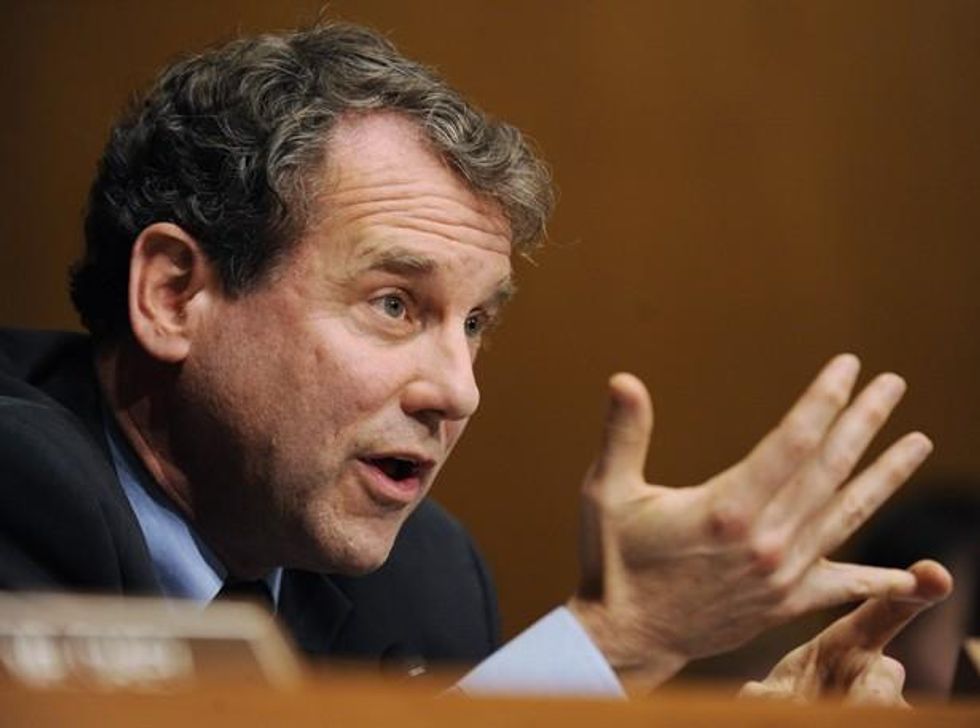
Democratic Senator Sherrod Brown, fresh from his impressive re-election victory last fall, is back again with a simple, straightforward solution: make the big boys smaller. He is working on legislation with Republican Senator David Vitter to break up the half-dozen mega-banks and strengthen capital standards. This forced downsizing would make space in the marketplace, allowing many more midsize and smaller banking institutions to flourish. It could also protect the nation from another disastrous bailout of Wall Street at public expense.
"It's not just that they are too big to fail," the senator says. "They really are too big to understand and too big to manage. They are certainly too big to regulate. And they have only gotten bigger since the financial crisis." The concentration of banking power in a few big-name firms was already dangerous. Now it is even more dangerous.
Senator Brown explains, "The four largest behemoths, now ranging from $1.4 trillion to $2.3 trillion in assets, are the result of thirty-seven banks merging thirty-three times. In 1995, the six biggest US banks had assets equal to 18 percent of GDP. Today, they are about 63 percent of GDP."
In earlier eras, such a gross distortion of the economy would have prompted popular outrage, political campaigns for reform, then government legislation. In our time, the outrage is plentiful, but the political system is dead in the water. Despite the vast destruction produced by the concentrated banking system, neither party wants to embrace the remedy Brown proposes.
The Dodd-Frank reform law of 2010, incomplete though it was, has been utterly stymied by the billion-dollar lobbying campaign of the financial sector. Nearly three years later, fewer than half of the regulations needed to implement Dodd-Frank have been completed. The president's proud boast that the law put an end to "too big to fail" banks has been twisted into Wall Street's sick little inside joke.
"It's not just the economic power these guys have, it's the political power," Brown says. "The inability to get these new rules in place is the result of these lobbying pressures from Wall Street."
Brown is guardedly optimistic that this can be changed. In 2010, when he proposed the same concept as an amendment to Dodd-Frank, he got only thirty-three votes. Yet afterward he told me he was confident the proposal would prevail someday, because business and even regional banks would eventually see that extreme Wall Street concentration is not good for the economy, the country or themselves.
When I reminded him of his earlier prediction, the senator paused and replied, "I think 'someday' is closer. There's never inevitability, but I'm more confident today than I was then."
He pointed out that conservative commentators like George Will and Peggy Noonan have expressed their own critiques of "too big to fail." Richard Fisher, conservative president of the Federal Reserve Bank of Dallas, has forcefully denounced the concept. Federal Reserve governor Daniel Tarullo, the Fed's point man for fending off Wall Street complaints about Dodd-Frank, has expressed his frustration and doubts. The privileged status of the mega-bankers, he says, is likely to endure until Congress steps up and enacts a stronger solution to "too big to fail."
Brown is not one of those hot-dog legislators you see on TV, grabbing attention with ridiculous claims. Nevertheless, he believes that breaking up the behemoths is a cause that can gain momentum as a bipartisan issue. It's not as crazy as it sounds; the public anger aimed at the mega-banks is not really a right-left matter. Indeed, anti-trust legislation originated in efforts to protect the free market from overbearing monopolists who crushed small and midsize businesses. But it's an uphill fight: in 2010, Brown's amendment received only three Republican votes (Senators Shelby, Coburn and Ensign). Now Brown is talking to ten Republicans who have expressed interest in his reform, and he hopes to connect with more.
* * *
There is a larger problem facing Brown--his own party and president. Barack Obama is not just absent on this issue; he is on the other side. So are many Democrats in Congress. Throughout his first term, Obama kept his distance from sharp critics of the big banks. His appointed lieutenants, led by Treasury Secretary Tim Geithner, were deeply loyal to Wall Street and protected its players from harsher measures, like criminal prosecution. (In recent Senate testimony, Attorney General Eric Holder frankly admitted another reason for the administration's reluctance to prosecute: "If you do bring a criminal charge, it will have a negative impact on the national economy, perhaps even the world economy. And I think that is a function of the fact that some of these institutions have become too large.")
When I asked Brown about the Obama administration, the senator replied, "Well, I'm disappointed so far. I think they are in a different place than they used to be, but they are still not where they need to be." At the Senate Finance Committee confirmation hearing for Jack Lew, nominated to be the new treasury secretary, Brown questioned him on the issue of size and scale in banking. "His answer was less than adequate, even on the advantage that the biggest banks have," Brown said, then added: "The Obama administration opposed my amendment on Dodd-Frank and even seemed gleeful afterward that we had lost."
Maybe Brown is being too polite. As he knows, the question of the big banks is deeply divisive for Democrats. It is an internal conflict that has roiled the party for two decades, ever since the center-right dogma took over in the Clinton era. Bill Clinton brought in the Robert Rubin team in 1993 to chart economic policy, and finance-friendly policy types have governed ever since. Democratic activists still faithful to older liberal-labor principles are usually excluded.
Obama was already in with Rubin and his crowd before he came to power. He has stayed true to that perspective as president, relentlessly excluding contrarian thinkers and treating big bankers with a gentle touch. No "Go Directly to Jail" cards in his deck. Some of us hoped Obama might allow a little more variety in his second term. That's not going to happen. Old faces, mostly associated with the Clinton years, are still running the show. Many learned well at Rubin's prep school for policy wonks. Lew was baptized by his tenure at Citigroup, where in 2008 he was paid an extraordinary $1.1 million or more for his short-term labor before returning to Washington to re-enter government. Gene Sperling, director of Obama's National Economic Council, got a similar baptism at Goldman Sachs.
Boiled down to its essence, Senator Brown's legislative initiative may compel Democrats to ask themselves, Are we with the people on this, or should we stick with the big guys? This may prove to be a seminal question for the future of the party, not to mention the health of the economy. If Democrats stay with the financial titans and ignore the disorders of the Wall Street monopoly, the party will become ever more distant from its working class legacy. If instead Democrats like Sherrod Brown, joined by newly elected bank critics like Elizabeth Warren, lead the party in the direction of aggressive reform, we might see the beginning of something big.
In olden days, it used to be that the bad guys robbed the banks. Now it seems the bad guys are running the banks, at least the big ones, and robbing the rest of us. Nearly every day, newspapers have another disturbing report about how the largest and most influential banks managed to escape prosecution for their blatant fraud or else finagled outrageous subsidies and profits from their monopolistic dominance of the financial system. The worst that happens to privileged bankers who are "too big to fail" is an occasional scolding lecture from angry members of Congress.
Democratic Senator Sherrod Brown, fresh from his impressive re-election victory last fall, is back again with a simple, straightforward solution: make the big boys smaller. He is working on legislation with Republican Senator David Vitter to break up the half-dozen mega-banks and strengthen capital standards. This forced downsizing would make space in the marketplace, allowing many more midsize and smaller banking institutions to flourish. It could also protect the nation from another disastrous bailout of Wall Street at public expense.
"It's not just that they are too big to fail," the senator says. "They really are too big to understand and too big to manage. They are certainly too big to regulate. And they have only gotten bigger since the financial crisis." The concentration of banking power in a few big-name firms was already dangerous. Now it is even more dangerous.
Senator Brown explains, "The four largest behemoths, now ranging from $1.4 trillion to $2.3 trillion in assets, are the result of thirty-seven banks merging thirty-three times. In 1995, the six biggest US banks had assets equal to 18 percent of GDP. Today, they are about 63 percent of GDP."
In earlier eras, such a gross distortion of the economy would have prompted popular outrage, political campaigns for reform, then government legislation. In our time, the outrage is plentiful, but the political system is dead in the water. Despite the vast destruction produced by the concentrated banking system, neither party wants to embrace the remedy Brown proposes.
The Dodd-Frank reform law of 2010, incomplete though it was, has been utterly stymied by the billion-dollar lobbying campaign of the financial sector. Nearly three years later, fewer than half of the regulations needed to implement Dodd-Frank have been completed. The president's proud boast that the law put an end to "too big to fail" banks has been twisted into Wall Street's sick little inside joke.
"It's not just the economic power these guys have, it's the political power," Brown says. "The inability to get these new rules in place is the result of these lobbying pressures from Wall Street."
Brown is guardedly optimistic that this can be changed. In 2010, when he proposed the same concept as an amendment to Dodd-Frank, he got only thirty-three votes. Yet afterward he told me he was confident the proposal would prevail someday, because business and even regional banks would eventually see that extreme Wall Street concentration is not good for the economy, the country or themselves.
When I reminded him of his earlier prediction, the senator paused and replied, "I think 'someday' is closer. There's never inevitability, but I'm more confident today than I was then."
He pointed out that conservative commentators like George Will and Peggy Noonan have expressed their own critiques of "too big to fail." Richard Fisher, conservative president of the Federal Reserve Bank of Dallas, has forcefully denounced the concept. Federal Reserve governor Daniel Tarullo, the Fed's point man for fending off Wall Street complaints about Dodd-Frank, has expressed his frustration and doubts. The privileged status of the mega-bankers, he says, is likely to endure until Congress steps up and enacts a stronger solution to "too big to fail."
Brown is not one of those hot-dog legislators you see on TV, grabbing attention with ridiculous claims. Nevertheless, he believes that breaking up the behemoths is a cause that can gain momentum as a bipartisan issue. It's not as crazy as it sounds; the public anger aimed at the mega-banks is not really a right-left matter. Indeed, anti-trust legislation originated in efforts to protect the free market from overbearing monopolists who crushed small and midsize businesses. But it's an uphill fight: in 2010, Brown's amendment received only three Republican votes (Senators Shelby, Coburn and Ensign). Now Brown is talking to ten Republicans who have expressed interest in his reform, and he hopes to connect with more.
* * *
There is a larger problem facing Brown--his own party and president. Barack Obama is not just absent on this issue; he is on the other side. So are many Democrats in Congress. Throughout his first term, Obama kept his distance from sharp critics of the big banks. His appointed lieutenants, led by Treasury Secretary Tim Geithner, were deeply loyal to Wall Street and protected its players from harsher measures, like criminal prosecution. (In recent Senate testimony, Attorney General Eric Holder frankly admitted another reason for the administration's reluctance to prosecute: "If you do bring a criminal charge, it will have a negative impact on the national economy, perhaps even the world economy. And I think that is a function of the fact that some of these institutions have become too large.")
When I asked Brown about the Obama administration, the senator replied, "Well, I'm disappointed so far. I think they are in a different place than they used to be, but they are still not where they need to be." At the Senate Finance Committee confirmation hearing for Jack Lew, nominated to be the new treasury secretary, Brown questioned him on the issue of size and scale in banking. "His answer was less than adequate, even on the advantage that the biggest banks have," Brown said, then added: "The Obama administration opposed my amendment on Dodd-Frank and even seemed gleeful afterward that we had lost."
Maybe Brown is being too polite. As he knows, the question of the big banks is deeply divisive for Democrats. It is an internal conflict that has roiled the party for two decades, ever since the center-right dogma took over in the Clinton era. Bill Clinton brought in the Robert Rubin team in 1993 to chart economic policy, and finance-friendly policy types have governed ever since. Democratic activists still faithful to older liberal-labor principles are usually excluded.
Obama was already in with Rubin and his crowd before he came to power. He has stayed true to that perspective as president, relentlessly excluding contrarian thinkers and treating big bankers with a gentle touch. No "Go Directly to Jail" cards in his deck. Some of us hoped Obama might allow a little more variety in his second term. That's not going to happen. Old faces, mostly associated with the Clinton years, are still running the show. Many learned well at Rubin's prep school for policy wonks. Lew was baptized by his tenure at Citigroup, where in 2008 he was paid an extraordinary $1.1 million or more for his short-term labor before returning to Washington to re-enter government. Gene Sperling, director of Obama's National Economic Council, got a similar baptism at Goldman Sachs.
Boiled down to its essence, Senator Brown's legislative initiative may compel Democrats to ask themselves, Are we with the people on this, or should we stick with the big guys? This may prove to be a seminal question for the future of the party, not to mention the health of the economy. If Democrats stay with the financial titans and ignore the disorders of the Wall Street monopoly, the party will become ever more distant from its working class legacy. If instead Democrats like Sherrod Brown, joined by newly elected bank critics like Elizabeth Warren, lead the party in the direction of aggressive reform, we might see the beginning of something big.
In olden days, it used to be that the bad guys robbed the banks. Now it seems the bad guys are running the banks, at least the big ones, and robbing the rest of us. Nearly every day, newspapers have another disturbing report about how the largest and most influential banks managed to escape prosecution for their blatant fraud or else finagled outrageous subsidies and profits from their monopolistic dominance of the financial system. The worst that happens to privileged bankers who are "too big to fail" is an occasional scolding lecture from angry members of Congress.
Democratic Senator Sherrod Brown, fresh from his impressive re-election victory last fall, is back again with a simple, straightforward solution: make the big boys smaller. He is working on legislation with Republican Senator David Vitter to break up the half-dozen mega-banks and strengthen capital standards. This forced downsizing would make space in the marketplace, allowing many more midsize and smaller banking institutions to flourish. It could also protect the nation from another disastrous bailout of Wall Street at public expense.
"It's not just that they are too big to fail," the senator says. "They really are too big to understand and too big to manage. They are certainly too big to regulate. And they have only gotten bigger since the financial crisis." The concentration of banking power in a few big-name firms was already dangerous. Now it is even more dangerous.
Senator Brown explains, "The four largest behemoths, now ranging from $1.4 trillion to $2.3 trillion in assets, are the result of thirty-seven banks merging thirty-three times. In 1995, the six biggest US banks had assets equal to 18 percent of GDP. Today, they are about 63 percent of GDP."
In earlier eras, such a gross distortion of the economy would have prompted popular outrage, political campaigns for reform, then government legislation. In our time, the outrage is plentiful, but the political system is dead in the water. Despite the vast destruction produced by the concentrated banking system, neither party wants to embrace the remedy Brown proposes.
The Dodd-Frank reform law of 2010, incomplete though it was, has been utterly stymied by the billion-dollar lobbying campaign of the financial sector. Nearly three years later, fewer than half of the regulations needed to implement Dodd-Frank have been completed. The president's proud boast that the law put an end to "too big to fail" banks has been twisted into Wall Street's sick little inside joke.
"It's not just the economic power these guys have, it's the political power," Brown says. "The inability to get these new rules in place is the result of these lobbying pressures from Wall Street."
Brown is guardedly optimistic that this can be changed. In 2010, when he proposed the same concept as an amendment to Dodd-Frank, he got only thirty-three votes. Yet afterward he told me he was confident the proposal would prevail someday, because business and even regional banks would eventually see that extreme Wall Street concentration is not good for the economy, the country or themselves.
When I reminded him of his earlier prediction, the senator paused and replied, "I think 'someday' is closer. There's never inevitability, but I'm more confident today than I was then."
He pointed out that conservative commentators like George Will and Peggy Noonan have expressed their own critiques of "too big to fail." Richard Fisher, conservative president of the Federal Reserve Bank of Dallas, has forcefully denounced the concept. Federal Reserve governor Daniel Tarullo, the Fed's point man for fending off Wall Street complaints about Dodd-Frank, has expressed his frustration and doubts. The privileged status of the mega-bankers, he says, is likely to endure until Congress steps up and enacts a stronger solution to "too big to fail."
Brown is not one of those hot-dog legislators you see on TV, grabbing attention with ridiculous claims. Nevertheless, he believes that breaking up the behemoths is a cause that can gain momentum as a bipartisan issue. It's not as crazy as it sounds; the public anger aimed at the mega-banks is not really a right-left matter. Indeed, anti-trust legislation originated in efforts to protect the free market from overbearing monopolists who crushed small and midsize businesses. But it's an uphill fight: in 2010, Brown's amendment received only three Republican votes (Senators Shelby, Coburn and Ensign). Now Brown is talking to ten Republicans who have expressed interest in his reform, and he hopes to connect with more.
* * *
There is a larger problem facing Brown--his own party and president. Barack Obama is not just absent on this issue; he is on the other side. So are many Democrats in Congress. Throughout his first term, Obama kept his distance from sharp critics of the big banks. His appointed lieutenants, led by Treasury Secretary Tim Geithner, were deeply loyal to Wall Street and protected its players from harsher measures, like criminal prosecution. (In recent Senate testimony, Attorney General Eric Holder frankly admitted another reason for the administration's reluctance to prosecute: "If you do bring a criminal charge, it will have a negative impact on the national economy, perhaps even the world economy. And I think that is a function of the fact that some of these institutions have become too large.")
When I asked Brown about the Obama administration, the senator replied, "Well, I'm disappointed so far. I think they are in a different place than they used to be, but they are still not where they need to be." At the Senate Finance Committee confirmation hearing for Jack Lew, nominated to be the new treasury secretary, Brown questioned him on the issue of size and scale in banking. "His answer was less than adequate, even on the advantage that the biggest banks have," Brown said, then added: "The Obama administration opposed my amendment on Dodd-Frank and even seemed gleeful afterward that we had lost."
Maybe Brown is being too polite. As he knows, the question of the big banks is deeply divisive for Democrats. It is an internal conflict that has roiled the party for two decades, ever since the center-right dogma took over in the Clinton era. Bill Clinton brought in the Robert Rubin team in 1993 to chart economic policy, and finance-friendly policy types have governed ever since. Democratic activists still faithful to older liberal-labor principles are usually excluded.
Obama was already in with Rubin and his crowd before he came to power. He has stayed true to that perspective as president, relentlessly excluding contrarian thinkers and treating big bankers with a gentle touch. No "Go Directly to Jail" cards in his deck. Some of us hoped Obama might allow a little more variety in his second term. That's not going to happen. Old faces, mostly associated with the Clinton years, are still running the show. Many learned well at Rubin's prep school for policy wonks. Lew was baptized by his tenure at Citigroup, where in 2008 he was paid an extraordinary $1.1 million or more for his short-term labor before returning to Washington to re-enter government. Gene Sperling, director of Obama's National Economic Council, got a similar baptism at Goldman Sachs.
Boiled down to its essence, Senator Brown's legislative initiative may compel Democrats to ask themselves, Are we with the people on this, or should we stick with the big guys? This may prove to be a seminal question for the future of the party, not to mention the health of the economy. If Democrats stay with the financial titans and ignore the disorders of the Wall Street monopoly, the party will become ever more distant from its working class legacy. If instead Democrats like Sherrod Brown, joined by newly elected bank critics like Elizabeth Warren, lead the party in the direction of aggressive reform, we might see the beginning of something big.