SUBSCRIBE TO OUR FREE NEWSLETTER
Daily news & progressive opinion—funded by the people, not the corporations—delivered straight to your inbox.
5
#000000
#FFFFFF
To donate by check, phone, or other method, see our More Ways to Give page.
Faced with rising anger from environmentalists last year over his plans for a transcontinental pipeline to deliver treacly Canadian tar
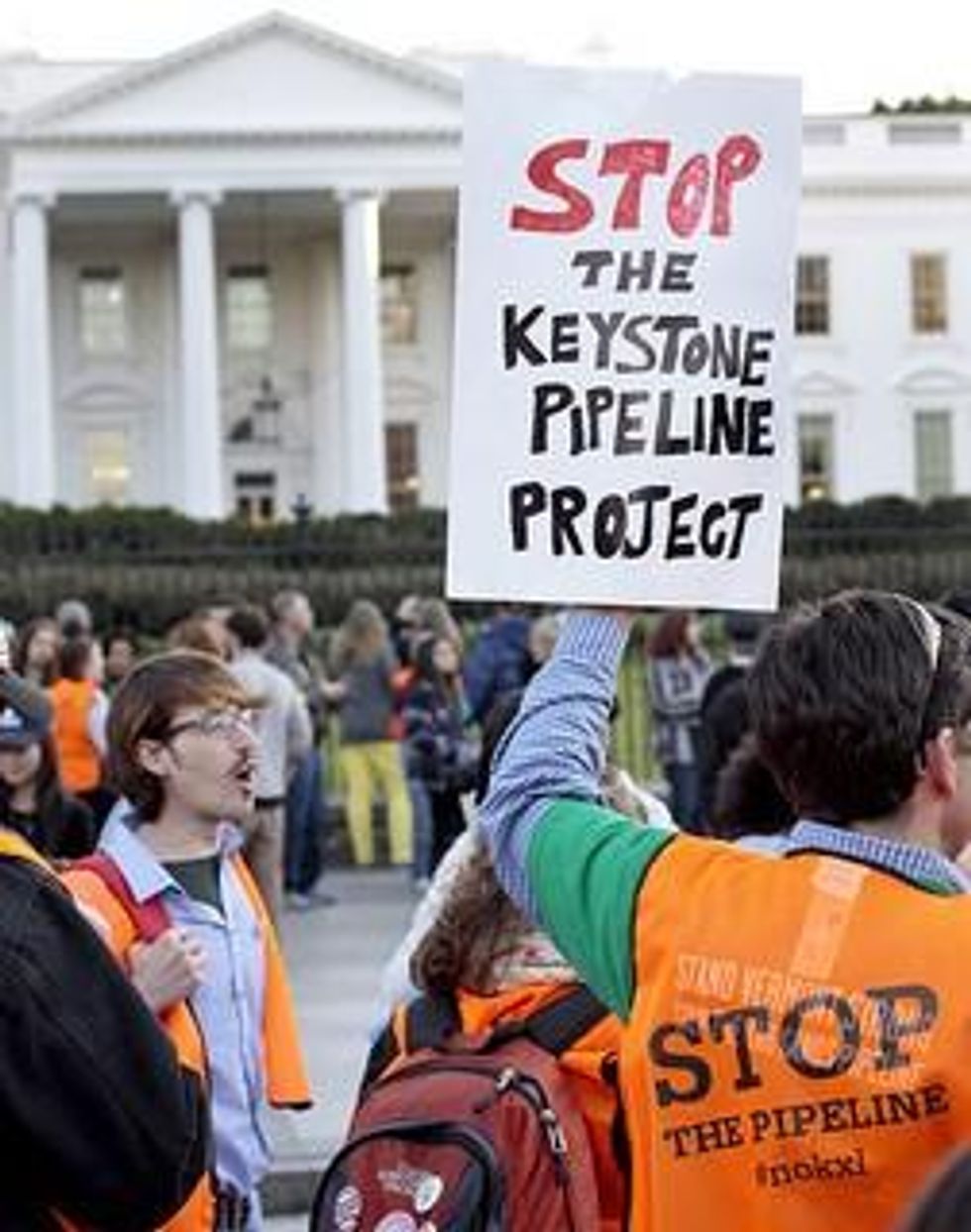
But that's the point. It is routine. The oil industry does do it every day. And if it carries on, it will wreck the world.
We need not rely on climate-changing fossil fuels. Alternative energy technologies are available. But fossil fuels, and the pipelines and other 20th-century infrastructure that underpin them, have created what John Schellnhuber, director of Germany's Potsdam Institute for Climate Impact Research, describes in a new paper as "lock-in dominance" (PNAS, DOI: 10.1073/pnas.1219791110). Even though we know how harmful it is, the "largest business on Earth" has ossified and is proving immovable, he says.
The question is how to break the lock and let in alternatives. Schellnhuber, a wily and worldly climate scientist, has an idea, to which I will return. But first the tar-sands pipeline, known as Keystone XL in the parlance of outsize clothing. Proponents say it would create jobs and improve US energy security. But for environmentalists in the US, the decision - due any time - on whether it should go ahead is a touchstone for Barack Obama's willingness to confront climate change in his second term.
Superficially, Keystone XL doesn't look like a huge deal. Since 2010, there has been a cross-border pipe bringing oil from tar sands in northern Alberta to the US Midwest. But this second link would double capacity and deliver oil to the refineries of the Gulf for global export. It looks like the key to a planned doubling of output from one of the world's largest deposits of one of the world's dirtiest fuels. And because the pipe would cross the US border, it requires state department and presidential sign-off.
Environmentalists are up in arms. They fear leaks. No matter what its sponsors suggest, this is no ordinary pipeline. The tar-sands oil - essentially diluted bitumen - is more acidic than regular oil and contains more sediment and moves at higher pressures. Critics say it risks corroding and grinding away the insides of the pipes. The US National Academy of Sciences has just begun a study on this, but its findings will probably be too late to influence Obama.
If there is a leak, clean-up will be difficult, as shown by the messy, protracted and acrimonious attempt to cleanse the Kalamazoo river in Michigan after tar-sands oil oozed into it in 2010.
To make matters worse, the pipeline would cross almost the entire length of the Ogallala aquifer, one of the world's largest underground water reserves, from South Dakota to Texas. Ogallala is a lifeline for the dust-bowl states of the Midwest. While TransCanada has agreed to bypass the ecologically important Sand Hills of Nebraska, where the water table is only 6 metres below the surface in places, a big unseen spill could still be disastrous.
Climate change is still the biggest deal. Extracting and processing tar sands creates a carbon footprint three times that of conventional crude. Obama would rightly lose all environmental credibility if he were to approve a scheme to double his country's imports of this fossil-fuel basket case. Yet he may do it. Why? Because of fossil-fuel lock-in. Changing course is hard. Really hard.
Part of the reason for the lock-in is the vast infrastructure dedicated to sustaining the supply of coal, oil and gas. There is no better symbol of that than a new pipeline. Partly it is political. Nobody has more political muscle than the fossil fuel industry, especially in Washington. And partly it is commercial. As Schellnhuber puts it: "Heavy investments in fossil fuels have led to big profits for shareholders, which in turn leads to greater investments in technologies that have proven to be profitable."
The result is domination by an outdated energy system that stifles alternatives. The potential for a renewable energy revolution is often compared to that of the IT revolution 30 years ago. But IT had little to fight except armies of clerks. Schellnhuber compares this lock-in to the synapses of an ageing human brain so exposed to repetitious thought that it "becomes addicted to specific observations and impressions to the exclusion of alternatives". Or, as Girling puts it, new pipelines become "routine".
What might free us from this addiction? With politicians weak, an obvious answer is to hold companies more financially accountable for environmental damage, including climate change. But Schellnhuber says this won't be enough unless individual shareholders become personally liable, too.
Here, he says, the problem is the public limited company (PLC), or publicly traded company in the US, which insulates shareholders from the consequences of decisions taken in their name. Even if their company goes bankrupt with huge debts, all they lose is the value of their shares. The PLC was invented to promote risk-taking in business. But it can also be an environmental menace, massively reducing incentives for industries to clean up their acts.
"If shareholders were held liable," he says, "then next time they might consider the risk before investing or reinvesting." More importantly, it could prevent us being locked into 20th century technologies that are quite incapable of solving 21st century problems. Fat chance, many might say. But just maybe Keystone XL and its uncanny ability to draw global attention will help catalyze growing anger at the environmental immunity of corporate shareholders.
Faced with rising anger from environmentalists last year over his plans for a transcontinental pipeline to deliver treacly Canadian tar
But that's the point. It is routine. The oil industry does do it every day. And if it carries on, it will wreck the world.
We need not rely on climate-changing fossil fuels. Alternative energy technologies are available. But fossil fuels, and the pipelines and other 20th-century infrastructure that underpin them, have created what John Schellnhuber, director of Germany's Potsdam Institute for Climate Impact Research, describes in a new paper as "lock-in dominance" (PNAS, DOI: 10.1073/pnas.1219791110). Even though we know how harmful it is, the "largest business on Earth" has ossified and is proving immovable, he says.
The question is how to break the lock and let in alternatives. Schellnhuber, a wily and worldly climate scientist, has an idea, to which I will return. But first the tar-sands pipeline, known as Keystone XL in the parlance of outsize clothing. Proponents say it would create jobs and improve US energy security. But for environmentalists in the US, the decision - due any time - on whether it should go ahead is a touchstone for Barack Obama's willingness to confront climate change in his second term.
Superficially, Keystone XL doesn't look like a huge deal. Since 2010, there has been a cross-border pipe bringing oil from tar sands in northern Alberta to the US Midwest. But this second link would double capacity and deliver oil to the refineries of the Gulf for global export. It looks like the key to a planned doubling of output from one of the world's largest deposits of one of the world's dirtiest fuels. And because the pipe would cross the US border, it requires state department and presidential sign-off.
Environmentalists are up in arms. They fear leaks. No matter what its sponsors suggest, this is no ordinary pipeline. The tar-sands oil - essentially diluted bitumen - is more acidic than regular oil and contains more sediment and moves at higher pressures. Critics say it risks corroding and grinding away the insides of the pipes. The US National Academy of Sciences has just begun a study on this, but its findings will probably be too late to influence Obama.
If there is a leak, clean-up will be difficult, as shown by the messy, protracted and acrimonious attempt to cleanse the Kalamazoo river in Michigan after tar-sands oil oozed into it in 2010.
To make matters worse, the pipeline would cross almost the entire length of the Ogallala aquifer, one of the world's largest underground water reserves, from South Dakota to Texas. Ogallala is a lifeline for the dust-bowl states of the Midwest. While TransCanada has agreed to bypass the ecologically important Sand Hills of Nebraska, where the water table is only 6 metres below the surface in places, a big unseen spill could still be disastrous.
Climate change is still the biggest deal. Extracting and processing tar sands creates a carbon footprint three times that of conventional crude. Obama would rightly lose all environmental credibility if he were to approve a scheme to double his country's imports of this fossil-fuel basket case. Yet he may do it. Why? Because of fossil-fuel lock-in. Changing course is hard. Really hard.
Part of the reason for the lock-in is the vast infrastructure dedicated to sustaining the supply of coal, oil and gas. There is no better symbol of that than a new pipeline. Partly it is political. Nobody has more political muscle than the fossil fuel industry, especially in Washington. And partly it is commercial. As Schellnhuber puts it: "Heavy investments in fossil fuels have led to big profits for shareholders, which in turn leads to greater investments in technologies that have proven to be profitable."
The result is domination by an outdated energy system that stifles alternatives. The potential for a renewable energy revolution is often compared to that of the IT revolution 30 years ago. But IT had little to fight except armies of clerks. Schellnhuber compares this lock-in to the synapses of an ageing human brain so exposed to repetitious thought that it "becomes addicted to specific observations and impressions to the exclusion of alternatives". Or, as Girling puts it, new pipelines become "routine".
What might free us from this addiction? With politicians weak, an obvious answer is to hold companies more financially accountable for environmental damage, including climate change. But Schellnhuber says this won't be enough unless individual shareholders become personally liable, too.
Here, he says, the problem is the public limited company (PLC), or publicly traded company in the US, which insulates shareholders from the consequences of decisions taken in their name. Even if their company goes bankrupt with huge debts, all they lose is the value of their shares. The PLC was invented to promote risk-taking in business. But it can also be an environmental menace, massively reducing incentives for industries to clean up their acts.
"If shareholders were held liable," he says, "then next time they might consider the risk before investing or reinvesting." More importantly, it could prevent us being locked into 20th century technologies that are quite incapable of solving 21st century problems. Fat chance, many might say. But just maybe Keystone XL and its uncanny ability to draw global attention will help catalyze growing anger at the environmental immunity of corporate shareholders.
Faced with rising anger from environmentalists last year over his plans for a transcontinental pipeline to deliver treacly Canadian tar
But that's the point. It is routine. The oil industry does do it every day. And if it carries on, it will wreck the world.
We need not rely on climate-changing fossil fuels. Alternative energy technologies are available. But fossil fuels, and the pipelines and other 20th-century infrastructure that underpin them, have created what John Schellnhuber, director of Germany's Potsdam Institute for Climate Impact Research, describes in a new paper as "lock-in dominance" (PNAS, DOI: 10.1073/pnas.1219791110). Even though we know how harmful it is, the "largest business on Earth" has ossified and is proving immovable, he says.
The question is how to break the lock and let in alternatives. Schellnhuber, a wily and worldly climate scientist, has an idea, to which I will return. But first the tar-sands pipeline, known as Keystone XL in the parlance of outsize clothing. Proponents say it would create jobs and improve US energy security. But for environmentalists in the US, the decision - due any time - on whether it should go ahead is a touchstone for Barack Obama's willingness to confront climate change in his second term.
Superficially, Keystone XL doesn't look like a huge deal. Since 2010, there has been a cross-border pipe bringing oil from tar sands in northern Alberta to the US Midwest. But this second link would double capacity and deliver oil to the refineries of the Gulf for global export. It looks like the key to a planned doubling of output from one of the world's largest deposits of one of the world's dirtiest fuels. And because the pipe would cross the US border, it requires state department and presidential sign-off.
Environmentalists are up in arms. They fear leaks. No matter what its sponsors suggest, this is no ordinary pipeline. The tar-sands oil - essentially diluted bitumen - is more acidic than regular oil and contains more sediment and moves at higher pressures. Critics say it risks corroding and grinding away the insides of the pipes. The US National Academy of Sciences has just begun a study on this, but its findings will probably be too late to influence Obama.
If there is a leak, clean-up will be difficult, as shown by the messy, protracted and acrimonious attempt to cleanse the Kalamazoo river in Michigan after tar-sands oil oozed into it in 2010.
To make matters worse, the pipeline would cross almost the entire length of the Ogallala aquifer, one of the world's largest underground water reserves, from South Dakota to Texas. Ogallala is a lifeline for the dust-bowl states of the Midwest. While TransCanada has agreed to bypass the ecologically important Sand Hills of Nebraska, where the water table is only 6 metres below the surface in places, a big unseen spill could still be disastrous.
Climate change is still the biggest deal. Extracting and processing tar sands creates a carbon footprint three times that of conventional crude. Obama would rightly lose all environmental credibility if he were to approve a scheme to double his country's imports of this fossil-fuel basket case. Yet he may do it. Why? Because of fossil-fuel lock-in. Changing course is hard. Really hard.
Part of the reason for the lock-in is the vast infrastructure dedicated to sustaining the supply of coal, oil and gas. There is no better symbol of that than a new pipeline. Partly it is political. Nobody has more political muscle than the fossil fuel industry, especially in Washington. And partly it is commercial. As Schellnhuber puts it: "Heavy investments in fossil fuels have led to big profits for shareholders, which in turn leads to greater investments in technologies that have proven to be profitable."
The result is domination by an outdated energy system that stifles alternatives. The potential for a renewable energy revolution is often compared to that of the IT revolution 30 years ago. But IT had little to fight except armies of clerks. Schellnhuber compares this lock-in to the synapses of an ageing human brain so exposed to repetitious thought that it "becomes addicted to specific observations and impressions to the exclusion of alternatives". Or, as Girling puts it, new pipelines become "routine".
What might free us from this addiction? With politicians weak, an obvious answer is to hold companies more financially accountable for environmental damage, including climate change. But Schellnhuber says this won't be enough unless individual shareholders become personally liable, too.
Here, he says, the problem is the public limited company (PLC), or publicly traded company in the US, which insulates shareholders from the consequences of decisions taken in their name. Even if their company goes bankrupt with huge debts, all they lose is the value of their shares. The PLC was invented to promote risk-taking in business. But it can also be an environmental menace, massively reducing incentives for industries to clean up their acts.
"If shareholders were held liable," he says, "then next time they might consider the risk before investing or reinvesting." More importantly, it could prevent us being locked into 20th century technologies that are quite incapable of solving 21st century problems. Fat chance, many might say. But just maybe Keystone XL and its uncanny ability to draw global attention will help catalyze growing anger at the environmental immunity of corporate shareholders.