The Extremist Cult of Capitalism
A 'cult,' according to Merriam-Webster, can be defined as "Great devotion to a person, idea, object, movement, or work..(and)..a usually small group of people characterized by such devotion."
Jan 21, 2013

Capitalism has been defined by adherents and detractors: Milton Friedman said, "The problem of social organization is how to set up an arrangement under which greed will do the least harm, capitalism is that kind of a system." John Maynard Keynes said, "Capitalism is the astounding belief that the most wickedest of men will do the most wickedest of things for the greatest good of everyone."
Perhaps it's best to turn to someone who actually practiced the art: "Capitalism is the legitimate racket of the ruling class." Al Capone said that.
Capitalism is a cult. It is devoted to the ideals of privatization over the common good, profit over social needs, and control by a small group of people who defy the public's will. The tenets of the cult lead to extremes rather than to compromise. Examples are not hard to find.
1. Extremes of Income
By sitting on their growing investments, the richest five Americans made almost $7 billion each in one year. That's $3,500,000.00 per hour. The minimum wage for tipped workers is $2.13 per hour.
Our unregulated capitalist financial system allows a few well-positioned individuals to divert billions of dollars from the needs of society. If the 400 richest Americans lumped together their investment profits from last year, the total would pay in-state tuition and fees for EVERY college student in the United States.
2. Extremes of Wealth
The combined net worth of the world's 250 richest individuals is more than the total annual living expenses of almost half the world - three billion people.
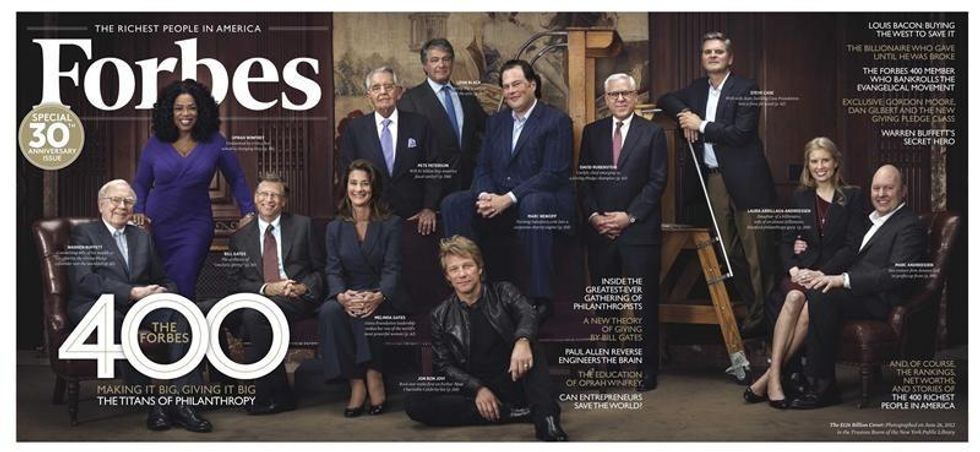
Within our own borders the disparity is no less shocking. For every one dollar of assets owned by a single black or Hispanic woman, a member of the Forbes 400 has over forty million dollars. That's equivalent to a can of soup versus a mansion, a yacht, and a private jet. Most of the Forbes 400 wealth has accrued from nonproductive capital gains. It's little wonder that with the exception of Russia, Ukraine, and Lebanon, the U.S. has the highest degree of wealth inequality in the world.
3. Extremes of Debt
Up until the 1970s U.S. households had virtually no debt. Now the total is $13 trillion, which averages out to $100,000 per American family.
Debt appears to be the only recourse for 21- to 35-year-olds, who have lost, on average, 68% of their median net worth since 1984, leaving each of them about $4,000.
4. Extremes of Health Care
A butler in black vest and tie passed the atrium waterfall and entered the $2,400 suite, where the linens were provided by the high-end bedding designer Frette of Italy and the bathroom glimmered with polished marble. Inside a senior financial executive awaited his 'concierge' doctor for private treatment.
He was waiting in the penthouse suite of the New York Presbyterian Hospital.
On the streets outside were some of the 26,000 Americans who will die this year because they are without health care. In 2010, 50 million Americans had no health insurance coverage.
5. Extremes of Justice
William James Rummel stole $80 with a credit card, then passed a bad check for $24, then refused to return $120 for a repair job gone bad. He got life in prison. Christopher Williams is facing over 80 years in prison for selling medical marijuana in Montana, a state which allows medical marijuana. Patricia Spottedcrow got 12 years for a $31 marijuana sale, and has seen her children only twice in the past two years. Numerous elderly Americans are in prison for life for non-violent marijuana offenses.
Banking giant HSBC, whose mission statement urges employees "to act with courageous integrity" in all they do, was described by a U.S. Senate report as having "exposed the U.S. financial system to 'a wide array of money laundering, drug trafficking, and terrorist financing'" in their dealings with Mexico's Sinaloa cartel, which is considered the deadliest drug gang in the world.
HSBC received a fine equivalent to four weeks' profits. The bank's CEO said, "we are profoundly sorry."
In the words of Bertrand Russell, "Advocates of capitalism are very apt to appeal to the sacred principles of liberty, which are embodied in one maxim: The fortunate must not be restrained in the exercise of tyranny over the unfortunate."
Accurate to the extreme.

An Urgent Message From Our Co-Founder
Dear Common Dreams reader, The U.S. is on a fast track to authoritarianism like nothing I've ever seen. Meanwhile, corporate news outlets are utterly capitulating to Trump, twisting their coverage to avoid drawing his ire while lining up to stuff cash in his pockets. That's why I believe that Common Dreams is doing the best and most consequential reporting that we've ever done. Our small but mighty team is a progressive reporting powerhouse, covering the news every day that the corporate media never will. Our mission has always been simple: To inform. To inspire. And to ignite change for the common good. Now here's the key piece that I want all our readers to understand: None of this would be possible without your financial support. That's not just some fundraising cliche. It's the absolute and literal truth. We don't accept corporate advertising and never will. We don't have a paywall because we don't think people should be blocked from critical news based on their ability to pay. Everything we do is funded by the donations of readers like you. Will you donate now to help power the nonprofit, independent reporting of Common Dreams? Thank you for being a vital member of our community. Together, we can keep independent journalism alive when it’s needed most. - Craig Brown, Co-founder |
Our work is licensed under Creative Commons (CC BY-NC-ND 3.0). Feel free to republish and share widely.
Paul Buchheit
Paul Buchheit is an advocate for social and economic justice, and the author of numerous papers on economic inequality and cognitive science. He was recently named one of 300 Living Peace and Justice Leaders and Models. He is the author of "American Wars: Illusions and Realities" (2008) and "Disposable Americans: Extreme Capitalism and the Case for a Guaranteed Income" (2017). Contact email: paul (at) youdeservefacts.org.

Capitalism has been defined by adherents and detractors: Milton Friedman said, "The problem of social organization is how to set up an arrangement under which greed will do the least harm, capitalism is that kind of a system." John Maynard Keynes said, "Capitalism is the astounding belief that the most wickedest of men will do the most wickedest of things for the greatest good of everyone."
Perhaps it's best to turn to someone who actually practiced the art: "Capitalism is the legitimate racket of the ruling class." Al Capone said that.
Capitalism is a cult. It is devoted to the ideals of privatization over the common good, profit over social needs, and control by a small group of people who defy the public's will. The tenets of the cult lead to extremes rather than to compromise. Examples are not hard to find.
1. Extremes of Income
By sitting on their growing investments, the richest five Americans made almost $7 billion each in one year. That's $3,500,000.00 per hour. The minimum wage for tipped workers is $2.13 per hour.
Our unregulated capitalist financial system allows a few well-positioned individuals to divert billions of dollars from the needs of society. If the 400 richest Americans lumped together their investment profits from last year, the total would pay in-state tuition and fees for EVERY college student in the United States.
2. Extremes of Wealth
The combined net worth of the world's 250 richest individuals is more than the total annual living expenses of almost half the world - three billion people.
Within our own borders the disparity is no less shocking. For every one dollar of assets owned by a single black or Hispanic woman, a member of the Forbes 400 has over forty million dollars. That's equivalent to a can of soup versus a mansion, a yacht, and a private jet. Most of the Forbes 400 wealth has accrued from nonproductive capital gains. It's little wonder that with the exception of Russia, Ukraine, and Lebanon, the U.S. has the highest degree of wealth inequality in the world.
3. Extremes of Debt
Up until the 1970s U.S. households had virtually no debt. Now the total is $13 trillion, which averages out to $100,000 per American family.
Debt appears to be the only recourse for 21- to 35-year-olds, who have lost, on average, 68% of their median net worth since 1984, leaving each of them about $4,000.
4. Extremes of Health Care
A butler in black vest and tie passed the atrium waterfall and entered the $2,400 suite, where the linens were provided by the high-end bedding designer Frette of Italy and the bathroom glimmered with polished marble. Inside a senior financial executive awaited his 'concierge' doctor for private treatment.
He was waiting in the penthouse suite of the New York Presbyterian Hospital.
On the streets outside were some of the 26,000 Americans who will die this year because they are without health care. In 2010, 50 million Americans had no health insurance coverage.
5. Extremes of Justice
William James Rummel stole $80 with a credit card, then passed a bad check for $24, then refused to return $120 for a repair job gone bad. He got life in prison. Christopher Williams is facing over 80 years in prison for selling medical marijuana in Montana, a state which allows medical marijuana. Patricia Spottedcrow got 12 years for a $31 marijuana sale, and has seen her children only twice in the past two years. Numerous elderly Americans are in prison for life for non-violent marijuana offenses.
Banking giant HSBC, whose mission statement urges employees "to act with courageous integrity" in all they do, was described by a U.S. Senate report as having "exposed the U.S. financial system to 'a wide array of money laundering, drug trafficking, and terrorist financing'" in their dealings with Mexico's Sinaloa cartel, which is considered the deadliest drug gang in the world.
HSBC received a fine equivalent to four weeks' profits. The bank's CEO said, "we are profoundly sorry."
In the words of Bertrand Russell, "Advocates of capitalism are very apt to appeal to the sacred principles of liberty, which are embodied in one maxim: The fortunate must not be restrained in the exercise of tyranny over the unfortunate."
Accurate to the extreme.
Paul Buchheit
Paul Buchheit is an advocate for social and economic justice, and the author of numerous papers on economic inequality and cognitive science. He was recently named one of 300 Living Peace and Justice Leaders and Models. He is the author of "American Wars: Illusions and Realities" (2008) and "Disposable Americans: Extreme Capitalism and the Case for a Guaranteed Income" (2017). Contact email: paul (at) youdeservefacts.org.

Capitalism has been defined by adherents and detractors: Milton Friedman said, "The problem of social organization is how to set up an arrangement under which greed will do the least harm, capitalism is that kind of a system." John Maynard Keynes said, "Capitalism is the astounding belief that the most wickedest of men will do the most wickedest of things for the greatest good of everyone."
Perhaps it's best to turn to someone who actually practiced the art: "Capitalism is the legitimate racket of the ruling class." Al Capone said that.
Capitalism is a cult. It is devoted to the ideals of privatization over the common good, profit over social needs, and control by a small group of people who defy the public's will. The tenets of the cult lead to extremes rather than to compromise. Examples are not hard to find.
1. Extremes of Income
By sitting on their growing investments, the richest five Americans made almost $7 billion each in one year. That's $3,500,000.00 per hour. The minimum wage for tipped workers is $2.13 per hour.
Our unregulated capitalist financial system allows a few well-positioned individuals to divert billions of dollars from the needs of society. If the 400 richest Americans lumped together their investment profits from last year, the total would pay in-state tuition and fees for EVERY college student in the United States.
2. Extremes of Wealth
The combined net worth of the world's 250 richest individuals is more than the total annual living expenses of almost half the world - three billion people.
Within our own borders the disparity is no less shocking. For every one dollar of assets owned by a single black or Hispanic woman, a member of the Forbes 400 has over forty million dollars. That's equivalent to a can of soup versus a mansion, a yacht, and a private jet. Most of the Forbes 400 wealth has accrued from nonproductive capital gains. It's little wonder that with the exception of Russia, Ukraine, and Lebanon, the U.S. has the highest degree of wealth inequality in the world.
3. Extremes of Debt
Up until the 1970s U.S. households had virtually no debt. Now the total is $13 trillion, which averages out to $100,000 per American family.
Debt appears to be the only recourse for 21- to 35-year-olds, who have lost, on average, 68% of their median net worth since 1984, leaving each of them about $4,000.
4. Extremes of Health Care
A butler in black vest and tie passed the atrium waterfall and entered the $2,400 suite, where the linens were provided by the high-end bedding designer Frette of Italy and the bathroom glimmered with polished marble. Inside a senior financial executive awaited his 'concierge' doctor for private treatment.
He was waiting in the penthouse suite of the New York Presbyterian Hospital.
On the streets outside were some of the 26,000 Americans who will die this year because they are without health care. In 2010, 50 million Americans had no health insurance coverage.
5. Extremes of Justice
William James Rummel stole $80 with a credit card, then passed a bad check for $24, then refused to return $120 for a repair job gone bad. He got life in prison. Christopher Williams is facing over 80 years in prison for selling medical marijuana in Montana, a state which allows medical marijuana. Patricia Spottedcrow got 12 years for a $31 marijuana sale, and has seen her children only twice in the past two years. Numerous elderly Americans are in prison for life for non-violent marijuana offenses.
Banking giant HSBC, whose mission statement urges employees "to act with courageous integrity" in all they do, was described by a U.S. Senate report as having "exposed the U.S. financial system to 'a wide array of money laundering, drug trafficking, and terrorist financing'" in their dealings with Mexico's Sinaloa cartel, which is considered the deadliest drug gang in the world.
HSBC received a fine equivalent to four weeks' profits. The bank's CEO said, "we are profoundly sorry."
In the words of Bertrand Russell, "Advocates of capitalism are very apt to appeal to the sacred principles of liberty, which are embodied in one maxim: The fortunate must not be restrained in the exercise of tyranny over the unfortunate."
Accurate to the extreme.
We've had enough. The 1% own and operate the corporate media. They are doing everything they can to defend the status quo, squash dissent and protect the wealthy and the powerful. The Common Dreams media model is different. We cover the news that matters to the 99%. Our mission? To inform. To inspire. To ignite change for the common good. How? Nonprofit. Independent. Reader-supported. Free to read. Free to republish. Free to share. With no advertising. No paywalls. No selling of your data. Thousands of small donations fund our newsroom and allow us to continue publishing. Can you chip in? We can't do it without you. Thank you.