SUBSCRIBE TO OUR FREE NEWSLETTER
Daily news & progressive opinion—funded by the people, not the corporations—delivered straight to your inbox.
5
#000000
#FFFFFF
To donate by check, phone, or other method, see our More Ways to Give page.
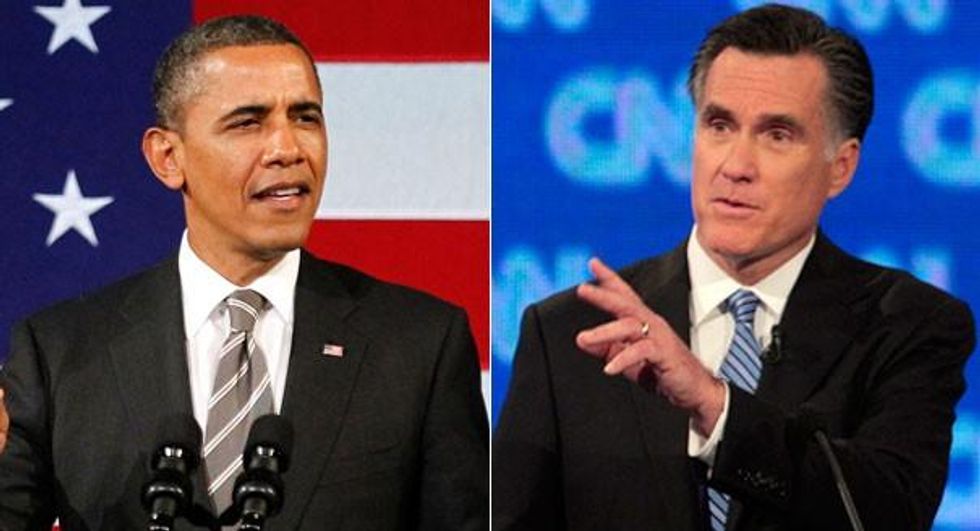
The question at the core of America's upcoming election isn't merely whose story most voting Americans believe to be true - Mitt Romney's claim that the economy is in a stall and Obama's policies haven't worked, or Barack Obama's that it's slowly mending and his approach is working.
If that were all there was to it, last Friday's report from the Bureau of Labor Statistics showing the economy added only 96,000 jobs in August - below what's needed merely to keep up with the growth in the number of eligible workers -- would seem to bolster Romney's claim.
But, of course, congressional Republicans have never even given Obama a chance to try his approach. They've blocked everything he's tried to do - including his proposed Jobs Act that would help state and local governments replace many of the teachers, police officers, social workers, and fire fighters they've had to let go over the last several years.
The deeper question is what should be done starting in January to boost a recovery that by anyone's measure is still anemic. In truth, not even the Jobs Act will be enough.
At the Republican convention in Tampa, Florida, Romney produced the predictable set of Republican bromides: cut taxes on corporations and the already rich, cut government spending (mainly on the lower-middle class and the poor), and gut business regulations.
It's the same supply-side nonsense that got the economy into trouble in the first place.
Corporations won't hire more workers just because their tax bill is lower and they spend less on regulations. In case you hadn't noticed, corporate profits are up. Most companies don't even know what to do with the profits they're already making. Not incidentally, much of those profits have come from replacing jobs with computer software or outsourcing them abroad.
Meanwhile, the wealthy don't create jobs, and giving them additional tax cuts won't bring unemployment down. America's rich are already garnering a bigger share of American income than they have in eighty years. They're using much of it to speculate in the stock market. All this has done is drive stock prices higher.
The way to get jobs back is to get American consumers to spend again. Consumer spending is 70 percent of the nation's economic activity. Most of it comes from the middle class and those aspiring to join the middle class. They're the real job creators.
But here's the problem. Middle-class consumers won't and can't spend because their savings are depleted, their homes are worth a fraction of what they were five years ago, their wages are dropping, and they're worried about keeping their jobs.
And they're no longer able borrow against the rising values of their homes because the housing bubble burst -- which means they can no longer pretend they're in better financial shape than they really are.
This is the heart of our economic dilemma.
Last Thursday night at the Democratic convention in Charlotte, North Carolina, President Obama suggested a way to correct this, or at least not make things worse: Raise taxes on the wealthy rather than cut programs the middle class and poor depend on (such as Medicare and Medicaid), give tax incentives to companies that create jobs in the United States, and invest in education.
It's a start but America's middle class and poor need far more. They need to be able to refinance their mortgages at today's low interest rates. They need a larger Earned Income Tax Credit - a wage subsidy for lower-paying jobs. And a higher minimum wage that's automatically adjusted for inflation.
They could use a new Works Projects Administration and Civilian Conservation Corps designed to put the long-term unemployed back to work.
They need stronger unions to bargain for a larger share of the gains from economic growth. And a Social Security payroll tax that exempts the first $25,000 of income and eliminates the ceiling (now $110,100) on income subject to it.
And they need an industrial policy designed to create high-wage jobs in America.
In accepting his party's nomination for president, Obama said the "basic bargain" that once rewarded hard work and gave everyone a fair shot had come undone.
He's right. And the U.S. economy won't return to normal until that basic bargain is remade.
If Obama gets a second term, recreating that bargain will be his central challenge - and America's.
The question at the core of America's upcoming election isn't merely whose story most voting Americans believe to be true - Mitt Romney's claim that the economy is in a stall and Obama's policies haven't worked, or Barack Obama's that it's slowly mending and his approach is working.
If that were all there was to it, last Friday's report from the Bureau of Labor Statistics showing the economy added only 96,000 jobs in August - below what's needed merely to keep up with the growth in the number of eligible workers -- would seem to bolster Romney's claim.
But, of course, congressional Republicans have never even given Obama a chance to try his approach. They've blocked everything he's tried to do - including his proposed Jobs Act that would help state and local governments replace many of the teachers, police officers, social workers, and fire fighters they've had to let go over the last several years.
The deeper question is what should be done starting in January to boost a recovery that by anyone's measure is still anemic. In truth, not even the Jobs Act will be enough.
At the Republican convention in Tampa, Florida, Romney produced the predictable set of Republican bromides: cut taxes on corporations and the already rich, cut government spending (mainly on the lower-middle class and the poor), and gut business regulations.
It's the same supply-side nonsense that got the economy into trouble in the first place.
Corporations won't hire more workers just because their tax bill is lower and they spend less on regulations. In case you hadn't noticed, corporate profits are up. Most companies don't even know what to do with the profits they're already making. Not incidentally, much of those profits have come from replacing jobs with computer software or outsourcing them abroad.
Meanwhile, the wealthy don't create jobs, and giving them additional tax cuts won't bring unemployment down. America's rich are already garnering a bigger share of American income than they have in eighty years. They're using much of it to speculate in the stock market. All this has done is drive stock prices higher.
The way to get jobs back is to get American consumers to spend again. Consumer spending is 70 percent of the nation's economic activity. Most of it comes from the middle class and those aspiring to join the middle class. They're the real job creators.
But here's the problem. Middle-class consumers won't and can't spend because their savings are depleted, their homes are worth a fraction of what they were five years ago, their wages are dropping, and they're worried about keeping their jobs.
And they're no longer able borrow against the rising values of their homes because the housing bubble burst -- which means they can no longer pretend they're in better financial shape than they really are.
This is the heart of our economic dilemma.
Last Thursday night at the Democratic convention in Charlotte, North Carolina, President Obama suggested a way to correct this, or at least not make things worse: Raise taxes on the wealthy rather than cut programs the middle class and poor depend on (such as Medicare and Medicaid), give tax incentives to companies that create jobs in the United States, and invest in education.
It's a start but America's middle class and poor need far more. They need to be able to refinance their mortgages at today's low interest rates. They need a larger Earned Income Tax Credit - a wage subsidy for lower-paying jobs. And a higher minimum wage that's automatically adjusted for inflation.
They could use a new Works Projects Administration and Civilian Conservation Corps designed to put the long-term unemployed back to work.
They need stronger unions to bargain for a larger share of the gains from economic growth. And a Social Security payroll tax that exempts the first $25,000 of income and eliminates the ceiling (now $110,100) on income subject to it.
And they need an industrial policy designed to create high-wage jobs in America.
In accepting his party's nomination for president, Obama said the "basic bargain" that once rewarded hard work and gave everyone a fair shot had come undone.
He's right. And the U.S. economy won't return to normal until that basic bargain is remade.
If Obama gets a second term, recreating that bargain will be his central challenge - and America's.
The question at the core of America's upcoming election isn't merely whose story most voting Americans believe to be true - Mitt Romney's claim that the economy is in a stall and Obama's policies haven't worked, or Barack Obama's that it's slowly mending and his approach is working.
If that were all there was to it, last Friday's report from the Bureau of Labor Statistics showing the economy added only 96,000 jobs in August - below what's needed merely to keep up with the growth in the number of eligible workers -- would seem to bolster Romney's claim.
But, of course, congressional Republicans have never even given Obama a chance to try his approach. They've blocked everything he's tried to do - including his proposed Jobs Act that would help state and local governments replace many of the teachers, police officers, social workers, and fire fighters they've had to let go over the last several years.
The deeper question is what should be done starting in January to boost a recovery that by anyone's measure is still anemic. In truth, not even the Jobs Act will be enough.
At the Republican convention in Tampa, Florida, Romney produced the predictable set of Republican bromides: cut taxes on corporations and the already rich, cut government spending (mainly on the lower-middle class and the poor), and gut business regulations.
It's the same supply-side nonsense that got the economy into trouble in the first place.
Corporations won't hire more workers just because their tax bill is lower and they spend less on regulations. In case you hadn't noticed, corporate profits are up. Most companies don't even know what to do with the profits they're already making. Not incidentally, much of those profits have come from replacing jobs with computer software or outsourcing them abroad.
Meanwhile, the wealthy don't create jobs, and giving them additional tax cuts won't bring unemployment down. America's rich are already garnering a bigger share of American income than they have in eighty years. They're using much of it to speculate in the stock market. All this has done is drive stock prices higher.
The way to get jobs back is to get American consumers to spend again. Consumer spending is 70 percent of the nation's economic activity. Most of it comes from the middle class and those aspiring to join the middle class. They're the real job creators.
But here's the problem. Middle-class consumers won't and can't spend because their savings are depleted, their homes are worth a fraction of what they were five years ago, their wages are dropping, and they're worried about keeping their jobs.
And they're no longer able borrow against the rising values of their homes because the housing bubble burst -- which means they can no longer pretend they're in better financial shape than they really are.
This is the heart of our economic dilemma.
Last Thursday night at the Democratic convention in Charlotte, North Carolina, President Obama suggested a way to correct this, or at least not make things worse: Raise taxes on the wealthy rather than cut programs the middle class and poor depend on (such as Medicare and Medicaid), give tax incentives to companies that create jobs in the United States, and invest in education.
It's a start but America's middle class and poor need far more. They need to be able to refinance their mortgages at today's low interest rates. They need a larger Earned Income Tax Credit - a wage subsidy for lower-paying jobs. And a higher minimum wage that's automatically adjusted for inflation.
They could use a new Works Projects Administration and Civilian Conservation Corps designed to put the long-term unemployed back to work.
They need stronger unions to bargain for a larger share of the gains from economic growth. And a Social Security payroll tax that exempts the first $25,000 of income and eliminates the ceiling (now $110,100) on income subject to it.
And they need an industrial policy designed to create high-wage jobs in America.
In accepting his party's nomination for president, Obama said the "basic bargain" that once rewarded hard work and gave everyone a fair shot had come undone.
He's right. And the U.S. economy won't return to normal until that basic bargain is remade.
If Obama gets a second term, recreating that bargain will be his central challenge - and America's.