
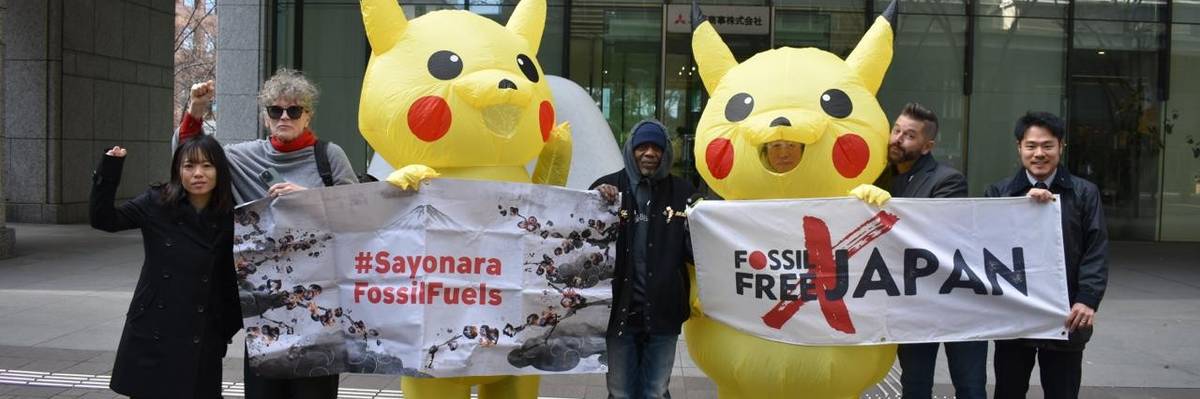
Advocates from Oil Change International, Texas Campaign for the Environment, Friends of the Earth Japan, Oilfield Witness, Free Port Haven Project, and Market Forces conduct an action protesting Mitsubishi Corp’s investment in LNG.
US Gulf South Activists to Japan: 'Enough Is Enough' When It Comes to Bankrolling LNG
As we meet with Japanese financial institutions and policymakers, we carry a clear message: The human cost of Japan's LNG investments can no longer be ignored.
The United States is at a political crossroads, with President Donald Trump and his allies promising to accelerate fossil fuel expansion. We write with urgency about the devastating impact of Japanese-funded methane gas exports on our communities.
As I, Manning Rollerson, stepped off a plane in Tokyo this week, I carry with me the stories of five generations of family who have watched our Texas Gulf South community transform into what can only be described as a "sacrifice zone." I am a Black community rights activist and founder of Freeport Haven Project for Environmental Justice. I have watched my historically Black community bear the brunt of industrial pollution for far too long. With 27 grandchildren, this fight is deeply personal. When our children are born with cancer and breathing issues, there should be accountability. That's why I'm here in Japan—to say enough is enough.
We are part of a delegation of frontline residents from the U.S. Gulf South traveling to Japan to confront the financial institutions bankrolling liquefied natural gas (LNG) expansion in their communities. Our mission comes at a critical moment, as Japanese banks line up to expand terminals like Cameron LNG in Louisiana.
Japanese leaders need to see our faces. They need to understand that when they sign LNG financing agreements, they're signing away our children's health, our neighborhoods' safety, and our planet's future.
The evidence we bring is compelling and direct. I, Sharon Wilson, spent 12 years in the oil industry before becoming an environmental investigator for Oilfield Witness. Using specialized optical gas imaging cameras, I've documented methane releases from Japanese-financed gas and LNG facilities. "If only people could see what's here, smell the air, drink the water, visualize the emissions, this wouldn't be happening," I can say with certainty. "The public would not stand for it."
Others, like Roishetta Ozane, founder of Louisiana's Vessel Project and a Black mother living in Sulphur, could not be with us in person but are with us in spirit: The journey to Japan is deeply personal. "My children face severe health conditions caused by pollution the oil and gas industry unleashes into our air and water," she says. "We cannot allow our communities to bear the burden of fossil fuel racism any longer."
Japanese institutions have emerged as the leading financiers of U.S. LNG export infrastructure. Private banks like MUFG are backing new projects like Rio Grande LNG near Port Isabel, Texas, while companies like Mitsui continue acquiring Texas gas fields—even as research shows exported LNG has a 33% greater climate impact than coal.
The Japanese government is the largest public financier of U.S. LNG. Japanese private banks MUFG, Mizuho, and SMBC are the top three private financiers of U.S. LNG, providing over $35 billion. Japanese institutions, such as the Nippon Export and Investment Insurance, are considering providing financing for the expansion of the Cameron LNG export terminal, while Japanese companies JERA and INPEX have signed offtake contracts for the Calcasieu Pass 2 project.
For us, this trip represents more than just advocacy—it's about bringing the reality of our communities directly to those making decisions half a world away. Japanese leaders need to see our faces. They need to understand that when they sign LNG financing agreements, they're signing away our children's health, our neighborhoods' safety, and our planet's future.
Our timing is strategic, coming just after Trump advisers signed an executive order to restart LNG export approvals—even as Japan positions itself as a clean energy leader in Asia while simultaneously pushing for expanded methane gas infrastructure across the region. There's no such thing as clean gas. Methane is intentionally released and blasted into our atmosphere from the moment a hole is drilled into the ground. This isn't about leaks—it's about a fundamentally dirty industry that cannot operate without massive pollution. And now, with Trump's team plotting to restart permits, our communities face even greater threats.
As we meet with Japanese financial institutions and policymakers, we carry a clear message: The human cost of Japan's LNG investments can no longer be ignored. Despite the threat of a fossil fuel-friendly administration, we have proven our resilience. We stopped LNG projects before, and we will do it again. This time, we're taking our fight directly to the source of the money. Human rights abuses are being committed in our Gulf South communities in the United States—and Japanese money is making it possible. We will not stop fighting until our communities are safe from harm.
An Urgent Message From Our Co-Founder
Dear Common Dreams reader, It’s been nearly 30 years since I co-founded Common Dreams with my late wife, Lina Newhouser. We had the radical notion that journalism should serve the public good, not corporate profits. It was clear to us from the outset what it would take to build such a project. No paid advertisements. No corporate sponsors. No millionaire publisher telling us what to think or do. Many people said we wouldn't last a year, but we proved those doubters wrong. Together with a tremendous team of journalists and dedicated staff, we built an independent media outlet free from the constraints of profits and corporate control. Our mission has always been simple: To inform. To inspire. To ignite change for the common good. Building Common Dreams was not easy. Our survival was never guaranteed. When you take on the most powerful forces—Wall Street greed, fossil fuel industry destruction, Big Tech lobbyists, and uber-rich oligarchs who have spent billions upon billions rigging the economy and democracy in their favor—the only bulwark you have is supporters who believe in your work. But here’s the urgent message from me today. It's never been this bad out there. And it's never been this hard to keep us going. At the very moment Common Dreams is most needed, the threats we face are intensifying. We need your support now more than ever. We don't accept corporate advertising and never will. We don't have a paywall because we don't think people should be blocked from critical news based on their ability to pay. Everything we do is funded by the donations of readers like you. When everyone does the little they can afford, we are strong. But if that support retreats or dries up, so do we. Will you donate now to make sure Common Dreams not only survives but thrives? —Craig Brown, Co-founder |
The United States is at a political crossroads, with President Donald Trump and his allies promising to accelerate fossil fuel expansion. We write with urgency about the devastating impact of Japanese-funded methane gas exports on our communities.
As I, Manning Rollerson, stepped off a plane in Tokyo this week, I carry with me the stories of five generations of family who have watched our Texas Gulf South community transform into what can only be described as a "sacrifice zone." I am a Black community rights activist and founder of Freeport Haven Project for Environmental Justice. I have watched my historically Black community bear the brunt of industrial pollution for far too long. With 27 grandchildren, this fight is deeply personal. When our children are born with cancer and breathing issues, there should be accountability. That's why I'm here in Japan—to say enough is enough.
We are part of a delegation of frontline residents from the U.S. Gulf South traveling to Japan to confront the financial institutions bankrolling liquefied natural gas (LNG) expansion in their communities. Our mission comes at a critical moment, as Japanese banks line up to expand terminals like Cameron LNG in Louisiana.
Japanese leaders need to see our faces. They need to understand that when they sign LNG financing agreements, they're signing away our children's health, our neighborhoods' safety, and our planet's future.
The evidence we bring is compelling and direct. I, Sharon Wilson, spent 12 years in the oil industry before becoming an environmental investigator for Oilfield Witness. Using specialized optical gas imaging cameras, I've documented methane releases from Japanese-financed gas and LNG facilities. "If only people could see what's here, smell the air, drink the water, visualize the emissions, this wouldn't be happening," I can say with certainty. "The public would not stand for it."
Others, like Roishetta Ozane, founder of Louisiana's Vessel Project and a Black mother living in Sulphur, could not be with us in person but are with us in spirit: The journey to Japan is deeply personal. "My children face severe health conditions caused by pollution the oil and gas industry unleashes into our air and water," she says. "We cannot allow our communities to bear the burden of fossil fuel racism any longer."
Japanese institutions have emerged as the leading financiers of U.S. LNG export infrastructure. Private banks like MUFG are backing new projects like Rio Grande LNG near Port Isabel, Texas, while companies like Mitsui continue acquiring Texas gas fields—even as research shows exported LNG has a 33% greater climate impact than coal.
The Japanese government is the largest public financier of U.S. LNG. Japanese private banks MUFG, Mizuho, and SMBC are the top three private financiers of U.S. LNG, providing over $35 billion. Japanese institutions, such as the Nippon Export and Investment Insurance, are considering providing financing for the expansion of the Cameron LNG export terminal, while Japanese companies JERA and INPEX have signed offtake contracts for the Calcasieu Pass 2 project.
For us, this trip represents more than just advocacy—it's about bringing the reality of our communities directly to those making decisions half a world away. Japanese leaders need to see our faces. They need to understand that when they sign LNG financing agreements, they're signing away our children's health, our neighborhoods' safety, and our planet's future.
Our timing is strategic, coming just after Trump advisers signed an executive order to restart LNG export approvals—even as Japan positions itself as a clean energy leader in Asia while simultaneously pushing for expanded methane gas infrastructure across the region. There's no such thing as clean gas. Methane is intentionally released and blasted into our atmosphere from the moment a hole is drilled into the ground. This isn't about leaks—it's about a fundamentally dirty industry that cannot operate without massive pollution. And now, with Trump's team plotting to restart permits, our communities face even greater threats.
As we meet with Japanese financial institutions and policymakers, we carry a clear message: The human cost of Japan's LNG investments can no longer be ignored. Despite the threat of a fossil fuel-friendly administration, we have proven our resilience. We stopped LNG projects before, and we will do it again. This time, we're taking our fight directly to the source of the money. Human rights abuses are being committed in our Gulf South communities in the United States—and Japanese money is making it possible. We will not stop fighting until our communities are safe from harm.
- Despite Global Pledge, US Still Pouring Public Money Into Fossil Fuel Projects Abroad ›
- Why Are Biden Officials Like Rahm Emanuel Touting False LNG Solutions? ›
- Activists to Insurance Giants: 'End Your Support for Oil and Gas Now' ›
- Meet the Banks and Investors Funding the LNG 'Carbon Bomb' ›
- Opinion | Rio Grande LNG Expansion: a Lose-Lose Proposition | Common Dreams ›
The United States is at a political crossroads, with President Donald Trump and his allies promising to accelerate fossil fuel expansion. We write with urgency about the devastating impact of Japanese-funded methane gas exports on our communities.
As I, Manning Rollerson, stepped off a plane in Tokyo this week, I carry with me the stories of five generations of family who have watched our Texas Gulf South community transform into what can only be described as a "sacrifice zone." I am a Black community rights activist and founder of Freeport Haven Project for Environmental Justice. I have watched my historically Black community bear the brunt of industrial pollution for far too long. With 27 grandchildren, this fight is deeply personal. When our children are born with cancer and breathing issues, there should be accountability. That's why I'm here in Japan—to say enough is enough.
We are part of a delegation of frontline residents from the U.S. Gulf South traveling to Japan to confront the financial institutions bankrolling liquefied natural gas (LNG) expansion in their communities. Our mission comes at a critical moment, as Japanese banks line up to expand terminals like Cameron LNG in Louisiana.
Japanese leaders need to see our faces. They need to understand that when they sign LNG financing agreements, they're signing away our children's health, our neighborhoods' safety, and our planet's future.
The evidence we bring is compelling and direct. I, Sharon Wilson, spent 12 years in the oil industry before becoming an environmental investigator for Oilfield Witness. Using specialized optical gas imaging cameras, I've documented methane releases from Japanese-financed gas and LNG facilities. "If only people could see what's here, smell the air, drink the water, visualize the emissions, this wouldn't be happening," I can say with certainty. "The public would not stand for it."
Others, like Roishetta Ozane, founder of Louisiana's Vessel Project and a Black mother living in Sulphur, could not be with us in person but are with us in spirit: The journey to Japan is deeply personal. "My children face severe health conditions caused by pollution the oil and gas industry unleashes into our air and water," she says. "We cannot allow our communities to bear the burden of fossil fuel racism any longer."
Japanese institutions have emerged as the leading financiers of U.S. LNG export infrastructure. Private banks like MUFG are backing new projects like Rio Grande LNG near Port Isabel, Texas, while companies like Mitsui continue acquiring Texas gas fields—even as research shows exported LNG has a 33% greater climate impact than coal.
The Japanese government is the largest public financier of U.S. LNG. Japanese private banks MUFG, Mizuho, and SMBC are the top three private financiers of U.S. LNG, providing over $35 billion. Japanese institutions, such as the Nippon Export and Investment Insurance, are considering providing financing for the expansion of the Cameron LNG export terminal, while Japanese companies JERA and INPEX have signed offtake contracts for the Calcasieu Pass 2 project.
For us, this trip represents more than just advocacy—it's about bringing the reality of our communities directly to those making decisions half a world away. Japanese leaders need to see our faces. They need to understand that when they sign LNG financing agreements, they're signing away our children's health, our neighborhoods' safety, and our planet's future.
Our timing is strategic, coming just after Trump advisers signed an executive order to restart LNG export approvals—even as Japan positions itself as a clean energy leader in Asia while simultaneously pushing for expanded methane gas infrastructure across the region. There's no such thing as clean gas. Methane is intentionally released and blasted into our atmosphere from the moment a hole is drilled into the ground. This isn't about leaks—it's about a fundamentally dirty industry that cannot operate without massive pollution. And now, with Trump's team plotting to restart permits, our communities face even greater threats.
As we meet with Japanese financial institutions and policymakers, we carry a clear message: The human cost of Japan's LNG investments can no longer be ignored. Despite the threat of a fossil fuel-friendly administration, we have proven our resilience. We stopped LNG projects before, and we will do it again. This time, we're taking our fight directly to the source of the money. Human rights abuses are being committed in our Gulf South communities in the United States—and Japanese money is making it possible. We will not stop fighting until our communities are safe from harm.
- Despite Global Pledge, US Still Pouring Public Money Into Fossil Fuel Projects Abroad ›
- Why Are Biden Officials Like Rahm Emanuel Touting False LNG Solutions? ›
- Activists to Insurance Giants: 'End Your Support for Oil and Gas Now' ›
- Meet the Banks and Investors Funding the LNG 'Carbon Bomb' ›
- Opinion | Rio Grande LNG Expansion: a Lose-Lose Proposition | Common Dreams ›