

SUBSCRIBE TO OUR FREE NEWSLETTER
Daily news & progressive opinion—funded by the people, not the corporations—delivered straight to your inbox.
5
#000000
#FFFFFF
To donate by check, phone, or other method, see our More Ways to Give page.
Daily news & progressive opinion—funded by the people, not the corporations—delivered straight to your inbox.

Another journalist called the assault "the latest instance of unacceptable and alarming settler violence toward journalists and Palestinians."
Israeli settlers attacked and wounded a Palestinian woman and four NBC team members who were interviewing her in the West Bank on Saturday, amid ongoing settler violence in the occupied Palestinian territory.
The settlers, who were wearing masks, drove up as Aida Ahmed Abdullah and her family were telling NBC about how settlers forced them from their home in the town of Jalud.
“They jumped out, beat us, then jumped back in the car,” NBC News international correspondent Matt Bradley told the outlet.
Make This Go VIRAL
Masked Israeli Settlers ATTACK Palestinian Woman and NBC News Crew in the West Bank
NBC correspondent Matt Bradley was struck twice pic.twitter.com/EMmWGsNk2X
— Ryan Rozbiani (@RyanRozbiani) August 30, 2026
Bradley was hit twice on the arm by the attackers, who carried sticks. They also threw rocks. Abdullah, Bradley, West Bank-based cameraman Khaldoon Eid, producer Producer Lawahez Jabari, and a driver were all injured in the ambush and treated afterword. Abdullah remained in the hospital as of Saturday night.
Both Eid and Jabari also described the assault.
“We didn’t expect that—that they would come to attack,” Eid told NBC. “We were in the middle of a Palestinian area next to Palestinian houses.”
Jabari said, "Suddenly a car came to us,” adding, "the settlers had sticks, I saw a gun, but they didn’t use the gun.”
Jeremy Diamond, a CNN correspondent in Jerusalem, called the incident "horrific" on social media and said it was "the latest instance of unacceptable and alarming settler violence toward journalists and Palestinians."
The NBC crew and their interviewee were not the only targets of such violence on Saturday, as attacks continued in the town of Qusra, where settlers have been conducting a nearly three-week siege of three Palestinian homes. Settlers pepper sprayed Palestinian workers, threw rocks at a building, and besieged a fourth home with at least four Palestinian residents inside, according to Hareetz and Al Jazeera.
Israeli Prime Minister Benjamin Netanyahu condemned Saturday's attacks, characterizing them as “criminal acts of violence committed in the villages of Qusra and Jalud by a handful of rioters who violate the law, cause enormous injustice to the law-abiding settler public, hinder the IDF [Israel Defense Forces] in fulfilling its missions, and harm Israel’s standing in the world.”
Yet Trita Parsi, executive vice president of the Quincy Institute for Responsible Statecraft, argued on social media:
1. The settler wouldn't do this to Americans had they not received a green light from the Israeli gov.
2. Israel's gov would not have given such a green light unless it felt confident that the US gov—and Amb. [Mike] Huckabee—wouldn't lift a finger to defend the Americans.
Journalists trying to report in both Gaza and the West Bank have long been targets of both settlers and the Israeli military. The IDF was found to be the leading killer of journalists worldwide for the third year in a row in 2025, and even before the Gaza genocide began in 2023, there were cases like the IDF killing of Palestinian-American reporter Shireen Abu Akleh in the West Bank in 2022.
The attacks on the NBC team also come amid an uptick in setter violence in the West Bank since 2023, which humans rights observers say is enabled by the Israeli government. Netanyahu's government has expanded settlements in the West Bank despite the fact that they are illegal under international law.

The merger would connect the US and Israeli militaries in unprecedented ways and make it exceedingly difficult for any future president to unwind this partnership with a foreign government, no matter what public opinion says.
It's called Section 219. Tucked away in the massive congressional spending bill known as the National Defense Authorization Act, or NDAA, this provision of the law would effectively require our nation to permanently entangle the American military with the Israeli military.
Among other things, the United States-Israel Defense Technology Cooperation Initiative would require the US to share intelligence with Israel and establish a system of weapons research, development, and production, particularly in the domains crucial to warfare in the modern age: artificial intelligence, autonomous systems, and various other fields of high defense technology.
The House provision, which has a Senate version known as Section 1217, would also forbid the president of the United States from limiting intelligence collaboration with Israel over its human rights abuses. If the President ever wants to limit such collaboration, he or she must tell Congress and can only cite American national security as a basis.
In other words, these bills would connect the US and Israeli militaries in unprecedented ways and make it exceedingly difficult for any future president to unwind this partnership with a foreign government.
There’s a reason why members of Congress are trying to sneak this bill through right now, buried in a massive and must-pass defense spending bill: This might be their best, last chance to thwart the will of the American people.
If these bills pass in their current form, the US military would be more integrated with Israel’s than with that of any other country, including America's NATO allies.
There’s a reason why members of Congress are trying to sneak this bill through right now, buried in a massive and must-pass defense spending bill: This might be their best, last chance to thwart the will of the American people.
Over the past three years, American public opinion has turned sharply against the Israeli government.
Thanks to the modern miracle of social media, Americans were able to directly see the human carnage as the Israeli military slaughtered and starved, by the most conservative estimate, over 73,000 people in Gaza.
Americans were also able to see the consequences of the Israeli military's ethnic cleansing in Lebanon, which has destroyed ancient cities, including Christian towns, and displaced a million people from their homes.
Most recently, the American people watched as the Israeli government openly convinced the Trump administration to launch an unnecessary, illegal and failed war on Iran that has resulted in the deaths of thousands of civilians, over a dozen American soldiers, and a global economic crisis, including a sharp rise in gas prices.
The American people are simply fed up.
Members of Congress who recognize American sovereignty and respect American democracy must join Rep. Smith and others in opposing these provisions, and all Americans should call on their members of Congress to do so.
According to recent Pew data, 60% of American adults have an unfavorable view of Israel, up from 42% in 2022.
Majorities of voters under 50 in both parties feel this way: 57% of young Republicans and 84% of young Democrats.
Most Americans oppose further unconditional US military aid for the Netanyahu government.
Recent election results, in which candidates who staked their campaigns on investing American taxpayer dollars here at home instead of overseas in the Israeli military, have also shown that the tide is rapidly changing.
Even prominent conservatives like Tucker Carlson have decried the Israeli government's influence on our political system while once-dominant conservative voices like Ben Shapiro known for supporting Israel have flailed and bled support.
Instead of respecting the clear will of the American people, members of Congress dedicated to maintaining unconditional US support for Israel have introduced bills meant to ensure changes in American public opinion never become changes in American public policy.
This should be unacceptable to everyone in our nation.
Although the US-Israel merger bills are currently making their way through Congress, the fight to strip these provisions from the NDAA is not over.
Just this week, Rep. Adam Smith (D-Wash.)—the ranking member on the House Armed Services committee—announced that he was withdrawing his support for the provision.
“I cannot support endless conflict even though I support Israel’s right to exist,” said Smith. “For these reasons, I will vote to remove Section 224 from the National Defense Authorization Act if it comes to the Floor.”
If the joint technology development, intelligence sharing, and weapons production are enshrined in law, they would become extraordinarily difficult for future presidents or Congresses to undo, regardless of changing public opinion or policy priorities.
The United States would be permanently locked into a strategic alignment with a foreign government, taking away the American people’s ability to decide on the future of the relationship.
Members of Congress who recognize American sovereignty and respect American democracy must join Rep. Smith and others in opposing these provisions, and all Americans should call on their members of Congress to do so.
If joint technology development, intelligence sharing, and weapons production are required by law, they would become extraordinarily difficult for another Congress or future presidents to undo, regardless of changing public opinion or policy priorities.
Our nation would be trapped a strategic alignment with a foreign government, taking away the American people’s ability to decide on the future of the relationship.
The US military is meant to protect American interests, and Congress is meant to serve the American people.
That's why Section the US-Israel merger bills must go.
"Everyone involved in this crime against humanity, and everyone who covered it up, would face prosecution in a world that had any shred of dignity left."
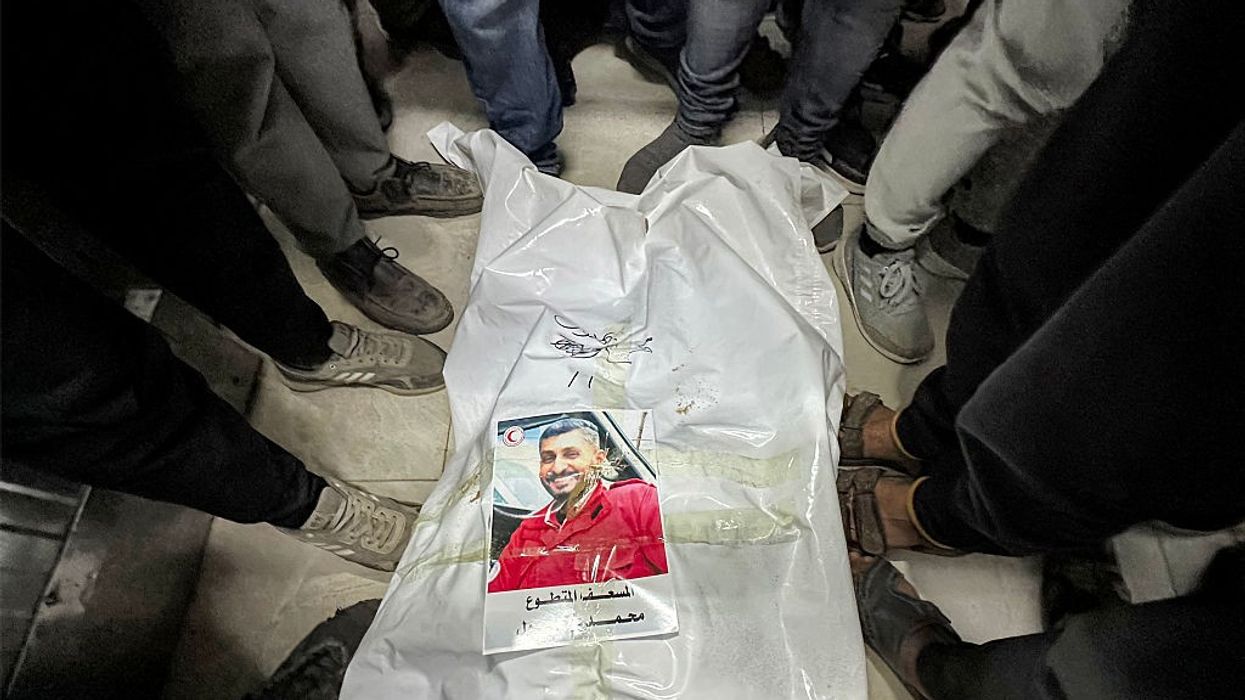
A video presented to officials at the United Nations on Friday and first made public Saturday by the New York Times provides more evidence that the recent massacre of Palestinian medics in Gaza did not happen the way Israeli government claimed—the latest in a long line of deception when it comes to violence against civilians that have led to repeated accusations of war crimes.
The video, according to the Palestine Red Crescent Society (PRCS), was found on the phone of a paramedic found in a mass grave with a bullet in his head after being killed, along with seven other medics, by Israeli forces on March 23. The eight medics, buried in the shallow grave with the bodies riddled with bullets, were: Mustafa Khafaja, Ezz El-Din Shaat, Saleh Muammar, Refaat Radwan, Muhammad Bahloul, Ashraf Abu Libda, Muhammad Al-Hila, and Raed Al-Sharif. The video reportedly belonged to Radwan. A ninth medic, identified as Asaad Al-Nasasra, who was at the scene of the massacre, which took place near the southern city of Rafah, is still missing.
The PRCS said it presented the video—which refutes the explanation of the killings offered by Israeli officials—to members of the UN Security Council on Friday.
"They were killed in their uniforms. Driving their clearly marked vehicles. Wearing their gloves. On their way to save lives," Jonathan Whittall, head of the UN's humanitarian affairs office in Palestine, said last week after the bodies were discovered. Some of the victims, according to Gaza officials, were found with handcuffs still on them and appeared to have been shot in the head, execution-style.
The Israeli military initially said its soldiers "did not randomly attack" any ambulances, but rather claimed they fired on "terrorists" who approached them in "suspicious vehicles." Lt. Col. Nadav Shoshani, an IDF spokesperson, said the vehicles that the soldiers opened fire on were driving with their lights off and did not have clearance to be in the area. The video evidence directly contradicts the IDF's version of events.
As the Times reports:
The Times obtained the video from a senior diplomat at the United Nations who asked not to be identified to be able to share sensitive information.
The Times verified the location and timing of the video, which was taken in the southern city of Rafah early on March 23. Filmed from what appears to be the front interior of a moving vehicle, it shows a convoy of ambulances and a fire truck, clearly marked, with headlights and flashing lights turned on, driving south on a road to the north of Rafah in the early morning. The first rays of sun can be seen, and birds are chirping.
In an interview with Drop Site News published Friday, the only known paramedic to survive the attack, Munther Abed, explained that he and his colleagues "were directly and deliberately shot at" by the IDF. "The car is clearly marked with 'Palestinian Red Crescent Society 101.' The car's number was clear and the crews' uniform was clear, so why were we directly shot at? That is the question."
The video's release sparked fresh outrage and demands for accountability on Saturday.
"The IDF denied access to the site for days; they sent in diggers to cover up the massacre and intentionally lied about it," said podcast producer Hamza M. Syed in reaction to the new revelations. "The entire leadership of the Israeli army is implicated in this unconscionable war crime. And they must be prosecuted."
"Everyone involved in this crime against humanity, and everyone who covered it up, would face prosecution in a world that had any shred of dignity left," said journalist Ryan Grim of DropSite News.

"It's an impossible situation, because even if we prioritize the little fuel that is left to the most urgent departments, we know that they won't last more than 36 to 48 hours," said Julie Faucon, MSF medical team leader in Gaza.
The international humanitarian group Médecins Sans Frontières, also known as Doctors Without Borders or MSF, warned in a Wednesday statement that newborn babies and other patients are at dire risk as southern Gaza's Nasser Hospital runs out of fuel.
The group warned that electricity for the MSF-supported Nasser Hospital, where MSF members are providing emergency, maternity, pediatric, burn, and trauma care, may be cut off for some hospital departments leaving patients without "lifesaving care." The hospital's neonatal intensive care unit is currently treating children and newborns who are reliant on mechanical ventilation and incubators. All of these young patients are dependent on electricity from fuel generators, MSF wrote.
Nasser Hospital, as well as two other facilities in the Gaza Strip, Al-Aqsa Hospital and European Gaza Hospital, are nearing the need to close due to lack of fuel, the group reported Wednesday.
"It's an impossible situation, because even if we prioritize the little fuel that is left to the most urgent departments, we know that they won't last more than 36 to 48 hours," said Julie Faucon, MSF medical team leader in Gaza, according to the statement. "While some patients are hanging on by a thread, the lack of sustained electricity is impacting the level of care we can provide to those with burns and trauma."
Pascale Coissard, MSF emergency coordinator, said that the situation is "a consequence of Israel's ongoing blockade and continuous criminal looting of lifesaving supplies."
In mid-July, the United Nations reported that "Israeli authorities continue to tightly control allocations of incoming fuel, thereby limiting humanitarian operations, especially by local partners," and just last week the body noted that only 16 of the region's 36 hospitals remained partially in operation.
Pointing to lack of medical supplies, equipment, and personnel, Rik Peeperkorn, the World Health Organization representative for the West Bank and Gaza, told a recent U.N. Security Council meeting that "the health sector is being systematically dismantled."
Attacks by the Israeli military have left northern Gaza's three hospitals—the Kamal Adwan Hospital, al-Awda Hospital, and the Indonesian Hospital—either entirely out of service or barely functioning.
Hussam Abu Safia, the head of the Kamal Adwan Hospital, was detained by Israeli forces during their raid on Kamal Adwan Hospital in late December.
Human rights defenders and the medical community have called for his release, it's believed that he is being held in an Israeli detention center, though the Israeli officials had given news media and human rights groups conflicting messages about his whereabouts.
"These preventable deaths lay bare the desperate and deteriorating conditions facing families and children across Gaza," said the humanitarian aid organization.
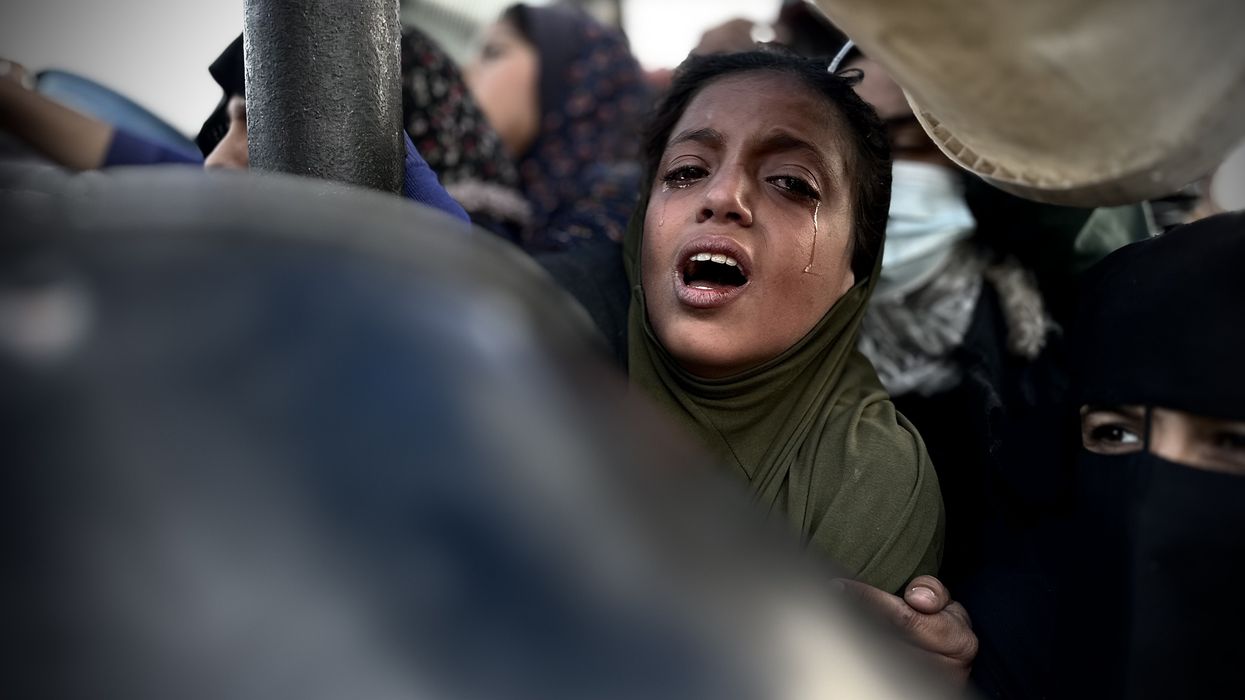
UNICEF, the United Nations agency tasked with providing humanitarian aid for children, released a statement Thursday decrying the recent deaths of Gazan children, particularly those who have perished because of cold and lack of adequate shelter.
"Cold injuries, such as frostbite and hypothermia, pose grave risks to young children in tents and other makeshift shelters that are ill-equipped for freezing weather. For newborns, infants, and medically vulnerable children, the danger is even more acute," said UNICEF regional director for the Middle East and North Africa Edouard Beigbeder.
"With temperatures expected to drop further in the coming days, it is tragically foreseeable that more children's lives will be lost to the inhumane conditions they are enduring, which offer no protection from the cold," he added.
The Quds News Network reported Thursday, citing the head of pediatrics and obstetrics at Nasser Hospital in Gaza, that four Gazan newborns have died in the past few days because of low temperatures and lack of shelter.
"These preventable deaths lay bare the desperate and deteriorating conditions facing families and children across Gaza," said Beigbeder.
One of those babies was Sila Mahmoud Al-Faseeh, a 3-week-old girl, who died Sunday "from the extreme cold" in a tent where her forcibly displaced family is sheltering on a beach in al-Mawasi, an Israeli-designated "safe zone" for displaced Palestinians that has repeatedly come under attack.
Sila's father, Mahmoud al-Faseeh, told The Associated Press that the family attempted to keep the baby warm as the temperatures fell to 48°F (9°C)—below the fatal threshold for hypothermia—in their unsealed tent on cold ground.
"It was very cold overnight and as adults we couldn't even take it," al-Faseeh said. "We couldn't stay warm."
Over 14,500 children have reportedly been killed since October 7, 2023 as of mid-December, according to UNICEF, though the Gaza Government Media Office cites a higher figure.
The U.S. government successfully sought the retraction of a report from an organization monitoring food crises that warned of looming famine in north Gaza under what the report called Israel's "near-total blockade," according to Thursday reporting from The Associated Press. The move drew concern from aid groups, per AP.
In November, more than two dozen international relief groups operating in Gaza warned that humanitarian assistance entering the enclave had "fallen to an all-time low" due to Israel's continued blockade.
The situation has also exacted a punishing psychological toll on the children of Gaza. A report from the Community Training Centre for Crisis Management released in November found that, of the more than 500 Palestinian children it surveyed in Gaza last summer, 96% of them fear imminent death, 92% are not accepting of reality, 79% suffer from nightmares, and 49% wish to die because of the war, and many more "show signs of withdrawal and severe anxiety, alongside a pervasive sense of hopelessness."

"This has devastating impacts for the people of Gaza who are already on the verge of famine," said the UNRWA's director of planning.
With tanks and ground forces, the Israeli military seized control of the Gaza side of Rafah's border crossing with Egypt on Tuesday, cutting off a critical humanitarian aid route as much of the enclave's population faces imminent famine.
Israel's takeover of the Rafah crossing came hours after the country's military ordered more than 100,000 people in the southern Gaza city to evacuate ahead of a ground assault, which is moving forward after the right-wing Israeli government rejected a cease-fire proposal accepted by Hamas. Cease-fire negotiations mediated by Egypt and Qatar are expected to continue in the coming days.
Video footage posted to social media shows an Israeli tank running over a Gaza sign as Israeli forces took control of the Rafah crossing on Tuesday.
Israeli tank bulldozers Gaza sign as Israeli army captures Rafah crossing this morning.
pic.twitter.com/JNnAXKeW9h
— Ragıp Soylu (@ragipsoylu) May 7, 2024
Reporting from Rafah, Al Jazeera's Hani Mahmoud said the Israeli military is "cutting off the only lifeline right now to the people in Gaza, particularly for the 1.5 million displaced Palestinians here in Rafah."
The Rafah crossing is closed, cutting off the life line for 1.5m people crammed into this tiny piece of land right at the southern end of the Gaza strip.
Hani Mahmoud reporting from Rafah. pic.twitter.com/kPeImrntDj
— Saul Staniforth (@SaulStaniforth) May 7, 2024
Two key humanitarian aid routes—the Rafah and Kerem Shalom crossings—have been shut down for days as the Israeli military plows ahead with its Rafah assault in the face of international outrage. More than 600,000 children are currently living in Rafah, and aid organizations say Israel has no credible plan to protect them.
Overnight, Israel launched deadly airstrikes in Rafah, describing its military operation in the overcrowded city as "very precise." One resident
told Reuters that the Israeli strikes killed his wife and children.
Jens Laerke, a spokesperson for the United Nations Office for the Coordination of Humanitarian Affairs, told The Associated Press that Israeli authorities have denied the agency access to the Rafah crossing.
A lasting shutdown of the route, Laerke warned, "will plunge this crisis into unprecedented levels of need, including the very real possibility of a famine." He added that Israel's military is "ignoring all warnings about what this could mean for civilians and for the humanitarian operation across the Gaza Strip."
Speaking to Al Jazeera on Tuesday, the director of planning at the U.N. Relief and Works Agency for Palestine Refugees in the Near East (UNRWA)—the most important aid organization operating in Gaza—said the closure of the Rafah crossing is having "catastrophic impacts on everyone in Gaza."
"Since October, this has been the main entry point of goods coming into Gaza," said Sam Rose. "There has only been a trickle of goods coming in, and since Sunday the crossing has been closed completely. And this has devastating impacts for the people of Gaza who are already on the verge of famine."
"No aid coming in means no aid distributed after a couple of days," Rose continued. "And equally importantly, Rafah and Kerem Shalom are the only entry points for fuel in Gaza, so without the fuel there's no ability for trucks to move around, there's no ability for desalination plants to operate and provide safe water, there's no electricity. It cuts off everything. Rafah and Kerem Shalom—they're the lifeblood for the small amount of goods that have been coming into Gaza since October, so absolutely devastating."
"Absolutely devastating"
This morning the IDF have seized the Palestinian side of the Rafah crossing, and Sam Rose from UNRWA explains what it means now that the crossing is closed. pic.twitter.com/iC1w8AWnt5
— Saul Staniforth (@SaulStaniforth) May 7, 2024
Laerke of the U.N. humanitarian affairs office said that cutting off the supply of fuel to Gaza for an extended period of time "would be a very effective way of putting the humanitarian operation in its grave."
Volker Türk, the U.N. high commissioner for human rights, said in a statement that "more attacks on what is now the primary humanitarian hub in the Gaza strip are not the answer."
"First and foremost, there must be a cease-fire. Humanitarian aid must be allowed to flow freely and at scale. And the hostages and those arbitrarily detained must be released at once," said Türk. "Those that elect to flout international humanitarian law and international human rights law must be held to account."

Refusing to fight in unjust and brutal wars is not new, but it remains a rare act of courage.
According to legend, the organization I lead, the Fellowship of Reconciliation, was founded in August 1914 when a British Quaker and a German Lutheran shook hands at a railway station in Cologne. With England on the cusp of joining World War I, they pledged, "We are one in Christ and can never be at war."
After Germany sunk the Lusitania ship in May 1915, American public support for joining the war swelled. But not everyone got on board.
Political activist and theologian A.J. Muste responded to his country’s gearing up for war by becoming a pacifist. His views resulted in him being forced out of his pastoral position. Likewise, pacifist and social reformer Jane Addams (who later went on to win the Nobel Peace Prize) was viciously criticized for calling the war “an insane outburst.”
Despite the pro-war hysteria that countries use to justify their military endeavors, conscientious objection remains a courageous option for those committed to peace. As the ongoing genocide of Palestinians unfolds in front of the eyes of the world, a couple of young Israelis are choosing this brave, though unpopular, path.
“Slaughter cannot solve slaughter,” 18-year-old Israeli-American Tal Mitnick said in December 2023 before receiving his first 30-day prison sentence for refusing to join Israel’s military.
The same week that Tal refused for the third time and received a third term in prison, he was joined by fellow teenager Sofia Orr. “I reject participating in the violent policies of oppression and apartheid that Israel has imposed on the Palestinian people, especially now during the war,” she said.
It’s not the sentences Tal and Sofia are enduring that make their actions exceptional. They have options. In fact, 12 percent of conscripted Israelis get out of service through notoriously easy-to-obtain mental health exemptions. Instead of the 10-year terms that Russian draft evaders face, even when Israelis are sentenced for refusing, they receive consecutive sentences with breaks in between to see if they have changed their minds.
Tal and Sofia are not being held indefinitely in overcrowded, abusive, deadly prison facilities like incarcerated Palestinians from Gaza and the West Bank. But, what Tal and Sophia are doing is heroic and places them within a legacy of great peacemakers.
The earliest recorded act of conscientious objection occurred in 295 A.D. when Maximilianus refused his conscription into the Roman Army. He was beheaded for refusing to kill. Later, he was canonized as a saint.
Like Maximilianus, Austrian farmer Franz Jägerstätter was arrested and executed for refusing conscription by the Nazis. He wrote, "I find that [my hands being in chains is] much better than if my will were in chains. Neither prison nor chains nor sentence of death can rob a man of the Faith and his free will.”
When, in 1944, devout Quaker Bayard Rustin was sentenced to three years for refusing to serve in World War II, he devoted his prison time to racial justice work. A disciple of Gandhian nonviolence, he organized his fellow prisoners to resist segregation in the prison. He was so successful that the head of the prison described him as “an extremely capable agitator.” Upon release, he traveled the country organizing communities, including the “First Freedom Ride” in 1947.
James Lawson, also a student of Gandhi, spent 13 months in prison between 1951 and 1952 for refusing to serve during the Korean War. Lawson went on to become, along with Rustin, an essential advisor to Dr. Martin Luther King.
Since its campaigns were broadcast on TV across America, the civil rights movement challenged the public, especially American youth, to choose between justice and segregation — between equality and oppression. At the same time, there was a surge of draft evaders and conscientious objectors to the Vietnam War, including prominent leaders like “good troublemaker” John Lewis.
Refusing and avoiding conscription became so popular during the Vietnam War that President Nixon’s commission reported that the movement was “expanding at an alarming rate,” leaving the government “almost powerless to apprehend and prosecute them.”
With the majority of Israelis opposing an end to the war in Gaza and 72 percent of them supporting no humanitarian aid, Tal and Sofia are not part of a growing popular movement, like what took place during the Vietnam War. But their contributions to peace are no less important.
Whether or not other young Israelis join them in jail — Tal and Sofia were part of a group of 200 Jewish Israeli 12th graders who pledged in August 2023 to refuse military service to protest the government’s effort to overhaul Israel’s judicial system — what Tal and Sofia have done places profound marks on the pages of history.
Members and contributors to the Fellowship of Reconciliation include the likes of Jane Addams, A.J. Muste, Mahatma Gandhi, Bayard Rustin, Martin Luther King Jr., Daniel Berrigan, Dorothy Day, James Lawson, and countless other brave conscientious objectors and peacemakers.
Today, as the world is watching a genocide take place in real-time — as of this writing, the death toll in Gaza is approaching 32,000 and famine is setting in — FOR-USA is proud to be raising money for an ad in an Israeli newspaper lifting up two of the most important conscientious objectors of our time. We invite you to join us by following Tal and Sofia’s journey at forusa.org/IsraeliRefusers.

"Everyone knows that the U.S. could end this today if we wanted to," said one analyst.
A new poll released Tuesday revealed that a majority of Americans want to the U.S. government to stop supplying the Israeli military with weaponry to carry out its brutal assault on Gaza that has killed over 30,000 Palestinians, most of them civilian men, women, and children.
As organizers called on Democratic voters in at least seven states to vote "uncommitted" on their Super Tuesday primary ballots on Tuesday to help push the Biden administration to demand a permanent cease-fire in Gaza, the YouGov poll provided another measure of Americans' growing outrage over their government's material and political support for the "genocidal" campaign by Israel's far-right government.
Commissioned by the Center for Economic and Policy Research (CEPR), the poll of 1,000 U.S. adults asked respondents whether they agreed with the statement: "The U.S. should stop weapons shipments to Israel until Israel discontinues its attacks on the people of Gaza."
Fifty-two percent of people said they agreed with the statement, while just 27% said they disagreed.
CEPR co-director Mark Weisbrot noted that while the call for a cease-fire "can mean different things to different people... the support for halting weapons shipments is specific and unambiguous."
Less than two weeks after scientists projected that at least 6,500 people would likely die in Gaza in the coming months even in the case of an immediate, permanent cease-fire, Weisbrot said many Americans may have "already moved past" the idea that a cease-fire is sufficient.
"Support for stopping U.S. weapons shipments to Israel has gained traction in recent days," noted CEPR, "as the Gaza death toll has surpassed 30,000 people, about two-thirds of them women and children."
Since the Biden administration's approval of weapons shipments to Israel since October, Israel has decimated civilian infrastructure across Gaza while also blocking nearly all humanitarian aid, leaving the entire population facing "crisis-level hunger" that is approaching famine in some areas.
"We have the power to stop this. Everyone knows that the U.S. could end this today if we wanted to," said Weisbrot, posting a video of European Union High Representative for Foreign Affairs and Security Policy Josep Borrell calling on U.S. President Joe Biden and other Western leaders to "provide less arms" to Israel, considering Biden's stated belief that too many civilians are being killed.
We have the power to stop this. Everyone knows that the U.S. could end this today if we wanted to. This is Josep Borell, the highest official of the European Union in charge of foreign policy, telling the United States government that they need to do something, like cut weapons… pic.twitter.com/F9y8zwgPxj
— Mark Weisbrot (@MarkWeisbrot) March 5, 2024
Tuesday's poll revealed that ending weapons shipments for Israel is popular across the political spectrum.
Sixty-two percent of people who voted for Biden in 2020 agreed that the U.S. should end shipments, while only 14% disagreed.
CEPR pointed out that "Among those who did not vote in the 2020 presidential elections—a key group containing voters that both Democrats and Republicans would like to turn out this year—fully 60% agreed that the U.S. should block weapons shipments."
The latter result is one "that the Biden campaign should be worried about," said Weisbrot. "These are the voters Biden needs to turn out to expand his base."
People who voted for former Republican President Donald Trump in 2020 were the only group in which a majority opposed halting weapons shipments, with 55% saying the shipments should continue. Thirty percent said they should stop.

"If you believe that too many people are being killed, maybe you should provide less arms in order to prevent so many people being killed," Josep Borrell said in remarks directed at U.S. President Joe Biden.
The European Union's top foreign policy official said Monday that the Biden administration and other governments professing concern about the grisly death toll in the Gaza Strip should stop supplying so much weaponry to the Israeli military as it carries out one of the most devastating bombing campaigns in modern history.
Pointing to U.S. President Joe Biden's statement late last week that Israel's war on Gaza has been "over the top," E.U. High Representative for Foreign Affairs and Security Policy Josep Borrell said during a press conference in Brussels, "Well, if you believe that too many people are being killed, maybe you should provide less arms in order to prevent so many people being killed."
Borrell then extended that suggestion to the rest of the international community, saying if governments believe that "this is a slaughter, that too many people are being killed, maybe they have to think about the provision of arms."
"Everybody goes to Tel Aviv, begging, 'Please don't do that, protect civilians, don't kill so many.' How many is too many?" Borrell asked. "It is a little bit contradictory to continue saying that there are 'too many people being killed, too many people being killed, please take care of people, please don't kill so many.' Stop saying please and [do] something."
Watch:
Update: EU's Borrell on US+Israel:
"If you believe too many people are being killed, maybe you should provide less arms"
"Everybody goes to Tel Aviv begging"
"Netanyahu doesn't listen to anyone. They're going to evacuate. Where? To the moon?"
"Stop saying please & do something!" pic.twitter.com/g8uiprUia2
— Rosie Birchard (@RosieBirchard) February 12, 2024
Shortly following Borrell's remarks, veteran Associated Press reporter Matt Lee grilled U.S. State Department spokesperson Matthew Miller on what leverage the Biden administration has used thus far to pressure the Israeli government to protect civilians in Gaza.
Lee challenged Miller by saying that top U.S. officials, including Biden, standing up and "wagging [their] finger" at Israel was "not really leverage."
Miller responded by citing "the words of the president of the United States" and other diplomatic engagement—a reply that exemplified the approach Borrell urged nations to abandon.
Watch:
AP's Matt Lee: What leverage is US using?
State Dept spox Matt Miller: "The words of the President…matter"
Lee: "Over the top?' That's leverage?"
(2 days after Biden called Israel's behavior "over the top," it attacked the last refuge for 1.5 million Palestinians—killing 90+) pic.twitter.com/pEOKbQlCsb
— Prem Thakker (@prem_thakker) February 12, 2024
The U.S. is by far the largest supplier of arms to Israel, but other countries—including the United Kingdom, Canada, Germany, and the Netherlands—have provided the country with weapons and other military equipment deployed during its ongoing assault on Gaza.
On Monday, a Netherlands court ordered the Dutch government to stop exporting F-35 fighter jet parts to Israel, citing the "clear risk" that the warplanes "might be used in the commission of serious violations of international humanitarian law." The government said it would appeal the ruling to the nation's Supreme Court.
Borrell's call for restrictions on weapons transfers to Israel came weeks after a coalition of leading humanitarian organizations urged all countries to impose an arms embargo on Israel and Palestinian militants, declaring that "all states have the obligation to prevent atrocity crimes and promote adherence to norms that protect civilians."
The U.S. Senate over the weekend advanced legislation that would provide Israel with over $10 billion in military assistance on top of what the Biden administration has already provided since the Hamas-led attack on October 7. U.S. Sen. Bernie Sanders (I-Vt.) was the lone member of the upper chamber's Democratic caucus to vote against advancing the bill.
In the E.U., the foreign ministers of 16 countries received a letter from human rights groups on Monday urging them to do everything in their power to ensure Israel complies with the International Court of Justice's (ICJ) interim order, which requires Israel to prevent acts of genocide in Gaza.
"Furthermore," the letter reads, "the E.U. and its member states must call for a cease-fire to ensure that no genocidal acts might be committed by the state of Israel and ensure that they do not cooperate on potential genocidal acts by suspending arms trade with Israel."
Pressure on governments to stop providing arms to the Israeli military is growing as the Netanyahu government prepares for an invasion of Rafah, a small Gaza city to which more than a million displaced Palestinians fled in an attempt to find refuge from incessant Israeli airstrikes.
During Monday's press conference in Brussels, Borrell criticized Israeli Prime Minister Benjamin Netanyahu's plan to forcibly "evacuate" Rafah's civilian population.
"They are going to evacuate. Where, to the moon?" he asked. "Where are they going to evacuate these people?"

"House Republicans are using aid for Israel as a political pawn in order to slash taxes for their wealthy donors," said Senate Finance Committee Chair Ron Wyden.
House Republicans released legislative text on Monday that pairs around $14 billion in military aid for Israel with steep cuts from Internal Revenue Service funding that has given the agency more capacity to pursue wealthy tax cheats.
The GOP bill would strip $14.3 billion in funds from the IRS, a move that would undercut the agency's renewed enforcement push and nix efforts to build out a free digital tax filing system to compete with private tax-prep firms, which have lobbied aggressively against the IRS alternative.
While the House GOP's proposed IRS cuts were widely presented as "offsets" for the new aid for Israel's military, such cuts would in fact add to the federal deficit by depriving the agency of resources to collect taxes from rich tax dodgers who are costing the U.S. tens of billions in revenue.
"Every $1 you cut IRS funding will lose about $2 of revenue," noted Marc Goldwein of the conservative Center for a Responsible Federal Budget. "So that means this bill would add about $30 billion to the deficit."
The IRS said earlier this month that it has collected $160 million in back taxes from millionaires this year thanks to new enforcement funding provided under the Inflation Reduction Act. The agency also recently launched an initiative aimed at cracking down on tax dodging by large corporations.
Senate Finance Committee Chair Ron Wyden (D-Ore.) argued on social media late Monday that "House Republicans are using aid for Israel as a political pawn in order to slash taxes for their wealthy donors."
"Making it easier for rich people to cheat on their taxes isn't an offset, it adds to the deficit," Wyden wrote.
House Republicans' bill comes in response to President Joe Biden's request for $14.3 billion in military aid for Israel as part of a broader $106 billion emergency funding request that also called for military assistance for Ukraine, disaster relief in the U.S., and some humanitarian aid for Gaza that human rights advocates say could bolster Israeli efforts to forcibly displace Palestinians.
The GOP legislation, which is likely dead on arrival in the narrowly Democratic U.S. Senate, only contains funding for Israel.
The bipartisan push to approve new military aid for Israel comes despite warnings from legal experts that the U.S. could be complicit in genocide and other war crimes against Palestinians in Gaza.
Israel's bombing campaign has killed more than 8,000 people—including more than 3,400 children—and sparked a humanitarian catastrophe, displacing more than a million Gazans, destroying or damaging roughly 40% of the territory's housing units, and pushing the enclave's healthcare system to the brink of total collapse.
The National Priorities Project cautioned in response to Biden's supplemental funding request that "more military aid to Israel will mean more deaths."
"In the face of massive suffering in Gaza and disregard for international law by the Israeli government, the U.S. must not provide additional military aid or weapons that would cause more deaths," the group said. "Instead, the U.S. should use its considerable diplomatic strength to call for an immediate cease-fire."