SUBSCRIBE TO OUR FREE NEWSLETTER
Daily news & progressive opinion—funded by the people, not the corporations—delivered straight to your inbox.
5
#000000
#FFFFFF
To donate by check, phone, or other method, see our More Ways to Give page.


Daily news & progressive opinion—funded by the people, not the corporations—delivered straight to your inbox.
“No one is safe from making these trade-offs,” said a researcher at Gallup, which found even insured Americans in higher income brackets have avoided daily expenses to pay medical bills.
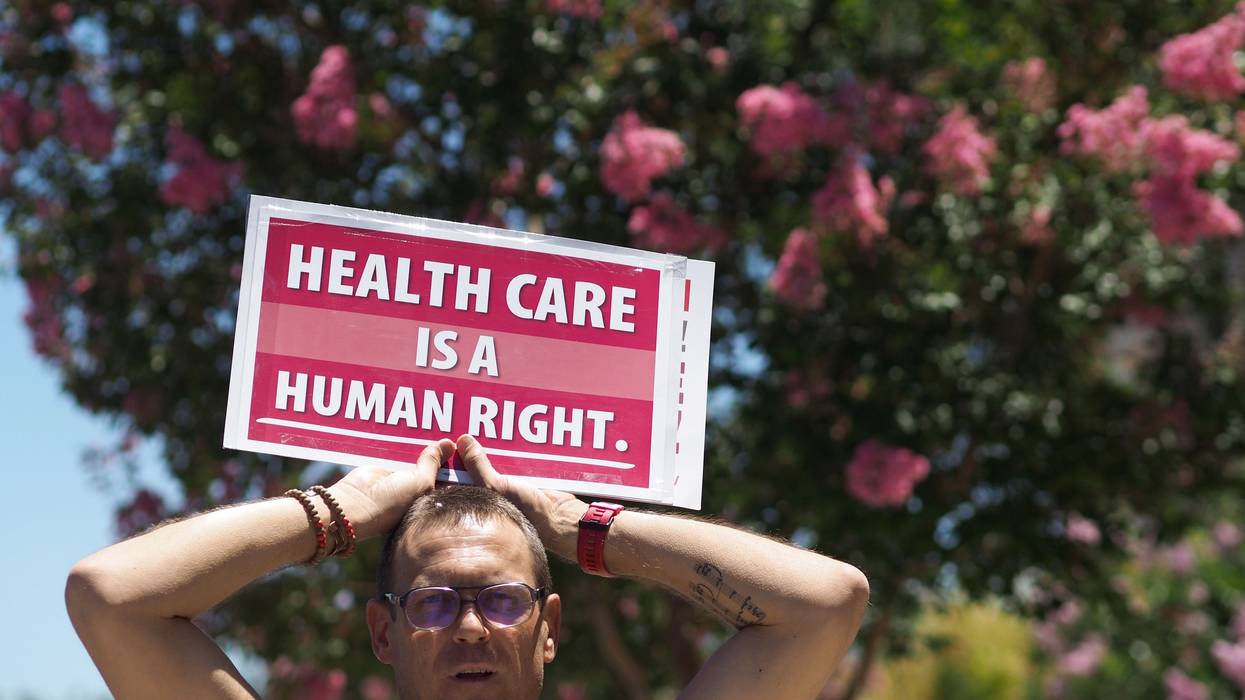
As the Trump administration spends an estimated $1 billion per day in taxpayer money bombing targets across Iran that have reportedly included an elementary school and healthcare facilities, Gallup released a survey Thursday that found one-third of Americans reported making financial trade-offs in order to pay for medical expenses last year.
The West Health-Gallup Center on Healthcare in America polled nearly 20,000 US adults between June and August 2025 and found that roughly one-third of them—equivalent to about 82 million people in the richest country in the world—were forced cut back on at least one expense in order to afford healthcare.
Eleven percent of respondents—equivalent to 28 million Americans—skipped a meal or intentionally drove less in order to pay a medical bill. Fifteen percent, the equivalent of nearly 40 million people, said they prolonged a current prescription or borrowed money, and 9% cut back on utilities.
Those numbers were strikingly similar among people who have health insurance, with 14% of insured people prolonging prescriptions to avoid paying for a new one and 9% skipping meals. Among insured Americans, 29% made at least one trade-off to afford healthcare.
The crisis is also not exclusively affecting low-income people. A quarter of people in households earning $90,000 to $120,000 per year skipped meals or other expenses to pay medical bills, and 11% of people in households earning $240,000 or more did the same.
“No one is safe from making these trade-offs,” Ellyn Maese, a senior researcher at Gallup and research director for the West Health-Gallup Center, told The New York Times.
Sixty-two percent of people without healthcare coverage were forced to make trade-offs, and 55% of people with household incomes lower than $24,000 per year as well as 47% of people earning $24,000 to $48,000 avoided expenses.
Gallup also released the results of a separate poll taken between October and December 2025, which showed how Americans are delaying major life decisions as well as altering their daily lives to afford healthcare under the for-profit insurance system.
As the Trump administration's policies slashed healthcare for 15 million Americans and raised healthcare premiums for tens of millions of people—and as the White House demanded that families have more children—6% of respondents said they had postponed having or adopting a child due to healthcare costs, equivalent to about 16 million Americans.
Nearly 30% said healthcare costs led them to avoid taking a vacation, 18% said they delayed finding a different job, 15% said they postponed pursuing education or job training, and 14% said they postponed buying a home.
The polls are “telling a consistent story here,” Maese said.
The survey results were released weeks after the Trump administration proposed new regulations for healthcare plans purchased through the Affordable Care Act marketplace that would charge deductibles as high as $15,000 for individuals and $31,000 for families to offset lower monthly premiums—underscoring how the healthcare law passed 16 years ago has left American households vulnerable to rising costs under the for-profit health insurance system.
A survey taken last November by Data for Progress found that 65% of voters support expanding the Medicare system to everyone in the US, a proposal that would save an estimated $650 billion annually.
But as Rep. Pramila Jayapal (D-Wash.)—who has sponsored Medicare for All legislation in the House—noted on Wednesday, Republicans and establishment Democrats continue to claim the proposal is unaffordable.
"When we ask for Medicare for All it’s 'too expensive,' and we 'don’t have the money,'" said Jayapal. "When the president drags us into his own personal war, no expense is spared. Our priorities are backwards."
"It is difficult to overstate the significance of this," said one analyst. "This is a key reason why Israel—and its supporters in the US—have a sense of desperate urgency when it comes to war with Iran and annexation of Palestine."
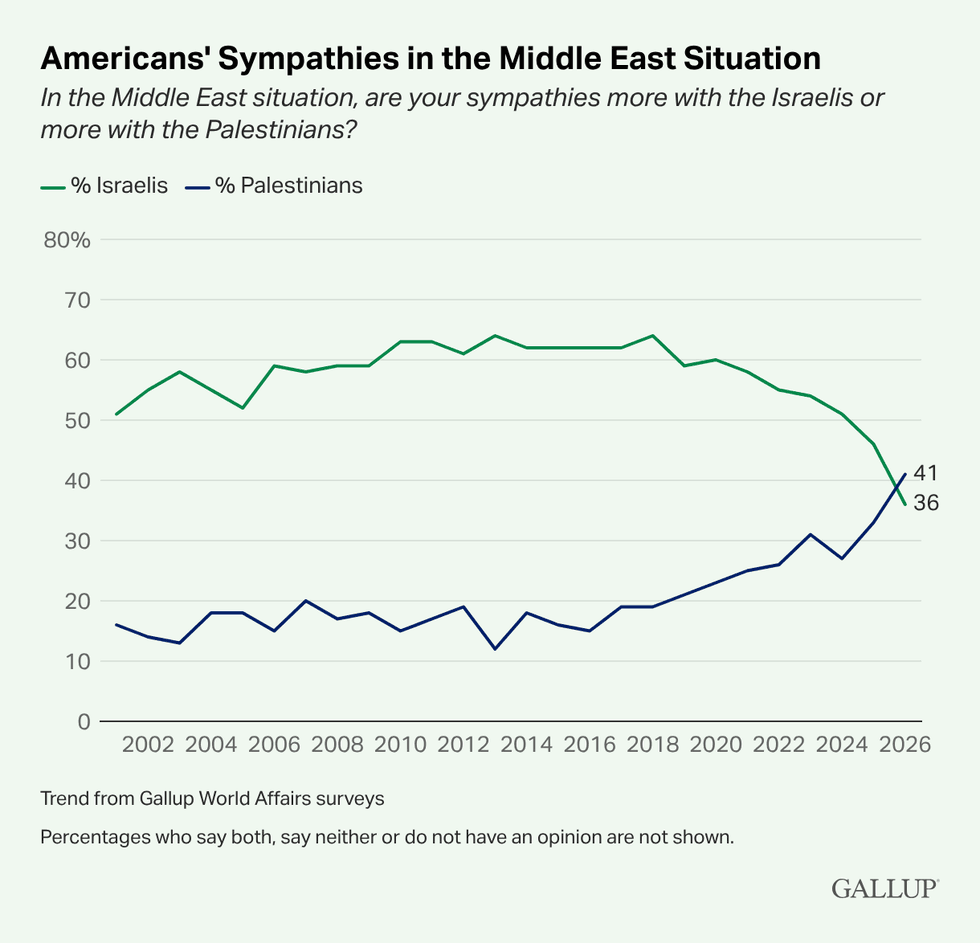
A Gallup survey released Friday found that a larger percentage of Americans sympathize with the Palestinians than with the Israelis in the decades-long Middle East conflict, which has exploded over the past two and a half years with the Hamas-led attack on Israel and the latter's genocidal response—fueled by military and diplomatic support from the US government.
The new poll marks the first time since Gallup began tracking the question in 2001 that a larger portion of respondents (41%) expressed sympathy for the Palestinians than the Israelis (36%) "in the Middle East situation." The organization noted that while "the five-percentage-point difference is not statistically significant," it "contrasts with a clear lead for the Israelis only a year ago (46% vs. 33%) and larger leads over the prior 24 years."
"From 2001 to 2025, Israelis consistently held double-digit leads in Americans’ Middle East sympathies, with the gap averaging 43 points between 2001 and 2018," Gallup reported. "However, public opinion began narrowing in 2019, several years before the Oct. 7, 2023, Hamas attack on Israel and the subsequent war in Gaza. The cumulative effect of gradual changes in US attitudes since then has led to the Israelis no longer being viewed more sympathetically."

Notably, the Gallup survey shows that "Americans of all age groups have grown more sympathetic to the Palestinians in recent years." A majority of Americans between the ages of 18 and 34 (53%) said they sympathize more with the Palestinians and 23% said they sympathize more with the Israelis, "a record low for the age group," according to Gallup.
The survey also showed a "near reversal" among Americans aged 35 to 54—with 46% now saying they sympathize more with the Palestinians—and the "narrowest gap in sympathies" Gallup has ever recorded for Americans aged 55 and older.
In terms of political affiliation, Gallup found that "Americans’ shifting sympathies in the Middle East situation this year are mostly driven by changes among political independents," who now sympathize more with the Palestinians than the Israelis by a margin of 41% to 30%.
"It is difficult to overstate the significance of this," Trita Parsi, executive vice president of the Quincy Institute for Responsible Statecraft, wrote in response to the Gallup survey. "This is a key reason why Israel—and its supporters in the US—have a sense of desperate urgency when it comes to war with Iran and annexation of Palestine."
"The window for these aggressions with US support is closing," Parsi added.
The new poll also found that Americans' support for a Palestinian state is at its highest level in more than two decades as current Israeli leaders vow to prevent Palestinian statehood and ramp up their illegal annexation of territory—an effort effectively endorsed by the Trump administration.
The grim data arrive as President Donald Trump is reportedly planning to "aggressively push back" on negative perceptions about his economy.
A new batch of data is offering more evidence that the US economy is in rough shape heading into the holidays.
The latest Economic Confidence Index released by Gallup on Thursday has found that Americans' confidence in the economy has fallen by seven points over the last month, and now stands at its lowest level in more than a year.
Overall, Gallup found that just 21% of Americans currently describe the economy as excellent or good, while 40% describe it as poor. The outlook for the near future also looks grim, as more than two-thirds of Americans surveyed said the economy is currently getting worse.
This deteriorating economic confidence is weighing on Americans' holiday shopping plans, as Gallup found that planned holiday spending expenditures have "plummeted" from just over $1,000 in October to $778 in November. The decline in spending expectations also occurred across all income groups, although it was particularly steep among low-income households, which slashed their estimated holiday spending by an average of $267.
Gallup noted that while it's common for shoppers to trim their spending plans the closer it gets to the holidays, the drop between October and November this year was the biggest it has ever recorded, even "surpassing the $185 drop seen during the 2008 global financial crisis."
The Gallup survey was not the only troubling economic data to drop on Thursday, as outplacement firm Challenger, Gray, and Christmas released its latest report showing that hiring in the US has slowed to its lowest level in the last 15 years, while layoffs now total their highest level since 2020, when the country was at the peak of the Covid-19 global pandemic.
The data on layoffs came just one day after global payroll processing firm ADP estimated that the US economy lost 32,000 jobs in November, with small businesses shouldering by far the most job losses.
President Donald Trump, who earlier this week dismissed concerns Americans might have about affordability as a "Democrat scam," has reportedly decided to hit the road in an effort to convince voters that they've never had it so good.
According to Axios, Trump next week will start touring the country to tout his administration's economic policies, and he is expected to "aggressively push back against criticism over the cost of everyday essentials—an issue that helped propel him to victory over Kamala Harris last year."
However, a new poll published by Politico on Thursday shows that Trump may have an uphill climb selling his economy even to his own voters.
Overall, the poll found that 37% of voters who backed Trump last year now say that the cost of living crisis is the worst they have experienced in their lifetimes, while only 24% of 2024 Trump voters say that the cost of living crisis at the moment is "not bad."
The poll also found that Trump's efforts to blame former President Joe Biden for the current state of the economy aren't flying, as 46% of voters say that Trump is most to blame for the current state of the economy, compared to 29% of voters who put the primary blame on Biden.