

SUBSCRIBE TO OUR FREE NEWSLETTER
Daily news & progressive opinion—funded by the people, not the corporations—delivered straight to your inbox.
5
#000000
#FFFFFF
To donate by check, phone, or other method, see our More Ways to Give page.
Daily news & progressive opinion—funded by the people, not the corporations—delivered straight to your inbox.

A federal judge ruled Monday afternoon that Don McGahn, former White House Counsel for President Donald Trump, must submit to a congressional subpoena and testify before members of the U.S. House of Representatives--a legal defeat for Trump who has tried to prevent the testimony.
In the ruling (pdf), U.S. District Judge Ketanji Brown Jackson, said "the primary takeaway from the past 250 years of recorded American history is that Presidents are not kings."
As such, Jackson continued, "This means that they do not have subjects, bound by loyalty or blood, whose destiny they are entitled to control. Rather, in this land of liberty, it is indisputable that current and former employees of the White House work for the People of the United States, and that they take an oath to protect and defend the Constitution of the United States. Moreover, as citizens of the United States, current and former senior-level presidential aides have constitutional rights, including the right to free speech, and they retain these rights even after they have transitioned back into private life."
According to the Associated Press:
McGahn was a star witness in special counsel Robert Mueller's investigation, and Democrats wanted to question McGahn about possible obstruction of justice by Trump. That was months before the House started an impeachment inquiry into Trump's effort to get Ukraine to announce an investigation of former Vice President Joe Biden.
In May of this year, as Common Dreams reported at the time, Trump ordered McGahn not to appear after he was subpoenaed by the House Judiciary Committee.
While ordering that McGahn must appear, Jackson said this does not prevent him from claiming certain legal privileges. However, the judge pushed back against repeated claims by Trump that his administration is immune from congressional oversight or prosecution for alleged misconduct.
"To make the point as plain as possible, it is clear to this Court," Jackson stated, "that, with respect to senior-level presidential aides, absolute immunity from compelled congressional process simply does not exist."
While the White House immediately said it would appeal the ruling, Marge Baker, executive vice president for Policy and Program at the People for the American Way, applauded the court's decision.
"This ruling comes as a timely reinforcement of our constitutional principles of separation of powers and checks and balances, which have been under relentless assault by the Trump administration," Baker said.
"It affirms the common-sense principle that Congress's power to subpoena the executive branch is essential to fulfill its duty of oversight," she added. "This ruling means not only that McGahn must provide testimony, but so must a raft of administration officials who have been stonewalling Congress in attempts to protect this president. Their failure to comply leaves congressional investigators no option but to assume that their testimony, if delivered, would incriminate the president who is ordering them not to testify."

After the Trump administration instructed former White House counsel Don McGahn to refuse to comply with a Judiciary Committee subpoena to testify, several members of House Speaker Nancy Pelosi's leadership team privately confronted the Democratic leader late Monday and demanded impeachment proceedings against the president immediately in response to the latest attempt to stonewall congressional oversight.
According to the Washington Post, at least "five members of Pelosi's leadership team--four of whom also sit on the House Judiciary Committee, with jurisdiction over impeachment--pressed Pelosi (D-Calif.) in a closed-door leadership meeting to allow the panel to start an [impeachment] inquiry, which they argued would help investigators attain documents and testimony that Trump has blocked."
"There's no doubt that opening an inquiry strengthens the hand of Congress in forcing compliance with subpoenas, whether it's for documents or individuals."
--Rep. David Cicilline
One of the lawmakers who reportedly pressed Pelosi to approve impeachment proceedings on Monday was House Judiciary Committee chairman Rep. Jerry Nadler (D-N.Y.), who has faced calls to act as his repeated attempts to investigate President Donald Trump and administration officials have been brazenly denied by the White House.
"The meeting marks the first time a chairman and top rank-and-file lawmakers--including members of Pelosi's leadership team--have lobbied her to change her long-held position on impeachment," the Post reported.
If McGahn doesn't show up for his scheduled testimony before the Judiciary Committee at 10:00am ET Tuesday, "a core group of Judiciary Democrats plans" to begin publicly calling for impeachment proceedings against Trump, according to the Post.
"That inquiry is also what happened during Watergate," Rep. Ted Lieu (D-Calif.) told the Post in an interview following the Democrats' private meeting. "It's not like the House Judiciary Committee just dropped articles of impeachment. There was an investigation that preceded it. This inquiry could lead to impeachment, or it could lead to nothing. But I think if McGahn doesn't show, we have to at least start it."
Democratic Reps. Jamie Raskin (Md.), Joe Neguse (Colo.), and David Cicilline (R.I.)--all of whom are members of the House Judiciary Committee--reportedly joined Lieu in pressuring the House Speaker to support an impeachment inquiry.
"There's no doubt that opening an inquiry strengthens the hand of Congress in forcing compliance with subpoenas, whether it's for documents or individuals," Cicilline told the Post.
Raskin reportedly made a similar case during the meeting, arguing that impeachment hearings "would allow leadership to streamline and centralize all of the investigations into one--and let everyone else focus on the Democratic agenda items that won them the majority in 2018," the Post reported.
Pelosi, however, refused to budge despite backlash from her own leadership team.
House Majority Leader Steny Hoyer (D-Md.), DCCC chair Rep. Cheri Bustos (D-Ill.), and Democratic caucus chair Rep. Hakeem Jeffries (D-N.Y.) all reportedly sided with Pelosi in the face of pressure from their colleagues as well as grassroots demands for Democrats to act on their grave warnings that the U.S. is in the midst of a "constitutional crisis."
"This isn't about politics at all. It's about patriotism. It's about the strength we need to have to see things through," Pelosi reportedly said of her refusal to sign off on impeachment hearings, a remark that provoked bafflement among progressives on social media.
The internal Democratic rebellion against Pelosi on impeachment comes just days after Rep. Justin Amash (R-Mich.) became the first congressional Republican to break with his party and call for impeachment proceedings against Trump after carefully examining Special Counsel Robert Mueller's findings.
"Plenty of liberals are asking why there aren't more Republican members of Congress with the guts, eloquence, or honesty to say what Amash has said," The Intercept's Mehdi Hasan wrote in a column on Monday. "It's a good question. But a better, more relevant question is this: Why aren't there more Democrats willing to say the same?"
During a live event in Washington, D.C., Monday night, Rep. Pramila Jayapal (D-Wash.)--a member of the House Judiciary Committee--made the case for launching impeachment proceedings against the president right away.
"I really believe we are now at the point where we have to start an impeachment inquiry. I don't say that lightly, I mean I think we have taken every possible step we can," said Jayapal. "We've issued subpoenas, we've called for witnesses, the president has issued blanket executive privilege over the Mueller report."
"If you have a president who thinks he's king, and isn't accountable to anybody, and is above the law," Jayapal said, "that is absolutely not acceptable."
Watch:

TD Editor's Note: This is the second installment of a two-part series examining the relationship between President Donald Trump and Attorney General William Barr, and the challenges their assertions of extreme executive authority pose to Congress. Read the first part here.
Why haven't congressional Democrats moved to impeach Donald Trump? Is their failure to act due to an inexcusable lack of courage and political will, or is the inaction attributable to an understandable fear of failure?
The answer, unfortunately, is a bit of both. Given the president's thoroughgoing corruption and reckless disregard for the rule of law, impeachment is imperative.
But impeachment is a two-step process, and that's where the fear sets in. Even if the current Democratic majority in the House votes to impeach Trump, there is little prospect that the Senate will convict the president and remove him from office following an impeachment trial conducted in the upper chamber.
Sooner rather than later, Democrats will have to find the fortitude to set aside their fears. The president and his new attorney general, William Barr, are daring them to initiate impeachment proceedings, refusing to comply with congressional subpoenas and document requests seeking, among other items, Trump's tax returns, and the full, unredacted report by special counsel Robert Mueller.
As New York Times reporters Peter Baker, Maggie Haberman and Michael Schmidt recently noted, "As the White House and Congress escalate their constitutional showdown, President Trump and his team are essentially trying to call what they see as the Democrats' bluff. The message: Put up or shut up. Impeach or move on."
On May 15, White House counsel Pat Cipollone upped the ante in a letter to House Judiciary Committee Chairman Jerrold Nadler, D-N.Y., in response to the committee's request for additional information related to the Mueller probe. Cipollone threatened to invoke executive privilege to block the committee's demands for documents. He also threatened to block the committee's efforts to summon testimony from current and past administration officials.
Contending that the committee's demands violate "the separation of powers and the constitutional prerogatives of the President," and alleging that Trump had fully cooperated with the special counsel, Cipollone wrote:
"Congressional investigations are intended to obtain information to aid in evaluating potential legislation, not to harass political opponents. ... The Committee's requests repeatedly run afoul of the Constitution by encroaching upon authorities that the Constitution assigns exclusively to the Executive Branch. These requests have no legitimate legislative purpose and exceed Congress's limited authority."
If any of this sounds familiar, it's because it has happened before. On May 22, 1974, President Richard Nixon, faced with House subpoenas seeking the infamous secret Watergate tape recordings, penned a similar letter to then-House Judiciary Committee Chairman Peter Rodino, D-N.Y., protesting:
"Thus it is clear that the continued succession of demands for additional Presidential conversations has become a never-ending process, and that to continue providing these conversations in response to the constantly escalating requests would constitute such a massive invasion into the confidentiality of Presidential conversations that the institution of the Presidency itself would be fatally compromised."
Nixon refused to turn over the tapes, not only to the House, but also to special prosecutor Leon Jaworski, sparking a legal battle that went all the way to the Supreme Court (United States v. Nixon), which Nixon lost. Shortly thereafter, he resigned.
The current Democratic leadership, guided by Majority Leader Nancy Pelosi of California, fears that a Trump impeachment will more closely resemble the failed campaign to remove President Bill Clinton from office than the successful effort against Nixon. After his impeachment by the House in 1998, Clinton's public approval rating spiked 10 points, to an astounding 73%. Clinton was subsequently acquitted by the Senate and served out the remainder of his second term.
Pelosi's impeachment trepidations are not unfounded. Although Trump's overall approval rating remains mired in the 42% range, she and other top Democrats believe that even a modest post-impeachment boost for Trump could prove decisive in the 2020 election.
The truth, of course, is that no one actually knows how impeachment would affect Trump's popularity or the next election. Given the scope of his malfeasance, impeachment proceedings may well cause his approval ratings to plummet, replicating Nixon's demise. Nixon began his second term with a lofty approval rating of 68%. But by August 1974--following Senate and House hearings, respectively, on Watergate and impeachment, and the Supreme Court's ruling on the White House tapes--57% of Americans thought Nixon should be removed from office.
In the end, the decision to impeach Trump shouldn't be based on predictions about poll numbers, however worrying they may be. It should be rooted in principle.
Like all of his predecessors, Trump took an oath on Inauguration Day pursuant to Article I, Clause 3 of the Constitution to "take care" that the laws of the nation be faithfully executed.
Trump has violated that oath in myriad ways, by:
* Defying the oversight authority of Congress.
* Attempting to obstruct the Mueller investigation.
* Using the presidency to enrich himself, his family and the Trump Organization in violation of the Constitution's "emoluments clause."
* Refusing to defend the Affordable Care Act, imperiling the health insurance available to millions of Americans.
* Undermining environmental protections and pulling out of the Paris Climate Agreement, endangering the health and safety of generations.
* Reneging on the Iran nuclear deal, bringing the nation to the brink of another war in the Middle East.
* Refusing to enforce the Voting Rights Act, promoting voter suppression and sowing racial hatred and resentments.
* Promising tax relief for middle-class and working families, but sponsoring a massive giveaway to the superrich.
* Incarcerating undocumented children in cages, and declaring a national emergency to fund his border wall.
Through it all, he has lied incessantly about these and other misdeeds, much as Nixon lied about Watergate. Nixon was cited for deceiving the public in the Articles of Impeachment ratified by the House Judiciary Committee in 1974. Trump should be as well.
All things considered, the real issue is not whether Trump should be impeached, but when and how impeachment should unfold.
As for when, there is no better time than the present. Trump and Barr show no signs of relenting in their crusade to expand presidential power. The sooner they are put on the defensive, the better.
As for how, the gravity and breadth of Trump's derelictions warrant lengthy and public hearings before the House Judiciary Committee. Congress' authority to subpoena documents and witnesses is at its greatest in impeachment proceedings. In those proceedings, we should hear from constitutional scholars, and such key witnesses as Robert Mueller and former White House counsel Don McGahn. We should also hear from scores of ordinary Americans who have been victimized by Trump's misconduct.
In the Senate, the House would be represented by a team of managers who would present the case against Trump. Supreme Court Chief Justice John Roberts would preside.
Among other demands, the managers should request a trial in open session in the well of the Senate--something that hasn't happened since the impeachment trial of Andrew Johnson in 1868. This would expose Trump's "high crimes and misdemeanors" for all the world to see, even if House managers do not ultimately prevail in the Senate. If the trial is properly handled, Trump's reelection prospects should tumble.
As Alexander Hamilton postulated in Federalist Paper No. 65, impeachment is the constitutional remedy for the removal of federal officials for behavior that violates the "public trust." Our 45th president has long exceeded that critical threshold.
All that's left is for the Democrats to take a shot of courage, stop wringing their hands and start wielding their gavels.

As the Trump administration's lawlessness reached an "inflection point" Tuesday with former White House counsel Don McGahn's refusal to testify before Congress, so too did progressive pressure on House Speaker Nancy Pelosi to stop abdicating her constitutional duties and immediately launch impeachment proceedings against the president.
"Without oversight of the executive branch any democracy is at serious risk of slipping toward a totalitarian regime. Congress must act now and act decisively."
-- Karen Hobert Flynn, Common Cause
"The dam is breaking, and the voices of people demanding impeachment are becoming impossible to ignore," Heidi Hess, co-director of CREDO Action, said in a statement. "Nancy Pelosi is running out of excuses, and her ability to delay impeachment proceedings is getting weaker by the day."
"We need her to heed the growing calls of her colleagues and people across the country demanding she defend our democracy and protect us from Donald Trump," Hess said.
MoveOn, an organization with more than a million members nationwide, echoed CREDO, tweeting simply: #ImpeachmentInquiryNow.
The progressive groups' calls for impeachment hearings were also shared by a number of House Democrats Tuesday, despite Pelosi's claim that she is not facing any pressure from members of her caucus.
Congressional Progressive Caucus co-chair Mark Pocan (D-Wis.) said in a statement that Trump's "most recent actions and continued disrespect for the Constitution are forcing us down the road to impeachment."
"Congress swore an oath to uphold the Constitution. That includes impeachment."
--Rep. Alexandria Ocasio-Cortez"Stonewalling Congress on witnesses and the unredacted Mueller report only enhances the president's appearance of guilt, and as a result, he has pushed Congress to a point where we must start an impeachment inquiry," Pocan said.
Pocan's demand for impeachment proceedings came as McGahn, on orders from the White House, defied a subpoena to testify before the House Judiciary Committee, continuing the Trump administration's blanket opposition to congressional investigations.
Addressing McGahn's empty seat Tuesday, House Judiciary Committee chairman Jerry Nadler said Congress "will hear Mr. McGahn's testimony, even if we have to go to court to secure it."
"We will not allow the president to prevent the America people from hearing from this witness," said Nadler. "We will not allow the president to block congressional subpoenas--putting himself and his allies above the law."
McGahn's no-show at Tuesday's hearing came on the heels of reports that even some members of Pelosi's own leadership team are revolting against her opposition to impeachment proceedings, arguing that the speaker's justification for continuing with business as usual is untenable in the face of the Trump administration's extraordinary defiance of congressional oversight efforts.
In an interview with MSNBC's Kasie Hunt Tuesday morning, Rep. Alexandria Ocasio-Cortez (D-N.Y.) said she believes "we have come to the time of impeachment."
"I think that at a certain point this is no longer about politics," said Ocasio-Cortez, "but this is about upholding the rule of law."
Asked what it is going to take for Pelosi to change her mind on impeachment, the New York congresswoman argued pressure from constituents will be essential.
"I think it really depends on everyday Americans," Ocasio-Cortez told MSNBC just before the Judiciary Committee hearing Tuesday morning. "If you have a representative that is in a close seat and you think that we should be upholding the rule of law, I think it's time to give your representative a call. It sounds like a cliche--it's like your dentist telling you to floss to call your representative--but it's because we listen and it's important that we communicate."
Rep. Rashida Tlaib (D-Mich.), who in March introduced a resolution to begin an impeachment inquiry into Trump, tweeted, "The drum is beating and it is getting louder."
"The future of our democracy depends on us putting country first," Tlaib wrote, adding the hashtag #TimetoImpeach.
In a statement Tuesday, Common Cause president Karen Hobert Flynn said the "time has come to act."
"Without oversight of the executive branch any democracy is at serious risk of slipping toward a totalitarian regime. Congress must act now and act decisively," said Flynn. "History will not look kindly on any member of Congress who continues to put their party before their country by condoning the Trump administration's defiance of the United States Constitution."

The Trump administration on Monday, via a legal opinion issued by the U.S. Department of Justice, has directed former White House counsel Don McGahn to disregard a subpoena issued by the House Judiciary Committee meant to compel testimony about the president's alleged efforts to obstruct justice by thwarting the investigation of Special Counsel Robert Mueller.
According to the DOJ memo (pdf), authored by the Office of Legal Counsel, "Congress may not constitutionally compel the President's senior advisers to testify about their official duties. This testimonial immunity is rooted in constituional separation of powers and derives from the President's independence from Congress."
Independent journalist Judd Legum said the order from the White House was a "pivotal moment" in the ongoing battle between the president and House Democrats. "This is the cover-up," he said.
As Politico reports:
Judiciary Committee Chairman Jerry Nadler (D-N.Y.) has threatened to hold McGahn in contempt of Congress if he refuses to show up.
Earlier this month, McGahn refused to turn over the requested documents after the White House instructed him not to comply with that part of the subpoena.
The committee kicked off a wide-ranging investigation in March into President Donald Trump for allegations of obstruction of justice and abuses of power. McGahn is emerging as a central witness in the committee's probe, after special counsel Robert Mueller's report outlined Trump's directives to McGahn to shut down the Mueller probe.
"The Department of Justice has provided a legal opinion stating that, based on long-standing, bipartisan, and Constitutional precedent, the former Counsel to the President cannot be forced to give such testimony, and Mr. McGahn has been directed to act accordingly," White House press secretary Sarah Sanders said in a statement Monday.
"This action," Sanders continued, "has been taken in order to ensure that future Presidents can effectively execute the responsibilities of the Office of the Presidency."
Given his role as a key witness in an episode that Mueller indicated could warrant an obstruction of justice charge, lawmakers like Rep. Ro Khanna (D-Calif.) said it was imperative that McGahn answer questions directly from the committee:

At President Donald Trump's request, White House officials reportedly asked Don McGahn--the president's former counsel and a key witness in the Mueller report--to say publicly that Trump never obstructed justice.
According to the New York Times, which cited two anonymous individuals briefed on the request, the White House asked McGahn to make a public statement on obstruction "at least twice in the past month"--once before the Mueller report was released to the public and once after.
"Mr. Trump asked White House officials to make the request to Mr. McGahn," the Times reported on Friday. "Mr. McGahn declined. His reluctance angered the president, who believed that Mr. McGahn showed disloyalty by telling investigators for the special counsel, Robert S. Mueller III, about Mr. Trump's attempts to maintain control over the Russia investigation."
The Times report continued:
The president's lawyers are particularly concerned about two episodes that Mr. McGahn detailed to prosecutors. In one, Mr. Trump asked him to fire the special counsel but backed off after Mr. McGahn refused. After that episode was revealed, the president asked Mr. McGahn to create a White House document falsely rebutting his account. Mr. McGahn declined to go along but told Mr. Mueller about the encounters.
The Wall Street Journal also reported late Friday that McGahn "rebuffed" a request from White House officials to issue a statement declaring that Trump did not obstruct justice.
Noah Bookbinder, executive director of Citizens for Responsibility and Ethics in Washington (CREW), suggested on Twitter that the White House's reported requests to McGahn may amount to obstruction of justice in themselves:
The Times report comes as McGahn is facing a subpoena from Democrats to testify before the House Judiciary Committee on the special counsel's findings.
The Trump White House has instructed McGahn to refuse to comply with Democrats' subpoena, and House Judiciary Committee chairman Rep. Jerry Nadler (D-N.Y.) has threatened to hold McGahn in contempt.
"This is why it is critical for Mr. McGahn to come before our committee and answer questions for the American people," Nadler tweeted following the Times report. "The president cannot keep McGahn from testifying."
The Mueller report details numerous instances in which Trump potentially committed obstruction of justice, though Mueller did not reach a conclusion on the question.
Following the release of Mueller's findings, Attorney General William Barr--who has been accused of acting as the president's personal lawyer as he refuses to comply with congressional oversight--decided not to charge Trump with obstruction of justice.
"The White House knows Trump hasn't been 'totally exonerated,'" progressive advocacy group Stand Up America wrote in a series of tweets in response to the Times report. "They asked McGahn to lie because they know there's overwhelming evidence of obstruction. "
"The evidence is so strong that if Trump were not president," the group added, "he'd be heading to prison."

ven Nancy Pelosi, who has rejected the idea of impeaching Donald Trump as a political trap for Democrats who should focus instead on the next election, is changing her tune. She now acknowledges that the country is in a "Constitutional crisis," and that Congress has no choice but to act.
The Trump Administration's open contempt for Congressional oversight puts Democrats in a corner. Impeachment might not be the formula for success in the 2020 presidential race. It might provoke a backlash and fire up Trump's base. But at some point, Congress has to do its job and provide a check on executive power.
The turning point came with Attorney General Robert Barr's dismissive testimony before the Senate Judiciary Committee on May 1, and his subsequent decision to skip his appearance in the House.
Barr was openly contemptuous of Congress. He waved away Special Counsel Robert Mueller's assertion that his summary of Mueller's report was misleading, brushed aside questions about the credibility of his own previous statements under oath denying knowledge of Mueller's objections, and outright refused to produce relevant documents. Finally, when he refused to comply with a subpoena for the full Mueller report, the House Judiciary Committee moved to hold him in contempt. The full House will decide whether to go along with that recommendation in the coming days.
The stonewalling by the Trump Administration is making it harder and harder for the Democrats to ignore the problem of a lawless President. The political question of whether anyone cares if Trump and his enablers are lying and cheating, and whether the Democrats gain anything by pointing it out, is being overwhelmed by this administration's brazen disregard for democratic norms.
Here's an idea: Maybe the Democrats should just get out and lead.
Here's an idea: Maybe the Democrats should just get out and lead. Sure, a lot of voters don't know a lot about the workings of government or the system of checks and balances set out in our Constitution. But the time for worrying about the politics of holding the President accountable is past.
Let the Democratic presidential candidates make their case to voters that they have the best plan to address problems like health care, wage stagnation, college debt, and climate change. The people we have already elected to Congress need to impose accountability on a lawless executive branch.
The stonewalling is truly breathtaking.
Barr has refused to turn over the Mueller report to Congress or appear to answer questions. And, during the back-and-forth between the Justice Department and Congress, the White House claimed executive privilege to shield evidence in the report from Congress.
The White House also blocked former Trump lawyer Donald McGahn from turning over documents subpoenaed by Congress that go to the heart of the issue of Trump's obstruction of justice. (McGahn, according to the redacted Mueller report, was pressured to fire the special counsel and to lie to cover it up by Trump.)
"Our fight is about defending the rights of Congress, as an independent branch, to hold the President, any President, accountable," House Judiciary Committee Chair Jerrold Nadler said, just before his committee voted to hold Barr in contempt.
Meanwhile, Trump's Treasury Secretary, Steven Mnuchin, refused to provide the House Ways and Means Committee the President's tax returns, in the same week that The New York Times released a blockbuster investigation showing Trump, contrary to his public representations of his ever-expanding wealth, spent a decade in the red, reporting more than $1 billion in losses between 1985 to 1994. The President himself, still withholding his tax documents, responded by suggesting that instead of being a billion-dollar loser, he is a major-league tax cheat.
No one who pays any attention is unaware of the fact that Trump is a liar. Last month, he reached the 10,000 mark for "false or misleading statements" during his time in office, according to The Washington Post.
Like her detailed policy proposals on a variety of other issues, Warren makes the case for impeachment in clear, simple terms.
Does it matter that some portion of the American public might find impeachment distasteful, or believe Trump's claims that the investigations just prove he is an outsider battling "the system"? It's hard to find the right formula for combatting a politician who so successfully exploits the info-tainment system, an increasingly divided electorate, and an entire alternative reality promoted by Fox.
Senator Elizabeth Warren, Democrat of Massachusetts, whose poll numbers have been steadily rising since she became the first Democratic candidate to call for impeachment, is showing the way.
Like her detailed policy proposals on a variety of other issues, Warren makes the case for impeachment in clear, simple terms:
"The Mueller report lays out facts showing that a hostile foreign government attacked our 2016 election to help Donald Trump and Donald Trump welcomed that help," she wrote. "Once elected, Donald Trump obstructed the investigation into that attack. Mueller put the next step in the hands of Congress: 'Congress has authority to prohibit a President's corrupt use of his authority in order to protect the integrity of the administration of justice.' The correct process for exercising that authority is impeachment."
Later, Warren added: "To ignore a President's repeated efforts to obstruct an investigation into his own disloyal behavior would inflict great and lasting damage on this country, and it would suggest that both the current and future Presidents would be free to abuse their power in similar ways."
Nadler agrees. "We must do all we can in the name of the American people to ensure that when the Trump Administration ends, we have as robust a democracy to hand to our children as was handed to us," he said, explaining why his committee should hold Barr in contempt.
At some point, efforts to court votes by avoiding the impeachment fight stops looking politically smart, and starts looking cowardly.
We have already reached that point.
As Congress' investigations into the Trump administration heat up, the White House has responded by refusing to comply with many of the subpoenas and oversight requests from the House Democratic majority. Citing House Democratic sources, Politico reports that the Trump administration has at least 30 times refused or delayed the release of information requested House committees and half a dozen officials have refused to appear before House panels. Notably, the Trump administration has ignored a deadline for releasing President Donald Trump's tax returns and attempted to block subpoenas for current and former officials to appear before Congress, including former White House counsel Don McGahn, former White House personnel security director Carl Kline, and senior policy adviser to the president Stephen Miller.
Victoria Bassetti, fellow at the Brennan Center who worked for the Senate Judiciary Committee for eight years, spoke with staff writer Tim Lau to discuss the context behind the House's investigations, how they differ from the Mueller inquiry, and what must be done to strengthen constitutional norms related to congressional oversight.
This interview has been edited for clarity and length.
Tim Lau: The White House has been refusing to comply with the House's subpoenas and oversight requests. Are there any historical parallels we can reference, and if so, how do they compare to this time around?
Victoria Bassetti: There aren't precise historical parallels because the Trump administration's refusal to comply with to House subpoenas and oversight requests is so sweeping and broad. We've never quite seen anything like this before.
However, there are two recent historical comparisons some people might make. One is the investigation that followed the U.S. Attorney firing scandal that started in late 2006 during the George W. Bush administration. And a second comparison was the House of Representative's 2012 investigation into the so-called Fast and Furious scandal involving the Bureau of Alcohol, Tobacco, Firearms and Explosives (ATF). With these two cases, we have examples of a Democratic House investigating a Republican executive branch and of a Republican house investigating a Democratic administration.
So those are two most recent analogies, but even they don't really hold up to the Trump administration's refusal to comply with Congress' subpoena and oversight requests. Both of the previous cases involved narrow topics about specific incidents and specific people. And in both cases, the House effectively "won." In the U.S. Attorney firing scandal, the House ultimately got their witnesses and documents after a number of legal proceedings. And in the Fast and Furious scandal, both the Justice Department and White House ended up turning over a large number of documents to the House. Although the House did ultimately cite then Attorney General Eric Holder for contempt, it did not further pursue the matter in court.
Neither of the previous examples had the same scope and breadth as the Trump administration's recalcitrance -- or the calculated, in-your-face rebuke to the House's oversight authority. What the Trump administration is doing now is all-encompassing. They're dragging their feet on pretty much every issue that the House wants to do oversight on. The current situation is more extreme in its affront to our constitutional separation of powers.
The Trump team argues that it's already finished its job, so to speak, by "complying" with the full process of the Mueller report.
First of all, complying with the Mueller investigation is different from complying with a properly issued subpoena from Congress -- whose status as a coequal branch of government is crucial to a functioning constitutional system of democracy. Also, it's a stretch to say that Trump complied with the Mueller investigation. But even if he had, it does not relieve him from respecting our constitutional system.
Second, the House has an incredibly important and radically different role to play than Mueller might have played in investigating Trump. Congress is the institution that passes obstruction of justice laws, and they probably have a lot to learn about how to modify those laws based on the aftermath of the Mueller report. Additionally, Congress can potentially pass laws on the independent counsel process. So, they might want to learn how Attorney General William Barr handled the Mueller investigation, and based on that, decide that some type of legislation needs to be passed. Finally, Congress plays a critical role in protecting and securing elections, including the allocation of funds to states or to the executive branch for administering our elections.
Across all of these issues, Congress' ability to fully know the facts and to investigate them thoroughly is critical for our democracy to work and to be protected against hostile powers. Congress also plays a critical role in keeping our justice system fair, providing strong defenses against obstruction of justice, and ensuring that the Justice Department can adequately investigate executive branch officers so that no one is above the law.
And let's remember that Congress' authority to subpoena and to request documents goes back to the founding decades of our democracy. As early as 1795, Congress was using its investigative and contempt power. By 1821, a Supreme Court ruling held that Congress has the inherent authority to seek information and to hold people in contempt for refusing to provide it. In other words, Congress' subpoena authority and its power to enforce its subpoenas are almost as old as our Constitution.
What kind of role, if any, will the courts play moving forward?
There's a strong likelihood that a lot of this is going to end up in the courts. At the end of the day, I don't see how the House is going to accept the Trump administration's recalcitrance, which leaves going to the courts as the final option. So, we're going to have kind of a triple play of our constitutional institutions swirling about one another trying to negotiate this conflict. What that means is that if the House exercises its subpoena authority, Congress and the Trump administration are frequently going to be in front of the courts as they attempt to adjudicate this conflict. And there are few things that are likely to happen.
The first is that it's likely going to go slowly, so it's unclear to what extent there will be any resolution for these cases before the 2020 election. (However, there's always a possibility that some individual cases will be fastracked.) The second is that the courts tend to try exercise restraint when it comes to mediating these interbranch conflicts, and that the courts tend to attempt to use sort of a deference when adjudicating these cases. But third, despite that deference, I think it's highly likely that the courts will ultimately be forced to decide. If that happens, the long line of precedent -- regarding executive privilege and the scope of Congress' power to request documents and for people to appear -- is largely in Congress' favor. That doesn't mean, however, that Congress is going to win every one of these battles.
Where do these recent developments fit within the broader narrative of the Trump presidency?
Over the last two years, we've consistently seen the Trump administration act like they are above and beyond anyone's oversight and questioning. In one recent example, just a few weeks ago, Commerce Secretary Wilbur Ross refused to appear before the House and Senate Appropriations committees to answer questions about his own budget requests. Also a few weeks ago, Treasury Secretary Steven Mnuchin gave cursory respect to the House Banking Committee's request for him to stay past a certain period of time. Right now, these high-level administration officials increasingly have an attitude of almost sneering at Congress, which sets up an increased potential for conflict across the board.
What can Congress do to strengthen the rule of law and constitutional norms?
You know, that's a very difficult task for Congress right now because the prospect of President Trump signing reforms into law are not particularly high at this moment. But it seems indisputable to me that the process of thinking through the codification of norms and rule of law principles needs to begin soon.
And that issue, as you know, is one that the Brennan Center Task Force has issued a report on, with a number of really critical suggestions on how to move forward on these reforms. But as it stands today, Congress unfortunately has only has two tools at its disposal. One is the slow-moving, slightly weak power that it has to enforce subpoenas. Going to court to seek contempt takes a long time and is difficult to accomplish.
The other major tool that Congress has at its disposal is the power of the purse, or its appropriations power. But that is an awfully blunt instrument. And as we know, using that power is not a straightforward process and can potentially create a crisis or a shutdown. The fact that there really only these two tools -- one weak, and one incredibly strong but blunt and hard to use -- really points to the need for something in between, in terms of laws. And it really points to the need for a return to a sense of comity and bipartisanship and shared values about our constitutional institutions.
More than 400 former federal prosecutors asserted in a statement published on Medium Monday that President Donald Trump would face multiple felony charges for obstruction of justice if he did not hold his current office.
"We recognize that prosecuting obstruction of justice cases is critical because unchecked obstruction... puts our whole system of justice at risk."
--Ex-prosecutors
The statement comes in response to Special Council Robert Mueller's final report on his investigation into allegations of election meddling by Russian agents as well as potential collusion or obstruction efforts by members of the Trump campaign or administration, including the president.
Attorney General William Barr--who could be found in contempt of Congress later this week for his refusal to hand over the unredacted version of the Mueller report to House lawmakers--released a summary in late March that critics called a "whitewash," followed by a redacted version of the report in mid-April.
Based on the redacted version, the former prosecutors wrote Monday:
The Mueller report describes several acts that satisfy all of the elements for an obstruction charge: conduct that obstructed or attempted to obstruct the truth-finding process, as to which the evidence of corrupt intent and connection to pending proceedings is overwhelming. These include:
The statement highlights some examples of obstruction detailed in the report, including Trump: directing then-White House Counsel Don McGahn to fire Mueller; pressuring then-Attorney General Jeff Sessions to reverse his legally-mandated decision to recuse himself from the probe; and trying to influence his former fixer Michael Cohen and former campaign chairman Paul Manafort to refuse to cooperate with investigators.
The only reason Trump has not been charged with multiple felonies, according to the ex-prosecutors' statement, is because of the Office of Legal Counsel (OLC) policy against indicting a sitting president.
"As former federal prosecutors, we recognize that prosecuting obstruction of justice cases is critical because unchecked obstruction--which allows intentional interference with criminal investigations to go unpunished--puts our whole system of justice at risk," they wrote. "We believe strongly that, but for the OLC memo, the overwhelming weight of professional judgment would come down in favor of prosecution for the conduct outlined in the Mueller report."
The special council's redacted report does not explicitly call for the president to be charged for obstructing justice, but it also does not exonerate him--contrary to Trump's repeated claims since Mueller's investigation concluded.
"[I]f we had confidence after a thorough investigation of the facts that the president clearly did not commit obstruction of justice, we would so state," the Mueller report says. "Based on the facts and the applicable legal standards, we are unable to reach that judgment. Accordingly, while this report does not conclude that the president committed a crime, it also does not exonerate him."
The ex-officials who signed on to the statement Monday served under both Republican and Democratic administrations as line attorneys, supervisors, special prosecutors, U.S. attorneys, and senior officials at the Justice Department.
Justin Vail of the nonprofit Protect Democracy told the Washington Post that his organization started collecting signatures in support of the statement after being contacted by some former prosecutors last week. The group continued to collect signatures on Monday.
"We strongly believe that Americans deserve to hear from the men and women who spent their careers weighing evidence and making decisions about whether it was sufficient to justify prosecution, so we agreed to send out a call for signatories," Vail said. "The response was overwhelming. This effort reflects the voices of former prosecutors who have served at DOJ and signed the statement."
Read the full statement below:
We are former federal prosecutors. We served under both Republican and Democratic administrations at different levels of the federal system: as line attorneys, supervisors, special prosecutors, United States Attorneys, and senior officials at the Department of Justice. The offices in which we served were small, medium, and large; urban, suburban, and rural; and located in all parts of our country.
Each of us believes that the conduct of President Trump described in Special Counsel Robert Mueller's report would, in the case of any other person not covered by the Office of Legal Counsel policy against indicting a sitting President, result in multiple felony charges for obstruction of justice.
The Mueller report describes several acts that satisfy all of the elements for an obstruction charge: conduct that obstructed or attempted to obstruct the truth-finding process, as to which the evidence of corrupt intent and connection to pending proceedings is overwhelming. These include:
Attempts to fire Mueller and then create false evidence
Despite being advised by then-White House Counsel Don McGahn that he could face legal jeopardy for doing so, Trump directed McGahn on multiple occasions to fire Mueller or to gin up false conflicts of interest as a pretext for getting rid of the Special Counsel. When these acts began to come into public view, Trump made "repeated efforts to have McGahn deny the story"--going so far as to tell McGahn to write a letter "for our files" falsely denying that Trump had directed Mueller's termination.
Firing Mueller would have seriously impeded the investigation of the President and his associates--obstruction in its most literal sense. Directing the creation of false government records in order to prevent or discredit truthful testimony is similarly unlawful. The Special Counsel's report states: "Substantial evidence indicates that in repeatedly urging McGahn to dispute that he was ordered to have the Special Counsel terminated, the President acted for the purpose of influencing McGahn's account in order to deflect or prevent scrutiny of the President's conduct toward the investigation."
Attempts to limit the Mueller investigation
The report describes multiple efforts by the president to curtail the scope of the Special Counsel's investigation.
First, the President repeatedly pressured then-Attorney General Jeff Sessions to reverse his legally-mandated decision to recuse himself from the investigation. The President's stated reason was that he wanted an attorney general who would "protect" him, including from the Special Counsel investigation. He also directed then-White House Chief of Staff Reince Priebus to fire Sessions and Priebus refused.
Second, after McGahn told the President that he could not contact Sessions himself to discuss the investigation, Trump went outside the White House, instructing his former campaign manager, Corey Lewandowski, to carry a demand to Sessions to direct Mueller to confine his investigation to future elections. Lewandowski tried and failed to contact Sessions in private. After a second meeting with Trump, Lewandowski passed Trump's message to senior White House official Rick Dearborn, who Lewandowski thought would be a better messenger because of his prior relationship with Sessions. Dearborn did not pass along Trump's message.
As the report explains, "[s]ubstantial evidence indicates that the President's effort to have Sessions limit the scope of the Special Counsel's investigation to future election interference was intended to prevent further investigative scrutiny of the President's and his campaign's conduct"--in other words, the President employed a private citizen to try to get the Attorney General to limit the scope of an ongoing investigation into the President and his associates.
All of this conduct--trying to control and impede the investigation against the President by leveraging his authority over others--is similar to conduct we have seen charged against other public officials and people in powerful positions.
Witness tampering and intimidation
The Special Counsel's report establishes that the President tried to influence the decisions of both Michael Cohen and Paul Manafort with regard to cooperating with investigators. Some of this tampering and intimidation, including the dangling of pardons, was done in plain sight via tweets and public statements; other such behavior was done via private messages through private attorneys, such as Trump counsel Rudy Giuliani's message to Cohen's lawyer that Cohen should "[s]leep well tonight[], you have friends in high places."
Of course, these aren't the only acts of potential obstruction detailed by the Special Counsel. It would be well within the purview of normal prosecutorial judgment also to charge other acts detailed in the report.
We emphasize that these are not matters of close professional judgment. Of course, there are potential defenses or arguments that could be raised in response to an indictment of the nature we describe here. In our system, every accused person is presumed innocent and it is always the government's burden to prove its case beyond a reasonable doubt. But, to look at these facts and say that a prosecutor could not probably sustain a conviction for obstruction of justice--the standard set out in Principles of Federal Prosecution--runs counter to logic and our experience.
As former federal prosecutors, we recognize that prosecuting obstruction of justice cases is critical because unchecked obstruction--which allows intentional interference with criminal investigations to go unpunished--puts our whole system of justice at risk. We believe strongly that, but for the OLC memo, the overwhelming weight of professional judgment would come down in favor of prosecution for the conduct outlined in the Mueller Report.
If you are a former federal prosecutor and would like to add your name below, click here. Protect Democracy will update this list daily with new signatories.
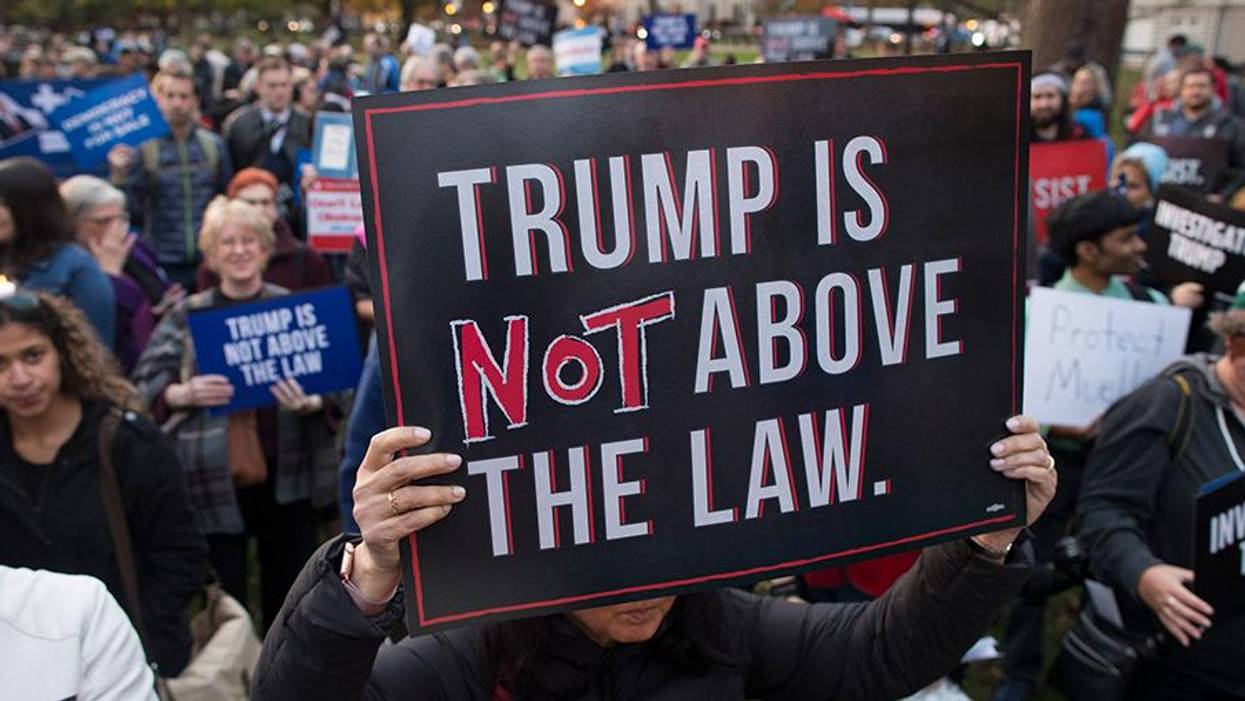
Donald Trump has fully earned impeachment and removal from office. However, the Democratic Party leadership opposes impeachment, because they fear the Senate will not remove Trump, and as a consequence, it will undermine their prospects in 2020.
There are several problems with that thesis. First, it presumes at a minimum that the 2020 election will be more or less free and fair. That assumption is unwarranted. Republican voter suppression of Democratic voters is constant and ongoing. Last year, for example, the five Republican judge majority on the U.S. Supreme Court in Husted v. A. Philip Randolph Institute upheld an Ohio law purging from the voter rolls persons who had not voted for six years, unless they re-registered. In her dissent in Husted Justice Sotomayor explained the law was voter suppression plain and simple and cited documentation that it disproportionately disenfranchised, among others, minority voters. Minority voters, of course, lean heavily Democrat.
Several states have enacted a requirement voters present government-issued identification. Again the rule disproportionately disenfranchises people of color. Numerous other methods of achieving this end have been and can be used.
In 2020 if Trump is running, we are sure to encounter ramped up voter suppression. Perhaps he will justify the additional measures as means to stop the "non-citizen" voters he invented to explain Clinton's winning almost 3,000,000 more votes than he in 2016?
Then there is increasingly aggressive Russian election interference. The New York Times recently reported there is evidence Russia successfully hacked into voter rolls in Florida last year. Unsurprisingly, Trump effectively has green-lighted further Russian interference (which Mueller showed assisted Trump in 2016) by precluding cabinet officials from even raising the issue.
Also, there is the considerable possibility the Democrats' own incompetence could cost them the 2020 election. While Russia conceivably tipped the 2016 election for Trump, absent what former Bill Clinton pollster Stanley Greenberg dubbed the Democratic campaign's "political malpractice and arrogance," Trump would not have won.
Nor was 2016 a one-off. In 2004 they lost to George W. Bush, who had taken us into a disastrous and unlawful war in Iraq based on phony intelligence and who was the first American President since the Great Depression to have failed to generate a single additional job during his four-year term.
Removing Trump in 2020, in short, is far from a sure thing. While currently, it is highly improbable that 20 of 53 Republican senators needed would vote to remove Trump, impeachment hearings likely will affect public opinion, and public opinion likely will affect at least some Republican senators.
Impeachment proceedings provide the Democrats the opportunity to establish a compelling narrative of Trump's extraordinary malfeasance. Such hearings undoubtedly would include first-person accounts from the witnesses on whom Mueller relied, such as former White House Counsel Don McGahn, detailing Trump's repeated and felonious abuse of office to obstruct the investigation into Russian interference on his behalf in the 2016 Presidential election. (As Mueller's report explains, obstruction of justice is committed by an obstructive act, such as firing FBI Director Comey, executed with the intention of obstructing an official proceeding, such as the FBI investigation -- regardless of whether act succeeds, e.g., whether it stops the investigation).
Impeachment hearings also would describe Trump's numerous covert and discrediting links to the Russian government. Those would include his pursuing a real estate project in Russia while he was running for president and his senior campaign staff meeting with a Russian government agent to secure assistance with his Presidential campaign. Trump repeatedly lied in public to conceal these links. Given the numerous ongoing counter-intelligence investigations pertaining to Russia, and criminal prosecutions spun off by Mueller, it is likely additional evidence of such links would be disclosed in impeachment hearings.
The importance of these covert and discrediting links, regardless of whether they are criminal, is that like the "pee tapes" rumored to be held by the Russians, they provide the Russians leverage over Trump, i.e. the Russians could disclose his secrets. Absent some such leverage; it is difficult to explain Trump's conduct towards Putin and Russia, such as his destruction of notes held by any American present at his meetings with Putin, and his obsequiousness in Putin's presence. Few Americans will approve of Trump once he is shown to be, in a sense, "Putin's poodle."
While impeachment proceedings likely would show even more grounds for impeachment, such as Trump's violation of the Constitution's emoluments clause -- an offense akin to bribery -- the bottom line is that impeachment hearings will demonstrate Trump needs to go. The retort that hearings won't matter, because Trump's "base," presumably referring to his typical 40% approval rating, is unshakeable is manifestly wrong. Base is what is solid, and the 40% is not. For example, only 25% of voters strongly approve of Trump's performance. That suggests a considerable portion of Trump's supporters, as is typical for those of any president, can be switched.
Consider the case of Richard Nixon. On the day he resigned, after impeachment proceedings had convened, the Gallup Poll showed 24% of the public stood by him. Yet, for most of his presidency, Nixon's approval exceeded 50%-- a level significantly higher than Trump ever reached. Why should Trump fare better? And if he does not, why would not many Republicans today do the same thing to Trump they did to Nixon in 1974, abandon him?
The Democratic leadership maintains impeachment without removal would mobilize Trump's base in 2020. Yet, as the political scientist Jeffrey Isaac has observed, Trump's base is and will remain mobilized by his ceaseless racist and jingoistic incitement, regardless of impeachment. Conversely, impeachment proceedings likely will reduce Trump's current support, perhaps down to his true base.
While it is impossible to be sure what impeachment proceedings will bring, based on what we know, impeachment is the Democrats' best option politically, as well as legally.