SUBSCRIBE TO OUR FREE NEWSLETTER
Daily news & progressive opinion—funded by the people, not the corporations—delivered straight to your inbox.
5
#000000
#FFFFFF
To donate by check, phone, or other method, see our More Ways to Give page.
Daily news & progressive opinion—funded by the people, not the corporations—delivered straight to your inbox.
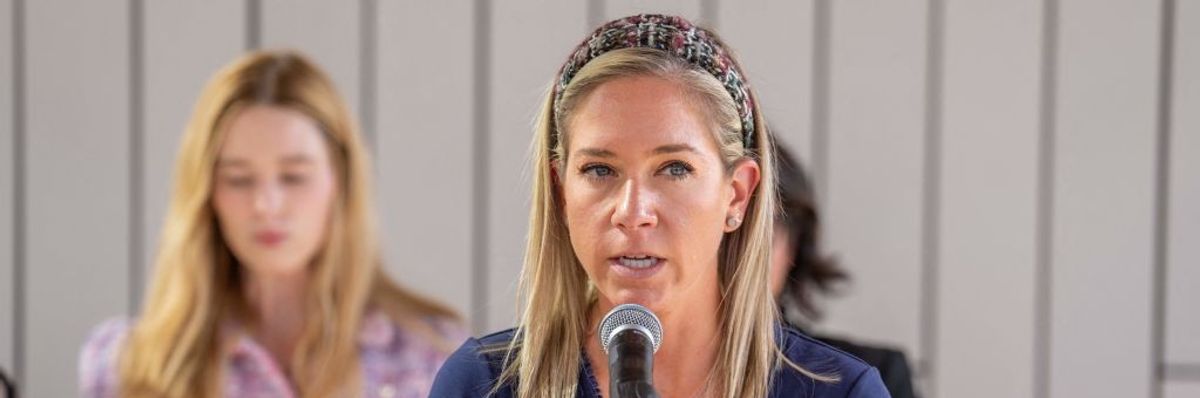
Amanda Zurawski speaks during a press conference outside the Travis County Courthouse in Austin, Texas, on July 20, 2023.
While the Texas Supreme Court instantly blocked the injunction by filing an appeal, it was seen as a victory by reproductive rights advocates.
In what The Associated Press reports is the first legal pushback since an abortion ban took effect in Texas in 2022, State District Judge Jessica Mangrum issued a temporary injunction against the ban late Friday afternoon in the case of unsafe pregnancies.
While the Texas Supreme Court instantly blocked the injunction by filing an appeal, it was seen as a victory by reproductive rights advocates.
"For the first time in a long time, I cried for joy when I heard the news," lead plaintiff Amanda Zurawski said in a statement. "This is exactly why we did this."
The injunction came in response to a case filed by the Center for Reproductive Rights (CPR) in March on behalf of two doctors and five women who were denied abortions despite facing complications—some of them life-threatening—from their pregnancies. The lawsuit made history because it was the first brought by women against a state that denied them abortions since the Supreme Court overturned Roe v. Wade, CPR said.
Zurawski v. State of Texas is limited to getting clarity on what constitutes a "medical emergency" under the Texas law, and not seeking to overturn the ban altogether. Texas in theory says medical concerns would exempt a pregnant person and doctor from the ban. In practice, the lawsuit argues that doctors have denied abortions even in medically necessary cases because they are unsure of the law's parameters and do not want to be hit with a potential 99 years in prison or upwards of $100,000 fine.
Mangrum ruled that the law has "has created an imminent risk that Physician Plaintiffs and other physicians throughout Texas will have no choice but to bar or delay the provision of abortion care to pregnant persons in Texas for whom an abortion would prevent or alleviate a risk of death or risk to their health (including their fertility) for fear of liability under Texas's abortion bans," as CNN reported.
"This makes me hopeful that we can continue to provide competent rational care."
She further ruled that doctors could not be prosecuted if they provided an abortion based on their "good faith judgement," and that S.B. 8, which bans abortions after six weeks and offers citizens a $10,000 bounty to turn in pregnant people and doctors who break it, is unconstitutional.
"This makes me hopeful that we can continue to provide competent rational care," Dr. Damla Karsan, one of the physician plaintiffs in the case, said in a statement.
"It's exactly what we needed," Karsan added. "The court has guaranteed that we can once again provide the best care without fear of criminal or professional retribution. We can once again rely on our knowledge and training especially in challenging situations where abortions are necessary."
The state was quick to appeal, however, meaning the short-term impact of the injunction is uncertain.
First Assistant Attorney General Brent Webster said in a statement reported by CNN that the appeal "stays an activist Austin judge's attempt to override Texas abortion laws pending a ruling by the Texas Supreme Court."
At the same time, abortion clinics in Texas have all closed down since the ban went into effect, AP reported.
When she filed the injunction, Mangrum had intended it to last until the case—which is slated for trial March 25—had been decided.
Plaintiffs in the case have already testified about their experiences during a two-day hearing in July, CPR reported.
Plaintiff Samantha Casiano became physically sick as she recounted being forced to deliver a baby with anencephaly, meaning parts of her brain and skull were missing, according to CPR and CNN.
"All she could do was fight to try to get air," Casiano said. "I had to watch my daughter go from being pink to red to purple."
Zurawski said Friday that Mangrum's ruling had justified the plaintiffs' decision to share these personal and deeply harrowing stories.
"This is why we put ourselves through the pain and the trauma over and over again to share our experiences and the harms caused by these awful laws," she said. "I have a sense of relief, a sense of hope, and a weight has been lifted. Now people don't have to be pregnant and scared in Texas anymore. We're back to relying on doctors and not politicians to help us make the best medical decisions for our bodies and our lives."
Dear Common Dreams reader, It’s been nearly 30 years since I co-founded Common Dreams with my late wife, Lina Newhouser. We had the radical notion that journalism should serve the public good, not corporate profits. It was clear to us from the outset what it would take to build such a project. No paid advertisements. No corporate sponsors. No millionaire publisher telling us what to think or do. Many people said we wouldn't last a year, but we proved those doubters wrong. Together with a tremendous team of journalists and dedicated staff, we built an independent media outlet free from the constraints of profits and corporate control. Our mission has always been simple: To inform. To inspire. To ignite change for the common good. Building Common Dreams was not easy. Our survival was never guaranteed. When you take on the most powerful forces—Wall Street greed, fossil fuel industry destruction, Big Tech lobbyists, and uber-rich oligarchs who have spent billions upon billions rigging the economy and democracy in their favor—the only bulwark you have is supporters who believe in your work. But here’s the urgent message from me today. It's never been this bad out there. And it's never been this hard to keep us going. At the very moment Common Dreams is most needed, the threats we face are intensifying. We need your support now more than ever. We don't accept corporate advertising and never will. We don't have a paywall because we don't think people should be blocked from critical news based on their ability to pay. Everything we do is funded by the donations of readers like you. When everyone does the little they can afford, we are strong. But if that support retreats or dries up, so do we. Will you donate now to make sure Common Dreams not only survives but thrives? —Craig Brown, Co-founder |
In what The Associated Press reports is the first legal pushback since an abortion ban took effect in Texas in 2022, State District Judge Jessica Mangrum issued a temporary injunction against the ban late Friday afternoon in the case of unsafe pregnancies.
While the Texas Supreme Court instantly blocked the injunction by filing an appeal, it was seen as a victory by reproductive rights advocates.
"For the first time in a long time, I cried for joy when I heard the news," lead plaintiff Amanda Zurawski said in a statement. "This is exactly why we did this."
The injunction came in response to a case filed by the Center for Reproductive Rights (CPR) in March on behalf of two doctors and five women who were denied abortions despite facing complications—some of them life-threatening—from their pregnancies. The lawsuit made history because it was the first brought by women against a state that denied them abortions since the Supreme Court overturned Roe v. Wade, CPR said.
Zurawski v. State of Texas is limited to getting clarity on what constitutes a "medical emergency" under the Texas law, and not seeking to overturn the ban altogether. Texas in theory says medical concerns would exempt a pregnant person and doctor from the ban. In practice, the lawsuit argues that doctors have denied abortions even in medically necessary cases because they are unsure of the law's parameters and do not want to be hit with a potential 99 years in prison or upwards of $100,000 fine.
Mangrum ruled that the law has "has created an imminent risk that Physician Plaintiffs and other physicians throughout Texas will have no choice but to bar or delay the provision of abortion care to pregnant persons in Texas for whom an abortion would prevent or alleviate a risk of death or risk to their health (including their fertility) for fear of liability under Texas's abortion bans," as CNN reported.
"This makes me hopeful that we can continue to provide competent rational care."
She further ruled that doctors could not be prosecuted if they provided an abortion based on their "good faith judgement," and that S.B. 8, which bans abortions after six weeks and offers citizens a $10,000 bounty to turn in pregnant people and doctors who break it, is unconstitutional.
"This makes me hopeful that we can continue to provide competent rational care," Dr. Damla Karsan, one of the physician plaintiffs in the case, said in a statement.
"It's exactly what we needed," Karsan added. "The court has guaranteed that we can once again provide the best care without fear of criminal or professional retribution. We can once again rely on our knowledge and training especially in challenging situations where abortions are necessary."
The state was quick to appeal, however, meaning the short-term impact of the injunction is uncertain.
First Assistant Attorney General Brent Webster said in a statement reported by CNN that the appeal "stays an activist Austin judge's attempt to override Texas abortion laws pending a ruling by the Texas Supreme Court."
At the same time, abortion clinics in Texas have all closed down since the ban went into effect, AP reported.
When she filed the injunction, Mangrum had intended it to last until the case—which is slated for trial March 25—had been decided.
Plaintiffs in the case have already testified about their experiences during a two-day hearing in July, CPR reported.
Plaintiff Samantha Casiano became physically sick as she recounted being forced to deliver a baby with anencephaly, meaning parts of her brain and skull were missing, according to CPR and CNN.
"All she could do was fight to try to get air," Casiano said. "I had to watch my daughter go from being pink to red to purple."
Zurawski said Friday that Mangrum's ruling had justified the plaintiffs' decision to share these personal and deeply harrowing stories.
"This is why we put ourselves through the pain and the trauma over and over again to share our experiences and the harms caused by these awful laws," she said. "I have a sense of relief, a sense of hope, and a weight has been lifted. Now people don't have to be pregnant and scared in Texas anymore. We're back to relying on doctors and not politicians to help us make the best medical decisions for our bodies and our lives."
In what The Associated Press reports is the first legal pushback since an abortion ban took effect in Texas in 2022, State District Judge Jessica Mangrum issued a temporary injunction against the ban late Friday afternoon in the case of unsafe pregnancies.
While the Texas Supreme Court instantly blocked the injunction by filing an appeal, it was seen as a victory by reproductive rights advocates.
"For the first time in a long time, I cried for joy when I heard the news," lead plaintiff Amanda Zurawski said in a statement. "This is exactly why we did this."
The injunction came in response to a case filed by the Center for Reproductive Rights (CPR) in March on behalf of two doctors and five women who were denied abortions despite facing complications—some of them life-threatening—from their pregnancies. The lawsuit made history because it was the first brought by women against a state that denied them abortions since the Supreme Court overturned Roe v. Wade, CPR said.
Zurawski v. State of Texas is limited to getting clarity on what constitutes a "medical emergency" under the Texas law, and not seeking to overturn the ban altogether. Texas in theory says medical concerns would exempt a pregnant person and doctor from the ban. In practice, the lawsuit argues that doctors have denied abortions even in medically necessary cases because they are unsure of the law's parameters and do not want to be hit with a potential 99 years in prison or upwards of $100,000 fine.
Mangrum ruled that the law has "has created an imminent risk that Physician Plaintiffs and other physicians throughout Texas will have no choice but to bar or delay the provision of abortion care to pregnant persons in Texas for whom an abortion would prevent or alleviate a risk of death or risk to their health (including their fertility) for fear of liability under Texas's abortion bans," as CNN reported.
"This makes me hopeful that we can continue to provide competent rational care."
She further ruled that doctors could not be prosecuted if they provided an abortion based on their "good faith judgement," and that S.B. 8, which bans abortions after six weeks and offers citizens a $10,000 bounty to turn in pregnant people and doctors who break it, is unconstitutional.
"This makes me hopeful that we can continue to provide competent rational care," Dr. Damla Karsan, one of the physician plaintiffs in the case, said in a statement.
"It's exactly what we needed," Karsan added. "The court has guaranteed that we can once again provide the best care without fear of criminal or professional retribution. We can once again rely on our knowledge and training especially in challenging situations where abortions are necessary."
The state was quick to appeal, however, meaning the short-term impact of the injunction is uncertain.
First Assistant Attorney General Brent Webster said in a statement reported by CNN that the appeal "stays an activist Austin judge's attempt to override Texas abortion laws pending a ruling by the Texas Supreme Court."
At the same time, abortion clinics in Texas have all closed down since the ban went into effect, AP reported.
When she filed the injunction, Mangrum had intended it to last until the case—which is slated for trial March 25—had been decided.
Plaintiffs in the case have already testified about their experiences during a two-day hearing in July, CPR reported.
Plaintiff Samantha Casiano became physically sick as she recounted being forced to deliver a baby with anencephaly, meaning parts of her brain and skull were missing, according to CPR and CNN.
"All she could do was fight to try to get air," Casiano said. "I had to watch my daughter go from being pink to red to purple."
Zurawski said Friday that Mangrum's ruling had justified the plaintiffs' decision to share these personal and deeply harrowing stories.
"This is why we put ourselves through the pain and the trauma over and over again to share our experiences and the harms caused by these awful laws," she said. "I have a sense of relief, a sense of hope, and a weight has been lifted. Now people don't have to be pregnant and scared in Texas anymore. We're back to relying on doctors and not politicians to help us make the best medical decisions for our bodies and our lives."