SUBSCRIBE TO OUR FREE NEWSLETTER
Daily news & progressive opinion—funded by the people, not the corporations—delivered straight to your inbox.
5
#000000
#FFFFFF
To donate by check, phone, or other method, see our More Ways to Give page.
Daily news & progressive opinion—funded by the people, not the corporations—delivered straight to your inbox.
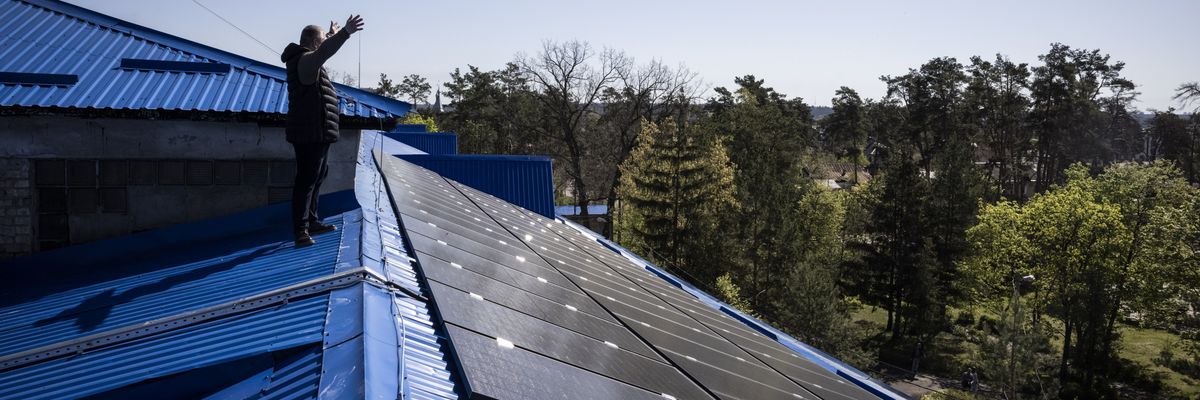
Principle Ivan Ptashnik, head teacher of School Number 17 in Irpin, waves at colleagues as he inspects solar panels the school's roof on May 2, 2023, in Kyiv Oblast, Ukraine.
In the face of full-scale conflict, climate-friendly renewable energy projects have emerged as a ray of light, showcasing Ukraine's innovative spirit and determination.
As we mark the two-year anniversary of the devastating war in Ukraine that has taken thousands of innocent lives, the crisis has also led to some positive changes in terms of clean energy independence.
Having to quickly adapt to targeted Russian attacks, which damaged 50% of its dated energy infrastructure, Ukraine has rapidly embarked on a journey toward climate-friendly renewable decentralised energy. This is not only a testament to Ukraine's resilience but also to the rapid clean energy transformation that offers economic benefits and can be a model for all of Europe.
Historically, Ukraine imported much of its fossil fuel resources from Russia, but since Russia's first invasion in 2014, Ukraine has been expanding its efforts in renewable energy. The aim is to reduce its dependence on imported energy, improve energy security, and create high-quality jobs in the booming renewables sector. After two years of fighting for survival, Ukraine's commitment to clean energy has only strengthened. Even Ukrainian President Volodymyr Zelenskyy has noted that green energy guarantees real energy stability, and Ukraine could be one of the key suppliers of clean electricity to Europe. The potential of this industry alone is about $400 billion.
Ukraine's new energy strategy demonstrates the nation's commitment to renewable energy development and aligns with the latest European Union Governance and climate requirements. New legislation, such as the Law on Alternative Energy Sources, is integral to cooperation with international partners such as the European Bank for Reconstruction and Development (EBRD). This close collaboration with Europe has helped Ukraine launch several ambitious new renewable energy projects.
Before the Russian invasion on February 24, 2022, Ukraine already had ambitious renewable energy targets, aiming to increase its share in the overall energy mix to 25% by 2035. According to the National Energy and Utilities Regulatory Commission (NEURC), as of December 31, 2021, the installed capacity of Ukraine's renewable energy sector had already reached impressive levels, including growth in solar installations for private households. But since the 2022 war started, Ukraine has pledged to radically increase the share of renewable energy in its energy mix to increase collaboration with the E.U.
Ukraine synchronised its power grid with continental Europe during wartime, presenting opportunities for green transition and clean energy exchange with the E.U. The European REPowerE.U. plan aims to increase the E.U.'s target for renewables in its electricity balance to 45% by 2030. Ukraine has enacted laws to develop energy storage systems and allowed the sale of renewable electricity directly on the markets. The government is actively working on 'Green' auctions for new solar and wind capacities, showcasing a strategic vision for the energy sector's recovery.
As a result of Russia's ongoing war, a significant part of the energy infrastructure, including renewable energy facilities, was damaged or located in the occupied territories. This reduced the country's total installed capacity of renewable energy sources and provided a further need to rapidly create replacement energy sources for people.
Such situations stress the critical need to accelerate the transition to decentralised clean energy for energy independence and sustainable development. Renewable energy emerges as a key player in economic recovery, job creation, and providing clean, affordable energy for all. During 2022-23, more than 660 megawatts of new renewable energy capacity was commissioned in Ukraine.
Ukraine's strides in transitioning to clean energy and enhancing energy efficiency have already yielded significant economic and social benefits.
Despite massive challenges, Ukraine has demonstrated innovation and resilience in adopting renewable energy solutions. Solar power plants (SPPs) were built for vital needs: schools, hospitals, and water utilities. Collaborative efforts between state-owned companies, private enterprises, and international firms highlight the nation's successes with green energy.
State-owned Ukrnafta, in cooperation with the City Council, lit up Boryslav Hospital by installing a 30 kilowatt solar power plant on the roof. Aurora invested in a rooftop solar power plant in Vinnytsia, and the city of Kyiv plans to install solar power plants to supply energy to medical facilities, reinforcing social responsibility through green energy. Scatec, an international company, is developing a project called "mobile SPP plus batteries". The city of Nizhyn, in cooperation with the German Society for International Cooperation (GIZ), will build an SPP to provide electricity to the water utility.
Wind farms in southern and western Ukraine have been significantly expanded, along with bioenergy projects like biogas plants, contributing to reducing greenhouse gas emissions and solving waste disposal challenges while generating energy.
Amid the relentless challenges posed by Putin's brutal war, Ukraine's unwavering commitment to clean energy stands as a beacon of resilience. In the face of full-scale conflict, climate-friendly renewable energy projects have emerged as a ray of light, showcasing Ukraine's innovative spirit and determination. These initiatives fortify the nation's economic growth and energy independence and chart new horizons for green energy.
Ukraine's strides in transitioning to clean energy and enhancing energy efficiency have already yielded significant economic and social benefits. Investment in renewables and efficiency have spurred job creation, reduced dependency on imported energy, and slashed energy costs. Beyond the economic impact, these efforts have elevated the quality of life, fostered a cleaner environment, mitigated health risks, and contributed significantly to winning the war. We in Ukraine stand strong, and despite our tough situation, we are rising to our challenges and creating a clean energy revolution that Europe would do well to follow.Dear Common Dreams reader, It’s been nearly 30 years since I co-founded Common Dreams with my late wife, Lina Newhouser. We had the radical notion that journalism should serve the public good, not corporate profits. It was clear to us from the outset what it would take to build such a project. No paid advertisements. No corporate sponsors. No millionaire publisher telling us what to think or do. Many people said we wouldn't last a year, but we proved those doubters wrong. Together with a tremendous team of journalists and dedicated staff, we built an independent media outlet free from the constraints of profits and corporate control. Our mission has always been simple: To inform. To inspire. To ignite change for the common good. Building Common Dreams was not easy. Our survival was never guaranteed. When you take on the most powerful forces—Wall Street greed, fossil fuel industry destruction, Big Tech lobbyists, and uber-rich oligarchs who have spent billions upon billions rigging the economy and democracy in their favor—the only bulwark you have is supporters who believe in your work. But here’s the urgent message from me today. It's never been this bad out there. And it's never been this hard to keep us going. At the very moment Common Dreams is most needed, the threats we face are intensifying. We need your support now more than ever. We don't accept corporate advertising and never will. We don't have a paywall because we don't think people should be blocked from critical news based on their ability to pay. Everything we do is funded by the donations of readers like you. When everyone does the little they can afford, we are strong. But if that support retreats or dries up, so do we. Will you donate now to make sure Common Dreams not only survives but thrives? —Craig Brown, Co-founder |
As we mark the two-year anniversary of the devastating war in Ukraine that has taken thousands of innocent lives, the crisis has also led to some positive changes in terms of clean energy independence.
Having to quickly adapt to targeted Russian attacks, which damaged 50% of its dated energy infrastructure, Ukraine has rapidly embarked on a journey toward climate-friendly renewable decentralised energy. This is not only a testament to Ukraine's resilience but also to the rapid clean energy transformation that offers economic benefits and can be a model for all of Europe.
Historically, Ukraine imported much of its fossil fuel resources from Russia, but since Russia's first invasion in 2014, Ukraine has been expanding its efforts in renewable energy. The aim is to reduce its dependence on imported energy, improve energy security, and create high-quality jobs in the booming renewables sector. After two years of fighting for survival, Ukraine's commitment to clean energy has only strengthened. Even Ukrainian President Volodymyr Zelenskyy has noted that green energy guarantees real energy stability, and Ukraine could be one of the key suppliers of clean electricity to Europe. The potential of this industry alone is about $400 billion.
Ukraine's new energy strategy demonstrates the nation's commitment to renewable energy development and aligns with the latest European Union Governance and climate requirements. New legislation, such as the Law on Alternative Energy Sources, is integral to cooperation with international partners such as the European Bank for Reconstruction and Development (EBRD). This close collaboration with Europe has helped Ukraine launch several ambitious new renewable energy projects.
Before the Russian invasion on February 24, 2022, Ukraine already had ambitious renewable energy targets, aiming to increase its share in the overall energy mix to 25% by 2035. According to the National Energy and Utilities Regulatory Commission (NEURC), as of December 31, 2021, the installed capacity of Ukraine's renewable energy sector had already reached impressive levels, including growth in solar installations for private households. But since the 2022 war started, Ukraine has pledged to radically increase the share of renewable energy in its energy mix to increase collaboration with the E.U.
Ukraine synchronised its power grid with continental Europe during wartime, presenting opportunities for green transition and clean energy exchange with the E.U. The European REPowerE.U. plan aims to increase the E.U.'s target for renewables in its electricity balance to 45% by 2030. Ukraine has enacted laws to develop energy storage systems and allowed the sale of renewable electricity directly on the markets. The government is actively working on 'Green' auctions for new solar and wind capacities, showcasing a strategic vision for the energy sector's recovery.
As a result of Russia's ongoing war, a significant part of the energy infrastructure, including renewable energy facilities, was damaged or located in the occupied territories. This reduced the country's total installed capacity of renewable energy sources and provided a further need to rapidly create replacement energy sources for people.
Such situations stress the critical need to accelerate the transition to decentralised clean energy for energy independence and sustainable development. Renewable energy emerges as a key player in economic recovery, job creation, and providing clean, affordable energy for all. During 2022-23, more than 660 megawatts of new renewable energy capacity was commissioned in Ukraine.
Ukraine's strides in transitioning to clean energy and enhancing energy efficiency have already yielded significant economic and social benefits.
Despite massive challenges, Ukraine has demonstrated innovation and resilience in adopting renewable energy solutions. Solar power plants (SPPs) were built for vital needs: schools, hospitals, and water utilities. Collaborative efforts between state-owned companies, private enterprises, and international firms highlight the nation's successes with green energy.
State-owned Ukrnafta, in cooperation with the City Council, lit up Boryslav Hospital by installing a 30 kilowatt solar power plant on the roof. Aurora invested in a rooftop solar power plant in Vinnytsia, and the city of Kyiv plans to install solar power plants to supply energy to medical facilities, reinforcing social responsibility through green energy. Scatec, an international company, is developing a project called "mobile SPP plus batteries". The city of Nizhyn, in cooperation with the German Society for International Cooperation (GIZ), will build an SPP to provide electricity to the water utility.
Wind farms in southern and western Ukraine have been significantly expanded, along with bioenergy projects like biogas plants, contributing to reducing greenhouse gas emissions and solving waste disposal challenges while generating energy.
Amid the relentless challenges posed by Putin's brutal war, Ukraine's unwavering commitment to clean energy stands as a beacon of resilience. In the face of full-scale conflict, climate-friendly renewable energy projects have emerged as a ray of light, showcasing Ukraine's innovative spirit and determination. These initiatives fortify the nation's economic growth and energy independence and chart new horizons for green energy.
Ukraine's strides in transitioning to clean energy and enhancing energy efficiency have already yielded significant economic and social benefits. Investment in renewables and efficiency have spurred job creation, reduced dependency on imported energy, and slashed energy costs. Beyond the economic impact, these efforts have elevated the quality of life, fostered a cleaner environment, mitigated health risks, and contributed significantly to winning the war. We in Ukraine stand strong, and despite our tough situation, we are rising to our challenges and creating a clean energy revolution that Europe would do well to follow.As we mark the two-year anniversary of the devastating war in Ukraine that has taken thousands of innocent lives, the crisis has also led to some positive changes in terms of clean energy independence.
Having to quickly adapt to targeted Russian attacks, which damaged 50% of its dated energy infrastructure, Ukraine has rapidly embarked on a journey toward climate-friendly renewable decentralised energy. This is not only a testament to Ukraine's resilience but also to the rapid clean energy transformation that offers economic benefits and can be a model for all of Europe.
Historically, Ukraine imported much of its fossil fuel resources from Russia, but since Russia's first invasion in 2014, Ukraine has been expanding its efforts in renewable energy. The aim is to reduce its dependence on imported energy, improve energy security, and create high-quality jobs in the booming renewables sector. After two years of fighting for survival, Ukraine's commitment to clean energy has only strengthened. Even Ukrainian President Volodymyr Zelenskyy has noted that green energy guarantees real energy stability, and Ukraine could be one of the key suppliers of clean electricity to Europe. The potential of this industry alone is about $400 billion.
Ukraine's new energy strategy demonstrates the nation's commitment to renewable energy development and aligns with the latest European Union Governance and climate requirements. New legislation, such as the Law on Alternative Energy Sources, is integral to cooperation with international partners such as the European Bank for Reconstruction and Development (EBRD). This close collaboration with Europe has helped Ukraine launch several ambitious new renewable energy projects.
Before the Russian invasion on February 24, 2022, Ukraine already had ambitious renewable energy targets, aiming to increase its share in the overall energy mix to 25% by 2035. According to the National Energy and Utilities Regulatory Commission (NEURC), as of December 31, 2021, the installed capacity of Ukraine's renewable energy sector had already reached impressive levels, including growth in solar installations for private households. But since the 2022 war started, Ukraine has pledged to radically increase the share of renewable energy in its energy mix to increase collaboration with the E.U.
Ukraine synchronised its power grid with continental Europe during wartime, presenting opportunities for green transition and clean energy exchange with the E.U. The European REPowerE.U. plan aims to increase the E.U.'s target for renewables in its electricity balance to 45% by 2030. Ukraine has enacted laws to develop energy storage systems and allowed the sale of renewable electricity directly on the markets. The government is actively working on 'Green' auctions for new solar and wind capacities, showcasing a strategic vision for the energy sector's recovery.
As a result of Russia's ongoing war, a significant part of the energy infrastructure, including renewable energy facilities, was damaged or located in the occupied territories. This reduced the country's total installed capacity of renewable energy sources and provided a further need to rapidly create replacement energy sources for people.
Such situations stress the critical need to accelerate the transition to decentralised clean energy for energy independence and sustainable development. Renewable energy emerges as a key player in economic recovery, job creation, and providing clean, affordable energy for all. During 2022-23, more than 660 megawatts of new renewable energy capacity was commissioned in Ukraine.
Ukraine's strides in transitioning to clean energy and enhancing energy efficiency have already yielded significant economic and social benefits.
Despite massive challenges, Ukraine has demonstrated innovation and resilience in adopting renewable energy solutions. Solar power plants (SPPs) were built for vital needs: schools, hospitals, and water utilities. Collaborative efforts between state-owned companies, private enterprises, and international firms highlight the nation's successes with green energy.
State-owned Ukrnafta, in cooperation with the City Council, lit up Boryslav Hospital by installing a 30 kilowatt solar power plant on the roof. Aurora invested in a rooftop solar power plant in Vinnytsia, and the city of Kyiv plans to install solar power plants to supply energy to medical facilities, reinforcing social responsibility through green energy. Scatec, an international company, is developing a project called "mobile SPP plus batteries". The city of Nizhyn, in cooperation with the German Society for International Cooperation (GIZ), will build an SPP to provide electricity to the water utility.
Wind farms in southern and western Ukraine have been significantly expanded, along with bioenergy projects like biogas plants, contributing to reducing greenhouse gas emissions and solving waste disposal challenges while generating energy.
Amid the relentless challenges posed by Putin's brutal war, Ukraine's unwavering commitment to clean energy stands as a beacon of resilience. In the face of full-scale conflict, climate-friendly renewable energy projects have emerged as a ray of light, showcasing Ukraine's innovative spirit and determination. These initiatives fortify the nation's economic growth and energy independence and chart new horizons for green energy.
Ukraine's strides in transitioning to clean energy and enhancing energy efficiency have already yielded significant economic and social benefits. Investment in renewables and efficiency have spurred job creation, reduced dependency on imported energy, and slashed energy costs. Beyond the economic impact, these efforts have elevated the quality of life, fostered a cleaner environment, mitigated health risks, and contributed significantly to winning the war. We in Ukraine stand strong, and despite our tough situation, we are rising to our challenges and creating a clean energy revolution that Europe would do well to follow.