

SUBSCRIBE TO OUR FREE NEWSLETTER
Daily news & progressive opinion—funded by the people, not the corporations—delivered straight to your inbox.
5
#000000
#FFFFFF
To donate by check, phone, or other method, see our More Ways to Give page.
Daily news & progressive opinion—funded by the people, not the corporations—delivered straight to your inbox.
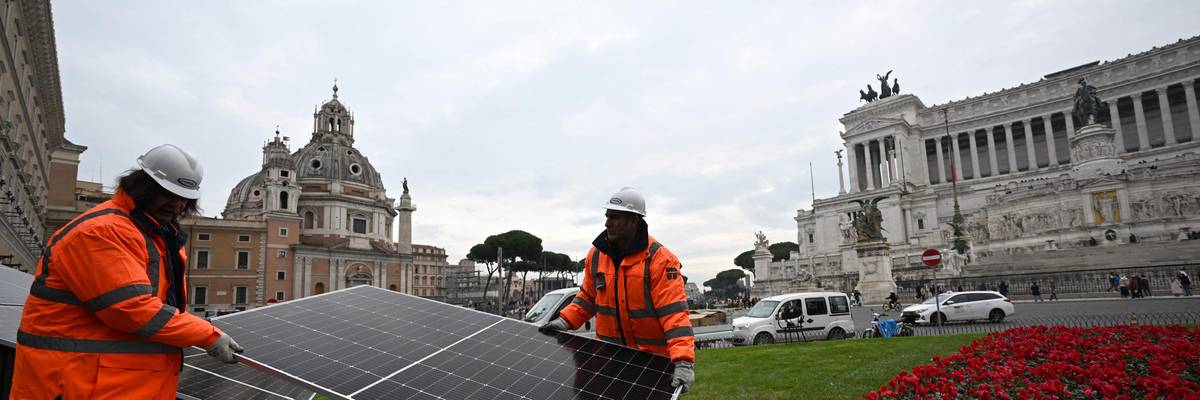
Workers install solar panels to power historical buildings and a Christmas tree in central Rome on December 2, 2022. (Photo: Filippo Monteforte/AFP via Getty Images)
Driven significantly by dramatically reduced fossil fuel imports following Russia's invasion of Ukraine, solar production soared nearly 50% in the European Union this year--with even greater growth forecast for 2023, a report published this week by an industry group revealed.
"We're building a secure, green, prosperous Europe on a foundation of solar."
SolarPower Europe said in the introduction to a new report that "2022 was the year when solar power displayed its true potential for the very first time in the E.U., driven by record high energy prices and geopolitical tensions that largely improved its business case."
No longer encumbered by serious supply chain bottlenecks due to the Covid-19 pandemic, the 27 E.U. nations added 41.4 gigawatts (GW) of new solar photovoltaic (PV) capacity to their grids, a 47% increase over 2021. That's enough to power the equivalent of around 12.4 million homes.
"The numbers are clear. Solar is offering a lifeline amid energy and climate crises," SolarPower Europe CEO Walburga Hemetsberger said in a statement. "No other energy source is growing as quickly or reliably as solar. We're building a secure, green, prosperous Europe on a foundation of solar."
Ten E.U. countries added at least 1 GW of solar power this year. Perennial leader Germany again paced the E.U. in PV installation, adding nearly 8 GW. Spain followed closely, adding 7.5 GW, or 55% more than in 2021. Poland (4.9 GW), the Netherlands (4.0 GW), and France (2.7 GW) rounded out the top five E.U. solar powers.
Russia's invasion of Ukraine, now approaching the 10-month mark, has spurred record growth of renewable energy in Europe. Not only has this accelerated the green energy transition amid the worsening climate emergency, it has also helped offset soaring gas costs.
Research published in October by think tanks E3G and Ember revealed that record European wind and solar production averted EUR11 billion ($11.7 billion) in extra gas costs since Russian troops invaded Ukraine on February 24.
"Wind and solar are already helping European citizens, but the future potential is even greater," Ember senior analyst Chris Rosslowe said at the time.
According to the International Energy Agency--which last year stressed the necessity of swiftly shifting from fossil fuels to clean energy--E.U. countries must install approximately 60 GW of solar power next year to make up for gas shortfalls caused by the reduction of Russian supplies.
SolarPower Europe is "confident that further annual market growth will beat all expectations, exceed 50 GW deployment level in 2023, and more than double from today to 85 GW in 2026."
Dear Common Dreams reader, It’s been nearly 30 years since I co-founded Common Dreams with my late wife, Lina Newhouser. We had the radical notion that journalism should serve the public good, not corporate profits. It was clear to us from the outset what it would take to build such a project. No paid advertisements. No corporate sponsors. No millionaire publisher telling us what to think or do. Many people said we wouldn't last a year, but we proved those doubters wrong. Together with a tremendous team of journalists and dedicated staff, we built an independent media outlet free from the constraints of profits and corporate control. Our mission has always been simple: To inform. To inspire. To ignite change for the common good. Building Common Dreams was not easy. Our survival was never guaranteed. When you take on the most powerful forces—Wall Street greed, fossil fuel industry destruction, Big Tech lobbyists, and uber-rich oligarchs who have spent billions upon billions rigging the economy and democracy in their favor—the only bulwark you have is supporters who believe in your work. But here’s the urgent message from me today. It's never been this bad out there. And it's never been this hard to keep us going. At the very moment Common Dreams is most needed, the threats we face are intensifying. We need your support now more than ever. We don't accept corporate advertising and never will. We don't have a paywall because we don't think people should be blocked from critical news based on their ability to pay. Everything we do is funded by the donations of readers like you. When everyone does the little they can afford, we are strong. But if that support retreats or dries up, so do we. Will you donate now to make sure Common Dreams not only survives but thrives? —Craig Brown, Co-founder |
Driven significantly by dramatically reduced fossil fuel imports following Russia's invasion of Ukraine, solar production soared nearly 50% in the European Union this year--with even greater growth forecast for 2023, a report published this week by an industry group revealed.
"We're building a secure, green, prosperous Europe on a foundation of solar."
SolarPower Europe said in the introduction to a new report that "2022 was the year when solar power displayed its true potential for the very first time in the E.U., driven by record high energy prices and geopolitical tensions that largely improved its business case."
No longer encumbered by serious supply chain bottlenecks due to the Covid-19 pandemic, the 27 E.U. nations added 41.4 gigawatts (GW) of new solar photovoltaic (PV) capacity to their grids, a 47% increase over 2021. That's enough to power the equivalent of around 12.4 million homes.
"The numbers are clear. Solar is offering a lifeline amid energy and climate crises," SolarPower Europe CEO Walburga Hemetsberger said in a statement. "No other energy source is growing as quickly or reliably as solar. We're building a secure, green, prosperous Europe on a foundation of solar."
Ten E.U. countries added at least 1 GW of solar power this year. Perennial leader Germany again paced the E.U. in PV installation, adding nearly 8 GW. Spain followed closely, adding 7.5 GW, or 55% more than in 2021. Poland (4.9 GW), the Netherlands (4.0 GW), and France (2.7 GW) rounded out the top five E.U. solar powers.
Russia's invasion of Ukraine, now approaching the 10-month mark, has spurred record growth of renewable energy in Europe. Not only has this accelerated the green energy transition amid the worsening climate emergency, it has also helped offset soaring gas costs.
Research published in October by think tanks E3G and Ember revealed that record European wind and solar production averted EUR11 billion ($11.7 billion) in extra gas costs since Russian troops invaded Ukraine on February 24.
"Wind and solar are already helping European citizens, but the future potential is even greater," Ember senior analyst Chris Rosslowe said at the time.
According to the International Energy Agency--which last year stressed the necessity of swiftly shifting from fossil fuels to clean energy--E.U. countries must install approximately 60 GW of solar power next year to make up for gas shortfalls caused by the reduction of Russian supplies.
SolarPower Europe is "confident that further annual market growth will beat all expectations, exceed 50 GW deployment level in 2023, and more than double from today to 85 GW in 2026."
Driven significantly by dramatically reduced fossil fuel imports following Russia's invasion of Ukraine, solar production soared nearly 50% in the European Union this year--with even greater growth forecast for 2023, a report published this week by an industry group revealed.
"We're building a secure, green, prosperous Europe on a foundation of solar."
SolarPower Europe said in the introduction to a new report that "2022 was the year when solar power displayed its true potential for the very first time in the E.U., driven by record high energy prices and geopolitical tensions that largely improved its business case."
No longer encumbered by serious supply chain bottlenecks due to the Covid-19 pandemic, the 27 E.U. nations added 41.4 gigawatts (GW) of new solar photovoltaic (PV) capacity to their grids, a 47% increase over 2021. That's enough to power the equivalent of around 12.4 million homes.
"The numbers are clear. Solar is offering a lifeline amid energy and climate crises," SolarPower Europe CEO Walburga Hemetsberger said in a statement. "No other energy source is growing as quickly or reliably as solar. We're building a secure, green, prosperous Europe on a foundation of solar."
Ten E.U. countries added at least 1 GW of solar power this year. Perennial leader Germany again paced the E.U. in PV installation, adding nearly 8 GW. Spain followed closely, adding 7.5 GW, or 55% more than in 2021. Poland (4.9 GW), the Netherlands (4.0 GW), and France (2.7 GW) rounded out the top five E.U. solar powers.
Russia's invasion of Ukraine, now approaching the 10-month mark, has spurred record growth of renewable energy in Europe. Not only has this accelerated the green energy transition amid the worsening climate emergency, it has also helped offset soaring gas costs.
Research published in October by think tanks E3G and Ember revealed that record European wind and solar production averted EUR11 billion ($11.7 billion) in extra gas costs since Russian troops invaded Ukraine on February 24.
"Wind and solar are already helping European citizens, but the future potential is even greater," Ember senior analyst Chris Rosslowe said at the time.
According to the International Energy Agency--which last year stressed the necessity of swiftly shifting from fossil fuels to clean energy--E.U. countries must install approximately 60 GW of solar power next year to make up for gas shortfalls caused by the reduction of Russian supplies.
SolarPower Europe is "confident that further annual market growth will beat all expectations, exceed 50 GW deployment level in 2023, and more than double from today to 85 GW in 2026."

