
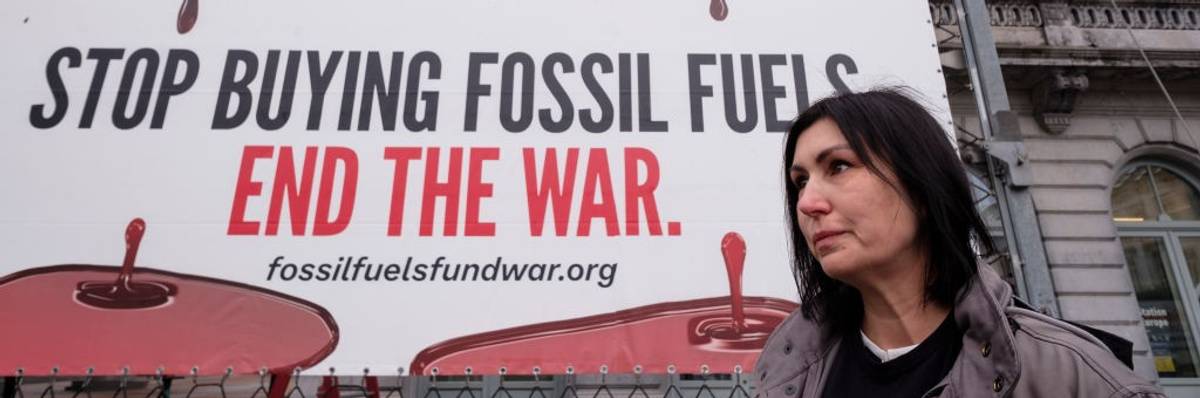
The author, Svitlana Romanko demonstrates in the Place du Luxembourg, in front of the European Parliament on September 27, 2022 in Brussels, Belgium.
Closing the Disconnect Between Peace in Ukraine and Russian Oil and Gas
To tackle the climate crisis, the world must have a real plan to phase out fossil fuels, starting with Russian oil and gas exports.
As the UN General Assembly took place during the New York Climate Week, the two key topics—war in Ukraine and climate change—seem far detached in the high-level discussions. A critical link was missing—between the deadly sprawl of the fossil fuels industry and petro-dictator Putin's assault on Ukraine, international law and democratic governance.
President Zelenskyy, during his speech at the UN General Assembly, noted that the world has repeatedly witnessed Russia's use of energy as a weapon. Russia consistently turns its fossil fuel exports and nuclear energy into geopolitical weapons.
There seems no limit to how far Russia can go—evidenced by numerous terrorist acts involving the Zaporizhzhya nuclear power plant: they shelled it, occupied it, and now are blackmailing the whole world with the threat of a radiation leak.
Yet an even more significant threat remains largely unnoticed by the international community and out of high-level speeches: Russia's dangerous oil and gas infrastructure sprawl in the Arctic. This poses a global climate threat as it could ignite the fuse to massive carbon bombs, unlocking extraction in new Russian oil and gas fields and enabling further exploration in the world's most climate-sensitive region.
It’s quite shocking that U.S. banks are among the biggest backers of these projects, despite civil society organizations urging them for years to stop financing fossil fuels and take the side of a radical shift to investment in clean energy solutions.
Russia’s sensitive northernmost territories, Yamal and Gydan peninsulas, are now being ravaged by new megaprojects and the frantic rush for gas. New gas projects in the icy lands of Yamal and Gydan can lead to increased methane, a potent greenhouse gas, leaking from damaged permafrost. Russia's expansion in the Arctic could have devastating consequences for all life on Earth.
During Climate Week in New York, hundreds of thousands worldwide urgently called for immediate climate action. These include small island nations threatened by rising seas, Africa grappling with severe food shortages, Southeast Asia dealing with droughts and floods, and Ukrainians resisting the Kremlin's invasion fueled by fossil fuels.
Concerns grow about Russia's LNG expansion coupled with the overall global crisis of climate disruption.
Yet it's precisely Russia's oil and gas industry and its sprawl in the Arctic that is turning this planet into hell, to use a metaphor from UN Secretary-General António Guterres last week. Hundreds of thousands are under constant and heavy attacks in Ukraine, and billions are affected by climate change. To tackle the climate crisis, the world must have a real plan to phase out fossil fuels, starting with Russian oil and gas exports. Their decline should be the first essential step.
Europe is already making progress in phasing out Russian fossil fuels. According to a recent briefing by the Centre for Research on Energy and Clean Air, in August 2023, the increased generation of solar and wind electricity in European Union countries led to a reduction in fossil gas consumption by 18 terawatt-hours (TWh), more than half of the total fossil gas imports from Russia. Yet, much further investment in renewable energy sources and energy efficiency is needed to safeguard the energy security and affordability of the world. The U.S. must implement additional policies to speed up the clean energy transition to keep energy affordable, reduce reliance on volatile fossil fuel markets, and stop cooperating with Russian energy companies that are financing Vladimir Putin's war on Ukraine.
Concerns grow about Russia's LNG expansion coupled with the overall global crisis of climate disruption. The global oil and gas industry would have to invest only 3% of the income it earned in 2022, or $100 billion, to reduce its methane emissions by 75%, according to the IEA's Methane Tracker 2023 report. Yet they didn't. Even with multiple supportive frameworks (OGMP, GMI, MGP) and commercial incentives, they do nothing to cut methane emissions. Some, like American company Halliburton, are doing the opposite by taking part in the deadly sprawl of the Russian gas industry.
Last week, press reports revealed that Halliburton sent equipment worth over $7 million into Russia in the past year. Media reports exposed that Halliburton's Russian business partners included Gazprom, which has its own mercenaries reportedly fighting on the front lines against us in Ukraine. The U.S. must immediately force all its companies, including Halliburton, to stop doing business with Russia.
These sort of fossil gas dealers further tarnish their reputations by becoming the embodiment of greed, neglect, and bad faith. They pay little attention to the human suffering or climate impacts their product causes and continue to expand gas infrastructure, contributing to fossil-fuelled violence and denying us the right to a liveable planet.
True leaders of the democratic world, including President Joe Biden, must unite and stand up to the challenge of dethroning petro-dictators like Putin and their greedy corporate partners. Making sure Russia will be isolated at the upcoming UN climate conference COP28 and gathering international support to cut Russian oil and gas exports is going to be a tough fight. Yet, it's one we cannot lose.
An Urgent Message From Our Co-Founder
Dear Common Dreams reader, It’s been nearly 30 years since I co-founded Common Dreams with my late wife, Lina Newhouser. We had the radical notion that journalism should serve the public good, not corporate profits. It was clear to us from the outset what it would take to build such a project. No paid advertisements. No corporate sponsors. No millionaire publisher telling us what to think or do. Many people said we wouldn't last a year, but we proved those doubters wrong. Together with a tremendous team of journalists and dedicated staff, we built an independent media outlet free from the constraints of profits and corporate control. Our mission has always been simple: To inform. To inspire. To ignite change for the common good. Building Common Dreams was not easy. Our survival was never guaranteed. When you take on the most powerful forces—Wall Street greed, fossil fuel industry destruction, Big Tech lobbyists, and uber-rich oligarchs who have spent billions upon billions rigging the economy and democracy in their favor—the only bulwark you have is supporters who believe in your work. But here’s the urgent message from me today. It's never been this bad out there. And it's never been this hard to keep us going. At the very moment Common Dreams is most needed, the threats we face are intensifying. We need your support now more than ever. We don't accept corporate advertising and never will. We don't have a paywall because we don't think people should be blocked from critical news based on their ability to pay. Everything we do is funded by the donations of readers like you. When everyone does the little they can afford, we are strong. But if that support retreats or dries up, so do we. Will you donate now to make sure Common Dreams not only survives but thrives? —Craig Brown, Co-founder |
As the UN General Assembly took place during the New York Climate Week, the two key topics—war in Ukraine and climate change—seem far detached in the high-level discussions. A critical link was missing—between the deadly sprawl of the fossil fuels industry and petro-dictator Putin's assault on Ukraine, international law and democratic governance.
President Zelenskyy, during his speech at the UN General Assembly, noted that the world has repeatedly witnessed Russia's use of energy as a weapon. Russia consistently turns its fossil fuel exports and nuclear energy into geopolitical weapons.
There seems no limit to how far Russia can go—evidenced by numerous terrorist acts involving the Zaporizhzhya nuclear power plant: they shelled it, occupied it, and now are blackmailing the whole world with the threat of a radiation leak.
Yet an even more significant threat remains largely unnoticed by the international community and out of high-level speeches: Russia's dangerous oil and gas infrastructure sprawl in the Arctic. This poses a global climate threat as it could ignite the fuse to massive carbon bombs, unlocking extraction in new Russian oil and gas fields and enabling further exploration in the world's most climate-sensitive region.
It’s quite shocking that U.S. banks are among the biggest backers of these projects, despite civil society organizations urging them for years to stop financing fossil fuels and take the side of a radical shift to investment in clean energy solutions.
Russia’s sensitive northernmost territories, Yamal and Gydan peninsulas, are now being ravaged by new megaprojects and the frantic rush for gas. New gas projects in the icy lands of Yamal and Gydan can lead to increased methane, a potent greenhouse gas, leaking from damaged permafrost. Russia's expansion in the Arctic could have devastating consequences for all life on Earth.
During Climate Week in New York, hundreds of thousands worldwide urgently called for immediate climate action. These include small island nations threatened by rising seas, Africa grappling with severe food shortages, Southeast Asia dealing with droughts and floods, and Ukrainians resisting the Kremlin's invasion fueled by fossil fuels.
Concerns grow about Russia's LNG expansion coupled with the overall global crisis of climate disruption.
Yet it's precisely Russia's oil and gas industry and its sprawl in the Arctic that is turning this planet into hell, to use a metaphor from UN Secretary-General António Guterres last week. Hundreds of thousands are under constant and heavy attacks in Ukraine, and billions are affected by climate change. To tackle the climate crisis, the world must have a real plan to phase out fossil fuels, starting with Russian oil and gas exports. Their decline should be the first essential step.
Europe is already making progress in phasing out Russian fossil fuels. According to a recent briefing by the Centre for Research on Energy and Clean Air, in August 2023, the increased generation of solar and wind electricity in European Union countries led to a reduction in fossil gas consumption by 18 terawatt-hours (TWh), more than half of the total fossil gas imports from Russia. Yet, much further investment in renewable energy sources and energy efficiency is needed to safeguard the energy security and affordability of the world. The U.S. must implement additional policies to speed up the clean energy transition to keep energy affordable, reduce reliance on volatile fossil fuel markets, and stop cooperating with Russian energy companies that are financing Vladimir Putin's war on Ukraine.
Concerns grow about Russia's LNG expansion coupled with the overall global crisis of climate disruption. The global oil and gas industry would have to invest only 3% of the income it earned in 2022, or $100 billion, to reduce its methane emissions by 75%, according to the IEA's Methane Tracker 2023 report. Yet they didn't. Even with multiple supportive frameworks (OGMP, GMI, MGP) and commercial incentives, they do nothing to cut methane emissions. Some, like American company Halliburton, are doing the opposite by taking part in the deadly sprawl of the Russian gas industry.
Last week, press reports revealed that Halliburton sent equipment worth over $7 million into Russia in the past year. Media reports exposed that Halliburton's Russian business partners included Gazprom, which has its own mercenaries reportedly fighting on the front lines against us in Ukraine. The U.S. must immediately force all its companies, including Halliburton, to stop doing business with Russia.
These sort of fossil gas dealers further tarnish their reputations by becoming the embodiment of greed, neglect, and bad faith. They pay little attention to the human suffering or climate impacts their product causes and continue to expand gas infrastructure, contributing to fossil-fuelled violence and denying us the right to a liveable planet.
True leaders of the democratic world, including President Joe Biden, must unite and stand up to the challenge of dethroning petro-dictators like Putin and their greedy corporate partners. Making sure Russia will be isolated at the upcoming UN climate conference COP28 and gathering international support to cut Russian oil and gas exports is going to be a tough fight. Yet, it's one we cannot lose.
- Opinion | Oil and Gas or Peace? A Call for Action Beyond Rhetoric at COP28 | Common Dreams ›
- Opinion | US Sanctions Having Impact on Russian Arctic LNG Project | Common Dreams ›
- Opinion | 2 Years Into War, Ukraine's Commitment to Clean Energy Is a Beacon of Resilience | Common Dreams ›
- Opinion | Absurd Russian and Ukrainian Demands Can Still Be a Starting Point for Peace | Common Dreams ›
- Opinion | Breaking the Chains: How Oil Addiction Empowers Putin's Terror | Common Dreams ›
- Opinion | Renewable Resilience: Why the US and Ukraine Should Team up on Clean Energy | Common Dreams ›
As the UN General Assembly took place during the New York Climate Week, the two key topics—war in Ukraine and climate change—seem far detached in the high-level discussions. A critical link was missing—between the deadly sprawl of the fossil fuels industry and petro-dictator Putin's assault on Ukraine, international law and democratic governance.
President Zelenskyy, during his speech at the UN General Assembly, noted that the world has repeatedly witnessed Russia's use of energy as a weapon. Russia consistently turns its fossil fuel exports and nuclear energy into geopolitical weapons.
There seems no limit to how far Russia can go—evidenced by numerous terrorist acts involving the Zaporizhzhya nuclear power plant: they shelled it, occupied it, and now are blackmailing the whole world with the threat of a radiation leak.
Yet an even more significant threat remains largely unnoticed by the international community and out of high-level speeches: Russia's dangerous oil and gas infrastructure sprawl in the Arctic. This poses a global climate threat as it could ignite the fuse to massive carbon bombs, unlocking extraction in new Russian oil and gas fields and enabling further exploration in the world's most climate-sensitive region.
It’s quite shocking that U.S. banks are among the biggest backers of these projects, despite civil society organizations urging them for years to stop financing fossil fuels and take the side of a radical shift to investment in clean energy solutions.
Russia’s sensitive northernmost territories, Yamal and Gydan peninsulas, are now being ravaged by new megaprojects and the frantic rush for gas. New gas projects in the icy lands of Yamal and Gydan can lead to increased methane, a potent greenhouse gas, leaking from damaged permafrost. Russia's expansion in the Arctic could have devastating consequences for all life on Earth.
During Climate Week in New York, hundreds of thousands worldwide urgently called for immediate climate action. These include small island nations threatened by rising seas, Africa grappling with severe food shortages, Southeast Asia dealing with droughts and floods, and Ukrainians resisting the Kremlin's invasion fueled by fossil fuels.
Concerns grow about Russia's LNG expansion coupled with the overall global crisis of climate disruption.
Yet it's precisely Russia's oil and gas industry and its sprawl in the Arctic that is turning this planet into hell, to use a metaphor from UN Secretary-General António Guterres last week. Hundreds of thousands are under constant and heavy attacks in Ukraine, and billions are affected by climate change. To tackle the climate crisis, the world must have a real plan to phase out fossil fuels, starting with Russian oil and gas exports. Their decline should be the first essential step.
Europe is already making progress in phasing out Russian fossil fuels. According to a recent briefing by the Centre for Research on Energy and Clean Air, in August 2023, the increased generation of solar and wind electricity in European Union countries led to a reduction in fossil gas consumption by 18 terawatt-hours (TWh), more than half of the total fossil gas imports from Russia. Yet, much further investment in renewable energy sources and energy efficiency is needed to safeguard the energy security and affordability of the world. The U.S. must implement additional policies to speed up the clean energy transition to keep energy affordable, reduce reliance on volatile fossil fuel markets, and stop cooperating with Russian energy companies that are financing Vladimir Putin's war on Ukraine.
Concerns grow about Russia's LNG expansion coupled with the overall global crisis of climate disruption. The global oil and gas industry would have to invest only 3% of the income it earned in 2022, or $100 billion, to reduce its methane emissions by 75%, according to the IEA's Methane Tracker 2023 report. Yet they didn't. Even with multiple supportive frameworks (OGMP, GMI, MGP) and commercial incentives, they do nothing to cut methane emissions. Some, like American company Halliburton, are doing the opposite by taking part in the deadly sprawl of the Russian gas industry.
Last week, press reports revealed that Halliburton sent equipment worth over $7 million into Russia in the past year. Media reports exposed that Halliburton's Russian business partners included Gazprom, which has its own mercenaries reportedly fighting on the front lines against us in Ukraine. The U.S. must immediately force all its companies, including Halliburton, to stop doing business with Russia.
These sort of fossil gas dealers further tarnish their reputations by becoming the embodiment of greed, neglect, and bad faith. They pay little attention to the human suffering or climate impacts their product causes and continue to expand gas infrastructure, contributing to fossil-fuelled violence and denying us the right to a liveable planet.
True leaders of the democratic world, including President Joe Biden, must unite and stand up to the challenge of dethroning petro-dictators like Putin and their greedy corporate partners. Making sure Russia will be isolated at the upcoming UN climate conference COP28 and gathering international support to cut Russian oil and gas exports is going to be a tough fight. Yet, it's one we cannot lose.
- Opinion | Oil and Gas or Peace? A Call for Action Beyond Rhetoric at COP28 | Common Dreams ›
- Opinion | US Sanctions Having Impact on Russian Arctic LNG Project | Common Dreams ›
- Opinion | 2 Years Into War, Ukraine's Commitment to Clean Energy Is a Beacon of Resilience | Common Dreams ›
- Opinion | Absurd Russian and Ukrainian Demands Can Still Be a Starting Point for Peace | Common Dreams ›
- Opinion | Breaking the Chains: How Oil Addiction Empowers Putin's Terror | Common Dreams ›
- Opinion | Renewable Resilience: Why the US and Ukraine Should Team up on Clean Energy | Common Dreams ›