SUBSCRIBE TO OUR FREE NEWSLETTER
Daily news & progressive opinion—funded by the people, not the corporations—delivered straight to your inbox.
5
#000000
#FFFFFF
To donate by check, phone, or other method, see our More Ways to Give page.
Daily news & progressive opinion—funded by the people, not the corporations—delivered straight to your inbox.
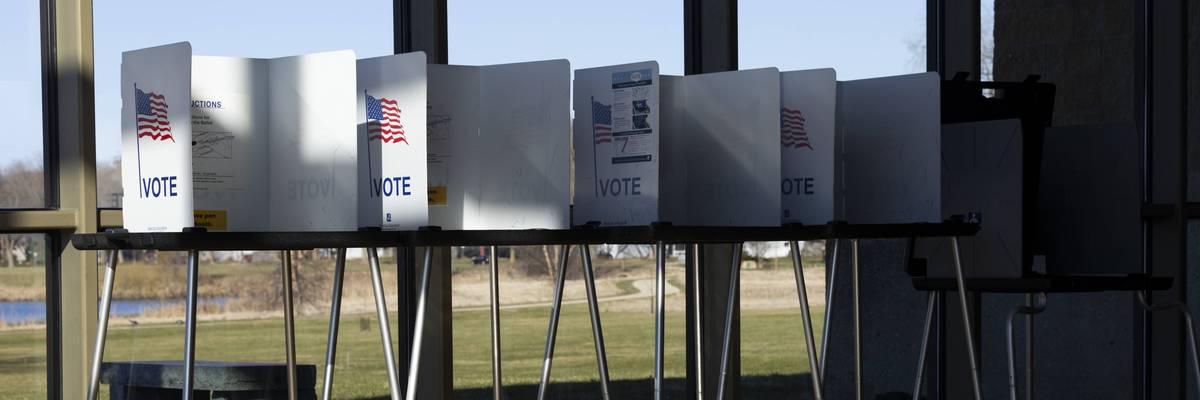
Ballot booths soak up morning sunshine during the spring election at Warner Park Community Recreation Center on April 7, 2026 in Madison, Wisconsin.
The voting booth is where private belief becomes public direction. Where individual dignity translates into collective decision-making. Where democracy is not debated, but practiced.
When asked to name America’s most sacred place, what comes to mind?
Perhaps the 9/11 Memorial, where grief and resilience coexist in quiet reflection. Or Arlington National Cemetery’s Tomb of the Unknown Soldier, honoring sacrifice beyond name or rank. For some, sacredness is rooted in heritage. The Black Hills of South Dakota, revered by the Sioux Nation. Seattle's Sakya Monastery. Newport's Touro Synagogue (the nation's first). The Martin Luther King Jr. Memorial in Washington, DC, or perhaps a bar in New York City called Stonewall, where a marginalized group refused to remain invisible.
All are worthy answers.
But for me, the most sacred place in America is far less grand, far less visible, and far more powerful.
This moment is not simply about policy differences. It is about how, and how well, our democratic system functions at its core.
It is the voting booth.
I came to understand this not through theory, but through experience.
In 1971, just two weeks after my 18th birthday, the 26th Amendment was ratified, granting 18-year-olds the right to vote. My generation had watched young men drafted into the Vietnam War, sent to fight and die, without having a voice in the democracy they were asked to defend.
That changed overnight.
I was among the first to step into that new reality.
My first voting booth was simple, a small curtained space with metal levers and switches. As I pulled the close-curtain lever, it made a unique sound, punctuating a sense of autonomy, privacy, freedom, personal power, and my passage into responsible adulthood.
That moment has stayed with me ever since.
Today, as we approach another pivotal election, that sacred space feels more important, and more fragile, than ever.
The six-month countdown to the midterms has begun.
This election carries a different kind of weight. In recent years, the balance of power that defines our system of government has shown visible strain. A legislative branch often mired in gridlock has struggled to provide consistent oversight of the executive. At the same time, a Supreme Court reshaped by a series of deeply consequential appointments has issued rulings that revisit and, in some cases, reverse long-settled precedents, altering the landscape of rights and federal authority. Layer onto that ongoing disputes over election integrity and the certification of results, and it becomes clear that this moment is not simply about policy differences. It is about how, and how well, our democratic system functions at its core.
Across the country, we are witnessing debates and decisions that directly affect who can vote, how they vote, and whether those votes are counted without interference. In some states, new legislation has shortened early voting periods, limited the use of ballot drop boxes, or imposed stricter identification requirements that can make participation more difficult. Court decisions have reshaped long-standing protections related to privacy and bodily autonomy, raising broader questions about how constitutional rights are interpreted and applied. We have also seen documented efforts to challenge certified election results and pressure officials to overturn outcomes, actions that test the durability of norms once considered settled.
This is not about party. It is about participation.
The voting booth remains one of the last places where power is perfectly equal. No wealth, status, or platform can amplify one person’s vote over another’s. Inside that space, each voice carries the same weight.
The voting booth.
A place where a mother of six in Jackson, Wyoming can vote her conscience without fearing a husband who prefers her silent and pregnant.
A place where a senior in a Florida group home can vote his mind despite the cable news chatter and groupthink that dominate the evening dining table.
A place where a devout Christian can still feel safe, without judgment, following her beliefs by supporting a woman’s right to choose.
A place where an assembly line worker from West Virginia can go against the grain and cast a vote that supports his gay nephew, a kid he knows deserves basic human rights just as much as any guy on his bowling team.
The voting booth is where private belief becomes public direction. Where individual dignity translates into collective decision-making. Where democracy is not debated, but practiced.
And yet, participation is not guaranteed.
Even in recent high-turnout elections, tens of millions of eligible Americans chose not to vote. Some out of frustration. Some out of disillusionment. Some out of the belief that their voice does not matter.
But absence has consequences.
A sacred place means nothing if it stands empty.
The voting booth does not defend itself. It does not speak unless we do. It does not protect rights, norms, or institutions on its own. It simply offers the opportunity.
What we do with that opportunity is everything.
This election, like many before it, will shape policies, priorities, and the direction of the country. Reasonable people will disagree on outcomes, candidates, and solutions. That is not a weakness of democracy. It is its design.
But participation is not optional if democracy is to endure.
The most sacred place in America is still there, waiting, quiet, unassuming, and powerful as ever.
The question is whether we will show up.
Vote.
Dear Common Dreams reader, It’s been nearly 30 years since I co-founded Common Dreams with my late wife, Lina Newhouser. We had the radical notion that journalism should serve the public good, not corporate profits. It was clear to us from the outset what it would take to build such a project. No paid advertisements. No corporate sponsors. No millionaire publisher telling us what to think or do. Many people said we wouldn't last a year, but we proved those doubters wrong. Together with a tremendous team of journalists and dedicated staff, we built an independent media outlet free from the constraints of profits and corporate control. Our mission has always been simple: To inform. To inspire. To ignite change for the common good. Building Common Dreams was not easy. Our survival was never guaranteed. When you take on the most powerful forces—Wall Street greed, fossil fuel industry destruction, Big Tech lobbyists, and uber-rich oligarchs who have spent billions upon billions rigging the economy and democracy in their favor—the only bulwark you have is supporters who believe in your work. But here’s the urgent message from me today. It's never been this bad out there. And it's never been this hard to keep us going. At the very moment Common Dreams is most needed, the threats we face are intensifying. We need your support now more than ever. We don't accept corporate advertising and never will. We don't have a paywall because we don't think people should be blocked from critical news based on their ability to pay. Everything we do is funded by the donations of readers like you. When everyone does the little they can afford, we are strong. But if that support retreats or dries up, so do we. Will you donate now to make sure Common Dreams not only survives but thrives? —Craig Brown, Co-founder |
When asked to name America’s most sacred place, what comes to mind?
Perhaps the 9/11 Memorial, where grief and resilience coexist in quiet reflection. Or Arlington National Cemetery’s Tomb of the Unknown Soldier, honoring sacrifice beyond name or rank. For some, sacredness is rooted in heritage. The Black Hills of South Dakota, revered by the Sioux Nation. Seattle's Sakya Monastery. Newport's Touro Synagogue (the nation's first). The Martin Luther King Jr. Memorial in Washington, DC, or perhaps a bar in New York City called Stonewall, where a marginalized group refused to remain invisible.
All are worthy answers.
But for me, the most sacred place in America is far less grand, far less visible, and far more powerful.
This moment is not simply about policy differences. It is about how, and how well, our democratic system functions at its core.
It is the voting booth.
I came to understand this not through theory, but through experience.
In 1971, just two weeks after my 18th birthday, the 26th Amendment was ratified, granting 18-year-olds the right to vote. My generation had watched young men drafted into the Vietnam War, sent to fight and die, without having a voice in the democracy they were asked to defend.
That changed overnight.
I was among the first to step into that new reality.
My first voting booth was simple, a small curtained space with metal levers and switches. As I pulled the close-curtain lever, it made a unique sound, punctuating a sense of autonomy, privacy, freedom, personal power, and my passage into responsible adulthood.
That moment has stayed with me ever since.
Today, as we approach another pivotal election, that sacred space feels more important, and more fragile, than ever.
The six-month countdown to the midterms has begun.
This election carries a different kind of weight. In recent years, the balance of power that defines our system of government has shown visible strain. A legislative branch often mired in gridlock has struggled to provide consistent oversight of the executive. At the same time, a Supreme Court reshaped by a series of deeply consequential appointments has issued rulings that revisit and, in some cases, reverse long-settled precedents, altering the landscape of rights and federal authority. Layer onto that ongoing disputes over election integrity and the certification of results, and it becomes clear that this moment is not simply about policy differences. It is about how, and how well, our democratic system functions at its core.
Across the country, we are witnessing debates and decisions that directly affect who can vote, how they vote, and whether those votes are counted without interference. In some states, new legislation has shortened early voting periods, limited the use of ballot drop boxes, or imposed stricter identification requirements that can make participation more difficult. Court decisions have reshaped long-standing protections related to privacy and bodily autonomy, raising broader questions about how constitutional rights are interpreted and applied. We have also seen documented efforts to challenge certified election results and pressure officials to overturn outcomes, actions that test the durability of norms once considered settled.
This is not about party. It is about participation.
The voting booth remains one of the last places where power is perfectly equal. No wealth, status, or platform can amplify one person’s vote over another’s. Inside that space, each voice carries the same weight.
The voting booth.
A place where a mother of six in Jackson, Wyoming can vote her conscience without fearing a husband who prefers her silent and pregnant.
A place where a senior in a Florida group home can vote his mind despite the cable news chatter and groupthink that dominate the evening dining table.
A place where a devout Christian can still feel safe, without judgment, following her beliefs by supporting a woman’s right to choose.
A place where an assembly line worker from West Virginia can go against the grain and cast a vote that supports his gay nephew, a kid he knows deserves basic human rights just as much as any guy on his bowling team.
The voting booth is where private belief becomes public direction. Where individual dignity translates into collective decision-making. Where democracy is not debated, but practiced.
And yet, participation is not guaranteed.
Even in recent high-turnout elections, tens of millions of eligible Americans chose not to vote. Some out of frustration. Some out of disillusionment. Some out of the belief that their voice does not matter.
But absence has consequences.
A sacred place means nothing if it stands empty.
The voting booth does not defend itself. It does not speak unless we do. It does not protect rights, norms, or institutions on its own. It simply offers the opportunity.
What we do with that opportunity is everything.
This election, like many before it, will shape policies, priorities, and the direction of the country. Reasonable people will disagree on outcomes, candidates, and solutions. That is not a weakness of democracy. It is its design.
But participation is not optional if democracy is to endure.
The most sacred place in America is still there, waiting, quiet, unassuming, and powerful as ever.
The question is whether we will show up.
Vote.
When asked to name America’s most sacred place, what comes to mind?
Perhaps the 9/11 Memorial, where grief and resilience coexist in quiet reflection. Or Arlington National Cemetery’s Tomb of the Unknown Soldier, honoring sacrifice beyond name or rank. For some, sacredness is rooted in heritage. The Black Hills of South Dakota, revered by the Sioux Nation. Seattle's Sakya Monastery. Newport's Touro Synagogue (the nation's first). The Martin Luther King Jr. Memorial in Washington, DC, or perhaps a bar in New York City called Stonewall, where a marginalized group refused to remain invisible.
All are worthy answers.
But for me, the most sacred place in America is far less grand, far less visible, and far more powerful.
This moment is not simply about policy differences. It is about how, and how well, our democratic system functions at its core.
It is the voting booth.
I came to understand this not through theory, but through experience.
In 1971, just two weeks after my 18th birthday, the 26th Amendment was ratified, granting 18-year-olds the right to vote. My generation had watched young men drafted into the Vietnam War, sent to fight and die, without having a voice in the democracy they were asked to defend.
That changed overnight.
I was among the first to step into that new reality.
My first voting booth was simple, a small curtained space with metal levers and switches. As I pulled the close-curtain lever, it made a unique sound, punctuating a sense of autonomy, privacy, freedom, personal power, and my passage into responsible adulthood.
That moment has stayed with me ever since.
Today, as we approach another pivotal election, that sacred space feels more important, and more fragile, than ever.
The six-month countdown to the midterms has begun.
This election carries a different kind of weight. In recent years, the balance of power that defines our system of government has shown visible strain. A legislative branch often mired in gridlock has struggled to provide consistent oversight of the executive. At the same time, a Supreme Court reshaped by a series of deeply consequential appointments has issued rulings that revisit and, in some cases, reverse long-settled precedents, altering the landscape of rights and federal authority. Layer onto that ongoing disputes over election integrity and the certification of results, and it becomes clear that this moment is not simply about policy differences. It is about how, and how well, our democratic system functions at its core.
Across the country, we are witnessing debates and decisions that directly affect who can vote, how they vote, and whether those votes are counted without interference. In some states, new legislation has shortened early voting periods, limited the use of ballot drop boxes, or imposed stricter identification requirements that can make participation more difficult. Court decisions have reshaped long-standing protections related to privacy and bodily autonomy, raising broader questions about how constitutional rights are interpreted and applied. We have also seen documented efforts to challenge certified election results and pressure officials to overturn outcomes, actions that test the durability of norms once considered settled.
This is not about party. It is about participation.
The voting booth remains one of the last places where power is perfectly equal. No wealth, status, or platform can amplify one person’s vote over another’s. Inside that space, each voice carries the same weight.
The voting booth.
A place where a mother of six in Jackson, Wyoming can vote her conscience without fearing a husband who prefers her silent and pregnant.
A place where a senior in a Florida group home can vote his mind despite the cable news chatter and groupthink that dominate the evening dining table.
A place where a devout Christian can still feel safe, without judgment, following her beliefs by supporting a woman’s right to choose.
A place where an assembly line worker from West Virginia can go against the grain and cast a vote that supports his gay nephew, a kid he knows deserves basic human rights just as much as any guy on his bowling team.
The voting booth is where private belief becomes public direction. Where individual dignity translates into collective decision-making. Where democracy is not debated, but practiced.
And yet, participation is not guaranteed.
Even in recent high-turnout elections, tens of millions of eligible Americans chose not to vote. Some out of frustration. Some out of disillusionment. Some out of the belief that their voice does not matter.
But absence has consequences.
A sacred place means nothing if it stands empty.
The voting booth does not defend itself. It does not speak unless we do. It does not protect rights, norms, or institutions on its own. It simply offers the opportunity.
What we do with that opportunity is everything.
This election, like many before it, will shape policies, priorities, and the direction of the country. Reasonable people will disagree on outcomes, candidates, and solutions. That is not a weakness of democracy. It is its design.
But participation is not optional if democracy is to endure.
The most sacred place in America is still there, waiting, quiet, unassuming, and powerful as ever.
The question is whether we will show up.
Vote.