5
#000000
#FFFFFF
To donate by check, phone, or other method, see our More Ways to Give page.
Daily news & progressive opinion—funded by the people, not the corporations—delivered straight to your inbox.
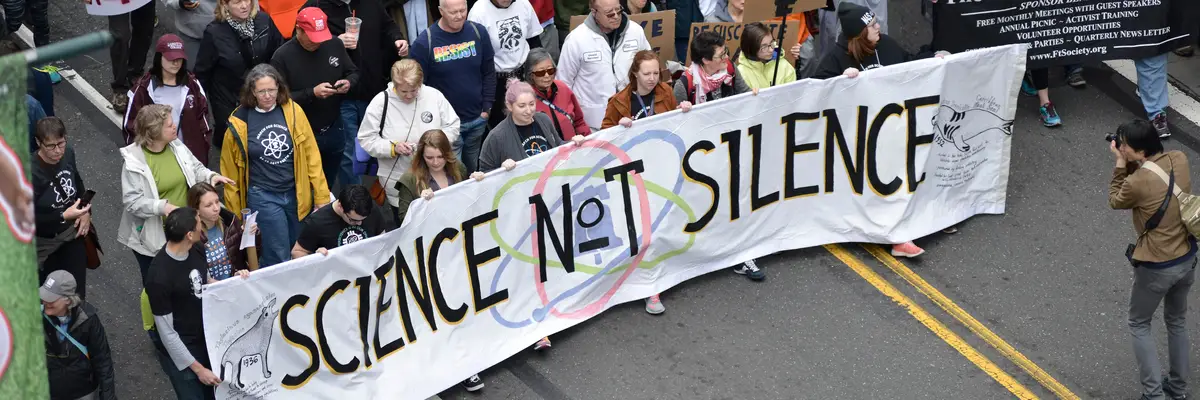
Thousands participate in the National March for Science in Philadelphia, Pennsylvania, on Earth Day, April 22, 2017. S
Late last week the White House announced plans for a major tightening of political control over research grants; instead of relying on the advice of expert panels as to which research should be funded, it will defer to political appointees.
There are moments when it feels like the president’s attention (as occasionally happens when we age) just keeps getting narrower and narrower—the things he really cares about (arch, reflecting pool, Kennedy Center, gilded horse statues) are all within a few miles of his home. He can barely be bothered to stay interested in the war he started in Iran; he’s more concerned with giving pretend tours of his imaginary ballroom. (“You come in, you have cocktails,” he explained to his daughter in law, interviewing him for Fox in true dear-leader fashion. “They they go through the door, in for dinner.”)
But the momentum behind the truly dangerous Project 2025 reordering of our society continues apace, even if—without Elon Musk to give it a face—we aren’t noticing. Late last week the White House announced plans for a major tightening of political control over research grants. Instead of relying on the advice of expert panels as to which research should be funded, as Kevin Bogardus explains:
One or more senior political appointees designated by their agency head must conduct “a pre-issuance review” of all discretionary grants, making sure they follow several principles, including to “demonstrably advance the President’s policy priorities.”
Since I enjoy making up new words (though surely someone has beaten me to this?) I’m going to call it “scilencing.”
The danger inherent in this should be entirely obvious. Jeff Mervis at Science interviewed a number of observers:
“What OMB [Office of Management and Budget] is proposing is not a reform of grants management,” Elizabeth Ginexi, a former program officer at the National Institutes of Health (NIH), writes in a Substack post. “It is a vehicle for complete political control of science… over every stage of the federal science funding lifecycle.” Representative Zoe Lofgren (D-Calif.), a leading critic of the Trump administration’s research policies, calls the proposal “a dystopian move that would destroy what remains of merit-based review.”
This would be a bad idea in a reason-based administration. In one that believes medieval nonsense about public health and that is eager to deregulate chemicals and end efforts to clean the air, it’s downright lethal.
And there is no doubt where the impulse really originated. The science the Trump administration really hates is climate science, because it threatens the “energy dominance” that the White House has made its basic foreign and economic policy, not to mention the profits of the fossil fuel industry that has been such an attentive donor. It’s not the first time that GOP administrations have tried to stymie climate science. Everyone remembers James Hansen’s crucial 1988 congressional testimony that global warming was underway; fewer recall that when he returned to Congress the next year the White House tried to rewrite and soften the conclusions in his testimony. That was under George H.W. Bush; under his son, in 2006, the White House tried again to rein him in. As he told Andy Revkin, NASA officials
ordered the public affairs staff to review his coming lectures, papers, postings on the Goddard Web site, and requests for interviews from journalists.
Dr. Hansen said he would ignore the restrictions. “They feel their job is to be this censor of information going out to the public,” he said.
Hansen was crucial enough—the Paul Revere of climate change—and senior enough that he was able to keep working and speaking. And the scientific research money kept more or less flowing. But now, in this new bureaucratic play, the Office of Management and Budget is trying to make sure that such independence (the single most obvious requirement for scientific advance) is a thing of the past. As John Timmer wrote at Ars Technica:
The result is a horror show for US science research. Not only is peer review made a secondary consideration, but the new rules would allow any federal agency to cancel any grant at any time based on the vague assertion that it isn’t in the “national interest.” The document would also ban any grants on a number of culture war topics, limit international collaborations, and block spending on things like publishing papers and attending conferences.
It is, in short, a recipe for how the government can finish the job of crippling American science.
This is not yet a done deal. There is a 45-day comment period for letting the government know what you think of their plan, and 41 of those days remain. Here’s the place to have your say.
I’m not, I must say, convinced they’ll pay great attention to the comments, so it’s also crucial to be letting your congresspeople know what you think about this attack on science. Congress has so far been able to save at least some of the things Russell Vought has sought to kill: indeed, word came this week that the NOAA budget will include money to keep the carbon dioxide observatory at Mauna Loa (aka the world’s most important scientific instrument) up and running. That’s a direct result of Congress hearing outcry, so let’s keep it up.
Remind them that real leaders actually want to know what science can tell them—case in point, the remarkable new movie, Pressure, which tells the story of how General Eisenhower listened to the new and unorthodox science of meteorology to guide his D-Day decision making (95% on Rotten Tomatoes, for those of you who like numbers).
That changes on this scale are possible is precisely what terrifies the fossil fuel industry, and in turn the Trump administration.
The good news, I suppose, is that on climate and energy the cat has largely escaped the bag. We do know what the problem is, even if the ramifications become more dire with each passing week. (Here’s a somewhat terrifying update on the prospects for this year’s wildfire season; meanwhile, Tom Harris has the new numbers on Antarctic melt.). And we know where the solution lies. Indeed, it too comes into clearer focus with each passing week. As I wrote earlier this year, the action in the next few years is going to be about batteries, and boy is that proving true. Bloomberg confirmed last month that 2025 was the first year the world installed more than a hundred gigawatts of battery storage, up 48% from the year before, and expected to grow another 46% this year.
South Australia held a big auction last month for “firm supply” across the territory’s electric grid. This is supposed to be the last place where fossil fuel is superior: always-on power. But all the low bids came from companies that wanted to (and now will) install big batteries. As Giles Parkinson reported:
It is yet another sign of the growing dominance of battery storage technology in Australia’s main grids (and off grid).
Big batteries have dominated other long duration storage tenders, particularly in NSW [New South Wales], were it has sidelined pumped hydro projects, and battery storage has been steadily sending gas peakers to the sidelines, particularly in the demand peaks they used to dominate.
Indeed, Australia is emerging as the test case for just how fast and furiously you can switch a grid to clean renewables. Even as its government continues to mine huge amounts of coal to send abroad, it’s providing a generous domestic subsidy for Aussies who want to put smaller batteries in their homes. And that, in turn, is underwriting a revolution on the grid. As Adam Morton and Petra Stock wrote this past week:
Nearly 60% of the household-scale battery capacity installed across almost 200 other countries this financial year will be in the southern continent, according to a recent analysis. Since July, about 415,000 have been connected—roughly 1 unit for every 25 Australian homes.
Previously, power prices would rocket in the evenings as gas-fired power—the most expensive form of energy generation on the Australian grid—was turned on to meet peak demand. With solar and wind now providing nearly half the electricity, and coal-fired power plants gradually closing, gas has been used to fill gaps after the sun sets.
But batteries are increasingly taking over that role. Total gas-fired generation was 24% lower across three months this summer compared with the year before. Tennant Reed, the climate change and energy director with the Australian Industry Group, representing more than 60,000 businesses, says it has “completely changed how electricity prices are formed.”
I hope you’ll go back and read the sentence I italicized in the last paragraph: the use of gas to create electricity dropped 23% in a year. This is much like what’s happened in California, where Mark Jacobson reports that the world’s fourth largest economy is using 60% less gas to produce electricity than it did three years ago. That changes on this scale are possible is precisely what terrifies the fossil fuel industry, and in turn the Trump administration.
Beginning one month from tomorrow, Australians, whether they have solar panels or batteries or none of the above, will get three free hours of electricity every afternoon from noon to 3:00 pm.
And the possibilities are everywhere. Canary Media’s Julian Spector wrote last week, a new global report shows that these so-called “firm renewables” (wind and sun coupled with batteries)
“has crossed the threshold of cost competitiveness with new fossil fuel generation,” in areas with plenty of sun or wind. “The central question is no longer whether firm renewables can compete on cost, but how quickly the structural conditions needed to realise their potential can be put in place across the diversity of markets and institutional contexts prevailing globally.”
China sets the bar with its shockingly low cost of firm renewables today.
IRENA [International Renewable Energy Agency] looked at 252 solar projects that went online there in 2024 and found that many of them could be augmented with extra solar capacity and batteries to deliver power cheaper than the $100-per-megawatt-hour benchmark for new gas-fired plants. Almost all the modeled solar-battery plants could beat that cost for firm clean power 90% of the time; even at the higher reliability threshold of 99%, nearly half the projects remained competitive, and the lowest cost was $46 per megawatt-hour.
And would any of this be, I don’t know, politically popular?
Beginning one month from tomorrow, Australians, whether they have solar panels or batteries or none of the above, will get three free hours of electricity every afternoon from noon to 3:00 pm. If you want to know why our government needs to shut up scientists and ward off engineers, that’s why.
Oh, they’re also trying to shut down the world’s central archive of disasters, which lets us learn from the past. I predict that will not slow the pace of trouble.
Dear Common Dreams reader, It’s been nearly 30 years since I co-founded Common Dreams with my late wife, Lina Newhouser. We had the radical notion that journalism should serve the public good, not corporate profits. It was clear to us from the outset what it would take to build such a project. No paid advertisements. No corporate sponsors. No millionaire publisher telling us what to think or do. Many people said we wouldn't last a year, but we proved those doubters wrong. Together with a tremendous team of journalists and dedicated staff, we built an independent media outlet free from the constraints of profits and corporate control. Our mission has always been simple: To inform. To inspire. To ignite change for the common good. Building Common Dreams was not easy. Our survival was never guaranteed. When you take on the most powerful forces—Wall Street greed, fossil fuel industry destruction, Big Tech lobbyists, and uber-rich oligarchs who have spent billions upon billions rigging the economy and democracy in their favor—the only bulwark you have is supporters who believe in your work. But here’s the urgent message from me today. It's never been this bad out there. And it's never been this hard to keep us going. At the very moment Common Dreams is most needed, the threats we face are intensifying. We need your support now more than ever. We don't accept corporate advertising and never will. We don't have a paywall because we don't think people should be blocked from critical news based on their ability to pay. Everything we do is funded by the donations of readers like you. When everyone does the little they can afford, we are strong. But if that support retreats or dries up, so do we. Will you donate now to make sure Common Dreams not only survives but thrives? —Craig Brown, Co-founder |
There are moments when it feels like the president’s attention (as occasionally happens when we age) just keeps getting narrower and narrower—the things he really cares about (arch, reflecting pool, Kennedy Center, gilded horse statues) are all within a few miles of his home. He can barely be bothered to stay interested in the war he started in Iran; he’s more concerned with giving pretend tours of his imaginary ballroom. (“You come in, you have cocktails,” he explained to his daughter in law, interviewing him for Fox in true dear-leader fashion. “They they go through the door, in for dinner.”)
But the momentum behind the truly dangerous Project 2025 reordering of our society continues apace, even if—without Elon Musk to give it a face—we aren’t noticing. Late last week the White House announced plans for a major tightening of political control over research grants. Instead of relying on the advice of expert panels as to which research should be funded, as Kevin Bogardus explains:
One or more senior political appointees designated by their agency head must conduct “a pre-issuance review” of all discretionary grants, making sure they follow several principles, including to “demonstrably advance the President’s policy priorities.”
Since I enjoy making up new words (though surely someone has beaten me to this?) I’m going to call it “scilencing.”
The danger inherent in this should be entirely obvious. Jeff Mervis at Science interviewed a number of observers:
“What OMB [Office of Management and Budget] is proposing is not a reform of grants management,” Elizabeth Ginexi, a former program officer at the National Institutes of Health (NIH), writes in a Substack post. “It is a vehicle for complete political control of science… over every stage of the federal science funding lifecycle.” Representative Zoe Lofgren (D-Calif.), a leading critic of the Trump administration’s research policies, calls the proposal “a dystopian move that would destroy what remains of merit-based review.”
This would be a bad idea in a reason-based administration. In one that believes medieval nonsense about public health and that is eager to deregulate chemicals and end efforts to clean the air, it’s downright lethal.
And there is no doubt where the impulse really originated. The science the Trump administration really hates is climate science, because it threatens the “energy dominance” that the White House has made its basic foreign and economic policy, not to mention the profits of the fossil fuel industry that has been such an attentive donor. It’s not the first time that GOP administrations have tried to stymie climate science. Everyone remembers James Hansen’s crucial 1988 congressional testimony that global warming was underway; fewer recall that when he returned to Congress the next year the White House tried to rewrite and soften the conclusions in his testimony. That was under George H.W. Bush; under his son, in 2006, the White House tried again to rein him in. As he told Andy Revkin, NASA officials
ordered the public affairs staff to review his coming lectures, papers, postings on the Goddard Web site, and requests for interviews from journalists.
Dr. Hansen said he would ignore the restrictions. “They feel their job is to be this censor of information going out to the public,” he said.
Hansen was crucial enough—the Paul Revere of climate change—and senior enough that he was able to keep working and speaking. And the scientific research money kept more or less flowing. But now, in this new bureaucratic play, the Office of Management and Budget is trying to make sure that such independence (the single most obvious requirement for scientific advance) is a thing of the past. As John Timmer wrote at Ars Technica:
The result is a horror show for US science research. Not only is peer review made a secondary consideration, but the new rules would allow any federal agency to cancel any grant at any time based on the vague assertion that it isn’t in the “national interest.” The document would also ban any grants on a number of culture war topics, limit international collaborations, and block spending on things like publishing papers and attending conferences.
It is, in short, a recipe for how the government can finish the job of crippling American science.
This is not yet a done deal. There is a 45-day comment period for letting the government know what you think of their plan, and 41 of those days remain. Here’s the place to have your say.
I’m not, I must say, convinced they’ll pay great attention to the comments, so it’s also crucial to be letting your congresspeople know what you think about this attack on science. Congress has so far been able to save at least some of the things Russell Vought has sought to kill: indeed, word came this week that the NOAA budget will include money to keep the carbon dioxide observatory at Mauna Loa (aka the world’s most important scientific instrument) up and running. That’s a direct result of Congress hearing outcry, so let’s keep it up.
Remind them that real leaders actually want to know what science can tell them—case in point, the remarkable new movie, Pressure, which tells the story of how General Eisenhower listened to the new and unorthodox science of meteorology to guide his D-Day decision making (95% on Rotten Tomatoes, for those of you who like numbers).
That changes on this scale are possible is precisely what terrifies the fossil fuel industry, and in turn the Trump administration.
The good news, I suppose, is that on climate and energy the cat has largely escaped the bag. We do know what the problem is, even if the ramifications become more dire with each passing week. (Here’s a somewhat terrifying update on the prospects for this year’s wildfire season; meanwhile, Tom Harris has the new numbers on Antarctic melt.). And we know where the solution lies. Indeed, it too comes into clearer focus with each passing week. As I wrote earlier this year, the action in the next few years is going to be about batteries, and boy is that proving true. Bloomberg confirmed last month that 2025 was the first year the world installed more than a hundred gigawatts of battery storage, up 48% from the year before, and expected to grow another 46% this year.
South Australia held a big auction last month for “firm supply” across the territory’s electric grid. This is supposed to be the last place where fossil fuel is superior: always-on power. But all the low bids came from companies that wanted to (and now will) install big batteries. As Giles Parkinson reported:
It is yet another sign of the growing dominance of battery storage technology in Australia’s main grids (and off grid).
Big batteries have dominated other long duration storage tenders, particularly in NSW [New South Wales], were it has sidelined pumped hydro projects, and battery storage has been steadily sending gas peakers to the sidelines, particularly in the demand peaks they used to dominate.
Indeed, Australia is emerging as the test case for just how fast and furiously you can switch a grid to clean renewables. Even as its government continues to mine huge amounts of coal to send abroad, it’s providing a generous domestic subsidy for Aussies who want to put smaller batteries in their homes. And that, in turn, is underwriting a revolution on the grid. As Adam Morton and Petra Stock wrote this past week:
Nearly 60% of the household-scale battery capacity installed across almost 200 other countries this financial year will be in the southern continent, according to a recent analysis. Since July, about 415,000 have been connected—roughly 1 unit for every 25 Australian homes.
Previously, power prices would rocket in the evenings as gas-fired power—the most expensive form of energy generation on the Australian grid—was turned on to meet peak demand. With solar and wind now providing nearly half the electricity, and coal-fired power plants gradually closing, gas has been used to fill gaps after the sun sets.
But batteries are increasingly taking over that role. Total gas-fired generation was 24% lower across three months this summer compared with the year before. Tennant Reed, the climate change and energy director with the Australian Industry Group, representing more than 60,000 businesses, says it has “completely changed how electricity prices are formed.”
I hope you’ll go back and read the sentence I italicized in the last paragraph: the use of gas to create electricity dropped 23% in a year. This is much like what’s happened in California, where Mark Jacobson reports that the world’s fourth largest economy is using 60% less gas to produce electricity than it did three years ago. That changes on this scale are possible is precisely what terrifies the fossil fuel industry, and in turn the Trump administration.
Beginning one month from tomorrow, Australians, whether they have solar panels or batteries or none of the above, will get three free hours of electricity every afternoon from noon to 3:00 pm.
And the possibilities are everywhere. Canary Media’s Julian Spector wrote last week, a new global report shows that these so-called “firm renewables” (wind and sun coupled with batteries)
“has crossed the threshold of cost competitiveness with new fossil fuel generation,” in areas with plenty of sun or wind. “The central question is no longer whether firm renewables can compete on cost, but how quickly the structural conditions needed to realise their potential can be put in place across the diversity of markets and institutional contexts prevailing globally.”
China sets the bar with its shockingly low cost of firm renewables today.
IRENA [International Renewable Energy Agency] looked at 252 solar projects that went online there in 2024 and found that many of them could be augmented with extra solar capacity and batteries to deliver power cheaper than the $100-per-megawatt-hour benchmark for new gas-fired plants. Almost all the modeled solar-battery plants could beat that cost for firm clean power 90% of the time; even at the higher reliability threshold of 99%, nearly half the projects remained competitive, and the lowest cost was $46 per megawatt-hour.
And would any of this be, I don’t know, politically popular?
Beginning one month from tomorrow, Australians, whether they have solar panels or batteries or none of the above, will get three free hours of electricity every afternoon from noon to 3:00 pm. If you want to know why our government needs to shut up scientists and ward off engineers, that’s why.
Oh, they’re also trying to shut down the world’s central archive of disasters, which lets us learn from the past. I predict that will not slow the pace of trouble.
There are moments when it feels like the president’s attention (as occasionally happens when we age) just keeps getting narrower and narrower—the things he really cares about (arch, reflecting pool, Kennedy Center, gilded horse statues) are all within a few miles of his home. He can barely be bothered to stay interested in the war he started in Iran; he’s more concerned with giving pretend tours of his imaginary ballroom. (“You come in, you have cocktails,” he explained to his daughter in law, interviewing him for Fox in true dear-leader fashion. “They they go through the door, in for dinner.”)
But the momentum behind the truly dangerous Project 2025 reordering of our society continues apace, even if—without Elon Musk to give it a face—we aren’t noticing. Late last week the White House announced plans for a major tightening of political control over research grants. Instead of relying on the advice of expert panels as to which research should be funded, as Kevin Bogardus explains:
One or more senior political appointees designated by their agency head must conduct “a pre-issuance review” of all discretionary grants, making sure they follow several principles, including to “demonstrably advance the President’s policy priorities.”
Since I enjoy making up new words (though surely someone has beaten me to this?) I’m going to call it “scilencing.”
The danger inherent in this should be entirely obvious. Jeff Mervis at Science interviewed a number of observers:
“What OMB [Office of Management and Budget] is proposing is not a reform of grants management,” Elizabeth Ginexi, a former program officer at the National Institutes of Health (NIH), writes in a Substack post. “It is a vehicle for complete political control of science… over every stage of the federal science funding lifecycle.” Representative Zoe Lofgren (D-Calif.), a leading critic of the Trump administration’s research policies, calls the proposal “a dystopian move that would destroy what remains of merit-based review.”
This would be a bad idea in a reason-based administration. In one that believes medieval nonsense about public health and that is eager to deregulate chemicals and end efforts to clean the air, it’s downright lethal.
And there is no doubt where the impulse really originated. The science the Trump administration really hates is climate science, because it threatens the “energy dominance” that the White House has made its basic foreign and economic policy, not to mention the profits of the fossil fuel industry that has been such an attentive donor. It’s not the first time that GOP administrations have tried to stymie climate science. Everyone remembers James Hansen’s crucial 1988 congressional testimony that global warming was underway; fewer recall that when he returned to Congress the next year the White House tried to rewrite and soften the conclusions in his testimony. That was under George H.W. Bush; under his son, in 2006, the White House tried again to rein him in. As he told Andy Revkin, NASA officials
ordered the public affairs staff to review his coming lectures, papers, postings on the Goddard Web site, and requests for interviews from journalists.
Dr. Hansen said he would ignore the restrictions. “They feel their job is to be this censor of information going out to the public,” he said.
Hansen was crucial enough—the Paul Revere of climate change—and senior enough that he was able to keep working and speaking. And the scientific research money kept more or less flowing. But now, in this new bureaucratic play, the Office of Management and Budget is trying to make sure that such independence (the single most obvious requirement for scientific advance) is a thing of the past. As John Timmer wrote at Ars Technica:
The result is a horror show for US science research. Not only is peer review made a secondary consideration, but the new rules would allow any federal agency to cancel any grant at any time based on the vague assertion that it isn’t in the “national interest.” The document would also ban any grants on a number of culture war topics, limit international collaborations, and block spending on things like publishing papers and attending conferences.
It is, in short, a recipe for how the government can finish the job of crippling American science.
This is not yet a done deal. There is a 45-day comment period for letting the government know what you think of their plan, and 41 of those days remain. Here’s the place to have your say.
I’m not, I must say, convinced they’ll pay great attention to the comments, so it’s also crucial to be letting your congresspeople know what you think about this attack on science. Congress has so far been able to save at least some of the things Russell Vought has sought to kill: indeed, word came this week that the NOAA budget will include money to keep the carbon dioxide observatory at Mauna Loa (aka the world’s most important scientific instrument) up and running. That’s a direct result of Congress hearing outcry, so let’s keep it up.
Remind them that real leaders actually want to know what science can tell them—case in point, the remarkable new movie, Pressure, which tells the story of how General Eisenhower listened to the new and unorthodox science of meteorology to guide his D-Day decision making (95% on Rotten Tomatoes, for those of you who like numbers).
That changes on this scale are possible is precisely what terrifies the fossil fuel industry, and in turn the Trump administration.
The good news, I suppose, is that on climate and energy the cat has largely escaped the bag. We do know what the problem is, even if the ramifications become more dire with each passing week. (Here’s a somewhat terrifying update on the prospects for this year’s wildfire season; meanwhile, Tom Harris has the new numbers on Antarctic melt.). And we know where the solution lies. Indeed, it too comes into clearer focus with each passing week. As I wrote earlier this year, the action in the next few years is going to be about batteries, and boy is that proving true. Bloomberg confirmed last month that 2025 was the first year the world installed more than a hundred gigawatts of battery storage, up 48% from the year before, and expected to grow another 46% this year.
South Australia held a big auction last month for “firm supply” across the territory’s electric grid. This is supposed to be the last place where fossil fuel is superior: always-on power. But all the low bids came from companies that wanted to (and now will) install big batteries. As Giles Parkinson reported:
It is yet another sign of the growing dominance of battery storage technology in Australia’s main grids (and off grid).
Big batteries have dominated other long duration storage tenders, particularly in NSW [New South Wales], were it has sidelined pumped hydro projects, and battery storage has been steadily sending gas peakers to the sidelines, particularly in the demand peaks they used to dominate.
Indeed, Australia is emerging as the test case for just how fast and furiously you can switch a grid to clean renewables. Even as its government continues to mine huge amounts of coal to send abroad, it’s providing a generous domestic subsidy for Aussies who want to put smaller batteries in their homes. And that, in turn, is underwriting a revolution on the grid. As Adam Morton and Petra Stock wrote this past week:
Nearly 60% of the household-scale battery capacity installed across almost 200 other countries this financial year will be in the southern continent, according to a recent analysis. Since July, about 415,000 have been connected—roughly 1 unit for every 25 Australian homes.
Previously, power prices would rocket in the evenings as gas-fired power—the most expensive form of energy generation on the Australian grid—was turned on to meet peak demand. With solar and wind now providing nearly half the electricity, and coal-fired power plants gradually closing, gas has been used to fill gaps after the sun sets.
But batteries are increasingly taking over that role. Total gas-fired generation was 24% lower across three months this summer compared with the year before. Tennant Reed, the climate change and energy director with the Australian Industry Group, representing more than 60,000 businesses, says it has “completely changed how electricity prices are formed.”
I hope you’ll go back and read the sentence I italicized in the last paragraph: the use of gas to create electricity dropped 23% in a year. This is much like what’s happened in California, where Mark Jacobson reports that the world’s fourth largest economy is using 60% less gas to produce electricity than it did three years ago. That changes on this scale are possible is precisely what terrifies the fossil fuel industry, and in turn the Trump administration.
Beginning one month from tomorrow, Australians, whether they have solar panels or batteries or none of the above, will get three free hours of electricity every afternoon from noon to 3:00 pm.
And the possibilities are everywhere. Canary Media’s Julian Spector wrote last week, a new global report shows that these so-called “firm renewables” (wind and sun coupled with batteries)
“has crossed the threshold of cost competitiveness with new fossil fuel generation,” in areas with plenty of sun or wind. “The central question is no longer whether firm renewables can compete on cost, but how quickly the structural conditions needed to realise their potential can be put in place across the diversity of markets and institutional contexts prevailing globally.”
China sets the bar with its shockingly low cost of firm renewables today.
IRENA [International Renewable Energy Agency] looked at 252 solar projects that went online there in 2024 and found that many of them could be augmented with extra solar capacity and batteries to deliver power cheaper than the $100-per-megawatt-hour benchmark for new gas-fired plants. Almost all the modeled solar-battery plants could beat that cost for firm clean power 90% of the time; even at the higher reliability threshold of 99%, nearly half the projects remained competitive, and the lowest cost was $46 per megawatt-hour.
And would any of this be, I don’t know, politically popular?
Beginning one month from tomorrow, Australians, whether they have solar panels or batteries or none of the above, will get three free hours of electricity every afternoon from noon to 3:00 pm. If you want to know why our government needs to shut up scientists and ward off engineers, that’s why.
Oh, they’re also trying to shut down the world’s central archive of disasters, which lets us learn from the past. I predict that will not slow the pace of trouble.