SUBSCRIBE TO OUR FREE NEWSLETTER
Daily news & progressive opinion—funded by the people, not the corporations—delivered straight to your inbox.
5
#000000
#FFFFFF
To donate by check, phone, or other method, see our More Ways to Give page.
Daily news & progressive opinion—funded by the people, not the corporations—delivered straight to your inbox.
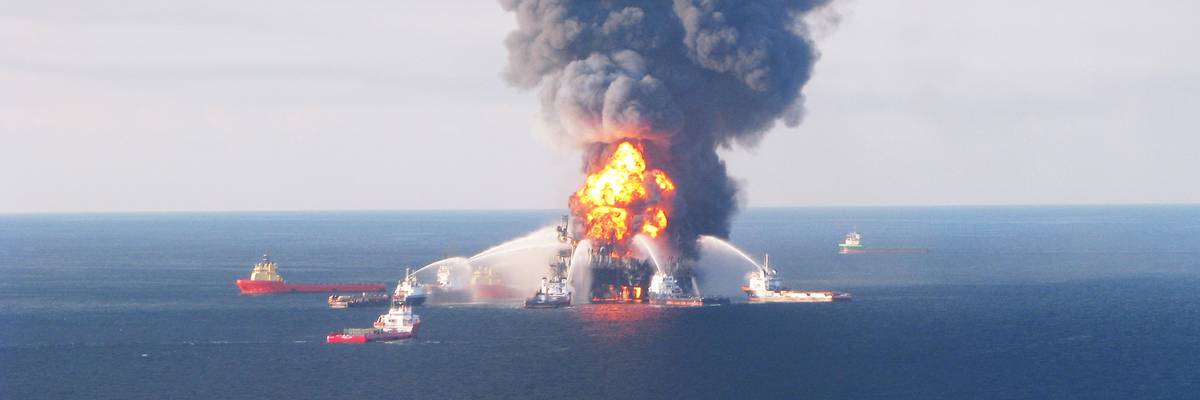
Fire boats battle a fire at the offshore oil rig Deepwater Horizon on April 21, 2010 in the Gulf of Mexico off the coast of Louisiana.
By allowing an industry tax toward oil spill prevention and response to expire, GOP leaders are exposing the nation to the unnecessary risk of continued oil pollution, including major disasters like Exxon Valdez and Deepwater Horizon.
As Congress recesses this week without reauthorizing the Affordable Care Act subsidies needed by millions of Americans, it also quietly gave the oil industry a multimillion dollar tax break by allowing the 9 cent-per-barrel oil tax (on domestic and imported oil) into the federal Oil Spill Liability Trust Fund to expire as well on December 31. The OSLTF, administered by the Coast Guard’s National Pollution Funds Center, is the nation’s central financial instrument for oil spill prevention and response, earning about $500 million per year from the nominal excise oil tax—about 0.1% of annual US oil industry revenue.
In our current political climate prioritizing industry over public interest, many feared that Congress and the Trump administration might simply allow the oil spill tax to expire, as a “Return on Investment” for industry contributions made to their political campaigns. Congress did just that. As they increase costs for millions of Americans, the Republican congress and administration are decreasing costs for some of the richest companies in the world.
For decades, Congress and the administration have remained stubbornly resistant to using the OSLTF to fund necessary oil spill prevention measures across the nation, and as tax revenue and spill damage recoveries continued to be collected, the fund balance has now grown to over $10 billion. Since the fund’s use for a single oil spill is limited to $1.5 billion, we have long proposed that a substantial portion of the remaining balance be used to better prevent oil pollution across the nation. Instead of just leaving all of this money in the bank, it should be put to work, while saving enough (perhaps $5 billion) for conventional oil spill response activities.
A transcendent lesson learned in all major oil spills around the world is that once oil is spilled, there is precious little that can be done to limit environmental damage. Historically, an average of 2-6% of total spill volume is actually recovered in major marine oil spills (Deepwater Horizon was about 4%, Exxon Valdez about 8%). These multibillion dollar spill responses may look good for oil company and government public relations, but they are virtually irrelevant in limiting environmental harm. Prevention is key to environmental protection.
As a fundamental cause of the 1989 Exxon Valdez and the 2010 Deepwater Horizon disasters was inadequate government oversight, expanding drilling while cutting oversight is as reckless as it gets.
Spill prevention measures across the nation in need of more funding include enhanced Vessel Traffic Systems, escort-rescue tugs to prevent groundings and collisions of tankers and cargo ships in dangerous passages (e.g. the March 2024 cargo ship Dali collision with the Francis Scott Key bridge in Baltimore Harbor), enhanced inspection of oil and liquefied natural gas tankers, and so on. However, the federal government has resisted using the fund for such preventive measures.
With the OSLTF tax expiration approaching this summer, we proposed that the fund’s 9 cent-per-barrel tax on domestic and imported crude oil (less than 0.2% of today’s crude oil price, or less than one cent-per-gallon of gasoline) be fully reauthorized, and that the fund’s use for many oil spill prevention measures be significantly expanded. Congress and the administration were unresponsive, raising suspicions that they intended to allow the oil tax to expire, which they just did.
One proposed use for the fund is to safely cap and decommission the millions of derelict, abandoned oil and gas wells across the nation, both onshore and offshore. Regarding these orphaned and abandoned oil wells, a 2021 scientific paper found that, of the 4,700,000 historic and active oil and gas wells across the US, only 1 in 3 (1,500,000) are considered safely plugged. Leakage from improperly abandoned oil and gas wells causes groundwater and air pollution, ecological damage, risk of explosions, and damage to human health.
Costs for well decommissioning and abandonment have been estimated to range from $10,000-$50,000 to plug old, shallow wells; $300,000 for newer, deeper wells; and up to $1 million for more complex wells. In a 2015 study, the Government Accountability Office (GAO) estimated the cost to securely decommission the thousands of deepwater oil and gas wells in the US Gulf of Mexico (two-thirds of the 5,000 wells in the Gulf of Mexico are in deep water) at $38.2 billion. The GAO study reported that, of the $38.2 billion in decommissioning liabilities, $2.3 billion were not covered by existing financial assurances; and of the remaining $35.9 billion in decommissioning liabilities, the federal government held $2.9 billion in bonds and other assurances, while waiving the remaining $33 billion for companies that passed a “financial strength test.” The GAO expressed concern about such extensive waivers of financial assurances, as this exposes the federal government to substantial future costs.
Clearly, abandoned oil and gas wells present enormous oil pollution risk, public safety hazard, and substantial government financial liability that we as a nation have ignored for too long. We have to do better, and using the OSLTF for this purpose would clearly be in the national interest.
Further, while the Trump administration recently proposed opening virtually the entire US Outer Continental Shelf (more than 1 billion acres of the nation's offshore waters) to oil and gas drilling, it slashed the budget for the Department of Interior’s Bureau of Safety and Environmental Enforcement (BSEE) by roughly 35%, from $220 million to just $143 million. As a fundamental cause of the 1989 Exxon Valdez and the 2010 Deepwater Horizon disasters was inadequate government oversight, expanding drilling while cutting oversight is as reckless as it gets. Thus, an important use for the federal oil spill fund should be to expand BSEE's budget, as it is largely focused on preventing catastrophic oil spills from the nation's several thousand offshore oil rigs. There are countless other cost-effective pollution prevention measures as well that need OSLTF funding.
But with Congress and the Trump administration ignoring these real funding needs, and allowing the oil tax to expire (as a gift to their oil industry contributors), the nation remains exposed to unnecessary risk of continued oil pollution, including small chronic releases, as well as major disasters like the Exxon Valdez and Deepwater Horizon. So much for “government efficiency.” Hopefully Congress will come to its senses in 2026, and fix what it just broke.
Dear Common Dreams reader, It’s been nearly 30 years since I co-founded Common Dreams with my late wife, Lina Newhouser. We had the radical notion that journalism should serve the public good, not corporate profits. It was clear to us from the outset what it would take to build such a project. No paid advertisements. No corporate sponsors. No millionaire publisher telling us what to think or do. Many people said we wouldn't last a year, but we proved those doubters wrong. Together with a tremendous team of journalists and dedicated staff, we built an independent media outlet free from the constraints of profits and corporate control. Our mission has always been simple: To inform. To inspire. To ignite change for the common good. Building Common Dreams was not easy. Our survival was never guaranteed. When you take on the most powerful forces—Wall Street greed, fossil fuel industry destruction, Big Tech lobbyists, and uber-rich oligarchs who have spent billions upon billions rigging the economy and democracy in their favor—the only bulwark you have is supporters who believe in your work. But here’s the urgent message from me today. It's never been this bad out there. And it's never been this hard to keep us going. At the very moment Common Dreams is most needed, the threats we face are intensifying. We need your support now more than ever. We don't accept corporate advertising and never will. We don't have a paywall because we don't think people should be blocked from critical news based on their ability to pay. Everything we do is funded by the donations of readers like you. When everyone does the little they can afford, we are strong. But if that support retreats or dries up, so do we. Will you donate now to make sure Common Dreams not only survives but thrives? —Craig Brown, Co-founder |
As Congress recesses this week without reauthorizing the Affordable Care Act subsidies needed by millions of Americans, it also quietly gave the oil industry a multimillion dollar tax break by allowing the 9 cent-per-barrel oil tax (on domestic and imported oil) into the federal Oil Spill Liability Trust Fund to expire as well on December 31. The OSLTF, administered by the Coast Guard’s National Pollution Funds Center, is the nation’s central financial instrument for oil spill prevention and response, earning about $500 million per year from the nominal excise oil tax—about 0.1% of annual US oil industry revenue.
In our current political climate prioritizing industry over public interest, many feared that Congress and the Trump administration might simply allow the oil spill tax to expire, as a “Return on Investment” for industry contributions made to their political campaigns. Congress did just that. As they increase costs for millions of Americans, the Republican congress and administration are decreasing costs for some of the richest companies in the world.
For decades, Congress and the administration have remained stubbornly resistant to using the OSLTF to fund necessary oil spill prevention measures across the nation, and as tax revenue and spill damage recoveries continued to be collected, the fund balance has now grown to over $10 billion. Since the fund’s use for a single oil spill is limited to $1.5 billion, we have long proposed that a substantial portion of the remaining balance be used to better prevent oil pollution across the nation. Instead of just leaving all of this money in the bank, it should be put to work, while saving enough (perhaps $5 billion) for conventional oil spill response activities.
A transcendent lesson learned in all major oil spills around the world is that once oil is spilled, there is precious little that can be done to limit environmental damage. Historically, an average of 2-6% of total spill volume is actually recovered in major marine oil spills (Deepwater Horizon was about 4%, Exxon Valdez about 8%). These multibillion dollar spill responses may look good for oil company and government public relations, but they are virtually irrelevant in limiting environmental harm. Prevention is key to environmental protection.
As a fundamental cause of the 1989 Exxon Valdez and the 2010 Deepwater Horizon disasters was inadequate government oversight, expanding drilling while cutting oversight is as reckless as it gets.
Spill prevention measures across the nation in need of more funding include enhanced Vessel Traffic Systems, escort-rescue tugs to prevent groundings and collisions of tankers and cargo ships in dangerous passages (e.g. the March 2024 cargo ship Dali collision with the Francis Scott Key bridge in Baltimore Harbor), enhanced inspection of oil and liquefied natural gas tankers, and so on. However, the federal government has resisted using the fund for such preventive measures.
With the OSLTF tax expiration approaching this summer, we proposed that the fund’s 9 cent-per-barrel tax on domestic and imported crude oil (less than 0.2% of today’s crude oil price, or less than one cent-per-gallon of gasoline) be fully reauthorized, and that the fund’s use for many oil spill prevention measures be significantly expanded. Congress and the administration were unresponsive, raising suspicions that they intended to allow the oil tax to expire, which they just did.
One proposed use for the fund is to safely cap and decommission the millions of derelict, abandoned oil and gas wells across the nation, both onshore and offshore. Regarding these orphaned and abandoned oil wells, a 2021 scientific paper found that, of the 4,700,000 historic and active oil and gas wells across the US, only 1 in 3 (1,500,000) are considered safely plugged. Leakage from improperly abandoned oil and gas wells causes groundwater and air pollution, ecological damage, risk of explosions, and damage to human health.
Costs for well decommissioning and abandonment have been estimated to range from $10,000-$50,000 to plug old, shallow wells; $300,000 for newer, deeper wells; and up to $1 million for more complex wells. In a 2015 study, the Government Accountability Office (GAO) estimated the cost to securely decommission the thousands of deepwater oil and gas wells in the US Gulf of Mexico (two-thirds of the 5,000 wells in the Gulf of Mexico are in deep water) at $38.2 billion. The GAO study reported that, of the $38.2 billion in decommissioning liabilities, $2.3 billion were not covered by existing financial assurances; and of the remaining $35.9 billion in decommissioning liabilities, the federal government held $2.9 billion in bonds and other assurances, while waiving the remaining $33 billion for companies that passed a “financial strength test.” The GAO expressed concern about such extensive waivers of financial assurances, as this exposes the federal government to substantial future costs.
Clearly, abandoned oil and gas wells present enormous oil pollution risk, public safety hazard, and substantial government financial liability that we as a nation have ignored for too long. We have to do better, and using the OSLTF for this purpose would clearly be in the national interest.
Further, while the Trump administration recently proposed opening virtually the entire US Outer Continental Shelf (more than 1 billion acres of the nation's offshore waters) to oil and gas drilling, it slashed the budget for the Department of Interior’s Bureau of Safety and Environmental Enforcement (BSEE) by roughly 35%, from $220 million to just $143 million. As a fundamental cause of the 1989 Exxon Valdez and the 2010 Deepwater Horizon disasters was inadequate government oversight, expanding drilling while cutting oversight is as reckless as it gets. Thus, an important use for the federal oil spill fund should be to expand BSEE's budget, as it is largely focused on preventing catastrophic oil spills from the nation's several thousand offshore oil rigs. There are countless other cost-effective pollution prevention measures as well that need OSLTF funding.
But with Congress and the Trump administration ignoring these real funding needs, and allowing the oil tax to expire (as a gift to their oil industry contributors), the nation remains exposed to unnecessary risk of continued oil pollution, including small chronic releases, as well as major disasters like the Exxon Valdez and Deepwater Horizon. So much for “government efficiency.” Hopefully Congress will come to its senses in 2026, and fix what it just broke.
As Congress recesses this week without reauthorizing the Affordable Care Act subsidies needed by millions of Americans, it also quietly gave the oil industry a multimillion dollar tax break by allowing the 9 cent-per-barrel oil tax (on domestic and imported oil) into the federal Oil Spill Liability Trust Fund to expire as well on December 31. The OSLTF, administered by the Coast Guard’s National Pollution Funds Center, is the nation’s central financial instrument for oil spill prevention and response, earning about $500 million per year from the nominal excise oil tax—about 0.1% of annual US oil industry revenue.
In our current political climate prioritizing industry over public interest, many feared that Congress and the Trump administration might simply allow the oil spill tax to expire, as a “Return on Investment” for industry contributions made to their political campaigns. Congress did just that. As they increase costs for millions of Americans, the Republican congress and administration are decreasing costs for some of the richest companies in the world.
For decades, Congress and the administration have remained stubbornly resistant to using the OSLTF to fund necessary oil spill prevention measures across the nation, and as tax revenue and spill damage recoveries continued to be collected, the fund balance has now grown to over $10 billion. Since the fund’s use for a single oil spill is limited to $1.5 billion, we have long proposed that a substantial portion of the remaining balance be used to better prevent oil pollution across the nation. Instead of just leaving all of this money in the bank, it should be put to work, while saving enough (perhaps $5 billion) for conventional oil spill response activities.
A transcendent lesson learned in all major oil spills around the world is that once oil is spilled, there is precious little that can be done to limit environmental damage. Historically, an average of 2-6% of total spill volume is actually recovered in major marine oil spills (Deepwater Horizon was about 4%, Exxon Valdez about 8%). These multibillion dollar spill responses may look good for oil company and government public relations, but they are virtually irrelevant in limiting environmental harm. Prevention is key to environmental protection.
As a fundamental cause of the 1989 Exxon Valdez and the 2010 Deepwater Horizon disasters was inadequate government oversight, expanding drilling while cutting oversight is as reckless as it gets.
Spill prevention measures across the nation in need of more funding include enhanced Vessel Traffic Systems, escort-rescue tugs to prevent groundings and collisions of tankers and cargo ships in dangerous passages (e.g. the March 2024 cargo ship Dali collision with the Francis Scott Key bridge in Baltimore Harbor), enhanced inspection of oil and liquefied natural gas tankers, and so on. However, the federal government has resisted using the fund for such preventive measures.
With the OSLTF tax expiration approaching this summer, we proposed that the fund’s 9 cent-per-barrel tax on domestic and imported crude oil (less than 0.2% of today’s crude oil price, or less than one cent-per-gallon of gasoline) be fully reauthorized, and that the fund’s use for many oil spill prevention measures be significantly expanded. Congress and the administration were unresponsive, raising suspicions that they intended to allow the oil tax to expire, which they just did.
One proposed use for the fund is to safely cap and decommission the millions of derelict, abandoned oil and gas wells across the nation, both onshore and offshore. Regarding these orphaned and abandoned oil wells, a 2021 scientific paper found that, of the 4,700,000 historic and active oil and gas wells across the US, only 1 in 3 (1,500,000) are considered safely plugged. Leakage from improperly abandoned oil and gas wells causes groundwater and air pollution, ecological damage, risk of explosions, and damage to human health.
Costs for well decommissioning and abandonment have been estimated to range from $10,000-$50,000 to plug old, shallow wells; $300,000 for newer, deeper wells; and up to $1 million for more complex wells. In a 2015 study, the Government Accountability Office (GAO) estimated the cost to securely decommission the thousands of deepwater oil and gas wells in the US Gulf of Mexico (two-thirds of the 5,000 wells in the Gulf of Mexico are in deep water) at $38.2 billion. The GAO study reported that, of the $38.2 billion in decommissioning liabilities, $2.3 billion were not covered by existing financial assurances; and of the remaining $35.9 billion in decommissioning liabilities, the federal government held $2.9 billion in bonds and other assurances, while waiving the remaining $33 billion for companies that passed a “financial strength test.” The GAO expressed concern about such extensive waivers of financial assurances, as this exposes the federal government to substantial future costs.
Clearly, abandoned oil and gas wells present enormous oil pollution risk, public safety hazard, and substantial government financial liability that we as a nation have ignored for too long. We have to do better, and using the OSLTF for this purpose would clearly be in the national interest.
Further, while the Trump administration recently proposed opening virtually the entire US Outer Continental Shelf (more than 1 billion acres of the nation's offshore waters) to oil and gas drilling, it slashed the budget for the Department of Interior’s Bureau of Safety and Environmental Enforcement (BSEE) by roughly 35%, from $220 million to just $143 million. As a fundamental cause of the 1989 Exxon Valdez and the 2010 Deepwater Horizon disasters was inadequate government oversight, expanding drilling while cutting oversight is as reckless as it gets. Thus, an important use for the federal oil spill fund should be to expand BSEE's budget, as it is largely focused on preventing catastrophic oil spills from the nation's several thousand offshore oil rigs. There are countless other cost-effective pollution prevention measures as well that need OSLTF funding.
But with Congress and the Trump administration ignoring these real funding needs, and allowing the oil tax to expire (as a gift to their oil industry contributors), the nation remains exposed to unnecessary risk of continued oil pollution, including small chronic releases, as well as major disasters like the Exxon Valdez and Deepwater Horizon. So much for “government efficiency.” Hopefully Congress will come to its senses in 2026, and fix what it just broke.