5
#000000
#FFFFFF
To donate by check, phone, or other method, see our More Ways to Give page.
Daily news & progressive opinion—funded by the people, not the corporations—delivered straight to your inbox.
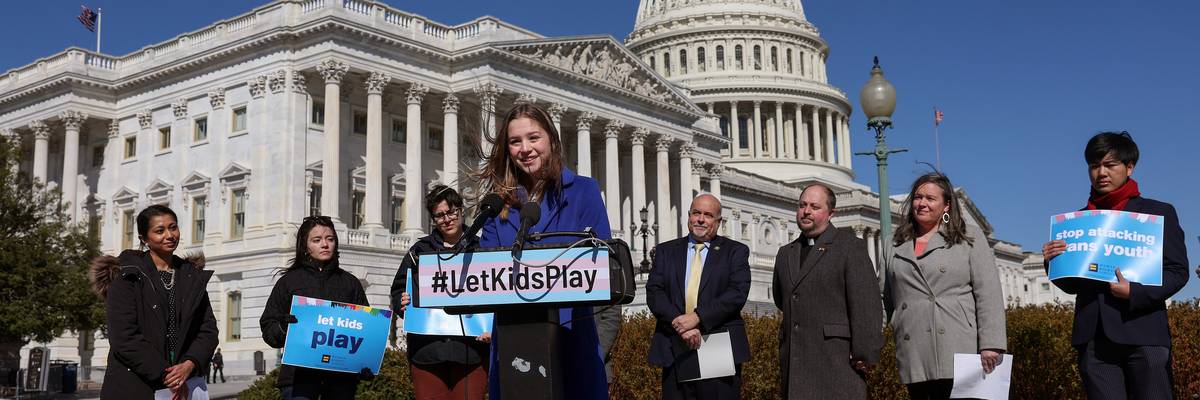
Rebekah Bruesehoff, a transgender student athlete, speaks at a press conference on LGBTQI+ rights, at the US Capitol on March 8, 2023 in Washington, DC..
The decision codifies transphobic language and opens the potential for the sex testing of youth athletes.
In one of its final decisions of the 2025-26 term, the Supreme Court of the United States solidified its place in the onslaught of eradicating trans rights, in a ruling that revolved largely around whether state bans of transgender athletes violated Title IX and the Equal Protection clause of the 14th Amendment.
In response to the question placed before the court of whether states could implement bans on transgender athlete participation in girls’ and women’s sports, 6 of the 9 justices said, “Yes.”
Outside of patchy citations and contradicting interpretations of legal precedents, the rationale behind the majority opinion of the court, written by Justice Brett Kavanaugh, echoed three key premises in the “sports context.” First, female bodies are inherently physiologically different from male bodies, which map onto sex-based athletic advantages for males. Second, regardless of these differences, girls and women should have equal opportunities to boys and men. And third, because of these differences and because of equal guarantees between the sexes, “competitive fairness” and “safety” look different for the female category as compared with the male category. Consequently, the only way to ensure equal sporting opportunities for girls and women is to keep transgender girls and women, or “biological males,” out of the female category.
Anti-transgender advocates in the broader “save women’s sports” movement frequently draw from these rationales, but also ignore the underlying deeply problematic and troubling considerations. On an ethical level, this approach undermines inclusive efforts and further stigmatizes transgender individuals. On a public health level, this reasoning deprives an exceptionally vulnerable population from enjoying the social, mental, and physical benefits from physical activity that should be enjoyed by all. And on a pragmatic level, these declarations overlook the minimal number of out transgender youth, of which even fewer participate in high school level sports.
Notably, of all the documented issues in and across women’s sports, there is no evidence demonstrating that transgender athletes, in any way, contribute to these inequalities.
Beyond parroting this tired transphobic logic, the majority opinion also points to other sports governing bodies, such as the National Collegiate Athletic Association (NCAA) and the US Olympic and Paralympic Committee, who have “drawn a biological line” to ensure safe and fair competition by banning transgender athletes. What Justice Kavanaugh omits, however, is that both organizations abruptly changed their policies following President Donald Trump’s Executive Order No. 14201, rather than in response to any scientific evidence or domination of transgender athletes (in response to a Senate hearing question about how many transgender athletes compete in the NCAA, NCAA President Charlie Baker infamously responded that of the more than 500,000 athletes competing, he knew of “only 10”).
While this ruling itself does not necessarily come as a surprise to those who have followed along with the US’ steady rollback of transgender rights, perhaps the most shocking element of the SCOTUS’ majority opinion is the brazen use of transphobic and misogynistic language in their ruling. “Biological males” and “biological females,” which are used 64 and 31 times respectively in Justice Kavanaugh’s 29-page majority opinion, are not rooted in medical terminology. Instead, these are terms that have become popularized and mobilized by anti-transgender advocates to reinforce a binary model of sex difference. This type of sex segregation is premised on patriarchal beliefs of male athletic superiority and female athletic inferiority, and has historically led to harmful body policing, racial discrimination, and erasure of intersex persons.
There is also reference to an “ongoing medical and scientific debate” surrounding whether transgender athletes maintain athletic and performative advantages after transitioning. What is absent from this brief discussion of science, however, is the concrete evidence that has shown the abundant health disparities experienced by the transgender community, particularly transgender youth. In 2024, the US Centers for Disease Control and Prevention (CDC) reported that, compared with their cisgender counterparts, transgender youth are more likely to report violence, victimization, unstable housing, and suicidal thoughts and behaviors. Similarly, a 2024 study in Nature Human Behavior found that anti-transgender state laws, including transgender sport participation bans, directly increased incidents of suicide attempts among transgender and nonbinary youth by as much as 72%.
The (mis)direction of attention to abstract ideas of “competitive fairness” and unsettled science also disregards the rampant incompliance of institutions with Title IX. In 2023, Florida State University (FSU) agreed to add women’s lacrosse as a varsity sport after threats of a sexual discrimination lawsuit from its women’s club lacrosse team. The threat came on the heels of an 18-month USA TODAY investigation, which revealed that the university was egregiously out of Title IX compliance. FSU was far from the exception, however, as the investigation exposed how hundreds of colleges and universities manipulated their roster numbers for women’s sports to create a mirage of compliance. These Title IX transgressions emerged under the backdrop of several systemic issues in women’s sports, such as the decline in the number of women coaches for women’s sports, consistent underfunding, disproportionate rates of harassment and abuse experienced by girls and women, and media underrepresentation. Notably, of all the documented issues in and across women’s sports, there is no evidence demonstrating that transgender athletes, in any way, contribute to these inequalities.
Despite these relevant considerations, and as Justice Sonia Sotomayer wrote in her dissent, “to the Court, the facts do not matter, even though the consequences are serious.”
In addition to the immediate impact on transgender athletes, this decision prompts questions around how girls’ and women’s sports will now be policed to “catch” athletes who do not fit within normative assumptions or understandings of female bodies. International sports governing organizations, such as World Athletics and the International Olympic Committee, have recently paired bans on transgender athlete participation with implementations of sex testing via chromosome tests, which has long been established as a fraught, unethical, and discriminatory practice.
The impacts on youth and high school sports are, and will be, more pronounced. Organizations at these levels lack the same resources and financial capacities, meaning that, for high school athletic associations, sex testing would most likely involve some type of genital or physical examination. While these might be conducted by medical personnel (though the Larry Nassar sex abuse scandal is evidence that this does not guarantee safeguarding minors), depending on access or finances, these could also be conducted by coaches, other parents, or officials, which prompts further questions and justified concerns surrounding training, confidentiality, consent, and protections of minors. These practices not only impact transgender athletes, but all athletes, regardless of gender identity or, to borrow from Justice Kavanaugh, “biological sex.”
The ruling closes with a half-hearted remark that “no student-athlete on either side of the issue, whether a biological female or transgender, deserves to be ostracized or vilified.” What the SCOTUS fails to recognize, however, is that their ruling is predicated on the misguided vilification of transgender athletes, with impacts that will continue to ostracize transgender people in sports and broader society.
Dear Common Dreams reader, It’s been nearly 30 years since I co-founded Common Dreams with my late wife, Lina Newhouser. We had the radical notion that journalism should serve the public good, not corporate profits. It was clear to us from the outset what it would take to build such a project. No paid advertisements. No corporate sponsors. No millionaire publisher telling us what to think or do. Many people said we wouldn't last a year, but we proved those doubters wrong. Together with a tremendous team of journalists and dedicated staff, we built an independent media outlet free from the constraints of profits and corporate control. Our mission has always been simple: To inform. To inspire. To ignite change for the common good. Building Common Dreams was not easy. Our survival was never guaranteed. When you take on the most powerful forces—Wall Street greed, fossil fuel industry destruction, Big Tech lobbyists, and uber-rich oligarchs who have spent billions upon billions rigging the economy and democracy in their favor—the only bulwark you have is supporters who believe in your work. But here’s the urgent message from me today. It's never been this bad out there. And it's never been this hard to keep us going. At the very moment Common Dreams is most needed, the threats we face are intensifying. We need your support now more than ever. We don't accept corporate advertising and never will. We don't have a paywall because we don't think people should be blocked from critical news based on their ability to pay. Everything we do is funded by the donations of readers like you. When everyone does the little they can afford, we are strong. But if that support retreats or dries up, so do we. Will you donate now to make sure Common Dreams not only survives but thrives? —Craig Brown, Co-founder |
In one of its final decisions of the 2025-26 term, the Supreme Court of the United States solidified its place in the onslaught of eradicating trans rights, in a ruling that revolved largely around whether state bans of transgender athletes violated Title IX and the Equal Protection clause of the 14th Amendment.
In response to the question placed before the court of whether states could implement bans on transgender athlete participation in girls’ and women’s sports, 6 of the 9 justices said, “Yes.”
Outside of patchy citations and contradicting interpretations of legal precedents, the rationale behind the majority opinion of the court, written by Justice Brett Kavanaugh, echoed three key premises in the “sports context.” First, female bodies are inherently physiologically different from male bodies, which map onto sex-based athletic advantages for males. Second, regardless of these differences, girls and women should have equal opportunities to boys and men. And third, because of these differences and because of equal guarantees between the sexes, “competitive fairness” and “safety” look different for the female category as compared with the male category. Consequently, the only way to ensure equal sporting opportunities for girls and women is to keep transgender girls and women, or “biological males,” out of the female category.
Anti-transgender advocates in the broader “save women’s sports” movement frequently draw from these rationales, but also ignore the underlying deeply problematic and troubling considerations. On an ethical level, this approach undermines inclusive efforts and further stigmatizes transgender individuals. On a public health level, this reasoning deprives an exceptionally vulnerable population from enjoying the social, mental, and physical benefits from physical activity that should be enjoyed by all. And on a pragmatic level, these declarations overlook the minimal number of out transgender youth, of which even fewer participate in high school level sports.
Notably, of all the documented issues in and across women’s sports, there is no evidence demonstrating that transgender athletes, in any way, contribute to these inequalities.
Beyond parroting this tired transphobic logic, the majority opinion also points to other sports governing bodies, such as the National Collegiate Athletic Association (NCAA) and the US Olympic and Paralympic Committee, who have “drawn a biological line” to ensure safe and fair competition by banning transgender athletes. What Justice Kavanaugh omits, however, is that both organizations abruptly changed their policies following President Donald Trump’s Executive Order No. 14201, rather than in response to any scientific evidence or domination of transgender athletes (in response to a Senate hearing question about how many transgender athletes compete in the NCAA, NCAA President Charlie Baker infamously responded that of the more than 500,000 athletes competing, he knew of “only 10”).
While this ruling itself does not necessarily come as a surprise to those who have followed along with the US’ steady rollback of transgender rights, perhaps the most shocking element of the SCOTUS’ majority opinion is the brazen use of transphobic and misogynistic language in their ruling. “Biological males” and “biological females,” which are used 64 and 31 times respectively in Justice Kavanaugh’s 29-page majority opinion, are not rooted in medical terminology. Instead, these are terms that have become popularized and mobilized by anti-transgender advocates to reinforce a binary model of sex difference. This type of sex segregation is premised on patriarchal beliefs of male athletic superiority and female athletic inferiority, and has historically led to harmful body policing, racial discrimination, and erasure of intersex persons.
There is also reference to an “ongoing medical and scientific debate” surrounding whether transgender athletes maintain athletic and performative advantages after transitioning. What is absent from this brief discussion of science, however, is the concrete evidence that has shown the abundant health disparities experienced by the transgender community, particularly transgender youth. In 2024, the US Centers for Disease Control and Prevention (CDC) reported that, compared with their cisgender counterparts, transgender youth are more likely to report violence, victimization, unstable housing, and suicidal thoughts and behaviors. Similarly, a 2024 study in Nature Human Behavior found that anti-transgender state laws, including transgender sport participation bans, directly increased incidents of suicide attempts among transgender and nonbinary youth by as much as 72%.
The (mis)direction of attention to abstract ideas of “competitive fairness” and unsettled science also disregards the rampant incompliance of institutions with Title IX. In 2023, Florida State University (FSU) agreed to add women’s lacrosse as a varsity sport after threats of a sexual discrimination lawsuit from its women’s club lacrosse team. The threat came on the heels of an 18-month USA TODAY investigation, which revealed that the university was egregiously out of Title IX compliance. FSU was far from the exception, however, as the investigation exposed how hundreds of colleges and universities manipulated their roster numbers for women’s sports to create a mirage of compliance. These Title IX transgressions emerged under the backdrop of several systemic issues in women’s sports, such as the decline in the number of women coaches for women’s sports, consistent underfunding, disproportionate rates of harassment and abuse experienced by girls and women, and media underrepresentation. Notably, of all the documented issues in and across women’s sports, there is no evidence demonstrating that transgender athletes, in any way, contribute to these inequalities.
Despite these relevant considerations, and as Justice Sonia Sotomayer wrote in her dissent, “to the Court, the facts do not matter, even though the consequences are serious.”
In addition to the immediate impact on transgender athletes, this decision prompts questions around how girls’ and women’s sports will now be policed to “catch” athletes who do not fit within normative assumptions or understandings of female bodies. International sports governing organizations, such as World Athletics and the International Olympic Committee, have recently paired bans on transgender athlete participation with implementations of sex testing via chromosome tests, which has long been established as a fraught, unethical, and discriminatory practice.
The impacts on youth and high school sports are, and will be, more pronounced. Organizations at these levels lack the same resources and financial capacities, meaning that, for high school athletic associations, sex testing would most likely involve some type of genital or physical examination. While these might be conducted by medical personnel (though the Larry Nassar sex abuse scandal is evidence that this does not guarantee safeguarding minors), depending on access or finances, these could also be conducted by coaches, other parents, or officials, which prompts further questions and justified concerns surrounding training, confidentiality, consent, and protections of minors. These practices not only impact transgender athletes, but all athletes, regardless of gender identity or, to borrow from Justice Kavanaugh, “biological sex.”
The ruling closes with a half-hearted remark that “no student-athlete on either side of the issue, whether a biological female or transgender, deserves to be ostracized or vilified.” What the SCOTUS fails to recognize, however, is that their ruling is predicated on the misguided vilification of transgender athletes, with impacts that will continue to ostracize transgender people in sports and broader society.
In one of its final decisions of the 2025-26 term, the Supreme Court of the United States solidified its place in the onslaught of eradicating trans rights, in a ruling that revolved largely around whether state bans of transgender athletes violated Title IX and the Equal Protection clause of the 14th Amendment.
In response to the question placed before the court of whether states could implement bans on transgender athlete participation in girls’ and women’s sports, 6 of the 9 justices said, “Yes.”
Outside of patchy citations and contradicting interpretations of legal precedents, the rationale behind the majority opinion of the court, written by Justice Brett Kavanaugh, echoed three key premises in the “sports context.” First, female bodies are inherently physiologically different from male bodies, which map onto sex-based athletic advantages for males. Second, regardless of these differences, girls and women should have equal opportunities to boys and men. And third, because of these differences and because of equal guarantees between the sexes, “competitive fairness” and “safety” look different for the female category as compared with the male category. Consequently, the only way to ensure equal sporting opportunities for girls and women is to keep transgender girls and women, or “biological males,” out of the female category.
Anti-transgender advocates in the broader “save women’s sports” movement frequently draw from these rationales, but also ignore the underlying deeply problematic and troubling considerations. On an ethical level, this approach undermines inclusive efforts and further stigmatizes transgender individuals. On a public health level, this reasoning deprives an exceptionally vulnerable population from enjoying the social, mental, and physical benefits from physical activity that should be enjoyed by all. And on a pragmatic level, these declarations overlook the minimal number of out transgender youth, of which even fewer participate in high school level sports.
Notably, of all the documented issues in and across women’s sports, there is no evidence demonstrating that transgender athletes, in any way, contribute to these inequalities.
Beyond parroting this tired transphobic logic, the majority opinion also points to other sports governing bodies, such as the National Collegiate Athletic Association (NCAA) and the US Olympic and Paralympic Committee, who have “drawn a biological line” to ensure safe and fair competition by banning transgender athletes. What Justice Kavanaugh omits, however, is that both organizations abruptly changed their policies following President Donald Trump’s Executive Order No. 14201, rather than in response to any scientific evidence or domination of transgender athletes (in response to a Senate hearing question about how many transgender athletes compete in the NCAA, NCAA President Charlie Baker infamously responded that of the more than 500,000 athletes competing, he knew of “only 10”).
While this ruling itself does not necessarily come as a surprise to those who have followed along with the US’ steady rollback of transgender rights, perhaps the most shocking element of the SCOTUS’ majority opinion is the brazen use of transphobic and misogynistic language in their ruling. “Biological males” and “biological females,” which are used 64 and 31 times respectively in Justice Kavanaugh’s 29-page majority opinion, are not rooted in medical terminology. Instead, these are terms that have become popularized and mobilized by anti-transgender advocates to reinforce a binary model of sex difference. This type of sex segregation is premised on patriarchal beliefs of male athletic superiority and female athletic inferiority, and has historically led to harmful body policing, racial discrimination, and erasure of intersex persons.
There is also reference to an “ongoing medical and scientific debate” surrounding whether transgender athletes maintain athletic and performative advantages after transitioning. What is absent from this brief discussion of science, however, is the concrete evidence that has shown the abundant health disparities experienced by the transgender community, particularly transgender youth. In 2024, the US Centers for Disease Control and Prevention (CDC) reported that, compared with their cisgender counterparts, transgender youth are more likely to report violence, victimization, unstable housing, and suicidal thoughts and behaviors. Similarly, a 2024 study in Nature Human Behavior found that anti-transgender state laws, including transgender sport participation bans, directly increased incidents of suicide attempts among transgender and nonbinary youth by as much as 72%.
The (mis)direction of attention to abstract ideas of “competitive fairness” and unsettled science also disregards the rampant incompliance of institutions with Title IX. In 2023, Florida State University (FSU) agreed to add women’s lacrosse as a varsity sport after threats of a sexual discrimination lawsuit from its women’s club lacrosse team. The threat came on the heels of an 18-month USA TODAY investigation, which revealed that the university was egregiously out of Title IX compliance. FSU was far from the exception, however, as the investigation exposed how hundreds of colleges and universities manipulated their roster numbers for women’s sports to create a mirage of compliance. These Title IX transgressions emerged under the backdrop of several systemic issues in women’s sports, such as the decline in the number of women coaches for women’s sports, consistent underfunding, disproportionate rates of harassment and abuse experienced by girls and women, and media underrepresentation. Notably, of all the documented issues in and across women’s sports, there is no evidence demonstrating that transgender athletes, in any way, contribute to these inequalities.
Despite these relevant considerations, and as Justice Sonia Sotomayer wrote in her dissent, “to the Court, the facts do not matter, even though the consequences are serious.”
In addition to the immediate impact on transgender athletes, this decision prompts questions around how girls’ and women’s sports will now be policed to “catch” athletes who do not fit within normative assumptions or understandings of female bodies. International sports governing organizations, such as World Athletics and the International Olympic Committee, have recently paired bans on transgender athlete participation with implementations of sex testing via chromosome tests, which has long been established as a fraught, unethical, and discriminatory practice.
The impacts on youth and high school sports are, and will be, more pronounced. Organizations at these levels lack the same resources and financial capacities, meaning that, for high school athletic associations, sex testing would most likely involve some type of genital or physical examination. While these might be conducted by medical personnel (though the Larry Nassar sex abuse scandal is evidence that this does not guarantee safeguarding minors), depending on access or finances, these could also be conducted by coaches, other parents, or officials, which prompts further questions and justified concerns surrounding training, confidentiality, consent, and protections of minors. These practices not only impact transgender athletes, but all athletes, regardless of gender identity or, to borrow from Justice Kavanaugh, “biological sex.”
The ruling closes with a half-hearted remark that “no student-athlete on either side of the issue, whether a biological female or transgender, deserves to be ostracized or vilified.” What the SCOTUS fails to recognize, however, is that their ruling is predicated on the misguided vilification of transgender athletes, with impacts that will continue to ostracize transgender people in sports and broader society.