SUBSCRIBE TO OUR FREE NEWSLETTER
Daily news & progressive opinion—funded by the people, not the corporations—delivered straight to your inbox.
5
#000000
#FFFFFF
To donate by check, phone, or other method, see our More Ways to Give page.
Daily news & progressive opinion—funded by the people, not the corporations—delivered straight to your inbox.
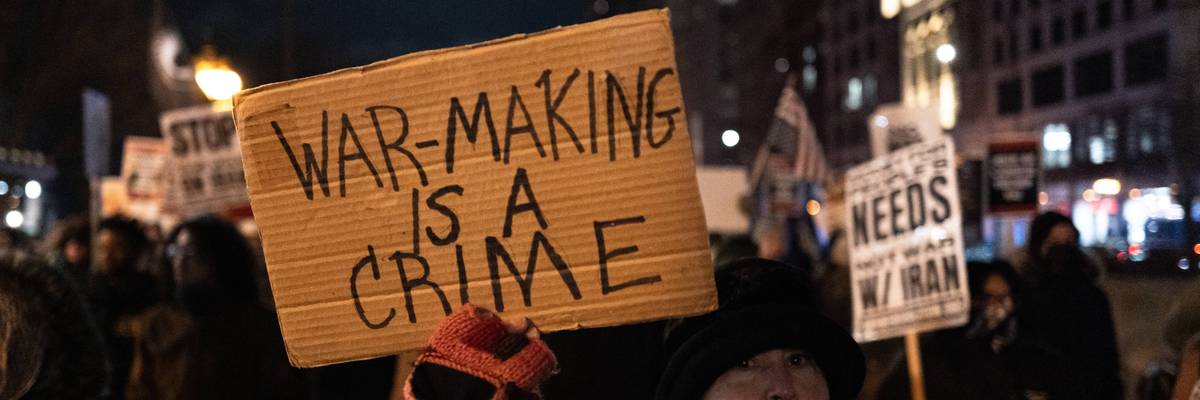
A protester holds placards reading ''war making is a crime'' during a demonstration against the war in Iran, in Chicago, Illinois, on February 28, 2026.
How about this for a concept: Those who can most afford to pay for the war be the ones who pay for it.
At some point, the war against Iran is going to be paid for. The military has expended billions of dollars of very expensive ammunition, jet fuel and other military resources. The Pentagon says it needs over $200 billion to cover its costs. The total price of the war will depend on how it progresses and requests to Congress may come in smaller chunks, or be delayed as long as possible, or rolled into broader funding requests.
Disagreeing with the war, Democrats can resist approving the funding, try to attach conditions related to how the war is waged and how long it lasts, or make other demands but, in the end, the bill will almost certainly be paid. One question then is who is going to pay it.
The answer to that question, and a demand that should be insisted on, is that those who can most afford to pay for the war be the ones who pay for it. Americans of modest incomes have been hit hard enough by tariffs and the fuel prices the war has caused. Let’s have the rich and corporations pay the direct, out-of-pocket, costs.
In the end, the bill will almost certainly be paid.
If the cost is $200 billion, a temporary tax effective for 2026 of 3.5 percent, applied to adjusted gross income in excess of $1,000,000 on the personal income tax, plus the same rate applied to corporate taxable income would cover it. If 3.5 percent is too jarring for some, a 1.7 percent rate applied for two years or a 1.1 percent rate applied through 2028 would cover the bill.
The war is widely unpopular. Whether the cost of the war ends up being $200 billion, more than that amount, or less, let’s at least have it paid for by those who can most afford it.
Dear Common Dreams reader, It’s been nearly 30 years since I co-founded Common Dreams with my late wife, Lina Newhouser. We had the radical notion that journalism should serve the public good, not corporate profits. It was clear to us from the outset what it would take to build such a project. No paid advertisements. No corporate sponsors. No millionaire publisher telling us what to think or do. Many people said we wouldn't last a year, but we proved those doubters wrong. Together with a tremendous team of journalists and dedicated staff, we built an independent media outlet free from the constraints of profits and corporate control. Our mission has always been simple: To inform. To inspire. To ignite change for the common good. Building Common Dreams was not easy. Our survival was never guaranteed. When you take on the most powerful forces—Wall Street greed, fossil fuel industry destruction, Big Tech lobbyists, and uber-rich oligarchs who have spent billions upon billions rigging the economy and democracy in their favor—the only bulwark you have is supporters who believe in your work. But here’s the urgent message from me today. It's never been this bad out there. And it's never been this hard to keep us going. At the very moment Common Dreams is most needed, the threats we face are intensifying. We need your support now more than ever. We don't accept corporate advertising and never will. We don't have a paywall because we don't think people should be blocked from critical news based on their ability to pay. Everything we do is funded by the donations of readers like you. When everyone does the little they can afford, we are strong. But if that support retreats or dries up, so do we. Will you donate now to make sure Common Dreams not only survives but thrives? —Craig Brown, Co-founder |
At some point, the war against Iran is going to be paid for. The military has expended billions of dollars of very expensive ammunition, jet fuel and other military resources. The Pentagon says it needs over $200 billion to cover its costs. The total price of the war will depend on how it progresses and requests to Congress may come in smaller chunks, or be delayed as long as possible, or rolled into broader funding requests.
Disagreeing with the war, Democrats can resist approving the funding, try to attach conditions related to how the war is waged and how long it lasts, or make other demands but, in the end, the bill will almost certainly be paid. One question then is who is going to pay it.
The answer to that question, and a demand that should be insisted on, is that those who can most afford to pay for the war be the ones who pay for it. Americans of modest incomes have been hit hard enough by tariffs and the fuel prices the war has caused. Let’s have the rich and corporations pay the direct, out-of-pocket, costs.
In the end, the bill will almost certainly be paid.
If the cost is $200 billion, a temporary tax effective for 2026 of 3.5 percent, applied to adjusted gross income in excess of $1,000,000 on the personal income tax, plus the same rate applied to corporate taxable income would cover it. If 3.5 percent is too jarring for some, a 1.7 percent rate applied for two years or a 1.1 percent rate applied through 2028 would cover the bill.
The war is widely unpopular. Whether the cost of the war ends up being $200 billion, more than that amount, or less, let’s at least have it paid for by those who can most afford it.
At some point, the war against Iran is going to be paid for. The military has expended billions of dollars of very expensive ammunition, jet fuel and other military resources. The Pentagon says it needs over $200 billion to cover its costs. The total price of the war will depend on how it progresses and requests to Congress may come in smaller chunks, or be delayed as long as possible, or rolled into broader funding requests.
Disagreeing with the war, Democrats can resist approving the funding, try to attach conditions related to how the war is waged and how long it lasts, or make other demands but, in the end, the bill will almost certainly be paid. One question then is who is going to pay it.
The answer to that question, and a demand that should be insisted on, is that those who can most afford to pay for the war be the ones who pay for it. Americans of modest incomes have been hit hard enough by tariffs and the fuel prices the war has caused. Let’s have the rich and corporations pay the direct, out-of-pocket, costs.
In the end, the bill will almost certainly be paid.
If the cost is $200 billion, a temporary tax effective for 2026 of 3.5 percent, applied to adjusted gross income in excess of $1,000,000 on the personal income tax, plus the same rate applied to corporate taxable income would cover it. If 3.5 percent is too jarring for some, a 1.7 percent rate applied for two years or a 1.1 percent rate applied through 2028 would cover the bill.
The war is widely unpopular. Whether the cost of the war ends up being $200 billion, more than that amount, or less, let’s at least have it paid for by those who can most afford it.