SUBSCRIBE TO OUR FREE NEWSLETTER
Daily news & progressive opinion—funded by the people, not the corporations—delivered straight to your inbox.
5
#000000
#FFFFFF
To donate by check, phone, or other method, see our More Ways to Give page.
Daily news & progressive opinion—funded by the people, not the corporations—delivered straight to your inbox.
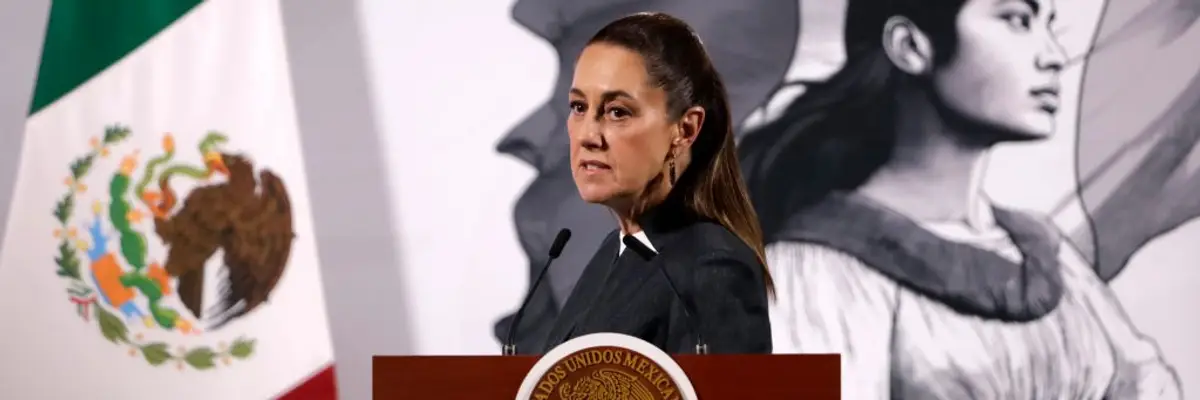
Claudia Sheinbaum Pardo, president of Mexico, speaks about Fentanyl seizures at the southwest border during a briefing conference at National Palace on March 3, 2025 in Mexico City, Mexico.
On one hand, demonstrating the ability to confront organized crime may help counter the narrative that progressive governments are soft on violence. On the other, history suggests that decapitation strategies rarely defeat cartels.
On February 22, 2026, Mexican special forces in Tapalpa, Jalisco, authorized by left-wing President Claudia Sheinbaum and acting on intelligence from the US military, killed Nemesio Oseguera Cervantes, Nom de Guerre “El Mencho,” the 59-year-old leader of the Jalisco New Generation Cartel (CJNG) and the most-wanted man in Mexico.
Within hours, the cartel put up roadblocks, arson attacks, and running gun battles across a dozen states, ravaging Tapalpa and other cities. By the time the violence subsided, over 70 people were dead, including 25 Mexican National Guard troops. The entire country is holding its breath as it prepares to enter a new phase of its decades-long Drug War.
Does decapitating a cartel end the Drug War?
The operation was also the culmination of a strategy that Claudia Sheinbaum's predecessor, Andrés Manuel López Obrador, had promised to abandon, namely, the militarized war on drugs that since 2006 has left between 350,000 and 400,000 Mexicans dead and more than 130,000 disappeared. Instead, while making some initial welcome gestures, he militarized the Southern Border, created the National Guard, and continued the War on Drugs.
Removing El Mencho may weaken CJNG in the short term. But it could also ignite the next phase of Mexico’s drug war, one that extends far beyond the country’s borders and deeper into the Western Hemisphere.
The Mexican drug war has never been Mexico's responsibility alone. It is the product of an insatiable American thirst for drugs that has only intensified with the opioid crisis, as fentanyl has flooded US streets, claiming tens of thousands of lives annually, with support from Big Pharma. The United States remains the world’s largest consumer market for narcotics; American demand generates billions of dollars annually for trafficking organizations.
Mexican cartels such as the CJNG and the Sinaloa Cartel now supply fentanyl, cocaine, methamphetamine, and heroin to a US market whose demand keeps increasing, according to new reporting.
American guns are also at the center of this crisis. There are exactly two legal gun stores in all of Mexico, operating under strict military supervision. Across the border, in the four US border states, there are more than 9,000 legal gun sale points.
An estimated 250,000 to 500,000 guns are trafficked from the United States into Mexico each year. Roughly 70% originate north of the border. These include .50-caliber rifles capable of piercing armored vehicles and downing helicopters; many of them were from the American military. A new raid on a CNJG ammo depot revealed that 47% of the ammunition came directly from one US Army plant in Kansas City. That very same ammo was used to kill 13 police officers in Michoacán in 2019.
The CJNG now dominates 23 out of Mexico’s 32 states, with operations stretching from the Pacific Coast all the way to the Northern border. The cartel's estimated worth exceeds $20 billion, drawn not only from drugs but from a diversified portfolio of extortion, petroleum theft, human trafficking, and kidnapping.
It has used extreme force and military-level tactical planning against its rivals, including the state itself. In 2015, it shot down a Mexican military helicopter in Jalisco. It has assassinated mayors, attacked police convoys with improvised armored vehicles, and used drones and explosives against state security forces.
Internally, polls suggest support for the operation is between 80 and 90%. After years of feeling helpless before cartel violence, many Mexicans welcome any action that produces “results.” With this, we see the rise of “penal populism” across Latin America, where electorates increasingly embrace tough-on-crime approaches, even when those approaches destroy democracy and human rights.
The high popularity of El Salvador's right-wing dictator Nayib Bukele, whose approval ratings have hovered around 90%, testifies to the political appeal of iron-fist tactics, regardless of their clear governance costs. Bukele's mass incarceration model, where tens of thousands have been jailed without due process in inhumane conditions where torture is common, has become a model that politicians across the region now invoke, including in Honduras, Chile, Argentina, Brazil, Ecuador, Costa Rica, and Peru.
That comes despite his success being predicated on secret deals with gangs, not on a War on Drugs—most countries that have tried his militarized tactics have suffered increases in the violent crime and homicide rates, at the same time as their economies have become increasingly unequal and democratic societies have cratered.
Externally, President Donald Trump has made clear his view that “cartels are runnning Mexico” and that Sheinbaum and other Latin American leaders should go to war with them, otherwise he will do it for them. His administration has designated Mexican cartels as foreign terrorist organizations and considered military intervention in Mexico. A US intervention would be disastrous for both Mexico and Sheinbaum, so the El Mencho operation is the price they settled on.
To add insult to injury, this summer, Mexico will host numerous World Cup matches, including four in Guadalajara, the capital of Jalisco state. The Sheinbaum government is trying to give the allure of tightening security ahead of the games.
She has modeled aspects of her approach on Brazil. Before the 2014 World Cup and 2016 Olympics, Rio de Janeiro launched aggressive “pacification” campaigns in favelas, military occupations that temporarily suppressed violence but failed to address its roots while killing high rates of civilians and eroding civil liberties. The War on Drugs has not stopped there, either. We have to wait and see if Mexico follows this tragic pattern.
Across Latin America, the right has successfully framed security as a question of toughness versus weakness, where, as Bukele would put it, “All the gangs know is violence,” and thus must be met with violence. This framing leaves progressive governments perpetually on the defensive, forced to prove their bravado by adopting policies that at the very least, in theory, fly in the face of leftist principles.
The left's consistent (and successful) approach, emphasizing socioeconomic development, public health interventions, drug decriminalization, negotiation, and targeted intelligence rather than mass militarization, has struggled to gain traction in a climate driven by right-wing narratives and fearmongering.
The fundamental problem is that leftist programs take years to bear actual results, while voters demand immediate security. The right, meanwhile, offers quick and strong-handed solutions that reassure voters. It is harder to kill monsters with microloan programs and harm reduction clinics than with tanks and M-16s.
When Former Mexican President Felipe Calderón launched his war on drugs in 2006, he targeted the Gulf Cartel and its armed wing, Los Zetas. The kingpin strategy eliminates cartel leaders, but each decapitation meant groups splintered, and each splintering produced more violence, creating an endless loop of violence until neoliberal President Enrique Peña Nieto was able to sign pacts with certain gangs before resuming the military approach.
During this period, the number of major cartels grew from about half a dozen to more than 200, operating across the country and the entire world. The homicide rate tripled, while many border cities have homicide rates well over 100 per 100,000. Now, hundreds of thousands are dead as a direct result.
Mexico finds itself once again at this crossroads, where it must choose wisely. El Mencho’s bras droit, “El Tuli,” was killed in a clash with security forces hours after. But, the pattern suggests that new leaders will emerge, and the violence will continue. Cartels are resilient, and can adapt to new leadership, new business structures, and market forces very reactively. Taking out one leader, or even the drug trade, won’t put them out of business.
Left-wing governments have struggled to respond without appearing weak. Some voices, particularly those outside of direct political power like academics, human rights advocates, and a few leftist intellectuals, have pointed out the dangers of returning to kingpin strategies, the inevitability of retaliation, and the way military operations invariably claim civilian lives.
So far, however, the Sheinbaum coalition and the left in Mexico have, for the most part, supported the operation, praying that embracing these shows of force can help the left reclaim dominance over the security debate. But, ceding ground to the right on security might risk alienating the rest of the left; shifting the Overton window to the right; and making politics, rather than policy solutions, determine the direction of Mexico’s Drug War.
Sheinbaum’s operation thus creates a profound paradox.
On one hand, demonstrating the ability to confront organized crime may help counter the narrative that progressive governments are soft on violence. On the other, history suggests that decapitation strategies rarely defeat cartels.
Removing El Mencho may weaken CJNG in the short term. But it could also ignite the next phase of Mexico’s drug war, one that extends far beyond the country’s borders and deeper into the Western Hemisphere.
Can you win the politics of security without reproducing the failures of the war on drugs? It may buy Sheinbaum and the left time to continue expanding the welfare state, strengthening institutions, and foolproof Mexican democracy, but it may also open the door for further weaponization of security to destroy that very progress later on.
The better alternative may be to instead embrace a true leftist, principled defense of nonviolent solutions, or, to theoretically and politically justify a security progressivism. Such will be the test of the Latin American left in the wake of rising right-wing populism on the back of security fears.
Dear Common Dreams reader, It’s been nearly 30 years since I co-founded Common Dreams with my late wife, Lina Newhouser. We had the radical notion that journalism should serve the public good, not corporate profits. It was clear to us from the outset what it would take to build such a project. No paid advertisements. No corporate sponsors. No millionaire publisher telling us what to think or do. Many people said we wouldn't last a year, but we proved those doubters wrong. Together with a tremendous team of journalists and dedicated staff, we built an independent media outlet free from the constraints of profits and corporate control. Our mission has always been simple: To inform. To inspire. To ignite change for the common good. Building Common Dreams was not easy. Our survival was never guaranteed. When you take on the most powerful forces—Wall Street greed, fossil fuel industry destruction, Big Tech lobbyists, and uber-rich oligarchs who have spent billions upon billions rigging the economy and democracy in their favor—the only bulwark you have is supporters who believe in your work. But here’s the urgent message from me today. It's never been this bad out there. And it's never been this hard to keep us going. At the very moment Common Dreams is most needed, the threats we face are intensifying. We need your support now more than ever. We don't accept corporate advertising and never will. We don't have a paywall because we don't think people should be blocked from critical news based on their ability to pay. Everything we do is funded by the donations of readers like you. When everyone does the little they can afford, we are strong. But if that support retreats or dries up, so do we. Will you donate now to make sure Common Dreams not only survives but thrives? —Craig Brown, Co-founder |
On February 22, 2026, Mexican special forces in Tapalpa, Jalisco, authorized by left-wing President Claudia Sheinbaum and acting on intelligence from the US military, killed Nemesio Oseguera Cervantes, Nom de Guerre “El Mencho,” the 59-year-old leader of the Jalisco New Generation Cartel (CJNG) and the most-wanted man in Mexico.
Within hours, the cartel put up roadblocks, arson attacks, and running gun battles across a dozen states, ravaging Tapalpa and other cities. By the time the violence subsided, over 70 people were dead, including 25 Mexican National Guard troops. The entire country is holding its breath as it prepares to enter a new phase of its decades-long Drug War.
Does decapitating a cartel end the Drug War?
The operation was also the culmination of a strategy that Claudia Sheinbaum's predecessor, Andrés Manuel López Obrador, had promised to abandon, namely, the militarized war on drugs that since 2006 has left between 350,000 and 400,000 Mexicans dead and more than 130,000 disappeared. Instead, while making some initial welcome gestures, he militarized the Southern Border, created the National Guard, and continued the War on Drugs.
Removing El Mencho may weaken CJNG in the short term. But it could also ignite the next phase of Mexico’s drug war, one that extends far beyond the country’s borders and deeper into the Western Hemisphere.
The Mexican drug war has never been Mexico's responsibility alone. It is the product of an insatiable American thirst for drugs that has only intensified with the opioid crisis, as fentanyl has flooded US streets, claiming tens of thousands of lives annually, with support from Big Pharma. The United States remains the world’s largest consumer market for narcotics; American demand generates billions of dollars annually for trafficking organizations.
Mexican cartels such as the CJNG and the Sinaloa Cartel now supply fentanyl, cocaine, methamphetamine, and heroin to a US market whose demand keeps increasing, according to new reporting.
American guns are also at the center of this crisis. There are exactly two legal gun stores in all of Mexico, operating under strict military supervision. Across the border, in the four US border states, there are more than 9,000 legal gun sale points.
An estimated 250,000 to 500,000 guns are trafficked from the United States into Mexico each year. Roughly 70% originate north of the border. These include .50-caliber rifles capable of piercing armored vehicles and downing helicopters; many of them were from the American military. A new raid on a CNJG ammo depot revealed that 47% of the ammunition came directly from one US Army plant in Kansas City. That very same ammo was used to kill 13 police officers in Michoacán in 2019.
The CJNG now dominates 23 out of Mexico’s 32 states, with operations stretching from the Pacific Coast all the way to the Northern border. The cartel's estimated worth exceeds $20 billion, drawn not only from drugs but from a diversified portfolio of extortion, petroleum theft, human trafficking, and kidnapping.
It has used extreme force and military-level tactical planning against its rivals, including the state itself. In 2015, it shot down a Mexican military helicopter in Jalisco. It has assassinated mayors, attacked police convoys with improvised armored vehicles, and used drones and explosives against state security forces.
Internally, polls suggest support for the operation is between 80 and 90%. After years of feeling helpless before cartel violence, many Mexicans welcome any action that produces “results.” With this, we see the rise of “penal populism” across Latin America, where electorates increasingly embrace tough-on-crime approaches, even when those approaches destroy democracy and human rights.
The high popularity of El Salvador's right-wing dictator Nayib Bukele, whose approval ratings have hovered around 90%, testifies to the political appeal of iron-fist tactics, regardless of their clear governance costs. Bukele's mass incarceration model, where tens of thousands have been jailed without due process in inhumane conditions where torture is common, has become a model that politicians across the region now invoke, including in Honduras, Chile, Argentina, Brazil, Ecuador, Costa Rica, and Peru.
That comes despite his success being predicated on secret deals with gangs, not on a War on Drugs—most countries that have tried his militarized tactics have suffered increases in the violent crime and homicide rates, at the same time as their economies have become increasingly unequal and democratic societies have cratered.
Externally, President Donald Trump has made clear his view that “cartels are runnning Mexico” and that Sheinbaum and other Latin American leaders should go to war with them, otherwise he will do it for them. His administration has designated Mexican cartels as foreign terrorist organizations and considered military intervention in Mexico. A US intervention would be disastrous for both Mexico and Sheinbaum, so the El Mencho operation is the price they settled on.
To add insult to injury, this summer, Mexico will host numerous World Cup matches, including four in Guadalajara, the capital of Jalisco state. The Sheinbaum government is trying to give the allure of tightening security ahead of the games.
She has modeled aspects of her approach on Brazil. Before the 2014 World Cup and 2016 Olympics, Rio de Janeiro launched aggressive “pacification” campaigns in favelas, military occupations that temporarily suppressed violence but failed to address its roots while killing high rates of civilians and eroding civil liberties. The War on Drugs has not stopped there, either. We have to wait and see if Mexico follows this tragic pattern.
Across Latin America, the right has successfully framed security as a question of toughness versus weakness, where, as Bukele would put it, “All the gangs know is violence,” and thus must be met with violence. This framing leaves progressive governments perpetually on the defensive, forced to prove their bravado by adopting policies that at the very least, in theory, fly in the face of leftist principles.
The left's consistent (and successful) approach, emphasizing socioeconomic development, public health interventions, drug decriminalization, negotiation, and targeted intelligence rather than mass militarization, has struggled to gain traction in a climate driven by right-wing narratives and fearmongering.
The fundamental problem is that leftist programs take years to bear actual results, while voters demand immediate security. The right, meanwhile, offers quick and strong-handed solutions that reassure voters. It is harder to kill monsters with microloan programs and harm reduction clinics than with tanks and M-16s.
When Former Mexican President Felipe Calderón launched his war on drugs in 2006, he targeted the Gulf Cartel and its armed wing, Los Zetas. The kingpin strategy eliminates cartel leaders, but each decapitation meant groups splintered, and each splintering produced more violence, creating an endless loop of violence until neoliberal President Enrique Peña Nieto was able to sign pacts with certain gangs before resuming the military approach.
During this period, the number of major cartels grew from about half a dozen to more than 200, operating across the country and the entire world. The homicide rate tripled, while many border cities have homicide rates well over 100 per 100,000. Now, hundreds of thousands are dead as a direct result.
Mexico finds itself once again at this crossroads, where it must choose wisely. El Mencho’s bras droit, “El Tuli,” was killed in a clash with security forces hours after. But, the pattern suggests that new leaders will emerge, and the violence will continue. Cartels are resilient, and can adapt to new leadership, new business structures, and market forces very reactively. Taking out one leader, or even the drug trade, won’t put them out of business.
Left-wing governments have struggled to respond without appearing weak. Some voices, particularly those outside of direct political power like academics, human rights advocates, and a few leftist intellectuals, have pointed out the dangers of returning to kingpin strategies, the inevitability of retaliation, and the way military operations invariably claim civilian lives.
So far, however, the Sheinbaum coalition and the left in Mexico have, for the most part, supported the operation, praying that embracing these shows of force can help the left reclaim dominance over the security debate. But, ceding ground to the right on security might risk alienating the rest of the left; shifting the Overton window to the right; and making politics, rather than policy solutions, determine the direction of Mexico’s Drug War.
Sheinbaum’s operation thus creates a profound paradox.
On one hand, demonstrating the ability to confront organized crime may help counter the narrative that progressive governments are soft on violence. On the other, history suggests that decapitation strategies rarely defeat cartels.
Removing El Mencho may weaken CJNG in the short term. But it could also ignite the next phase of Mexico’s drug war, one that extends far beyond the country’s borders and deeper into the Western Hemisphere.
Can you win the politics of security without reproducing the failures of the war on drugs? It may buy Sheinbaum and the left time to continue expanding the welfare state, strengthening institutions, and foolproof Mexican democracy, but it may also open the door for further weaponization of security to destroy that very progress later on.
The better alternative may be to instead embrace a true leftist, principled defense of nonviolent solutions, or, to theoretically and politically justify a security progressivism. Such will be the test of the Latin American left in the wake of rising right-wing populism on the back of security fears.
On February 22, 2026, Mexican special forces in Tapalpa, Jalisco, authorized by left-wing President Claudia Sheinbaum and acting on intelligence from the US military, killed Nemesio Oseguera Cervantes, Nom de Guerre “El Mencho,” the 59-year-old leader of the Jalisco New Generation Cartel (CJNG) and the most-wanted man in Mexico.
Within hours, the cartel put up roadblocks, arson attacks, and running gun battles across a dozen states, ravaging Tapalpa and other cities. By the time the violence subsided, over 70 people were dead, including 25 Mexican National Guard troops. The entire country is holding its breath as it prepares to enter a new phase of its decades-long Drug War.
Does decapitating a cartel end the Drug War?
The operation was also the culmination of a strategy that Claudia Sheinbaum's predecessor, Andrés Manuel López Obrador, had promised to abandon, namely, the militarized war on drugs that since 2006 has left between 350,000 and 400,000 Mexicans dead and more than 130,000 disappeared. Instead, while making some initial welcome gestures, he militarized the Southern Border, created the National Guard, and continued the War on Drugs.
Removing El Mencho may weaken CJNG in the short term. But it could also ignite the next phase of Mexico’s drug war, one that extends far beyond the country’s borders and deeper into the Western Hemisphere.
The Mexican drug war has never been Mexico's responsibility alone. It is the product of an insatiable American thirst for drugs that has only intensified with the opioid crisis, as fentanyl has flooded US streets, claiming tens of thousands of lives annually, with support from Big Pharma. The United States remains the world’s largest consumer market for narcotics; American demand generates billions of dollars annually for trafficking organizations.
Mexican cartels such as the CJNG and the Sinaloa Cartel now supply fentanyl, cocaine, methamphetamine, and heroin to a US market whose demand keeps increasing, according to new reporting.
American guns are also at the center of this crisis. There are exactly two legal gun stores in all of Mexico, operating under strict military supervision. Across the border, in the four US border states, there are more than 9,000 legal gun sale points.
An estimated 250,000 to 500,000 guns are trafficked from the United States into Mexico each year. Roughly 70% originate north of the border. These include .50-caliber rifles capable of piercing armored vehicles and downing helicopters; many of them were from the American military. A new raid on a CNJG ammo depot revealed that 47% of the ammunition came directly from one US Army plant in Kansas City. That very same ammo was used to kill 13 police officers in Michoacán in 2019.
The CJNG now dominates 23 out of Mexico’s 32 states, with operations stretching from the Pacific Coast all the way to the Northern border. The cartel's estimated worth exceeds $20 billion, drawn not only from drugs but from a diversified portfolio of extortion, petroleum theft, human trafficking, and kidnapping.
It has used extreme force and military-level tactical planning against its rivals, including the state itself. In 2015, it shot down a Mexican military helicopter in Jalisco. It has assassinated mayors, attacked police convoys with improvised armored vehicles, and used drones and explosives against state security forces.
Internally, polls suggest support for the operation is between 80 and 90%. After years of feeling helpless before cartel violence, many Mexicans welcome any action that produces “results.” With this, we see the rise of “penal populism” across Latin America, where electorates increasingly embrace tough-on-crime approaches, even when those approaches destroy democracy and human rights.
The high popularity of El Salvador's right-wing dictator Nayib Bukele, whose approval ratings have hovered around 90%, testifies to the political appeal of iron-fist tactics, regardless of their clear governance costs. Bukele's mass incarceration model, where tens of thousands have been jailed without due process in inhumane conditions where torture is common, has become a model that politicians across the region now invoke, including in Honduras, Chile, Argentina, Brazil, Ecuador, Costa Rica, and Peru.
That comes despite his success being predicated on secret deals with gangs, not on a War on Drugs—most countries that have tried his militarized tactics have suffered increases in the violent crime and homicide rates, at the same time as their economies have become increasingly unequal and democratic societies have cratered.
Externally, President Donald Trump has made clear his view that “cartels are runnning Mexico” and that Sheinbaum and other Latin American leaders should go to war with them, otherwise he will do it for them. His administration has designated Mexican cartels as foreign terrorist organizations and considered military intervention in Mexico. A US intervention would be disastrous for both Mexico and Sheinbaum, so the El Mencho operation is the price they settled on.
To add insult to injury, this summer, Mexico will host numerous World Cup matches, including four in Guadalajara, the capital of Jalisco state. The Sheinbaum government is trying to give the allure of tightening security ahead of the games.
She has modeled aspects of her approach on Brazil. Before the 2014 World Cup and 2016 Olympics, Rio de Janeiro launched aggressive “pacification” campaigns in favelas, military occupations that temporarily suppressed violence but failed to address its roots while killing high rates of civilians and eroding civil liberties. The War on Drugs has not stopped there, either. We have to wait and see if Mexico follows this tragic pattern.
Across Latin America, the right has successfully framed security as a question of toughness versus weakness, where, as Bukele would put it, “All the gangs know is violence,” and thus must be met with violence. This framing leaves progressive governments perpetually on the defensive, forced to prove their bravado by adopting policies that at the very least, in theory, fly in the face of leftist principles.
The left's consistent (and successful) approach, emphasizing socioeconomic development, public health interventions, drug decriminalization, negotiation, and targeted intelligence rather than mass militarization, has struggled to gain traction in a climate driven by right-wing narratives and fearmongering.
The fundamental problem is that leftist programs take years to bear actual results, while voters demand immediate security. The right, meanwhile, offers quick and strong-handed solutions that reassure voters. It is harder to kill monsters with microloan programs and harm reduction clinics than with tanks and M-16s.
When Former Mexican President Felipe Calderón launched his war on drugs in 2006, he targeted the Gulf Cartel and its armed wing, Los Zetas. The kingpin strategy eliminates cartel leaders, but each decapitation meant groups splintered, and each splintering produced more violence, creating an endless loop of violence until neoliberal President Enrique Peña Nieto was able to sign pacts with certain gangs before resuming the military approach.
During this period, the number of major cartels grew from about half a dozen to more than 200, operating across the country and the entire world. The homicide rate tripled, while many border cities have homicide rates well over 100 per 100,000. Now, hundreds of thousands are dead as a direct result.
Mexico finds itself once again at this crossroads, where it must choose wisely. El Mencho’s bras droit, “El Tuli,” was killed in a clash with security forces hours after. But, the pattern suggests that new leaders will emerge, and the violence will continue. Cartels are resilient, and can adapt to new leadership, new business structures, and market forces very reactively. Taking out one leader, or even the drug trade, won’t put them out of business.
Left-wing governments have struggled to respond without appearing weak. Some voices, particularly those outside of direct political power like academics, human rights advocates, and a few leftist intellectuals, have pointed out the dangers of returning to kingpin strategies, the inevitability of retaliation, and the way military operations invariably claim civilian lives.
So far, however, the Sheinbaum coalition and the left in Mexico have, for the most part, supported the operation, praying that embracing these shows of force can help the left reclaim dominance over the security debate. But, ceding ground to the right on security might risk alienating the rest of the left; shifting the Overton window to the right; and making politics, rather than policy solutions, determine the direction of Mexico’s Drug War.
Sheinbaum’s operation thus creates a profound paradox.
On one hand, demonstrating the ability to confront organized crime may help counter the narrative that progressive governments are soft on violence. On the other, history suggests that decapitation strategies rarely defeat cartels.
Removing El Mencho may weaken CJNG in the short term. But it could also ignite the next phase of Mexico’s drug war, one that extends far beyond the country’s borders and deeper into the Western Hemisphere.
Can you win the politics of security without reproducing the failures of the war on drugs? It may buy Sheinbaum and the left time to continue expanding the welfare state, strengthening institutions, and foolproof Mexican democracy, but it may also open the door for further weaponization of security to destroy that very progress later on.
The better alternative may be to instead embrace a true leftist, principled defense of nonviolent solutions, or, to theoretically and politically justify a security progressivism. Such will be the test of the Latin American left in the wake of rising right-wing populism on the back of security fears.