5
#000000
#FFFFFF
To donate by check, phone, or other method, see our More Ways to Give page.
Daily news & progressive opinion—funded by the people, not the corporations—delivered straight to your inbox.
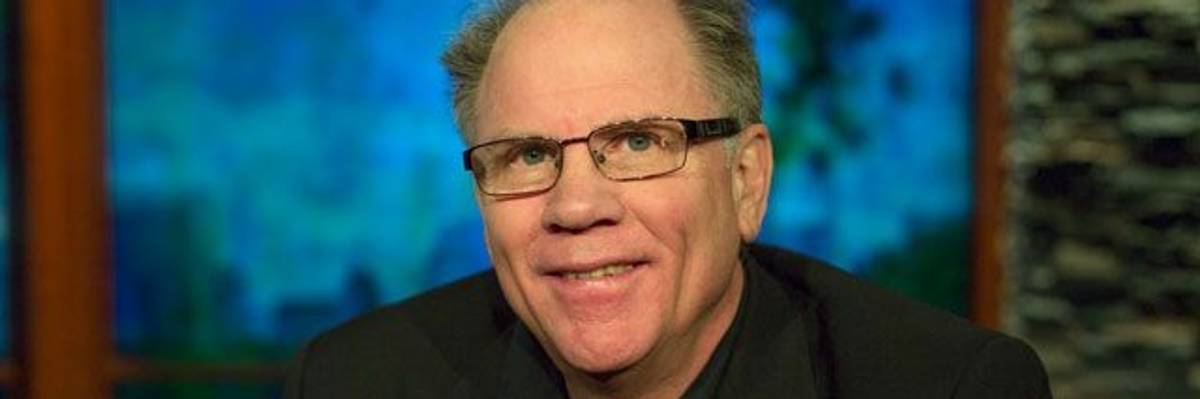
Media scholar Robert W. McChesney (1952-2025) pictured on the set of Moyers & Company in 2013.
From radio to the internet, a reading of his body of work offers a grand and inglorious tour of media history, and how we got to the horrific era of disinfotainment we’re in today.
Robert W. McChesney was a leading voice and a precious colleague in the battle for a more democratic media system, and a more democratic society. Bob passed away on Tuesday, March 24, at the age of 72. No one did more to analyze the negative and censorial impacts of our media and information systems being controlled by giant, amoral corporations.
Bob was a scholar—the Gutgsell endowed professor of communications at University of Illinois—and a prolific author. Each and every book taught us more about corporate control of information. (I helped edit some of his works.)
Particularly enlightening was his 2014 book, Digital Disconnect: How Capitalism Is Turning the Internet Against Democracy—in which McChesney explained in step-by-step detail how the internet that held so much promise for journalism and democracy was being strangled by corporate greed, and by government policy that put greed in the driver’s seat.
That was a key point for Bob in all his work: He detested the easy phrase “media deregulation,” when in fact government policy was actively and heavily regulating the media system (and so many other systems) toward corporate control.
For media activists like those of us at FAIR—whose board McChesney has served on for many years—it was a revelation to read his pioneering 1993 book Telecommunications, Mass Media and Democracy: The Battle for the Control of US Broadcasting, 1928–1935. It examined the broad-based movement in the 1920s and ’30s that sought to democratize radio, which was then in the hands of commercial hucksters and snake-oil salesmen.
From radio to the internet, a reading of his body of work offers a grand and inglorious tour of media history, and how we got to the horrific era of disinfotainment we’re in today.
Bob McChesney was not just a scholar. He was an activist. He co-founded the media reform group Free Press, with his close friend and frequent co-author John Nichols. Bob told me how glad he was to go door to door canvassing for Bernie Sanders’ presidential campaigns. (Bernie wrote the intro to one of McChesney and Nichols’ books.)
Bob was a proud socialist, and a proud journalist—and he saw no conflict between the two. In 1979, he was founding publisher of The Rocket, a renowned publication covering the music scene in Seattle. For years, while he taught classes, he hosted an excellent Illinois public radio show, Media Matters.
In 2011, he and Victor Pickard edited the book Will the Last Reporter Please Turn out the Lights: The Collapse of Journalism and What Can Be Done. One of Bob’s favorite proposals to begin to address the problem of US media (developed with economist Dean Baker) was to provide any willing taxpayer a voucher, so they could steer $200 or so of their tax money to the nonprofit news outlet of their choosing, possibly injecting billions of non-corporate dollars into journalism.
Bob was a beloved figure in the media reform/media activist movement. We need more scholar/activists like him today. He will be sorely missed.
Dear Common Dreams reader, It’s been nearly 30 years since I co-founded Common Dreams with my late wife, Lina Newhouser. We had the radical notion that journalism should serve the public good, not corporate profits. It was clear to us from the outset what it would take to build such a project. No paid advertisements. No corporate sponsors. No millionaire publisher telling us what to think or do. Many people said we wouldn't last a year, but we proved those doubters wrong. Together with a tremendous team of journalists and dedicated staff, we built an independent media outlet free from the constraints of profits and corporate control. Our mission has always been simple: To inform. To inspire. To ignite change for the common good. Building Common Dreams was not easy. Our survival was never guaranteed. When you take on the most powerful forces—Wall Street greed, fossil fuel industry destruction, Big Tech lobbyists, and uber-rich oligarchs who have spent billions upon billions rigging the economy and democracy in their favor—the only bulwark you have is supporters who believe in your work. But here’s the urgent message from me today. It's never been this bad out there. And it's never been this hard to keep us going. At the very moment Common Dreams is most needed, the threats we face are intensifying. We need your support now more than ever. We don't accept corporate advertising and never will. We don't have a paywall because we don't think people should be blocked from critical news based on their ability to pay. Everything we do is funded by the donations of readers like you. When everyone does the little they can afford, we are strong. But if that support retreats or dries up, so do we. Will you donate now to make sure Common Dreams not only survives but thrives? —Craig Brown, Co-founder |
Robert W. McChesney was a leading voice and a precious colleague in the battle for a more democratic media system, and a more democratic society. Bob passed away on Tuesday, March 24, at the age of 72. No one did more to analyze the negative and censorial impacts of our media and information systems being controlled by giant, amoral corporations.
Bob was a scholar—the Gutgsell endowed professor of communications at University of Illinois—and a prolific author. Each and every book taught us more about corporate control of information. (I helped edit some of his works.)
Particularly enlightening was his 2014 book, Digital Disconnect: How Capitalism Is Turning the Internet Against Democracy—in which McChesney explained in step-by-step detail how the internet that held so much promise for journalism and democracy was being strangled by corporate greed, and by government policy that put greed in the driver’s seat.
That was a key point for Bob in all his work: He detested the easy phrase “media deregulation,” when in fact government policy was actively and heavily regulating the media system (and so many other systems) toward corporate control.
For media activists like those of us at FAIR—whose board McChesney has served on for many years—it was a revelation to read his pioneering 1993 book Telecommunications, Mass Media and Democracy: The Battle for the Control of US Broadcasting, 1928–1935. It examined the broad-based movement in the 1920s and ’30s that sought to democratize radio, which was then in the hands of commercial hucksters and snake-oil salesmen.
From radio to the internet, a reading of his body of work offers a grand and inglorious tour of media history, and how we got to the horrific era of disinfotainment we’re in today.
Bob McChesney was not just a scholar. He was an activist. He co-founded the media reform group Free Press, with his close friend and frequent co-author John Nichols. Bob told me how glad he was to go door to door canvassing for Bernie Sanders’ presidential campaigns. (Bernie wrote the intro to one of McChesney and Nichols’ books.)
Bob was a proud socialist, and a proud journalist—and he saw no conflict between the two. In 1979, he was founding publisher of The Rocket, a renowned publication covering the music scene in Seattle. For years, while he taught classes, he hosted an excellent Illinois public radio show, Media Matters.
In 2011, he and Victor Pickard edited the book Will the Last Reporter Please Turn out the Lights: The Collapse of Journalism and What Can Be Done. One of Bob’s favorite proposals to begin to address the problem of US media (developed with economist Dean Baker) was to provide any willing taxpayer a voucher, so they could steer $200 or so of their tax money to the nonprofit news outlet of their choosing, possibly injecting billions of non-corporate dollars into journalism.
Bob was a beloved figure in the media reform/media activist movement. We need more scholar/activists like him today. He will be sorely missed.
Robert W. McChesney was a leading voice and a precious colleague in the battle for a more democratic media system, and a more democratic society. Bob passed away on Tuesday, March 24, at the age of 72. No one did more to analyze the negative and censorial impacts of our media and information systems being controlled by giant, amoral corporations.
Bob was a scholar—the Gutgsell endowed professor of communications at University of Illinois—and a prolific author. Each and every book taught us more about corporate control of information. (I helped edit some of his works.)
Particularly enlightening was his 2014 book, Digital Disconnect: How Capitalism Is Turning the Internet Against Democracy—in which McChesney explained in step-by-step detail how the internet that held so much promise for journalism and democracy was being strangled by corporate greed, and by government policy that put greed in the driver’s seat.
That was a key point for Bob in all his work: He detested the easy phrase “media deregulation,” when in fact government policy was actively and heavily regulating the media system (and so many other systems) toward corporate control.
For media activists like those of us at FAIR—whose board McChesney has served on for many years—it was a revelation to read his pioneering 1993 book Telecommunications, Mass Media and Democracy: The Battle for the Control of US Broadcasting, 1928–1935. It examined the broad-based movement in the 1920s and ’30s that sought to democratize radio, which was then in the hands of commercial hucksters and snake-oil salesmen.
From radio to the internet, a reading of his body of work offers a grand and inglorious tour of media history, and how we got to the horrific era of disinfotainment we’re in today.
Bob McChesney was not just a scholar. He was an activist. He co-founded the media reform group Free Press, with his close friend and frequent co-author John Nichols. Bob told me how glad he was to go door to door canvassing for Bernie Sanders’ presidential campaigns. (Bernie wrote the intro to one of McChesney and Nichols’ books.)
Bob was a proud socialist, and a proud journalist—and he saw no conflict between the two. In 1979, he was founding publisher of The Rocket, a renowned publication covering the music scene in Seattle. For years, while he taught classes, he hosted an excellent Illinois public radio show, Media Matters.
In 2011, he and Victor Pickard edited the book Will the Last Reporter Please Turn out the Lights: The Collapse of Journalism and What Can Be Done. One of Bob’s favorite proposals to begin to address the problem of US media (developed with economist Dean Baker) was to provide any willing taxpayer a voucher, so they could steer $200 or so of their tax money to the nonprofit news outlet of their choosing, possibly injecting billions of non-corporate dollars into journalism.
Bob was a beloved figure in the media reform/media activist movement. We need more scholar/activists like him today. He will be sorely missed.