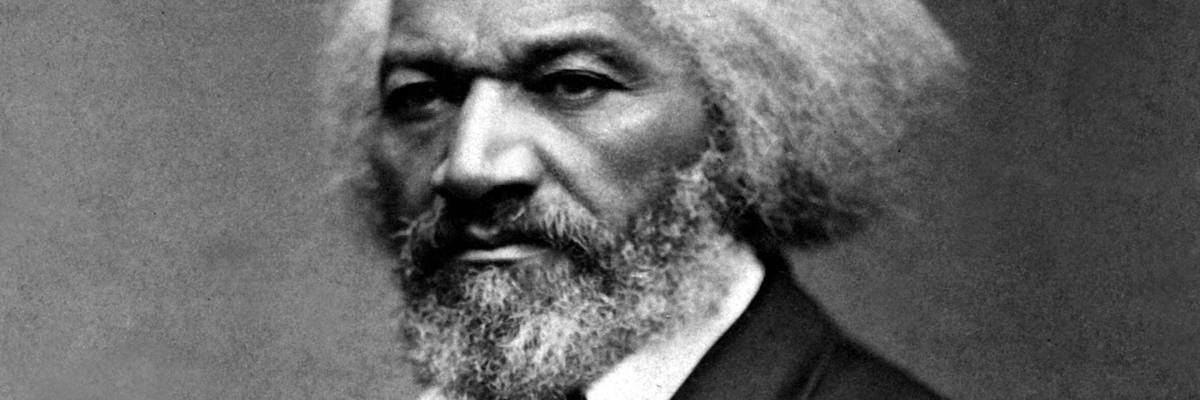
Frederick Douglass is pictured.
What the Right-Wing AI-Slop Machine Gets Wrong About Frederick Douglass
One hundred and fifty years ago to the day, Frederick Douglass gave his “Oration in Memory of Abraham Lincoln,” a radical speech that refutes MAGA attempts to co-opt him.
Prager U—a producer of right-wing “educational videos” founded by conservative radio host and edutainment entrepreneur Dennis Prager—has recently been in the news regarding its “America at 250” initiative, a collaboration with the Trump White House well described by The New Yorker as “Serving AI Slop for America’s Birthday.” The initiative is one of many administration efforts to conscript this year’s July 4 celebration in its culture war against the left, a war, announced by President Donald Trump back in March 2025 with his Executive Order 14253, cynically named “Restoring Truth and Sanity to American History.”
It seems particularly appropriate to reflect on the MAGA effort to promote historical misunderstanding today, the 150th anniversary of one of Frederick Douglass’ most important speeches, “Oration in Memory of Abraham Lincoln.” For Prager U first made headlines back in September 2021, with the posting of an animated video entitled “Leo & Layla’s History Adventure with Frederick Douglass.” While Prager is a stridently anti-“woke” enterprise, purveying a manifestly whitewashed historical narrative, this video was particularly notable, and outrageous, because it featured Douglass, the ardent Black abolitionist and radical Republican, as a self-righteous extoller of caution and celebrant of American Greatness. Like Trump’s “1776 Commission Report,” published that same year within weeks of the January 6 insurrection, Prager sought to co-opt Douglass (and also Elizabeth Cady Stanton and Martin Luther King, Jr.) rather than to ignore him, all the better to promote its right-wing conception of “patriotic history.” Prager did this in a particularly insidious way.
“Leo” and “Layla” are two white kids innocently watching TV when a newscaster reports on “angry” (obviously BLM) protesters demanding the abolition of the police. Leo, put off by a math teacher who strangely teaches about “systemic injustice,” then asks his older sister: “Why is everyone so angry? Are they burning a car? What does abolish even mean?” Seeking to understand, the siblings enter a time machine, where they are immediately greeted—“welcome to 1852!”—by a dapper Frederick Douglass eager to school the innocent children and restore their abiding reverence for all things American.
Douglass proceeds to explain “abolition” by informing the kids that he was himself once a slave, and when they ask him how he dealt with his unenviable situation, he replies: “It was very hard, and I was often sad. I taught myself to read and write... knowledge is the pathway from slavery to freedom... [and] today I am a free American, fighting for all to be free.” When the children express confusion about how the “founding fathers” could have reconciled slavery with the idea that “all men are created equal,” Douglass reassures them: “Children, our founding fathers knew that slavery was evil and wrong... They wanted it to end, but... made a compromise to achieve something great: the making of the United States.” Noting that abolition would have alienated the Southern plantocracy, he explains that “our founders created a system that would have slavery end gradually.”
Today’s anniversary of Frederick Douglass’s dedication of the Freedmen’s Monument is an occasion to remember that our history is not so easily conscripted; that the struggle for a truly multiracial and egalitarian democracy requires reckoning with racism and not denying its existence.
When the naïve students fret about hypocrisy, Douglass explains further: “Sometimes things are more complicated than they might seem, and complicated problems take time to solve... big problems need to be approached very carefully.” He then delivers the coup de gras: “Have you kids heard of William Lloyd Garrison? He’s an abolitionist like me, and he and I used to be friends, but we aren’t any longer... William refuses all compromises, demands immediate change, and if he doesn’t get what he wants, he likes to set things on fire.” He then explains that he is “trying to work for change inside the American system, and that “our system is wonderful, and the Constitution is a glorious liberty document. We just need to convince enough Americans to be true to it.” Douglass then warns the kids to avoid people like Garrison, radicals who “don’t just want slavery abolished, but the whole American system.”
The video obviously centers on a tendentious reading of Douglass’ famous 1852 speech “What to the Slave is the Fourth of July” that completely ignores the way Douglass brilliantly shifted back and forth in that speech between identification with his white audience and harsh challenge to it:
But, your fathers, who had not adopted the fashionable idea of this day, of the infallibility of government, and the absolute character of its acts, presumed to differ from the home government in respect to the wisdom and the justice of some of those burdens and restraints. They went so far in their excitement as to pronounce the measures of government unjust, unreasonable, and oppressive, and altogether such as ought not to be quietly submitted to. I scarcely need say, fellow citizens, that my opinion of those measures fully accords with that of your fathers. Such a declaration of agreement on my part would not be worth much to anybody. It would, certainly, prove nothing, as to what part I might have taken, had I lived during the great controversy of 1776. To say now that America was right, and England wrong, is exceedingly easy. Everybody can say it; the dastard, not less than the noble brave, can flippantly discant on the tyranny of England towards the American Colonies. It is fashionable to do so; but there was a time when to pronounce against England, and in favor of the cause of the colonies, tried men’s souls. They who did so were accounted in their day, plotters of mischief, agitators and rebels, dangerous men. To side with the right, against the wrong, with the weak against the strong, and with the oppressed against the oppressor! Here lies the merit, and the one which, of all others, seems unfashionable in our day. The cause of liberty may be stabbed by the men who glory in the deeds of your fathers.
In his speech Douglass embraced the revolutionary rhetoric of 1776. But he did not say that the American system was “wonderful,” and indeed he committed himself to working with other abolitionists to radically change the system. And while he did break with Garrison, his former mentor, believing that the Constitution—if properly interpreted to support radical abolition, a big “if”—was a “glorious liberty document,” he also clearly believed that its promise had yet to be redeemed, and could only be redeemed through a broad-based and uncompromising abolitionist movement. Far from disparaging Garrison’s radicalism, Douglass actually literally extols it in his closing words: “In the fervent aspirations of William Lloyd Garrison, I say, and let every heart join in saying it:
God speed the year of jubilee
The wide world o’er
When from their galling chains set free,
Th’ oppress’d shall vilely bend the knee,
And wear the yoke of tyranny
Like brutes no more.
That year will come, and freedom’s reign,
To man his plundered rights again
Restore...
Douglass’ 1852 speech, a brilliant reclaiming of the “spirit of ’76,” was no kind of celebration. It was a subtle but nonetheless powerful disruption of celebration, and an invitation and incitement to radical action. And what Douglass says in it was perfectly consistent with the equally famous and more radical words that he would utter a few years later, in his 1857 speech “On West India Emancipation”:
Let me give you a word of the philosophy of reform. The whole history of the progress of human liberty shows that all concessions yet made to her august claims have been born of earnest struggle. The conflict has been exciting, agitating, all-absorbing, and for the time being, putting all other tumults to silence. It must do this or it does nothing. If there is no struggle there is no progress. Those who profess to favor freedom and yet deprecate agitation are men who want crops without plowing up the ground; they want rain without thunder and lightning. They want the ocean without the awful roar of its many waters.
This struggle may be a moral one, or it may be a physical one, and it may be both moral and physical, but it must be a struggle. Power concedes nothing without a demand. It never did and it never will. Find out just what any people will quietly submit to and you have found out the exact measure of injustice and wrong which will be imposed upon them, and these will continue till they are resisted with either words or blows, or with both. The limits of tyrants are prescribed by the endurance of those whom they oppress. In the light of these ideas, Negroes will be hunted at the North and held and flogged at the South so long as they submit to those devilish outrages and make no resistance, either moral or physical. Men may not get all they pay for in this world, but they must certainly pay for all they get. If we ever get free from the oppressions and wrongs heaped upon us, we must pay for their removal. We must do this by labor, by suffering, by sacrifice, and if needs be, by our lives and the lives of others.
These are not the words of a man who believed that “our founders created a system that would have slavery end gradually.” They are the words of a man who believed, to the contrary, that slavery would not end until it was politically and militarily defeated.
Douglass, like his Radical Republican allies, Wendell Phillips, Charles Sumner, and Thaddeus Stevens, vigorously supported the Union in the Civil War precipitated by Abraham Lincoln’s 1860 election and the wave of secessions that followed it. But he did this not to vindicate the greatness of the Constitution or to preserve the existing American system, but to effectuate a radical democratic and in some ways revolutionary transformation of the American system. And the policy of Reconstruction he supported involved nothing less than such a transformation, upending the Southern plantocracy, redistributing property and opportunity to emancipated former slaves, and enforcing Black civil and political rights. He made this clear during the war in a July 4, 1862 speech entitled “The Slaveholders’ Rebellion,” and he made it even clearer in the substantial essay he published after the war, in the December 1866 issue of The Atlantic Monthly, entitled “Reconstruction.”
But perhaps the clearest statement of this theme is to be found in Douglass’ “Oration in Memory of Abraham Lincoln,” delivered, at the dedication of the much-heralded Freedmen’s Memorial, on April 14, 1876, the eleventh anniversary of Lincoln’s assassination. Historian David Blight opens his magisterial Pulitzer Prize-winning 2018 biography, Frederick Douglass, Prophet of Freedom, with Douglass’s delivery of this speech, pointing out that the dedication had been declared a national holiday; that the event was attended by “a distinguished array of guests” that included President Ulysses S. Grant and many members of Congress and the Supreme Court; and that the entire event held a special meaning for the “huge crowd, largely African-American,” who were present not simply to commemorate Lincoln’s role in Emancipation, but to celebrate a Black-financed and produced monument whose dedication featured the most prominent Black man in the country.
As in his more famous 1852 “What to the Slave is the Fourth of July,” delivered as abolitionist sentiment was picking up steam, Douglass begins this speech in a spirit of civic communion. Invoking “the sentiment of gratitude and appreciation,” he reminds his audience of the history that made the Freedmen’s Memorial possible:
I refer to the past not in malice, for this is no day for malice; but simply to place more distinctly in front the gratifying and glorious change which has come both to our white fellow-citizens and ourselves, and to congratulate all upon the contrast between now and then; the new dispensation of freedom with its thousand blessings to both races, and the old dispensation of slavery with its ten thousand evils to both races—white and black.
Yet he then proceeds to note that “truth compels me to admit, even here in the presence of the monument we have erected to his memory, Abraham Lincoln was not, in the fullest sense of the word, either our man or our model. In his interests, in his associations, in his habits of thought, and in his prejudices, he was a white man.”
In a speech whose overall purpose is the celebration of a vision of multiracial and universal citizenship, a vision that still remained far from realization, Douglass—the fugitive slave who had become both symbol and tribune of liberation—refuses to erase the very divisive question of race and racial identity. He insists that Lincoln “was preëminently the white man’s President,” and proceeds to outline the many ways, over time, that Lincoln had prioritized the Constitution, and the Union, over abolition, and the emancipation of Black Americans:
The race to which we belong were not the special objects of his consideration. Knowing this, I concede to you, my white fellow-citizens, a preëminence in this worship at once full and supreme... You are the children of Abraham Lincoln. We are at best only his step-children; children by adoption, children by forces of circumstances and necessity. To you it especially belongs to sound his praises, to preserve and perpetuate his memory, to multiply his statues, to hang his pictures high upon your walls, and commend his example, for to you he was a great and glorious friend and benefactor. Instead of supplanting you at his altar, we would exhort you to build high his monuments; let them be of the most costly material, of the most cunning workmanship; let their forms be symmetrical, beautiful, and perfect; let their bases be upon solid rocks, and their summits lean against the unchanging blue, overhanging sky, and let them endure forever! But... in the fullness of your just and patriotic devotion... we entreat you to despise not the humble offering we this day unveil to view; for while Abraham Lincoln saved for you a country, he delivered us from a bondage, according to Jefferson, one hour of which was worse than ages of the oppression your fathers rose in rebellion to oppose.
In his speech, Douglass recounts the many ways that Lincoln was despised, both by defenders of slavery who thought him an abolitionist, and by abolitionists who thought him too willing to compromise with the defenders of slavery. He describes Lincoln’s assassination as an awful crime against a great man and against the freedom that Lincoln’s presidency ultimately symbolized.
And while refusing to ignore Lincoln’s flaws, Douglass insists that “we”—he is referring here to Black Americans like himself—“We were able to take a comprehensive view of Abraham Lincoln, and to make reasonable allowance for the circumstances of his position. We saw him, measured him, and estimated him... by a broad survey, in the light of the stern logic of great events, and in view of that divinity which shapes our ends, rough hew them how we will, we came to the conclusion that the hour and the man of our redemption had somehow met in the person of Abraham Lincoln.”
Recalling his joy upon learning of Lincoln’s “Emancipation Proclamation,” his pride at the masses of Black soldiers that Lincoln had eventually mobilized to serve in the Union Army, and his determination to continue the struggle for freedom that Lincoln had advanced through his leadership in the Civil War, Douglass closed his oration with a sober appreciation of the fact that Lincoln’s very limits had perhaps been the very source of his strength. Noting that Lincoln “shared the prejudices common to his countrymen towards the colored race,” and that this had long made him an uncertain ally and sometimes even an opponent, Douglass concludes:
Looking back to his times and to the condition of his country, we are compelled to admit that this unfriendly feeling on his part may be safely set down as one element of his wonderful success in organizing the loyal American people for the tremendous conflict before them, and bringing them safely through that conflict. His great mission was to accomplish two things: first, to save his country from dismemberment and ruin; and, second, to free his country from the great crime of slavery. To do one or the other, or both, he must have the earnest sympathy and the powerful coöperation of his loyal fellow-countrymen... The honest and comprehensive statesman, clearly discerning the needs of his country, and earnestly endeavoring to do his whole duty, though covered and blistered with reproaches, may safely leave his course to the silent judgment of time...But now behold the change: the judgment of the present hour is, that taking him for all in all, measuring the tremendous magnitude of the work before him, considering the necessary means to ends, and surveying the end from the beginning, infinite wisdom has seldom sent any man into the world better fitted for his mission than Abraham Lincoln.
As Blight observes: “Douglass employed a stunning level of directness for such a ceremony... In the rhetorical twists and turns of this complex speech, Douglass had one overriding target—the declension and betrayal of Reconstruction in the South by the federal government.” Speaking only months before the Declaration’s July 4 centennial anniversary, Douglass well understood how vulnerable was the halting progress achieved by Reconstruction. Indeed, within a year, the infamous Compromise of 1877 was effected, Rutherford B. Hayes was inaugurated president, and federal troops were finally withdrawn from formerly Confederate states, sealing the death of Reconstruction, a wave of racist violence and intimidation, and the resumption of white supremacy.
And so Douglass, on April 16, 1888—almost 12 years to the day of his Freedmen’s Monument speech—delivered another speech in the nation’s capital, describing the indignities and oppressions of the Jim Crow system as a betrayal of the promise of Reconstruction, and declaring that “I Denounce This Emancipation as a Tremendous Fraud.”
We are now living through another tremendous fraud—a Trump administration intent on destroying the rule of law, an independent civil society, and the safeguards that protect free and fair democratic elections, all in the name of an increasingly hollow vision of “American Greatness” resting on what David Blight and James Grossman have rightly called a “brutish assault on history.”
Today’s anniversary of Frederick Douglass’s dedication of the Freedmen’s Monument is an occasion to remember that our history is not so easily conscripted; that the struggle for a truly multiracial and egalitarian democracy requires reckoning with racism and not denying its existence; and that if American greatness means anything, it means the example of figures like Douglass, who persistently fought against both injustice and the celebratory cant typically invoked to reinforce it. And as we prepare ourselves for the ostentatious displays of patriotism that Trump has planned for us this coming July, we can do no better than to recall what Douglass said about an earlier July 4: “To side with the right, against the wrong, with the weak against the strong, and with the oppressed against the oppressor! Here lies the merit, and the one which, of all others, seems unfashionable in our day. The cause of liberty may be stabbed by the men who glory in the deeds of your fathers.”
Thanks to Bob Ivie for his helpful comments on this essay.
An earlier version of this piece referred to "William Sumner" as an ally of Frederick Douglas. This has been corrected to Charles Sumner, the abolitionist Massachusetts senator.
We are at a crossroads
This country and this world are at a monumental crossroads. In a few short weeks, US voters will have an opportunity to beat back the forces of fascism and confront the billionaires who are rigging the economy, our media system, and our democracy, making it increasingly impossible for ordinary people to get by. We’re not just talking about the election. We’re talking about what must be done once these fascist elements are vanquished from power. We need a bolder set of solutions than what either major party has so far been willing to offer and a working-class movement ready to fight like hell for it. Trump didn't emerge from nowhere. The conditions that fueled MAGA authoritarianism were created by decades of radical neoliberal economic policies and a corrupt political system dominated by corporate interests. They slashed taxes on the super-rich, promising that the benefits would trickle down. They said giveaways to the corporate titans would make life more affordable for the rest of us. It was all bullshit. And when a bitter, betrayed populace searches for someone to blame, right-wing demagogues have little trouble finding scapegoats. People know when they're being lied to, but you won't hear any of this from the corporate media. Only independent journalism—powered and funded by people who believe in building a better world—can deliver truly trustworthy daily news. Our Fall Campaign is underway, and we need your help. To power our newsroom through the rest of the year, we need to raise $125,000 by midnight on October 31. So if you share our vision, please contribute whatever you can to sustain our work. |
Prager U—a producer of right-wing “educational videos” founded by conservative radio host and edutainment entrepreneur Dennis Prager—has recently been in the news regarding its “America at 250” initiative, a collaboration with the Trump White House well described by The New Yorker as “Serving AI Slop for America’s Birthday.” The initiative is one of many administration efforts to conscript this year’s July 4 celebration in its culture war against the left, a war, announced by President Donald Trump back in March 2025 with his Executive Order 14253, cynically named “Restoring Truth and Sanity to American History.”
It seems particularly appropriate to reflect on the MAGA effort to promote historical misunderstanding today, the 150th anniversary of one of Frederick Douglass’ most important speeches, “Oration in Memory of Abraham Lincoln.” For Prager U first made headlines back in September 2021, with the posting of an animated video entitled “Leo & Layla’s History Adventure with Frederick Douglass.” While Prager is a stridently anti-“woke” enterprise, purveying a manifestly whitewashed historical narrative, this video was particularly notable, and outrageous, because it featured Douglass, the ardent Black abolitionist and radical Republican, as a self-righteous extoller of caution and celebrant of American Greatness. Like Trump’s “1776 Commission Report,” published that same year within weeks of the January 6 insurrection, Prager sought to co-opt Douglass (and also Elizabeth Cady Stanton and Martin Luther King, Jr.) rather than to ignore him, all the better to promote its right-wing conception of “patriotic history.” Prager did this in a particularly insidious way.
“Leo” and “Layla” are two white kids innocently watching TV when a newscaster reports on “angry” (obviously BLM) protesters demanding the abolition of the police. Leo, put off by a math teacher who strangely teaches about “systemic injustice,” then asks his older sister: “Why is everyone so angry? Are they burning a car? What does abolish even mean?” Seeking to understand, the siblings enter a time machine, where they are immediately greeted—“welcome to 1852!”—by a dapper Frederick Douglass eager to school the innocent children and restore their abiding reverence for all things American.
Douglass proceeds to explain “abolition” by informing the kids that he was himself once a slave, and when they ask him how he dealt with his unenviable situation, he replies: “It was very hard, and I was often sad. I taught myself to read and write... knowledge is the pathway from slavery to freedom... [and] today I am a free American, fighting for all to be free.” When the children express confusion about how the “founding fathers” could have reconciled slavery with the idea that “all men are created equal,” Douglass reassures them: “Children, our founding fathers knew that slavery was evil and wrong... They wanted it to end, but... made a compromise to achieve something great: the making of the United States.” Noting that abolition would have alienated the Southern plantocracy, he explains that “our founders created a system that would have slavery end gradually.”
Today’s anniversary of Frederick Douglass’s dedication of the Freedmen’s Monument is an occasion to remember that our history is not so easily conscripted; that the struggle for a truly multiracial and egalitarian democracy requires reckoning with racism and not denying its existence.
When the naïve students fret about hypocrisy, Douglass explains further: “Sometimes things are more complicated than they might seem, and complicated problems take time to solve... big problems need to be approached very carefully.” He then delivers the coup de gras: “Have you kids heard of William Lloyd Garrison? He’s an abolitionist like me, and he and I used to be friends, but we aren’t any longer... William refuses all compromises, demands immediate change, and if he doesn’t get what he wants, he likes to set things on fire.” He then explains that he is “trying to work for change inside the American system, and that “our system is wonderful, and the Constitution is a glorious liberty document. We just need to convince enough Americans to be true to it.” Douglass then warns the kids to avoid people like Garrison, radicals who “don’t just want slavery abolished, but the whole American system.”
The video obviously centers on a tendentious reading of Douglass’ famous 1852 speech “What to the Slave is the Fourth of July” that completely ignores the way Douglass brilliantly shifted back and forth in that speech between identification with his white audience and harsh challenge to it:
But, your fathers, who had not adopted the fashionable idea of this day, of the infallibility of government, and the absolute character of its acts, presumed to differ from the home government in respect to the wisdom and the justice of some of those burdens and restraints. They went so far in their excitement as to pronounce the measures of government unjust, unreasonable, and oppressive, and altogether such as ought not to be quietly submitted to. I scarcely need say, fellow citizens, that my opinion of those measures fully accords with that of your fathers. Such a declaration of agreement on my part would not be worth much to anybody. It would, certainly, prove nothing, as to what part I might have taken, had I lived during the great controversy of 1776. To say now that America was right, and England wrong, is exceedingly easy. Everybody can say it; the dastard, not less than the noble brave, can flippantly discant on the tyranny of England towards the American Colonies. It is fashionable to do so; but there was a time when to pronounce against England, and in favor of the cause of the colonies, tried men’s souls. They who did so were accounted in their day, plotters of mischief, agitators and rebels, dangerous men. To side with the right, against the wrong, with the weak against the strong, and with the oppressed against the oppressor! Here lies the merit, and the one which, of all others, seems unfashionable in our day. The cause of liberty may be stabbed by the men who glory in the deeds of your fathers.
In his speech Douglass embraced the revolutionary rhetoric of 1776. But he did not say that the American system was “wonderful,” and indeed he committed himself to working with other abolitionists to radically change the system. And while he did break with Garrison, his former mentor, believing that the Constitution—if properly interpreted to support radical abolition, a big “if”—was a “glorious liberty document,” he also clearly believed that its promise had yet to be redeemed, and could only be redeemed through a broad-based and uncompromising abolitionist movement. Far from disparaging Garrison’s radicalism, Douglass actually literally extols it in his closing words: “In the fervent aspirations of William Lloyd Garrison, I say, and let every heart join in saying it:
God speed the year of jubilee
The wide world o’er
When from their galling chains set free,
Th’ oppress’d shall vilely bend the knee,
And wear the yoke of tyranny
Like brutes no more.
That year will come, and freedom’s reign,
To man his plundered rights again
Restore...
Douglass’ 1852 speech, a brilliant reclaiming of the “spirit of ’76,” was no kind of celebration. It was a subtle but nonetheless powerful disruption of celebration, and an invitation and incitement to radical action. And what Douglass says in it was perfectly consistent with the equally famous and more radical words that he would utter a few years later, in his 1857 speech “On West India Emancipation”:
Let me give you a word of the philosophy of reform. The whole history of the progress of human liberty shows that all concessions yet made to her august claims have been born of earnest struggle. The conflict has been exciting, agitating, all-absorbing, and for the time being, putting all other tumults to silence. It must do this or it does nothing. If there is no struggle there is no progress. Those who profess to favor freedom and yet deprecate agitation are men who want crops without plowing up the ground; they want rain without thunder and lightning. They want the ocean without the awful roar of its many waters.
This struggle may be a moral one, or it may be a physical one, and it may be both moral and physical, but it must be a struggle. Power concedes nothing without a demand. It never did and it never will. Find out just what any people will quietly submit to and you have found out the exact measure of injustice and wrong which will be imposed upon them, and these will continue till they are resisted with either words or blows, or with both. The limits of tyrants are prescribed by the endurance of those whom they oppress. In the light of these ideas, Negroes will be hunted at the North and held and flogged at the South so long as they submit to those devilish outrages and make no resistance, either moral or physical. Men may not get all they pay for in this world, but they must certainly pay for all they get. If we ever get free from the oppressions and wrongs heaped upon us, we must pay for their removal. We must do this by labor, by suffering, by sacrifice, and if needs be, by our lives and the lives of others.
These are not the words of a man who believed that “our founders created a system that would have slavery end gradually.” They are the words of a man who believed, to the contrary, that slavery would not end until it was politically and militarily defeated.
Douglass, like his Radical Republican allies, Wendell Phillips, Charles Sumner, and Thaddeus Stevens, vigorously supported the Union in the Civil War precipitated by Abraham Lincoln’s 1860 election and the wave of secessions that followed it. But he did this not to vindicate the greatness of the Constitution or to preserve the existing American system, but to effectuate a radical democratic and in some ways revolutionary transformation of the American system. And the policy of Reconstruction he supported involved nothing less than such a transformation, upending the Southern plantocracy, redistributing property and opportunity to emancipated former slaves, and enforcing Black civil and political rights. He made this clear during the war in a July 4, 1862 speech entitled “The Slaveholders’ Rebellion,” and he made it even clearer in the substantial essay he published after the war, in the December 1866 issue of The Atlantic Monthly, entitled “Reconstruction.”
But perhaps the clearest statement of this theme is to be found in Douglass’ “Oration in Memory of Abraham Lincoln,” delivered, at the dedication of the much-heralded Freedmen’s Memorial, on April 14, 1876, the eleventh anniversary of Lincoln’s assassination. Historian David Blight opens his magisterial Pulitzer Prize-winning 2018 biography, Frederick Douglass, Prophet of Freedom, with Douglass’s delivery of this speech, pointing out that the dedication had been declared a national holiday; that the event was attended by “a distinguished array of guests” that included President Ulysses S. Grant and many members of Congress and the Supreme Court; and that the entire event held a special meaning for the “huge crowd, largely African-American,” who were present not simply to commemorate Lincoln’s role in Emancipation, but to celebrate a Black-financed and produced monument whose dedication featured the most prominent Black man in the country.
As in his more famous 1852 “What to the Slave is the Fourth of July,” delivered as abolitionist sentiment was picking up steam, Douglass begins this speech in a spirit of civic communion. Invoking “the sentiment of gratitude and appreciation,” he reminds his audience of the history that made the Freedmen’s Memorial possible:
I refer to the past not in malice, for this is no day for malice; but simply to place more distinctly in front the gratifying and glorious change which has come both to our white fellow-citizens and ourselves, and to congratulate all upon the contrast between now and then; the new dispensation of freedom with its thousand blessings to both races, and the old dispensation of slavery with its ten thousand evils to both races—white and black.
Yet he then proceeds to note that “truth compels me to admit, even here in the presence of the monument we have erected to his memory, Abraham Lincoln was not, in the fullest sense of the word, either our man or our model. In his interests, in his associations, in his habits of thought, and in his prejudices, he was a white man.”
In a speech whose overall purpose is the celebration of a vision of multiracial and universal citizenship, a vision that still remained far from realization, Douglass—the fugitive slave who had become both symbol and tribune of liberation—refuses to erase the very divisive question of race and racial identity. He insists that Lincoln “was preëminently the white man’s President,” and proceeds to outline the many ways, over time, that Lincoln had prioritized the Constitution, and the Union, over abolition, and the emancipation of Black Americans:
The race to which we belong were not the special objects of his consideration. Knowing this, I concede to you, my white fellow-citizens, a preëminence in this worship at once full and supreme... You are the children of Abraham Lincoln. We are at best only his step-children; children by adoption, children by forces of circumstances and necessity. To you it especially belongs to sound his praises, to preserve and perpetuate his memory, to multiply his statues, to hang his pictures high upon your walls, and commend his example, for to you he was a great and glorious friend and benefactor. Instead of supplanting you at his altar, we would exhort you to build high his monuments; let them be of the most costly material, of the most cunning workmanship; let their forms be symmetrical, beautiful, and perfect; let their bases be upon solid rocks, and their summits lean against the unchanging blue, overhanging sky, and let them endure forever! But... in the fullness of your just and patriotic devotion... we entreat you to despise not the humble offering we this day unveil to view; for while Abraham Lincoln saved for you a country, he delivered us from a bondage, according to Jefferson, one hour of which was worse than ages of the oppression your fathers rose in rebellion to oppose.
In his speech, Douglass recounts the many ways that Lincoln was despised, both by defenders of slavery who thought him an abolitionist, and by abolitionists who thought him too willing to compromise with the defenders of slavery. He describes Lincoln’s assassination as an awful crime against a great man and against the freedom that Lincoln’s presidency ultimately symbolized.
And while refusing to ignore Lincoln’s flaws, Douglass insists that “we”—he is referring here to Black Americans like himself—“We were able to take a comprehensive view of Abraham Lincoln, and to make reasonable allowance for the circumstances of his position. We saw him, measured him, and estimated him... by a broad survey, in the light of the stern logic of great events, and in view of that divinity which shapes our ends, rough hew them how we will, we came to the conclusion that the hour and the man of our redemption had somehow met in the person of Abraham Lincoln.”
Recalling his joy upon learning of Lincoln’s “Emancipation Proclamation,” his pride at the masses of Black soldiers that Lincoln had eventually mobilized to serve in the Union Army, and his determination to continue the struggle for freedom that Lincoln had advanced through his leadership in the Civil War, Douglass closed his oration with a sober appreciation of the fact that Lincoln’s very limits had perhaps been the very source of his strength. Noting that Lincoln “shared the prejudices common to his countrymen towards the colored race,” and that this had long made him an uncertain ally and sometimes even an opponent, Douglass concludes:
Looking back to his times and to the condition of his country, we are compelled to admit that this unfriendly feeling on his part may be safely set down as one element of his wonderful success in organizing the loyal American people for the tremendous conflict before them, and bringing them safely through that conflict. His great mission was to accomplish two things: first, to save his country from dismemberment and ruin; and, second, to free his country from the great crime of slavery. To do one or the other, or both, he must have the earnest sympathy and the powerful coöperation of his loyal fellow-countrymen... The honest and comprehensive statesman, clearly discerning the needs of his country, and earnestly endeavoring to do his whole duty, though covered and blistered with reproaches, may safely leave his course to the silent judgment of time...But now behold the change: the judgment of the present hour is, that taking him for all in all, measuring the tremendous magnitude of the work before him, considering the necessary means to ends, and surveying the end from the beginning, infinite wisdom has seldom sent any man into the world better fitted for his mission than Abraham Lincoln.
As Blight observes: “Douglass employed a stunning level of directness for such a ceremony... In the rhetorical twists and turns of this complex speech, Douglass had one overriding target—the declension and betrayal of Reconstruction in the South by the federal government.” Speaking only months before the Declaration’s July 4 centennial anniversary, Douglass well understood how vulnerable was the halting progress achieved by Reconstruction. Indeed, within a year, the infamous Compromise of 1877 was effected, Rutherford B. Hayes was inaugurated president, and federal troops were finally withdrawn from formerly Confederate states, sealing the death of Reconstruction, a wave of racist violence and intimidation, and the resumption of white supremacy.
And so Douglass, on April 16, 1888—almost 12 years to the day of his Freedmen’s Monument speech—delivered another speech in the nation’s capital, describing the indignities and oppressions of the Jim Crow system as a betrayal of the promise of Reconstruction, and declaring that “I Denounce This Emancipation as a Tremendous Fraud.”
We are now living through another tremendous fraud—a Trump administration intent on destroying the rule of law, an independent civil society, and the safeguards that protect free and fair democratic elections, all in the name of an increasingly hollow vision of “American Greatness” resting on what David Blight and James Grossman have rightly called a “brutish assault on history.”
Today’s anniversary of Frederick Douglass’s dedication of the Freedmen’s Monument is an occasion to remember that our history is not so easily conscripted; that the struggle for a truly multiracial and egalitarian democracy requires reckoning with racism and not denying its existence; and that if American greatness means anything, it means the example of figures like Douglass, who persistently fought against both injustice and the celebratory cant typically invoked to reinforce it. And as we prepare ourselves for the ostentatious displays of patriotism that Trump has planned for us this coming July, we can do no better than to recall what Douglass said about an earlier July 4: “To side with the right, against the wrong, with the weak against the strong, and with the oppressed against the oppressor! Here lies the merit, and the one which, of all others, seems unfashionable in our day. The cause of liberty may be stabbed by the men who glory in the deeds of your fathers.”
Thanks to Bob Ivie for his helpful comments on this essay.
An earlier version of this piece referred to "William Sumner" as an ally of Frederick Douglas. This has been corrected to Charles Sumner, the abolitionist Massachusetts senator.
Prager U—a producer of right-wing “educational videos” founded by conservative radio host and edutainment entrepreneur Dennis Prager—has recently been in the news regarding its “America at 250” initiative, a collaboration with the Trump White House well described by The New Yorker as “Serving AI Slop for America’s Birthday.” The initiative is one of many administration efforts to conscript this year’s July 4 celebration in its culture war against the left, a war, announced by President Donald Trump back in March 2025 with his Executive Order 14253, cynically named “Restoring Truth and Sanity to American History.”
It seems particularly appropriate to reflect on the MAGA effort to promote historical misunderstanding today, the 150th anniversary of one of Frederick Douglass’ most important speeches, “Oration in Memory of Abraham Lincoln.” For Prager U first made headlines back in September 2021, with the posting of an animated video entitled “Leo & Layla’s History Adventure with Frederick Douglass.” While Prager is a stridently anti-“woke” enterprise, purveying a manifestly whitewashed historical narrative, this video was particularly notable, and outrageous, because it featured Douglass, the ardent Black abolitionist and radical Republican, as a self-righteous extoller of caution and celebrant of American Greatness. Like Trump’s “1776 Commission Report,” published that same year within weeks of the January 6 insurrection, Prager sought to co-opt Douglass (and also Elizabeth Cady Stanton and Martin Luther King, Jr.) rather than to ignore him, all the better to promote its right-wing conception of “patriotic history.” Prager did this in a particularly insidious way.
“Leo” and “Layla” are two white kids innocently watching TV when a newscaster reports on “angry” (obviously BLM) protesters demanding the abolition of the police. Leo, put off by a math teacher who strangely teaches about “systemic injustice,” then asks his older sister: “Why is everyone so angry? Are they burning a car? What does abolish even mean?” Seeking to understand, the siblings enter a time machine, where they are immediately greeted—“welcome to 1852!”—by a dapper Frederick Douglass eager to school the innocent children and restore their abiding reverence for all things American.
Douglass proceeds to explain “abolition” by informing the kids that he was himself once a slave, and when they ask him how he dealt with his unenviable situation, he replies: “It was very hard, and I was often sad. I taught myself to read and write... knowledge is the pathway from slavery to freedom... [and] today I am a free American, fighting for all to be free.” When the children express confusion about how the “founding fathers” could have reconciled slavery with the idea that “all men are created equal,” Douglass reassures them: “Children, our founding fathers knew that slavery was evil and wrong... They wanted it to end, but... made a compromise to achieve something great: the making of the United States.” Noting that abolition would have alienated the Southern plantocracy, he explains that “our founders created a system that would have slavery end gradually.”
Today’s anniversary of Frederick Douglass’s dedication of the Freedmen’s Monument is an occasion to remember that our history is not so easily conscripted; that the struggle for a truly multiracial and egalitarian democracy requires reckoning with racism and not denying its existence.
When the naïve students fret about hypocrisy, Douglass explains further: “Sometimes things are more complicated than they might seem, and complicated problems take time to solve... big problems need to be approached very carefully.” He then delivers the coup de gras: “Have you kids heard of William Lloyd Garrison? He’s an abolitionist like me, and he and I used to be friends, but we aren’t any longer... William refuses all compromises, demands immediate change, and if he doesn’t get what he wants, he likes to set things on fire.” He then explains that he is “trying to work for change inside the American system, and that “our system is wonderful, and the Constitution is a glorious liberty document. We just need to convince enough Americans to be true to it.” Douglass then warns the kids to avoid people like Garrison, radicals who “don’t just want slavery abolished, but the whole American system.”
The video obviously centers on a tendentious reading of Douglass’ famous 1852 speech “What to the Slave is the Fourth of July” that completely ignores the way Douglass brilliantly shifted back and forth in that speech between identification with his white audience and harsh challenge to it:
But, your fathers, who had not adopted the fashionable idea of this day, of the infallibility of government, and the absolute character of its acts, presumed to differ from the home government in respect to the wisdom and the justice of some of those burdens and restraints. They went so far in their excitement as to pronounce the measures of government unjust, unreasonable, and oppressive, and altogether such as ought not to be quietly submitted to. I scarcely need say, fellow citizens, that my opinion of those measures fully accords with that of your fathers. Such a declaration of agreement on my part would not be worth much to anybody. It would, certainly, prove nothing, as to what part I might have taken, had I lived during the great controversy of 1776. To say now that America was right, and England wrong, is exceedingly easy. Everybody can say it; the dastard, not less than the noble brave, can flippantly discant on the tyranny of England towards the American Colonies. It is fashionable to do so; but there was a time when to pronounce against England, and in favor of the cause of the colonies, tried men’s souls. They who did so were accounted in their day, plotters of mischief, agitators and rebels, dangerous men. To side with the right, against the wrong, with the weak against the strong, and with the oppressed against the oppressor! Here lies the merit, and the one which, of all others, seems unfashionable in our day. The cause of liberty may be stabbed by the men who glory in the deeds of your fathers.
In his speech Douglass embraced the revolutionary rhetoric of 1776. But he did not say that the American system was “wonderful,” and indeed he committed himself to working with other abolitionists to radically change the system. And while he did break with Garrison, his former mentor, believing that the Constitution—if properly interpreted to support radical abolition, a big “if”—was a “glorious liberty document,” he also clearly believed that its promise had yet to be redeemed, and could only be redeemed through a broad-based and uncompromising abolitionist movement. Far from disparaging Garrison’s radicalism, Douglass actually literally extols it in his closing words: “In the fervent aspirations of William Lloyd Garrison, I say, and let every heart join in saying it:
God speed the year of jubilee
The wide world o’er
When from their galling chains set free,
Th’ oppress’d shall vilely bend the knee,
And wear the yoke of tyranny
Like brutes no more.
That year will come, and freedom’s reign,
To man his plundered rights again
Restore...
Douglass’ 1852 speech, a brilliant reclaiming of the “spirit of ’76,” was no kind of celebration. It was a subtle but nonetheless powerful disruption of celebration, and an invitation and incitement to radical action. And what Douglass says in it was perfectly consistent with the equally famous and more radical words that he would utter a few years later, in his 1857 speech “On West India Emancipation”:
Let me give you a word of the philosophy of reform. The whole history of the progress of human liberty shows that all concessions yet made to her august claims have been born of earnest struggle. The conflict has been exciting, agitating, all-absorbing, and for the time being, putting all other tumults to silence. It must do this or it does nothing. If there is no struggle there is no progress. Those who profess to favor freedom and yet deprecate agitation are men who want crops without plowing up the ground; they want rain without thunder and lightning. They want the ocean without the awful roar of its many waters.
This struggle may be a moral one, or it may be a physical one, and it may be both moral and physical, but it must be a struggle. Power concedes nothing without a demand. It never did and it never will. Find out just what any people will quietly submit to and you have found out the exact measure of injustice and wrong which will be imposed upon them, and these will continue till they are resisted with either words or blows, or with both. The limits of tyrants are prescribed by the endurance of those whom they oppress. In the light of these ideas, Negroes will be hunted at the North and held and flogged at the South so long as they submit to those devilish outrages and make no resistance, either moral or physical. Men may not get all they pay for in this world, but they must certainly pay for all they get. If we ever get free from the oppressions and wrongs heaped upon us, we must pay for their removal. We must do this by labor, by suffering, by sacrifice, and if needs be, by our lives and the lives of others.
These are not the words of a man who believed that “our founders created a system that would have slavery end gradually.” They are the words of a man who believed, to the contrary, that slavery would not end until it was politically and militarily defeated.
Douglass, like his Radical Republican allies, Wendell Phillips, Charles Sumner, and Thaddeus Stevens, vigorously supported the Union in the Civil War precipitated by Abraham Lincoln’s 1860 election and the wave of secessions that followed it. But he did this not to vindicate the greatness of the Constitution or to preserve the existing American system, but to effectuate a radical democratic and in some ways revolutionary transformation of the American system. And the policy of Reconstruction he supported involved nothing less than such a transformation, upending the Southern plantocracy, redistributing property and opportunity to emancipated former slaves, and enforcing Black civil and political rights. He made this clear during the war in a July 4, 1862 speech entitled “The Slaveholders’ Rebellion,” and he made it even clearer in the substantial essay he published after the war, in the December 1866 issue of The Atlantic Monthly, entitled “Reconstruction.”
But perhaps the clearest statement of this theme is to be found in Douglass’ “Oration in Memory of Abraham Lincoln,” delivered, at the dedication of the much-heralded Freedmen’s Memorial, on April 14, 1876, the eleventh anniversary of Lincoln’s assassination. Historian David Blight opens his magisterial Pulitzer Prize-winning 2018 biography, Frederick Douglass, Prophet of Freedom, with Douglass’s delivery of this speech, pointing out that the dedication had been declared a national holiday; that the event was attended by “a distinguished array of guests” that included President Ulysses S. Grant and many members of Congress and the Supreme Court; and that the entire event held a special meaning for the “huge crowd, largely African-American,” who were present not simply to commemorate Lincoln’s role in Emancipation, but to celebrate a Black-financed and produced monument whose dedication featured the most prominent Black man in the country.
As in his more famous 1852 “What to the Slave is the Fourth of July,” delivered as abolitionist sentiment was picking up steam, Douglass begins this speech in a spirit of civic communion. Invoking “the sentiment of gratitude and appreciation,” he reminds his audience of the history that made the Freedmen’s Memorial possible:
I refer to the past not in malice, for this is no day for malice; but simply to place more distinctly in front the gratifying and glorious change which has come both to our white fellow-citizens and ourselves, and to congratulate all upon the contrast between now and then; the new dispensation of freedom with its thousand blessings to both races, and the old dispensation of slavery with its ten thousand evils to both races—white and black.
Yet he then proceeds to note that “truth compels me to admit, even here in the presence of the monument we have erected to his memory, Abraham Lincoln was not, in the fullest sense of the word, either our man or our model. In his interests, in his associations, in his habits of thought, and in his prejudices, he was a white man.”
In a speech whose overall purpose is the celebration of a vision of multiracial and universal citizenship, a vision that still remained far from realization, Douglass—the fugitive slave who had become both symbol and tribune of liberation—refuses to erase the very divisive question of race and racial identity. He insists that Lincoln “was preëminently the white man’s President,” and proceeds to outline the many ways, over time, that Lincoln had prioritized the Constitution, and the Union, over abolition, and the emancipation of Black Americans:
The race to which we belong were not the special objects of his consideration. Knowing this, I concede to you, my white fellow-citizens, a preëminence in this worship at once full and supreme... You are the children of Abraham Lincoln. We are at best only his step-children; children by adoption, children by forces of circumstances and necessity. To you it especially belongs to sound his praises, to preserve and perpetuate his memory, to multiply his statues, to hang his pictures high upon your walls, and commend his example, for to you he was a great and glorious friend and benefactor. Instead of supplanting you at his altar, we would exhort you to build high his monuments; let them be of the most costly material, of the most cunning workmanship; let their forms be symmetrical, beautiful, and perfect; let their bases be upon solid rocks, and their summits lean against the unchanging blue, overhanging sky, and let them endure forever! But... in the fullness of your just and patriotic devotion... we entreat you to despise not the humble offering we this day unveil to view; for while Abraham Lincoln saved for you a country, he delivered us from a bondage, according to Jefferson, one hour of which was worse than ages of the oppression your fathers rose in rebellion to oppose.
In his speech, Douglass recounts the many ways that Lincoln was despised, both by defenders of slavery who thought him an abolitionist, and by abolitionists who thought him too willing to compromise with the defenders of slavery. He describes Lincoln’s assassination as an awful crime against a great man and against the freedom that Lincoln’s presidency ultimately symbolized.
And while refusing to ignore Lincoln’s flaws, Douglass insists that “we”—he is referring here to Black Americans like himself—“We were able to take a comprehensive view of Abraham Lincoln, and to make reasonable allowance for the circumstances of his position. We saw him, measured him, and estimated him... by a broad survey, in the light of the stern logic of great events, and in view of that divinity which shapes our ends, rough hew them how we will, we came to the conclusion that the hour and the man of our redemption had somehow met in the person of Abraham Lincoln.”
Recalling his joy upon learning of Lincoln’s “Emancipation Proclamation,” his pride at the masses of Black soldiers that Lincoln had eventually mobilized to serve in the Union Army, and his determination to continue the struggle for freedom that Lincoln had advanced through his leadership in the Civil War, Douglass closed his oration with a sober appreciation of the fact that Lincoln’s very limits had perhaps been the very source of his strength. Noting that Lincoln “shared the prejudices common to his countrymen towards the colored race,” and that this had long made him an uncertain ally and sometimes even an opponent, Douglass concludes:
Looking back to his times and to the condition of his country, we are compelled to admit that this unfriendly feeling on his part may be safely set down as one element of his wonderful success in organizing the loyal American people for the tremendous conflict before them, and bringing them safely through that conflict. His great mission was to accomplish two things: first, to save his country from dismemberment and ruin; and, second, to free his country from the great crime of slavery. To do one or the other, or both, he must have the earnest sympathy and the powerful coöperation of his loyal fellow-countrymen... The honest and comprehensive statesman, clearly discerning the needs of his country, and earnestly endeavoring to do his whole duty, though covered and blistered with reproaches, may safely leave his course to the silent judgment of time...But now behold the change: the judgment of the present hour is, that taking him for all in all, measuring the tremendous magnitude of the work before him, considering the necessary means to ends, and surveying the end from the beginning, infinite wisdom has seldom sent any man into the world better fitted for his mission than Abraham Lincoln.
As Blight observes: “Douglass employed a stunning level of directness for such a ceremony... In the rhetorical twists and turns of this complex speech, Douglass had one overriding target—the declension and betrayal of Reconstruction in the South by the federal government.” Speaking only months before the Declaration’s July 4 centennial anniversary, Douglass well understood how vulnerable was the halting progress achieved by Reconstruction. Indeed, within a year, the infamous Compromise of 1877 was effected, Rutherford B. Hayes was inaugurated president, and federal troops were finally withdrawn from formerly Confederate states, sealing the death of Reconstruction, a wave of racist violence and intimidation, and the resumption of white supremacy.
And so Douglass, on April 16, 1888—almost 12 years to the day of his Freedmen’s Monument speech—delivered another speech in the nation’s capital, describing the indignities and oppressions of the Jim Crow system as a betrayal of the promise of Reconstruction, and declaring that “I Denounce This Emancipation as a Tremendous Fraud.”
We are now living through another tremendous fraud—a Trump administration intent on destroying the rule of law, an independent civil society, and the safeguards that protect free and fair democratic elections, all in the name of an increasingly hollow vision of “American Greatness” resting on what David Blight and James Grossman have rightly called a “brutish assault on history.”
Today’s anniversary of Frederick Douglass’s dedication of the Freedmen’s Monument is an occasion to remember that our history is not so easily conscripted; that the struggle for a truly multiracial and egalitarian democracy requires reckoning with racism and not denying its existence; and that if American greatness means anything, it means the example of figures like Douglass, who persistently fought against both injustice and the celebratory cant typically invoked to reinforce it. And as we prepare ourselves for the ostentatious displays of patriotism that Trump has planned for us this coming July, we can do no better than to recall what Douglass said about an earlier July 4: “To side with the right, against the wrong, with the weak against the strong, and with the oppressed against the oppressor! Here lies the merit, and the one which, of all others, seems unfashionable in our day. The cause of liberty may be stabbed by the men who glory in the deeds of your fathers.”
Thanks to Bob Ivie for his helpful comments on this essay.
An earlier version of this piece referred to "William Sumner" as an ally of Frederick Douglas. This has been corrected to Charles Sumner, the abolitionist Massachusetts senator.